• Skip to primary navigation
  • Skip to main content
  • Skip to primary sidebar
  • US Open Cup Central
  • US Open Cup Qualifying
  • US Open Cup History
  • Amateur Cup

Complete U.S. Open Cup Coverage

  • 2026 USOC Schedule
  • 2026 USOC Stat Leaders
  • 2027 USOC Qualifying Results
  • TheCup.us Awards
  • Join TheCup.us Patreon!
  • Contact Us

San Jose Earthquakes/San Jose Clash

2014 US Open Cup Round 4: San Jose Earthquakes begin tourney run with 2-1 win over Sacramento Republic

June 12, 2014 by Robert Jonas

san-jose-earthquakes-2014-logo

The San Jose Earthquakes survived a first half goal from notorious Quakes-killer Justin Braun and netted two of their own to beat Sacramento Republic FC 2-1 in a fourth round Lamar Hunt U.S. Open Cup match at historic Kezar Stadium.

Khari Stephenson equalized with a first half stoppage time penalty kick, and Cordell Cato netted the game winner late in the second half to give San Jose its first Open Cup win in nearly two years.

“Cup games are always tough,” said Stephenson. “You never know how it’s going to go. We all come out here; we never want to lose. It wasn’t the best of games, but we got the win, and that is what counts.”

Cato, a menace on the wings all evening long, had narrowly missed scoring five minutes prior to his game winner, but his perseverance finally paid off in leading the Earthquakes to the next round of the tournament.

#USOC2014 LINKS 

Support TheCup.us: Buy #USOC2014 gear 

Notable upsets/facts about Round 4
2014 Round 5 draw scenarios
2014 Player of the Round winners 

2014 US Open Cup results
2014 US Open Cup bracket
2014 US Open Cup goalscoring leaders
2015 US Open Cup qualifying news
The First Cup series (1913/14)

Twitter | Facebook | Flickr | Reddit

“We played them in preseason,” said Cato, “so we know they are a tough team. They pressed us, they worked hard, and we knew it was going to be a tough game. We kept pushing, we kept talking and letting each other know we were going to win, and it happened.”

In the last U.S. Open Cup game played at Kezar Stadium, a 2012 quarterfinal affair between San Jose and the Seattle Sounders, Cato famously scored against the Earthquakes in that 1-0 defeat. His game winner this time out made up for his Seattle goal, making amends in the eyes of head coach Mark Watson.

“We did remind him of that,” said Watson, “a couple of times. Cordell had a good memory here before with another team, and he did well for us tonight … He kept plugging away, kept working, and got better and better. He got rewarded for his efforts.”

Sacramento could not overcome the deficit, and when a second yellow card offense to Chad Bartlome dropped the USL PRO newcomers to 10 men, the Republic failed to muster up any late game magic against its Northern California MLS opponents.

“We always knew San Jose would be a tough opponent,” said Republic head coach Preki, “but our plan was to make it difficult for them and also to play our style of football. I thought we did that tonight, but there is still a lot of room for improvement.”

But upset-minded Sacramento did earn praise from Watson, who knew the Quakes affiliate would make it difficult on his side in what could be called the Republic’s biggest game of the year.

“That was the one thing we mentioned before the game,” said Watson. “You need to approach the game the right way and you need to match their energy, their work-rate, and their fight because they are going to come at you. If you take them lightly, you are going to get beat.”

The game started brightly for San Jose, as inside the first minute Stephenson tested Republic goalkeeper Dominik Jakubek with a blistering shot from long range that was parried high into the Golden Gate Park fog before being cleared from danger.

With Sacramento on its back foot, the Earthquakes continued to press forward, often with all 10 field players on the attacking side of the center line. In the fifth minute, JJ Koval tested the ‘keeper forcing a save, Atiba Harris followed up with a loose ball shot that went wanting, and Cordell Cato finished the trifecta of terrific scoring opportunities by firing wide.

Weathering the early Quakes surge, Sacramento countered over the next 15 minutes and pushed the issue on offense. San Jose nemesis Braun fired a shot on target that was deflected wide in the 29th minute, and Max Alvarez deposited his follow-up into the side netting.

The match settled into a back-and-forth affair as the clock pushed toward intermission — until out of little, the Republic opened the scoring. A pass from Rodrigo Lopez into the left corner found a wide open Chad Bartlome with space to whip a cross into the six-yard box. Beating his defender to the ball, Braun glanced a header inside the near post that eluded goalkeeper David Bingham and bulged the back of the net for a 1-0 lead. It was Braun’s second goal of the tournament, and the fourth of his career.
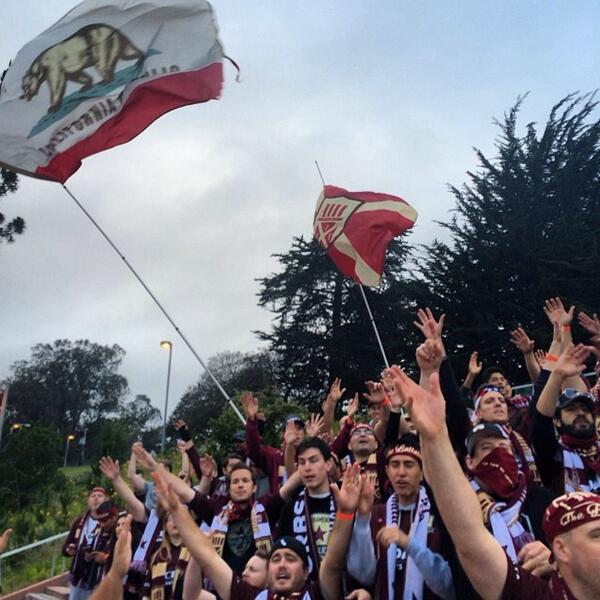
Sacramento Republic fans made the trip to San Francisco for the game. Photo: Twitter @AmericanCasual1

The goal seemed to unnerve the Earthquakes, and on the restart, the home side poured forward toward the Pacific end of Kezar. A corner kick in the 44th minute by San Jose was hammered home by Clarence Goodson with a thundering header, but the goal was waved off. Not for a foul on the Quakes, but instead for a foul by Bartlome, which was egregious enough to earn a yellow card.

Confusion reigned, as referee Juan Guzman, surrounded by a perplexed phalanx of blue and white, pointed to the spot. Lopez, among many to express his frustration, earned a yellow card for his outburst. And in the first minute of stoppage time, Stephenson drilled a hard shot into the upper right corner of the goal to level that score a 1-1 with his third career tournament goal.

The second half was all Sacramento through the 60th minute, but Bingham and the defense did enough to deny the visitors. In the 67th minute, after disposing Shaun Francis inside the area, Bartlome turned and blasted a shot that a sliding Ty Harden deflected inches over the crossbar.

The Earthquakes made the first substitution of the game as Jean-Baptiste Pierazzi entered for Koval in the 68th minute. In that same sequence, an excellent give-and-go between Steven Lenhart and Cato freed the young winger to fire on target, but Jakubek made the save of the night with his trailing leg.

Five minutes later, Cato would get the better of Jakubek, as a ball in the area deflected off a defender and fell to the Trinidadian. Having learned from his earlier attempt, Cato directed his shot through the ‘keeper’s legs and into the goal for a 2-1 Earthquakes lead — the very same goal mouth that he scored into two years ago for the Seattle Sounders in an Open Cup Quarterfinal.

The Republic would not yield, and in the 76th minute nearly equalized on a corner kick attempt that was flicked wide by Emrah Klimenta. But their comeback attempt seemed to fizzle when Bartlome was shown a second caution for dissent in the 78th, earning an early trip to the locker room and dibs on the limited Kezar Stadium hot water supply.

San Jose settled into a more defensive formation, happy to counter on the exposed Republic, but little troubled along the back line. In the 88th minute, Lenhart collected a clearance along the left sideline, and after cutting inside, rocketed a shot toward goal that skimmed the outside of the post.

Sacramento chased the game past regulation and into two minutes of stoppage time, but it was not enough, and the Earthquakes held on for a 2-1 victory against their USL PRO affiliate.

Robert Jonas writes for Center Line Soccer. You can follow him on Twitter @RobertJonas or @CtrLineSoccer
Filed Under: US Open Cup Tagged With: 2014 Fourth Round, 2014 US Open Cup, Sacramento Republic, San Jose Earthquakes/San Jose Clash

Fourth Round fun facts: Notable upsets, things you should know about Round 4

May 23, 2014 by Josh Hakala

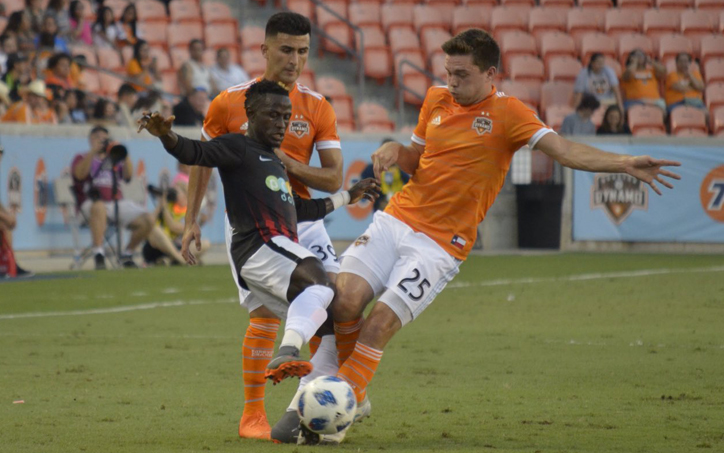
Players from the Houston Dynamo (orange) and NTX Rayados battle for the ball in their Fourth Round match in the 2018 US Open Cup. Photo: Jose Castellanos | Prost Amerika

The US Open Cup has only had a Fourth Round (prior to the Quarterfinals) 12 times in the Modern Era (2003, 2004, 2005, 2006, 2012-22).

The first indoor game in US Open Cup history took place in the Fourth Round. On July 20, 2004, the Minnesota Thunder hosted the Los Angeles Galaxy at the Hubert H. Humphrey Metrodome in Minneapolis, Minn. The Thunder upset the Galaxy that day 1-0, in front of 5,505 fans. Defender Chris Brunt scored the game-winning goal in the 21st minute.

No Open Division team in the Modern Era has ever advanced beyond the Fourth Round

Only 7 USL League Two (PDL) teams have advanced to the Fourth Round, all but one have faced MLS teams
2018: FC Golden State Force (lost 3-1 at Los Angeles Galaxy)
2016: Kitsap Pumas (lost 2-0 at Seattle Sounders FC)
2014: Laredo Heat (lost 1-0 at Houston Dynamo)
2014: Orlando City U23s (lost 3-0 at Portland Timbers)
2012: Michigan Bucks (lost 2-1 AET vs. Dayton Dutch Lions)
2006: Carolina Dynamo (lost 4-2 vs. Houston Dynamo)
2005: Des Moines Menace (lost 6-1 vs. Kansas City Wizards)
2003: Fresno Fuego (lost 3-1 vs. Los Angeles Galaxy)

Only 6 Open Division Local (USASA) teams have advanced to the Fourth Round
2018: NTX Rayados (lost 5-0 at Houston Dynamo)
2017: Christos FC (lost 4-1 at D.C. United of MLS)
2016: La Maquina (lost 4-1 AET at Los Angeles Galaxy of MLS)
2015: PSA Elite (lost 6-1 at Los Angeles Galaxy of MLS)
2014: PSA Elite (lost 5-0 at Seattle Sounders of MLS)
2012: Cal FC (lost 5-0 at Seattle Sounders of MLS)
2006: Dallas Roma FC (lost 2-0 at Los Angeles Galaxy of MLS)

Only 2 NPSL teams have advanced to the Fourth Round
2019: Orange County FC (lost 3-0 at Los Angeles Galaxy)
2018: Miami United FC (lost 3-0 vs. Orlando City SC)

In 2006, only teams from Major League Soccer emerged from the Fourth Round.

The Harrisburg City Islanders (USL Pro) won a Fourth Round game in 2012 by upsetting the New York Red Bulls 3-1 after extra time. Photo: Harrisburg City Islanders

The Chicago Fire did not lose a Fourth Round game until 2019 when they lost to Saint Louis FC. Prior to that, they had a 7-0-2 (2-0 PKs) record.

Major League Soccer began playing in the tournament in the Fourth Round for the first time in 2014 as part of an expanded format.

The attendance record in the Modern Era was set in 2013 when Sporting Kansas City (MLS) hosted Orlando City SC (USL PRO) at Sporting Park in front of an announced attendance of 15,981. Thanks to that figure, the record for Fourth Round average attendance was broken with 6,887 across the eight games. Sporting Kansas City later broke their own record in 2015 when they hosted and defeated Saint Louis FC (USL) 1-0 on June 16, 2015 in front of an announced crowd of 19,298. FC Cincinnati shattered that record in 2017 when they drew 30,160 to Nippert Stadium to watch them upset the Columbus Crew (MLS), 1-0.

In 2014, with Major League Soccer not entering the tournament until Round 4, a record three amateur teams (Laredo Heat, Orlando City U23s, PSA Elite) advanced beyond the Third Round, followed by five amateur teams reaching the Fourth Round in 2015.

Notable upsets in the Fourth Round

2003: Wilmington Hammerheads (PSL) 4:1 Dallas Burn (MLS)
2003: Seattle Sounders (A-League) 1:0 San Jose Earthquakes (MLS)
2004: Charleston Battery (A-League) 1:0 Metrostars (MLS)
2004: Rochester Raging Rhinos (A-League) 1:1 New England Revolution (MLS) (ROC advances on PKs 3-1)
2004: Richmond Kickers (PSL) 2:1 DC United (MLS)
2004: Minnesota Thunder (A-League) 1:0 Los Angeles Galaxy (MLS)
2005: Rochester Raging Rhinos (USL-1) 3:1 Metrostars (MLS)
2005: Minnesota Thunder (USL-1) 4:1 Colorado Rapids (MLS)
2006: None
2012: Harrisburg City Islanders (USL PROro) 3:1 (AET) New York Red Bulls (MLS)
2012: Charlotte Eagles (USL PRO) 2:1 (AET) San Antonio Scorpions (NASL)
2013: Carolina RailHawks (NASL) 3:1 (AET) Chivas USA (MLS)
2013: Orlando City SC (USL PRO) 1:0 Sporting Kansas City (MLS)
2014: Atlanta Silverbacks (NASL) 2:1 Real Salt Lake (MLS)
2014: Carolina RailHawks (NASL) 1:1 (3:2 PKs) Chivas USA (MLS)
2014: New York Cosmos (NASL) 3:0 New York Red Bulls (MLS)
2014: Rochester Rhinos (USL) 1:0 DC United (MLS)
2015: Charlotte Independence (USL) 1:0 New England Revolution (MLS)
2015: New York Cosmos 2:2 (4:3 PKs) New York City FC (MLS)
2016: New York City FC (MLS) 0:1 New York Cosmos (NASL)
2016: D.C. United (MLS) 0:0 (3:4 PKs) Fort Lauderdale Strikers (NASL)
2017: Columbus Crew (MLS) 0:1 FC Cincinnati (USL)
2017: Miami FC (NASL) 3:1 Orlando City SC (MLS)
2017: Sacramento Republic FC (USL) 4:1 Real Salt Lake (MLS)
2018: Louisville City FC (USL) 3:2 New England Revolution (MLS)
2018: Nashville SC (USL) 2:0 Colorado Rapids (MLS)
2018: Sacramento Republic FC (USL) 2:1 (AET) Seattle Sounders FC (MLS)
2019: Saint Louis FC (USL-C) 2:1 Chicago Fire (MLS)
2019: Colorado Rapids (MLS) 2:2 (2:4 PKs) New Mexico United (USL-C)
2022: None

Filed Under: Feature - Main, Featured Post - Main, US Open Cup, US Open Cup History Tagged With: Carolina Dynamo, Charleston Battery, Chicago Fire MLS, Colorado Rapids, Dallas Roma FC, DC United, Des Moines Menace, FC Dallas/Dallas Burn, Feature, Fourth Round, Fresno Fuego, Houston Dynamo, Los Angeles Galaxy, Minnesota Thunder, New England Revolution, New York Red Bulls/Metrostars, Richmond Kickers, Rochester Rhinos, San Jose Earthquakes/San Jose Clash, Seattle Sounders USL, Sporting Kansas City/Kansas City Wizards, Things You Should Know, Wilmington Hammerheads

Things you should know about the Semifinals of the US Open Cup

July 3, 2012 by Josh Hakala

The New York Red Bulls take on FC Cincinnati in the US Open Cup Semifinals at Nippert Stadium in Cincinnati, OH on Tuesday August 15, 2017. Photo: Ryan Meyer | New York Red Bulls

Since 1996, only 14 non-MLS teams have advanced to the Semifinals.

2022 – Sacramento Republic FC (USL Championship)*
2017 – FC Cincinnati (USL)
2011 – Richmond Kickers (USL Pro – 3rd Division)
2009 – Rochester Rhinos (USL First Division)
2008 – Charleston Battery (USL First Division)*, Seattle Sounders (USL First Division)
2007 – Carolina RailHawks (USL First Division), Seattle Sounders (USL First Division)
2005 – Minnesota Thunder (USL First Division)
2004 – Charleston Battery (A-League)
1999 – Charleston Battery (A-League), Rochester Raging Rhinos (A-League)*
1997 – San Francisco Bay Seals (USISL Division 3 Pro League)
1996 – Rochester Raging Rhinos (A-League)*

* Advanced to the Final

Since 1996, only seven teams have advanced to the Semifinals after beginning play in the First Round. The Richmond Kickers (2011), Rochester Rhinos (2009), Charleston Battery (2008), Carolina RailHawks (2007), San Francisco Bay Seals (1997) and the Seattle Sounders who did it twice in 2007 and 2008. San Francisco and Richmond are the only Third Division pro clubs to advance to the final four during that span.Ukrainian Nationals logo

When the Sacramento Republic eliminated Sporting Kansas City in penalty kicks in the 2022 Semifinals, they became just the fourth lower division club in the Modern Era (1995-present) to advance to the Final. They joined the Charleston Battery who eliminated the Seattle Sounders in the 2008 Semifinals, and the Rochester Raging Rhinos in 1996 and 1999. The Rhinos were the only non-MLS team (since 1996) to win the title when they defeated the Colorado Rapids 2-0 in 1999.

In 2008, the Charleston Battery and the Seattle Sounders ended in a 1-1 draw, and then went to penalties where the Battery moved on 4-3. It was the first time a Semifinal game went to penalties during the Modern Era and the first time two non-MLS teams met in the final four.

The Chicago Fire entered Major League Soccer as an expansion team in 1998, and won the US Open Cup (and MLS Cup) in their inaugural season. In total, they have advanced to the Semifinals 13 times, which is more than any team in the history of the tournament (1913-present).

After Major League Soccer debuted in 1996 (1996 doesn’t make sense to include, since every Semifinalist was in their inaugural season that year), only four teams have advanced to the Semifinals in their inaugural season. The Fire (1998), Houston Dynamo (2006 – although they were essentially the San Jose Earthquakes, but they were still technically a “new franchise”), Carolina RailHawks (2007). The Seattle Sounders were a new MLS franchise in 2009, but the club had existed in the USL for several years prior to joining MLS.

In 2010, the Seattle Sounders became the first MLS expansion team to win a Semifinal match in each of their first two seasons as a franchise. They also won a Semifinal match in their third year (2011), and their fourth year (2012).

The Houston Dynamo celebrate after defeated LAFC in a PK shootout in the 2018 US Open Cup Semifinals. Photo: Houston Dynamo
The Houston Dynamo celebrate after defeating LAFC in a PK shootout in the 2018 US Open Cup Semifinals. Photo: Houston Dynamo

The 2007 US Open Cup marked the first time that both Semifinal matches went to extra time. The New England Revolution edged the Carolina RailHawks 2-1, followed by FC Dallas eliminating the Seattle Sounders (USL-1) by the same scoreline. Since then, this has only happened one other time: 2017 US Open Cup when Sporting Kansas City needed penalty kicks to take out the San Jose Earthquakes and then the New York Red Bulls came back to beat FC Cincinnati, 3-2 in extra time. It happened again in 2017 when Sporting Kansas City eliminated the San Jose Earthquakes in penalty kicks while the New York Red Bulls edged USL side FC Cincinnati 3-2 in extra time.

Semifinal appearances by MLS teams:

Chicago Fire – 13 (6-7-0 record)
DC United – 9 (5-4-0)
FC Dallas – 9 (4-4-1, 0-1 PKs)
LA Galaxy – 7 (4-3-0)
New York Red Bulls – 6 (2-4-0)
Sporting Kansas City – 6 (3-1-2, 1-1 PKs)
Seattle Sounders – 5 (5-0-0)
Columbus Crew – 4 (3-1-0)
New England Revolution – 4 (3-1-0)
Philadelphia Union – 4 (2-1-1, 1-0 PKs)
Houston Dynamo – 4 (1-2-1, 1-0 PKs)
Real Salt Lake – 3 (1-2-0)
Chivas USA – 2 (0-2-0)
Colorado Rapids – 2 (1-1-0)
Orlando City SC – 2 (1-1-0)
Portland Timbers – 2 (0-2-0)
San Jose Earthquakes – 2 (0-1-1, 0-1 PKs)
Atlanta United FC – 1 (1-0-0)
FC Cincinnati – 1 (0-0-1, 0-1 PKs)
Inter Miami CF – 1 (0-0-1, 1-0 PKs)
Los Angeles FC – 1 (0-0-1, 0-1 PKs)
Miami Fusion – 1 (1-0-0)
Minnesota United FC – 1 (1-0-0)
Tampa Bay Mutiny – 0

Note: The New York Red Bulls (Metrostars) have the most semifinal appearances (six) without an Open Cup championship.

Semifinal appearances by non-MLS teams:

Charleston Battery – 3 (0-2-1, 1-0 PKs)
Rochester Rhinos – 3 (2-1-0)
Seattle Sounders – 2 (0-1-1, 0-1 PKs)
Carolina RailHawks – 1 (0-1-0)
FC Cincinnati – 1 (0-1-0)
Minnesota Thunder – 1 (0-1-0)
Richmond Kickers – 1 (0-1-0)
Sacramento Republic FC – 1 (0-0-1, 1-0 PKs)
San Francisco Bay Seals – 1 (0-1-0)

Most consecutive Semifinal appearances (all-time):

Ukrainian Nationals (Philadelphia) – 8 (1959-66) — champions: 1960, 1961, 1963, 1966
Seattle Sounders (USL/MLS) – 6 (2007-2012) — champions: 2009, 2010, 2011, 2012
Stix, Baer & Fuller (St. Louis) – 6 (1932-37) — champions: 1933, 1934, 1935
Bethlehem Steel (Bethlehem, Pa.) – 5 (1915-19) — champions: 1915, 1916, 1918, 1919
Chicago Fire – 4 (2003-06) — champions: 2003, 2006
Chicago Fire – 4 (2013-16) — champions: None
Los Angeles Galaxy – 4 (2000-03) — champions: 2001
Philadelphia Nationals (1949-52) — champions: None
DC United – 3 (2008-2010) — champions: 2008
Pawtucket Rangers – 3 (1933-35) — champions: 1941
Dallas Burn (FC Dallas) – 3 (1996-98) — champions: 1997
Maccabee AC (Los Angeles) – 3 (1980-82) — champions: 1973, 1975, 1977, 1978, 1981
NY Greek Americans (New York City) – 3 (1967-69) — champions: 1967-69
Brooklyn Hispano (Brooklyn, NY) – 3 (1943-45) — champions: 1943, 1944
Croatian SC (Chicago) – 3 (1979-81) — champions: None
Ponta Delgada (Mass.) – 3 (1946-48) — champions: 1947
Fall River Rovers (Mass.) – 3 (1916-18) — champions: 1917
Scullin Steel (St. Louis) – 3 (1921-23) — champions: 1922

The most popular Semifinal matchup in the Modern Era has been the Chicago Fire against the Los Angeles Galaxy who have played each other three times.

2000: Chicago Fire 2:1 (ASDET) Los Angeles Galaxy (at Los Angeles)
2001: Los Angeles Galaxy 1:0 (ASDET) Chicago Fire (at Los Angeles)
2003: Chicago Fire 3:2 Los Angeles Galaxy (at Chicago)

The highest attendance for a Semifinal match in the Modern Era was 16,117 set by Sporting Kansas City when they defeated Real Salt Lake 3-1 at Sporting Park in Kansas City on Aug. 12, 2015. Two years later, USL side FC Cincinnati more than doubled that record with an announced crowd of 33,250. At the time, according to TheCup.us records, this was the second-highest attendance ever recorded for a US Open Cup match.

The highest average attendance between two Semifinal matches came in 2013 when Real Salt Lake hosted the Portland Timbers and the Chicago Fire hosted DC United. The average was 12,889. Real Salt Lake drew a then-record 14,742 and Chicago had an announced crowd of 11,036. However, in 2017, FC Cincinnati’s record crowd of 33,250 pushed the average attendance to nearly double the previous record: 24,722.

The following states have never had a team advance to the Semifinals:
Alabama
Alaska
Arizona
Arkansas
Delaware
Hawaii
Idaho
Iowa
Kentucky
Maine
Mississippi
Montana
Nebraska
Nevada
New Hampshire
North Dakota
Oklahoma
South Dakota
Tennessee
Vermont
West Virginia
Wyoming

The longest current Semifinal drought is from the state of Rhode Island, who hasn’t had a time reach the Semifinals since 1942 when the Pawtucket Rangers reached the final four for the ninth and final time.

Filed Under: US Open Cup, US Open Cup History Tagged With: Carolina RailHawks, Charleston Battery, Chicago Fire MLS, Colorado Rapids, Columbus Crew, DC United, FC Dallas/Dallas Burn, Houston Dynamo, Los Angeles Galaxy, Miami Fusion, Minnesota Thunder, New England Revolution, New York Red Bulls/Metrostars, Rochester Rhinos, San Francisco Bay Seals, San Jose Earthquakes/San Jose Clash, Seattle Sounders USL, Sporting Kansas City/Kansas City Wizards, Things You Should Know

2012 US Open Cup Quarterfinals: Tempers flare as Sounders escape with 1-0 win over San Jose Earthquakes

June 27, 2012 by Robert Jonas

Photo: Julie Logan | TheJulieLogan.com Copyright 2012, All rights reserved

The San Jose Earthquakes crashed out of the Lamar Hunt US Open Cup tournament with a 1-0 loss to the three-time defending champions Seattle Sounders in front of a crowd of 7,219 at historic Kezar Stadium in San Francisco. A first half goal from Sounders rookie midfielder Cordell Cato proved to be the difference for the visitors when the Earthquakes were unable to continue their season of late-game magic and find an equalizing goal.

The win-or-go-home nature of the tournament resulted in a fiercely competitive game, which featured numerous yellow cards to both teams, a straight red card to Earthquakes forward Alan Gordon, and a post game melee resulting from the intense emotions surrounding the match. Forward Chris Wondolowski, who entered as a second half substitute, recognized just how hard each team was going for the victory.

“We’re both good teams this year so there will be a lot of fight and a lot of heart,” said Wondolowski. “You put 22 guys on a small field, a bumpy field, with a referee that let a lot of stuff go, and there’s going to be a lot of fire.”

Earthquakes head coach Frank Yallop used everything at his disposal to try to knock off the three-time champions, but the Sounders proved resolute despite the heavy pressure put on them by the San Jose offense.

“You have to give Seattle credit for the way they defended, especially the last 35 minutes,” said Yallop. “We just couldn’t quite get that touch in front of goal. We pushed the issue on what was a difficult pitch and went direct but couldn’t score.”

Facing a setting sun to start the game and field conditions that were far from pristine, the Earthquakes found it difficult to muster up anything on offense early on. It took until the 9th minute for San Jose to find a seam in the Seattle defense. Rafael Baca, with space to work with on the left sideline, carried the ball into the top corner of the area and squared a pass to an onrushing Shea Salinas 15 yards from goal. The Quakes winger had trouble settling the ball and his weakly taken shot was comfortably saved by Sounders goalkeeper Andrew Weber.

The Sounders began to turn the momentum to their advantage over the next quarter hour, and were rewarded for their efforts in the 19th minute when they broke through for the game’s opening goal. A pass across the top of the Earthquakes penalty area was misjudged by defender Ike Opara and fell to the feet of Sounders midfielder Cato. With Justin Morrow stabbing at the loose ball, Cato rounded the Earthquakes defender and drove the ball to the endline. The Sounders rookie’s shot across goal took a slight deflection and managed to sneak the ball through the legs of goalkeeper David Bingham and into the goal for a Seattle 1-0 lead.

“I think we gave the ball away poorly in the midfield which didn’t help,” said Yallop. “We still had a chance to defend it and we didn’t. The shot took a nick off of somebody and it was not easy for the goalkeeper.”

Photo: Julie Logan | TheJulieLogan.com Copyright 2012, All rights reserved

Following an ineffective opening half for San Jose, coach Yallop went to his bench early in the second half in an effort to bolster his offense. Regular first-teamers Wondolowski and Steven Lenhart, along with speedy Marvin Chavez were all inserted into the line-up with an eye toward cracking the resolute Sounders defense. Instead, the frustration mounted for the home side, as they were able to consistently deliver the ball into the Seattle area, but they were not able to create a single shot on goal.

With tempers boiling over and physical play being ramped up a notch or two by both sides as the game dragged toward a conclusion, referee Yader Reyes was required to be more active in keeping the match in control. Yellow card cautions for hard tackles went to Gordon and Morrow for the Earthquakes and Zach Scott, Andy Rose and Marc Burch for the Sounders were all issued in the second half.

As the match entered six minutes of stoppage time, the Earthquakes continued to press for the equalizer in the midst of the chippy play. The 93rd minute saw things come to a boil, as Burch fouled Gordon hard from behind, sending the Quakes forward to the turf and earning Burch his yellow card. However, Gordon then sprang back up and headbutted Burch from behind, leaving San Jose with just 10 men, in an eerily similar meltdown to Zinadine Zidane’s in the 2002 World Cup final.

A throw-in from Steven Beitashour in the 95th minute was flicked toward the mix of players and popped out to the top of area. Defender Victor Bernardez stepped into the loose ball and unleashed a volley that took a deflection off a defender. The Earthquakes claimed a hand ball against Seattle, but the referee did not agree. “It looked a hand ball,” said Yallop. “I thought we had a couple calls that could have gone our way. That’s being diplomatic.”

Wondolowski, who protested vehemently at the time of the disputed play to referee Reyes, was much less diplomatic than his coach.

“The hand ball was very clear,” said Wondolowski. “The defender made a last ditch effort just to save the goal. And it was a good ‘save,’ one that Busch or Bingham would be proud of.”

The match ended a minute later, and the two teams engaged in a significant melee on the field between the two team benches brought about because of a confrontation between Sounders forward Eddie Johnson and Quakes defender Jed Zayner. The latter accused the former of hitting him in the face, but the former had no comment on the incident. Both teams engaged in some pushing and shoving, but eventually separated and went their own ways to their locker rooms. The video replay does show Zayner making contact with Johnson right before the supposed punch.

“There’s always a rivalry between us and Seattle,” said Yallop. “We beat them once this year, and they beat us in the Cup. We’ll play them twice again this year, so we have got to look forward to that.”

While Seattle moves forward in the US Open Cup tournament to the semifinal round, San Jose focuses on a weekend match against rival Los Angeles Galaxy at a sold-out Stanford Stadium this Saturday, June 30.

Seattle Sounders FC at San Jose Earthquakes
June 26, 2012 — Kezar Stadium in San Francisco, Calif.
Attendance: 7,219

Scoring Summary
SEA — Cordell Cato (unassisted) 19

Misconduct Summary:
SJ — Alan Gordon (caution) 49
SEA — Zach Scott (caution) 51
SJ — Justin Morrow (caution) 75
SEA — Andy Rose (caution) 82
SJ — Alan Gordon (ejection) 93
SEA — Marc Burch (caution) 94

San Jose Earthquakes — David Bingham, Steven Beitashour, Victor Bernardez, Ike Opara, Justin Morrow, Rafael Baca (Marvin Chavez 80), Sam Cronin, Tressor Moreno (Steven Lenhart 53), Shea Salinas, Khari Stephenson (Chris Wondolowski 53), Alan Gordon.
Statistics: Total Shots: 7; Shots on Goal: 4; Saves: 4; Fouls: 12; Offside: 3; Corner Kicks: 11.

Seattle Sounders FC — Andrew Weber, Brad Evans, Patrick Ianni, Zach Scott, Leo Gonzalez, Cordell Cato (Marc Burch 82), Servando Carrasco, Andy Rose, Alvaro Fernadez (Jhon Kennedy Hurtado 89), Roger Levesque, Sammy Ochoa (Eddie Johnson 75).
Statistics: Total Shots: 8; Shots on Goal: 4; Saves: 4; Fouls: 9; Offside: 1; Corner Kicks: 3.

Filed Under: US Open Cup Tagged With: 2012 Lamar Hunt US Open Cup, 2012 US Open Cup, Cordell Cato, San Jose Earthquakes/San Jose Clash, Seattle Sounders MLS

2012 US Open Cup Fourth Round: Late Steven Lenhart goal helps San Jose Earthquakes advance 1-0 over Minnesota Stars

June 6, 2012 by Robert Jonas

Steven Lenhart celebrates after scoring a goal in the 85th minute against the Minnesota Stars. Photo: Joe Nuxoll | CenterLineSoccer.com

Robert Jonas writes for Centerline Soccer and you can follow him on Twitter @RobertJonas.

The San Jose Earthquakes ensured that their 2012 US Open Cup tournament run will continue for at least another round, as a Steven Lenhart headed goal proved the difference in a 1-0 victory over the resilient Minnesota Stars. Coming in the 85th minute of a tense affair between the MLS and NASL representatives, Lenhart’s score, assisted by a wonderful cross from Steven Beitashour, treated the 1,548 fans in attendance at Stanford University’s Cagan Stadium to another evening of late game heroics from the “Never Say Die” Earthquakes.

“I am confident in our team, and I knew we were going to get a couple chances,” said Lenhart of the team’s will to win. “The teams we are playing are fighting and make for good competition, but we did a good job to give ourselves a chance in the game and also to keep a clean sheet. It all worked out tonight.”

Earthquakes head coach Frank Yallop was also pleased with his team’s effort on the night, especially against a tough opponent in the Minnesota Stars, the defending champions of the NASL, and their “We Believe” torch bearing head coach Manny Lagos.

“They are a good side,” said Yallop with a profound respect for the Earthquakes’ opponent, “and that was their first loss in 18 matches. You have to give credit to Minnesota for they were good tonight, and they made it difficult for us. We played pretty well in spells but not a dominate game for us. I think in the end, on the balance of chances, we deserved to go through.”

From the opening whistle, the Stars executed a game plan that relied heavily on defense with bursts of counterattacking soccer in their efforts to upset their MLS opponent. And for the better part of Tuesday night, their efforts were rewarded, as the Earthquakes were consistently frustrated in trying to earn the game’s first goal. However, even the most stalwart of defenses can unfortunately yield if even for a moment, and San Jose’s perseverance finally paid off with Lenhart’s late match winner.

“I think you saw a different level of opposition tonight,” continued Yallop. “That was a good side we played tonight. They made it difficult for us and moved well on the break, but I thought we handled it well. It shows the spirit of this team. We had chances early, but we kept going and I was very proud of the way we managed it and won in the end.”

The Fourth Round US Open Cup victory over Minnesota keeps the Earthquakes alive in America’s oldest running soccer tournament, now in its 99th year, and means that the team will add another game to its already crowded early summer schedule. Including San Jose’s Quarterfinal match on June 26 when they will face off against fellow MLS foe Seattle Sounders, the Earthquakes could play as many as 10 games during the 33-day stretch that starts when they return to league action on June 20 for a road match against the Colorado Rapids. However, Lenhart wasn’t concerned by the impending fixture congestion, and instead suggested that the upcoming intense run of games comes at a good time and would help the team in the long run of the 2012 season.

Steven Lenhart celebrates with his San Jose teammates after scoring what would prove to be the game-winning goal. Photo: Joe Nuxoll | CenterLineSoccer.com

“To win tonight was a totally good result for our team,” said Lenhart. “The more games the better. Guys get opportunities to play in these games, and we like to win. The more games we play, the more we mesh and the more we learn about each other, the more we build character and camaraderie. So I enjoy these games, and this tournament is important to us.”

The match against the Minnesota Stars kicked off at the unusual time of 8:00 p.m., a time change concession made in order to minimize the impact of the setting sun on the south end goalkeeper, but neither team showed any lack of energy during the game’s opening stages. Intensity from both sides favored the defenses early on, and scoring opportunities rarely developed, but as the first half wore on, the game began to open up.

In the 17th minute, San Jose registered their first quality shot when Alan Gordon, paired up top with Lenhart as part of a twin-towers forward duo, nearly put the home side ahead with a left footed effort. Following a nifty pass from midfield maestro Tressor Moreno that gave Lenhart the opportunity to turn the ball into the path of Gordon, the lanky forward was not able to strike the ball cleanly and the ball squirted just wide of the left post.

The Earthquakes had their best scoring chance of the opening stanza when in the 27th minute Gordon directed a deft pass from Moreno into open space in the Minnesota penalty area for Lenhart. With just the goalkeeper to beat, Lenhart unleashed a blistering shot that Stars goalkeeper Matt VanOekel got a hand to and deflected the ball off the inside of the far post and bottom of the crossbar before it was cleared by the defense. The entire Earthquakes team sensed that the goal was imminent, and all seemed to shut down when the chance presented itself to attack the rebound, and the Stars defused the dangerous situation.

In the 32nd minute, the Earthquakes again had an opportunity to break the deadlock, when the Minnesota defense could only clear the ball as far as the top of the area following a San Jose drive into the Stars attacking third. Midfielder Marvin Chavez collected the loose ball, took a touch to balance himself, and shot the ball on target, but directly at the ‘keeper. VanOekel made the initial save on the blazing shot, but the ball squirted away dangerously in the six yard box. Sensing an opportunity to deposit the rebound in the net, Lenhart raced into the area in pursuit of the ball, but VanOekel reached it just before the Earthquakes striker.

The Stars had their best first half chance to take the lead in the 37th minute, when on a counterattack against the run of play, midfielder Miguel Ibarra found possession of the ball near the top right corner of the Quakes’ penalty area and took a chance from 20 yards out that barely eluded the upward grasp of Earthquakes goalkeeper David Bingham and skimmed teasingly off the top of the crossbar.

With neither team looking like a threat to break the scoreless tie in the closing minutes of the first half, the play from both sides turned a bit more physical. The two teams traded yellow cards as the first half wore down, with Stars captain Kyle Altman earning a caution for a tackle on Lenhart in the 42nd minute and Earthquakes defender Beitashour seeing a card for obstruction on a Minnesota counterattack in the 45th minute.

The Earthquakes opened the second half with a much more verve than they displayed in the first 45 minutes. In the 48th minute, a great headed ball from defender Ike Opara, playing in an advanced position following a prior corner kick, appeared destined to find the back of the net, and ‘keeper VanOekel did well to tip the effort over the bar.

The match turned into a track meet over the next twenty minutes as both sides looked to exploit defensive lapses by their opponents. Nothing came of the opportunities, but a succession of aggressive plays from both teams led to yellow cards awarded to Earthquakes captain Ramiro Corrales in the 55th minute and Stars defender Justin Davis in the 60th minute by referee Alejandro Mariscal.

A heads-up play by Corrales nearly provided the pass that the Earthquakes needed to break the deadlock, as the Earthquakes captain stole a poor defensive clearance attempt and carried the ball deep into Stars territory. Righting himself at the left edge of the penalty area, Corrales sent the ball solidly to the far post in search of one of the two twin tower Quakes’ forwards. Recent late game hero Gordon jumped high into the Palo Alto evening air to meet the ball, but could not direct his header on target, and the ball flew agonizingly high and wide of the target.

The Earthquakes made their first substitution of the match in the 65th minute, as midfielder Simon Dawkins came in for a hobbled Sam Garza. In the 78th minute, another change brought Rafael Baca in for Gordon. The pair of substitutes turned the momentum of the match in the favor of the Earthquakes, and the team finally began to separate themselves from their worthy NASL opponent.

The Earthquakes finally broke through in the 85th minute, as some fancy footwork from Chavez along the right touchline freed the Honduran playmaker to spring Beitashour on a deep overlapping run into the right corner. From the edge of the byline, as he was being taken out by a Stars defender, the Quakes’ leading assist provider floated the ball into the area for Lenhart to expertly head past goalkeeper VanOekel for the San Jose goal.

“Beitashour made a good run,” described Lenhart. “It looked like he was trying really hard to get there, and it might have taken a deflection when he crossed it, but it kind of happened in just the right way. The team kept us in a good position to get that goal, with guys pushing forward and we kept our heads in the game just like every other game. It was a good play.”

“Marvin played a great ball and saw me overlapping,” said Beitashour. “I just got to it before the other guy and put in a good ball for Lenhart, and he does what he does: score goals. Lenny is great. He finishes almost everything with his head. All I try to do is get the ball in the air and Lenny will do the rest.”

Following a joyous goal celebration, the Earthquakes set about salting away the match with a stifling total team defensive effort over the final minutes of regulation and stoppage time. Minnesota tried in vain to find an equalizer but could not break through, and the match ended 1-0 in favor of San Jose.

Up next for the Earthquakes in the US Open Cup is a quarterfinal against fellow MLS side and three-time defending tournament champion Seattle Sounders on June 26 at 7:30 p.m. at Kezar Stadium in San Francisco.

Minnesota Stars FC (NASL) at San Jose Earthquakes (MLS)
June 5, 2012 — Cagan Stadium, Stanford, Calif.
Attendance: 1,548

Scoring Summary: SJ — Steven Lenhart (Steven Beitashour) 85.

Misconduct Summary: MN — Kyle Altman (caution) 42; SJ — Steven Beitashour (caution) 45; SJ — Ramiro Corrales (caution) 55; MN — Justin Davis (caution) 60; MN — Brian Kallman (caution) 90+3.

San Jose Earthquakes — David Bingham, Steven Beitashour, Ike Opara, Jason Hernandez, Ramiro Corrales, Sam Garza (Simon Dawkins 65), Jean-Marc Alexandre, Tressor Moreno (Sam Cronin 88), Marvin Chavez, Alan Gordon (Rafael Baca 77), Steven Lenhart.

Statistics: Total Shots: 13; Shots on Goal: 4; Saves: 3; Fouls: 13; Offside: 0; Corner Kicks: 8.

Minnesota Stars FC — Matt VanOekel, Justin Davis, Cristiano Dias, Kyle Altman, Brian Kallman, Neil Hlavaty, Kentaro Takada, Miguel Ibarra, Kevin Venegas, Simone Bracalello (Amani Walker 74), Martin Nunez (Devin Del Do 82).

Statistics: Total Shots: 10; Shots on Goal: 3; Saves: 3; Fouls: 8; Offside: 1; Corner Kicks: 5.

Filed Under: US Open Cup Tagged With: 2012 Fourth Round, 2012 Lamar Hunt US Open Cup, 2012 US Open Cup, Minnesota Stars FC, San Jose Earthquakes/San Jose Clash, Steven Lenhart

2012 US Open Cup Round 3: Sam Garza brace guides San Jose Earthquakes past Fort Lauderdale Strikers

May 30, 2012 by Robert Jonas

Lamar Hunt US Open Cup success finally arrived for the San Jose Earthquakes on Tuesday, as over a decade of efforts to host a victory in the nation’s oldest soccer tournament finally came through. Playing in the cozy confines of Cagan Stadium on the campus of Stanford University, the Quakes dispatched of NASL side Fort Lauderdale Strikers by a score of 2-1 in front of 1,271 fans to advance to the Fourth Round of the Open Cup tournament. A pair of second half goals from rookie Sam Garza was enough to secure the win for San Jose after Strikers forward Mark Anderson had staked the visitors to a 1-0 lead with a 55-yard first half golazo from inside his own half.

“We kept pressing them and keeping them in jail the second half, and luckily I came through with two goals,” said man of the match Garza. “It was a great performance by the team and Goonies never say die.”

The player that first made reference to the ‘80s movie classic following the team’s big road win at the Los Angeles Galaxy a week earlier, Steven Lenhart, was also thrilled by the resiliency shown by the Earthquakes despite falling behind a goal in the first half.

“We just have guys that know how to do it,” said Lenhart of the team’s penchant for comeback results this season. “We can get a goal at any point of the game, and it’s a good group to be a part of. It was great to see how we kept going again after getting down and we really played our style in the second half.”

Head coach Frank Yallop, who elected to make wholesale changes to his starting XI following three MLS league matches over the last week and a half, knew his team might struggle out of the gate, but he remained confident that despite falling behind by a goal, they would finish strong.

“It’s like boxing, when a boxer gets knocked to the canvas, it stunned us a bit,” said an elated Yallop. “At halftime, I just said we had 45 minutes to get back in the game. I felt like our energy and belief was there when we kicked off the second half. We don’t panic, we change things around and I think the ability to keep our composure and come from behind is a good quality for any team to have. When you do it a few times, you don’t worry about the score. You know there is time to get back in it and that’s what this team does.”

Garza echoed the comments of his coach when discussing the transformation the team underwent during the halftime break. The rookie midfielder, who had been preaching caution about the toughness of the opponent late last week and the need for the Earthquakes to play with a full 90 minutes of intensity, was still pleased that did enough to pull out the victory.

“We found our second wind and I found my second wind,” said Garza of the second half. “We kept the ball really well and went forward when we needed it.  We knew it wasn’t going to be an easy game, but we never give up, and that’s been the story of our season for this team.”

The breakout performance from the Earthquakes rookie will certainly assuage the fears from some supporters that the team failed to maximize the value of their 2012 first round MLS SuperDraft selection, but coach Yallop never wavered on his support for the UCSB Gauchos product.

“Great night for Sam, to put it together in a really good second half hopefully gives him a ton of confidence,” said coach Yallop. “What I liked after the miss earlier in the game was he didn’t worry about it. He got his goal and I thought he was very exciting to watch the rest of the second half. It was nice to see the potential to play great come through. He was excellent tonight. I’m really happy for him.”

Lenhart, who assisted on Garza’s game winning goal, and also played the role of motivator after the rookie missed a glorious scoring opportunity midway through the second half with the Quakes still trailing 1-0 in the match, echoed the words of his coach in praising the young midfielder.

“He showed that every half of soccer is important and that he kept working hard,” said Lenhart on Garza playing hard for the full 90 minutes. “He played well tonight and it was fun.”

On a night when seven other MLS teams fell victim to lower tier opponents, the San Jose Earthquakes appeared headed in that dubious direction following an opening stanza that saw them fail to open the match’s scoring. Instead, on what might end up being called the goal of the tournament, the home side ended the first half trailing their Floridian opposition by a score of 1-0.

In the 38th minute, following a well timed tackle by a teammate that pushed the ball back into his half of play, Strikers forward Mark Anderson settled the ball and looked up at his options to play the ball forward. However, instead of making a safe pass to a teammate, Anderson spied Earthquakes goalkeeper David Bingham stationed well off his line at the opposite end of the field. Sensing an opportunity, Anderson took a quick touch to settle the ball, and from within his team’s own side of the centerline, sent a blistering shot toward goal that caught Bingham out of position. The ball flew over his outstretched arms and just cleared the underside of the crossbar to punch the back of the net and give the Strikers a shock 1-0 lead.

Somewhat blindsided by the goal, the Earthquakes retreated to their locker room at halftime and regrouped for a tough second half. Within a couple minutes of the restart, it appeared the Earthquakes had equalized, as an expertly fed through ball from Tressor Moreno out of midfield to a streaking Garza on the right wing looked set up for success. The rookie midfielder sent a looping cross above the six yard box and just inside the byline to a waiting Sercan Guvenisik. The Turkish forward sent the ball back into the mouth of goal, but Strikers goalkeeper Matt Glaeser, while prone on his backside, managed to grasp the ball out of harm’s way and keep the Fort Lauderdale advantage at 1-0.

The Earthquakes continued their ascendancy in the half, and with the introduction of substitute Simon Dawkins, asserted their dominance over their NASL opposition. In the 61st minute, Garza was again the man on the scene, when a loose ball found him alone at the top right of the area with only Glaeser in his sights. The rookie, as rookies are apt to do, skied his shot attempt from 18 yards out well over the goal. The opportunity was lost, but the young midfielder bounced back over the next 10 minutes to secure his place in Earthquakes U.S. Open Cup lore.

Just over a minute later, following some slick passing in the attacking third, Earthquakes striker Guvenisik slid the ball to Garza inside the area for a literal shot of redemption.
This time, the rookie struck is shot with thoughtful intent, and the ball skimmed low along the Cagan Stadium field and into the net for the long deserved equalizer.

The Earthquakes were not done, and immediately seized on the restart to pressure the visitors off the ball. Over the next few minutes San Jose dominated possession and searched for a way through the Strikers defense. In the 70th minute, they finally had their opportunity, as a loose ball at the top of the area was tapped back into the center of the pitch by Lenhart and into the path of a lurking Garza. The rookie one-timed the ball past the helpless Strikers ‘keeper and gave his team the lead with his second goal of the evening.

The Floridians did not capitulate completely at relinquishing the lead, and over the match’s remaining 15 minutes tested ‘keeper Bingham with three very difficult shots on goal. However, unlike when faced with 55 yard bombs from distance, the second year goalkeeper was up to the challenge of saving the short range efforts, and the Earthquakes defense did the rest to see the home side off to the third round tournament win.

With the 2-1 victory, the Earthquakes move on in the U.S. Open Cup tournament and will next host another side from the NASL when they face the Minnesota Stars in a fourth round match next Tuesday evening at 7:30 p.m. at Cagan Stadium.

Robert Jonas writes for Centerline Soccer and you can follow him on Twitter @RobertJonas.

Fort Lauderdale Strikers (NASL) 1:2 San Jose Earthquakes (MLS)
Cagan Stadium, Stanford, Calif.

Scoring Summary:
FTL: Mark Anderson (unassisted) 38;
SJ: Sam Garza (Sercan Guvenisik, Simon Dawkins) 63;
SJ: Sam Garza (Steven Lenhart) 70.

Misconduct Summary:
SJ: Justin Morrow (caution) 50;
FTL: Scott Lorenz (caution) 55;
SJ: Sam Garza (caution) 66;
FTL: Walter Restrepo (caution) 89.

Lineups

San Jose Earthquakes — David Bingham, Brad Ring, Ike Opara, Justin Morrow, Josh Suggs (Steven Beitashour 65), Sam Cronin (Simon Dawkins 56), Jean-Marc Alexandre, Tressor Moreno, Sam Garza, Steven Lenhart, Sercan Guvenisik (Rafael Baca 88).
Fort Lauderdale Strikers — Matt Glaeser, Nickardo Blake, Conor Shanosky, Jack Stewart, Scott Lorenz, Leopaldo Morales (Andy Herron 78), Alfonso Motagalvan (Abel Gebor 64), Walter Restrepo, Pecka, Abe Thompson, Mark Anderson.

SJ Statistics: Total Shots: 21; Shots on Goal: 10; Saves: 5; Fouls: 7; Offside: 2; Corner Kicks: 7.
FTL Statistics: Total Shots: 8; Shots on Goal: 6; Saves: 8; Fouls: 11; Offside: 3; Corner Kicks: 1.

Attendance: 1,271

Filed Under: US Open Cup Tagged With: 2012 Lamar Hunt US Open Cup, 2012 Third Round, 2012 US Open Cup, Fort Lauderdale Strikers, Mark Anderson, Sam Garza, San Jose Earthquakes/San Jose Clash

The Other US Opens and marketing the ‘US Soccer Majors’

September 25, 2011 by Gerald Barnhart

Every year when the Lamar Hunt US Open Cup tournament rolls into the lights shining down onto the stadium pitch, the inevitable comparisons to the FA Cup in England come into play as part of the explanation to what the tournament is for journalists. And often times it’s followed by the unfortunate analogizing of the event to minor and major league baseball teams playing one another in a single-elimination tournament.

But perhaps the better comparisons we should all be making is to the other Opens in which the American media already treat as serious events. These events also pit amateurs versus professionals on an open entry basis, and are also among numerous events within the specific sport. These events, of course, are the US Open tennis tournaments held annually in New York and the US Open golf championship held in a different location each year around the United States.

Each fall, the world’s best tennis players convene on the hard courts of the USTA’s Billy Jean King National Tennis Center in Queens, NY for the tour’s fourth and final major of what the sport considers the Grand Slam. Those top-flight professionals are joined by winners of an open playoff system that is comprised 16 sectionals and a national playoff event in which only USTA members may participate. In the end, 128 participants each take part in the men’s and women’s brackets (64 for doubles).

Last year, over 1,200 players took part in the USTA’s National Playoffs for a chance to compete in the singles events at the US Open. Unlike US Soccer’s Open Cup, only one male and one female earned qualification spots to compete against the world’s best in the tournament.

The Chicago Fire have won six majors, including four US Open Cup championships | Photo by Brian Kersey/Wireimage.com

The US Open golf tournament, held in June, is comparatively more open with approximately half the participants advancing from qualification play to join the world’s top players who are automatically in the field through 17 exemptions categories via such things as being tournament winners or holding a certain world ranking.

At the 2010 tournament, 75 of the 156 participants were non-exempted players who qualified through the two-stage process to reach the famed Pebble Beach Golf Links for the championship. The process begins with Local Qualifying, a series of over 100 18-hole tournaments held around the country. Many top players not already qualified through full exemption are, however, exempt from local qualifying and join the process at the Sectional Qualifying stage where they participate in one of several one-day, 36-hole tournaments in the United States. There is also a Sectional tournament in both Europe and Japan where 11 and 4 individuals qualified, respectively, in 2010.

The major difference between the US Open Cup and the US Open tennis and golf duo is that the US Soccer Federation event is the only one that is a championship tournament for Americans while the other two are open to foreign participants. The only clubs eligible for the US Open Cup are American-based teams that are affiliated through the USSF; however, for argument’s sake it does still feature a foreign component as teams are comprised, in part, of players that are not American.

The Los Angeles Galaxy have won eight majors, and are one of only two MLS clubs to win the CONCACAF Champions Cup (DC United). They won the Champions Cup in 2000 | Photo: Los Angeles Galaxy

Continuing on the golf tangent, another significant open tournament American media and sports fans are very familiar with and follow every July is the British Open (officially known as The Open Championship), which is the oldest of the four golf majors and is the only one held outside of the United States. Similar to the US Open, the majority of the 156 participants are automatic entrants through exemption with the remaining players advancing from a two-stage qualification process.

Through 2004, players from around the world were only able to qualify through 18-hole Local Qualifying events held around Britain and Ireland within two weeks of The British Open followed by 36-hole Local Final Qualifying tournaments a few days later. International Qualifying events, 36-hole tournaments, were added in 2004 to assist foreign professionals wishing to participate, holding qualifiers in Africa, Australia, Asia, America and Europe with more stringent entrance standards than Local Qualifying.

Packaging & Marketing US Soccer Majors

The golf and tennis tours are lengthy seasons that run from January to the fall with tournament events nearly every week, but it is the majors where media coverage amps up and fan viewership heightens. With the similarities of the American Open majors to the US Open Cup, perhaps there are other lessons to be learned from the golf and tennis tours, such as the incorporation US Soccer Majors as a marketing tool for the sports’ leading championship events for American clubs.

A matching structure of four championships already exists with the US Open Cup joined by the MLS Cup, MLS Supporters’ Shield (regular season championship) and the CONCACAF Champions League.  Currently, the MLS Cup is the leading championship, but by creating a platform that raises the perception of the other three events to a comparable level to the league’s championship playoff, it will increase awareness among the media and fans while also, hopefully, creating a greater sense of seriousness and urgency to win the other events among the clubs and coaches.

Bringing these four championships together into one packaged series allows for a greater ability to compare the success of clubs beyond just winning MLS Cup as though this was the NFL and the Super Bowl while clubs around the rest of the world are evaluated on all the various events in which they participate. It would be similar to how tennis players and golfers are measured by majors won.

DC United lead all MLS clubs with 11 majors, including the 1996 US Open Cup championship | Photo: DC United

For instance, the Los Angeles Galaxy and DC United are the only two clubs that have won all four majors (dating back to the CCL precursor CONCACAF Champions Cup). In fact, the two also hold the most total majors with DC boasting 11 (4 MLS Cups, 4 Supporters’ Shields, 2 Open Cups and a CCC) and the Galaxy having eight (2 MLS Cups, 3 Supporters’ Shields, 2 Open Cups and the CCC).

Only five clubs have won all three of the domestic majors with the Chicago Fire, Columbus Crew and Sporting Kansas City having won everything but a CONCACAF championship at least once. The Fire are third in total majors (6) and the Crew are fourth (5).

Only three American MLS clubs are without a major championship, excluding expansion Portland. The New York Red Bulls, Chivas USA and Philadelphia Union have yet to claim one of the big prizes.

In the last five years, the most successful clubs in the United States have been Columbus and DC, each having won three majors. The Crew have won the Supporters’ Shield twice and the MLS Cup once. DC also has two Supporters’ Shields, but has a US Open Cup championship to round things out. Houston and Seattle each have two titles with the Dynamo winning MLS Cup twice in a row and the Sounders taking the Open Cup title back-to-back. Five other teams each have one major as nine clubs have won the 15 possible domestic majors while coming up empty in the Champions League, which is completing its third run with Real Salt Lake still in the hunt for a second major in the same cycle in which it won the MLS Cup title and qualified for the event.

All-Time ‘US Soccer Majors’ Winners List

11 – DC United (4 MC, 4 SS, 2 OC, 1 CCC)
8 – Los Angeles Galaxy (2 MC, 3 SS, 2 OC, 1 CCC)
6 – Chicago Fire (1 MC, 1 SS, 4 OC)
5 – Columbus Crew (1 MC, 3 SS, 1 OC)
3 – San Jose Earthquakes (2 MC, 1 SS)
3 – Sporting Kansas City (1 MC, 1 SS, 1 OC)
2 – Houston Dynamo (2 MC)
2 – Seattle Sounders (2 OC)
1 – Colorado Rapids (MC), FC Dallas (OC), Real Salt Lake (MC), New England Revolution (OC), Rochester Rhinos (OC), Tampa Bay Mutiny (SS), Miami Fusion (SS)

(MC – MLS Cup, SS – Supporters’ Shield, OC – US Open Cup, CCC/CCL – CONCACAF Champions Cup/League)

Filed Under: US Open Cup Tagged With: Chicago Fire MLS, Colorado Rapids, Columbus Crew, concacaf, CONCACAF Champions League, DC United, FC Dallas/Dallas Burn, Houston Dynamo, Lamar Hunt US Open Cup, Los Angeles Galaxy, Major League Soccer, Miami Fusion, MLS, MLS Cup, MLS Supporters’ Shield, New England Revolution, Real Salt Lake, San Jose Earthquakes/San Jose Clash, Seattle Sounders MLS, Sporting Kansas City/Kansas City Wizards, Tampa Bay Mutiny, US Open Cup

2011 US Open Cup qualifying: Chicago Fire rally, beat Earthquakes in PKs to keep Open Cup streak alive

May 25, 2011 by Gerald Barnhart

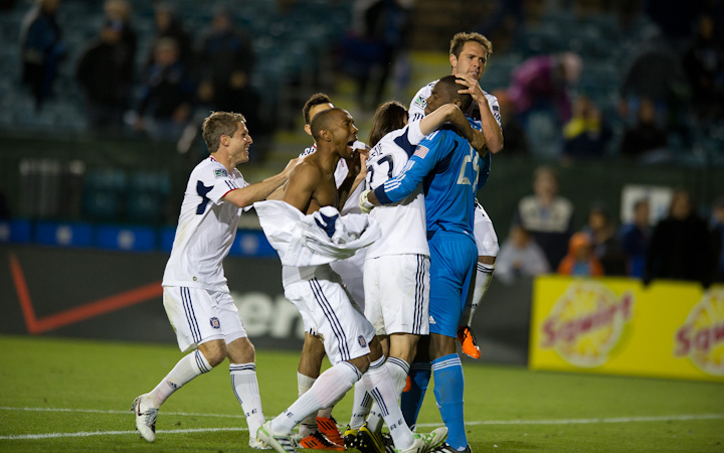
The Chicago Fire celebrate after defeated the San Jose Earthquakes in a penalty kick shootout in the 2011 US Open Cup qualifying tournament. Photo: John Todd | isiphotos.com

Trailing 2-0 at halftime, it looked as though the Chicago Fire were going to miss the Lamar Hunt US Open Cup for the first time in team history, but a pair of second half goals and a San Jose shot off the crossbar in sudden death penalties kept the perfect appearance record intact. The rally by the visitors dashed the Earthquakes’ hopes of returning for the first time since 2005.

Twenty-year old Ellis McLoughlin gave the home side the advantage 14 minutes into the contest and Justin Morrow doubled the lead two minutes before the break for San Jose. Chicago’s comeback was kicked off by 19-year old Israeli Orr Barouch in the 61st minute with the Fire finding the equalizer from Colombian Yamith Cuesta in the 77th.

With the momentum in the Fire’s favor, overtime saw the advantage flip back to San Jose eight minutes in with the direct red card send-off of Chicago’s Gonzalo Segares, apparently for making contact of some sort with Steven Lenhart’s face. The Earthquakes, however, were unable to capitalize on the extra man and watched as the clock ticked toward penalties.

Photo: John Todd | isiphotos.com

After the opening salvos were buried by Chicago’s Marco Pappa and San Jose’s Chris Wondolowski, Logan Pause sent his shot high and Sam Cronin smacked his attempt off the crossbar. Six consecutive conversions sent the tiebreaker to sudden death, where it would be decided in the sixth round. Chicago’s Daniel Paladini found the top left corner and watched as Trinidadian Scott Sealy sent his shot off the crossbar.

It was a bit of déjà vu for the Chicago and San Jose. In the Fire’s first-ever Open Cup match versus an MLS opponent in the tournament quarterfinals during their inaugural 1998 campaign, the Fire prevailed in penalties 4-3 after a 1-1 draw at the Cotton Bowl. They would go on to defeat Dallas and Columbus en route to the first of their four tournament titles.

Chicago has plenty of extra time experience when it comes to Open Cup related fixtures, going to overtime 14 times with a record of 7-3-4. The club is 3-1 in penalty kick tiebreakers, advancing in 10 of the 14 contests. San Jose meanwhile, is 2-1-6 in similar matches and has a lengthy, unfortunate history at the spot with only two victories in six tiebreakers.

The game could have taken a completely different path as Chicago’s Gaston Puerari, a standout in the previous qualifier, flashed a shot wide of goal just six minutes into the game.

Eight minutes later though, McLoughlin opened the scoring from the top of the penalty area after Cronin had dispossessed Paladini. The former US U17 international was making his first start for the club after entering the Portland qualifier in the 111th minute for his MLS debut. The youngster, whose shot deflected off Cuesta’s foot for the goal, has been hot of late, also scoring twice a week ago in a reserve match against Santa Clara University.

Another steal by the feisty Earthquakes created another immediate opportunity for the hosts in the 16th minute as Wondolowski put a shot on goal that forced a save from Sean Johnson.

A miscommunication by the Fire in their own half allowed San Jose another opportunity just before the break that proved fruitful. Steven Beitashour was able to acquire possession and send a through ball on to Anthony Ampaipitakwong, who delivered it to McLoughlin for a chance at a second on the night. Johnson made the stop, but allowed the ball to come out directly to Morrow for the easy three-yard finish in the 43rd minute.

Chicago got off to a similar start to the second half as they did the first as Pappa sent a shot from the top of the box wide of the goal in the 54th minute.

Hope at making a comeback was secured just after the hour mark when Segares squared a ball from the left side to Barouch, who sent a left-footed effort from the top of the area kissing off the inside of the right post and into the back of the net to slice the deficit in half. A new addition to the club, the Israeli-born striker joined the club after helping lead the Tigres U20 team to a runners-up finish in the Mexican Clausura.

A give-and-go between Wondolowski and Sealy nearly restored the two-goal advantage for the hosts only to see Wondolowski’s shot stopped by Johnson in the 71st.

Five minutes later though, the Earthquakes found themselves under fire. Dominic Oduro squared a ball to Christian Nazarit, who had an open look at goal denied by San Jose defender Bobby Burling. Less than a minute later though, the ball was sent into the fray from the corner, allowing Cuesta to get his boot on it and slip it past Weber, who erred on the play.

Four minutes into stoppage time Sealy made one final effort for San Jose only to see Johnson make the save seconds before the whistle to end regulation.

Eight minutes into extra time San Jose’s Khari Stephenson received a yellow card for a harsh tackle, but amidst the confusion afterword Segares would receive the surprising red card, reducing the visitors to 10 men.

The rest of overtime was rather uneventful as San Jose’s Stephen Lenhart turned and let off a shot in stoppage time of the first session that missed. Shortly after play resumed Nazarit fired a 40-yard free kick toward goal that forced Weber to tip it over the goal for a Fire corner. Pappa had the final chance for Chicago in the 111th minute, sending into the hands of Weber.

SCORING
SJ – Ellis McLoughlin 14
SJ – Justin Morrow 43
CHI – Orr Barouch (Gonzalo Segares) 61
CHI – Yamith Cuesta 76

PENALTY KICK TIEBREAKER
Chicago (5):  Pappa goal, Pause miss (high), Nazarit goal, Barouch goal, Oduro goal, Paladini goal
San Jose (4):  Wondolowski goal, Cronin miss (off crossbar), Corrales goal, Stephenson goal, McDonald goal, Sealy miss (off crossbar)

MISCONDUCT:
SJ – Chris Wondolowski (caution) 37
CHI – Yamith Cuesta (caution) 39
CHI – Daniel Paladini (caution) 63
SJ – Brad Ring (caution) 69
CHI – Orr Barouch (caution) 69
CHI – Bratislav Ristic (caution) 74
CHI – Cristian Nazarit (caution) 89
SJ – Khari Stephenson (caution) 97
CHI – Gonzalo Segares (ejection) 98

LINEUPS:
Chicago – Sean Johnson; Jalil Anibaba (Dominic Oduro 46), Yamith Cuesta, Dasan Robinson (Cory Gibbs 88), Gonzalo Segares; Bratislav Ristic, Daniel Paladini, Logan Pause, Marco Pappa; Cristian Nazarit, Gaston Puerari (Orr Barouch 46)
Substitutes not used: Jon Conway, Corben Bone, Baggio Husidic, Pari Pantazopoulos

San Jose – Andrew Weber; Steven Beitashour, Bobby Burling, Brandon McDonald, Ramiro Corrales; Anthony Ampaipitakwong (Steven Lenhart 83), Sam Cronin, Brad Ring (Khari Stephenson 71), Justin Morrow; Ellis McLoughlin (Scott Sealy 46), Chris Wondolowski
Substitutes not used: Jon Busch, Bobby Convey, Matt Luzunaris, Ike Opara

Referee: Daniel Radford
Referee’s Assistants: Mike Kampmeinert, Colin Arblaster
4th Official: Yader Reyes
Weather: Clear and 62 degrees
Attendance: 4,124

Filed Under: US Open Cup, US Open Cup Qualifying Tagged With: 2011 MLS Qualifying, 2011 US Open Cup qualifying, 2011 USOC Qualifying, Chicago Fire MLS, Major League Soccer, MLS, San Jose Earthquakes/San Jose Clash

2011 US Open Cup qualifying updates: MLS play-in tournament underway

May 19, 2011 by Josh Hakala

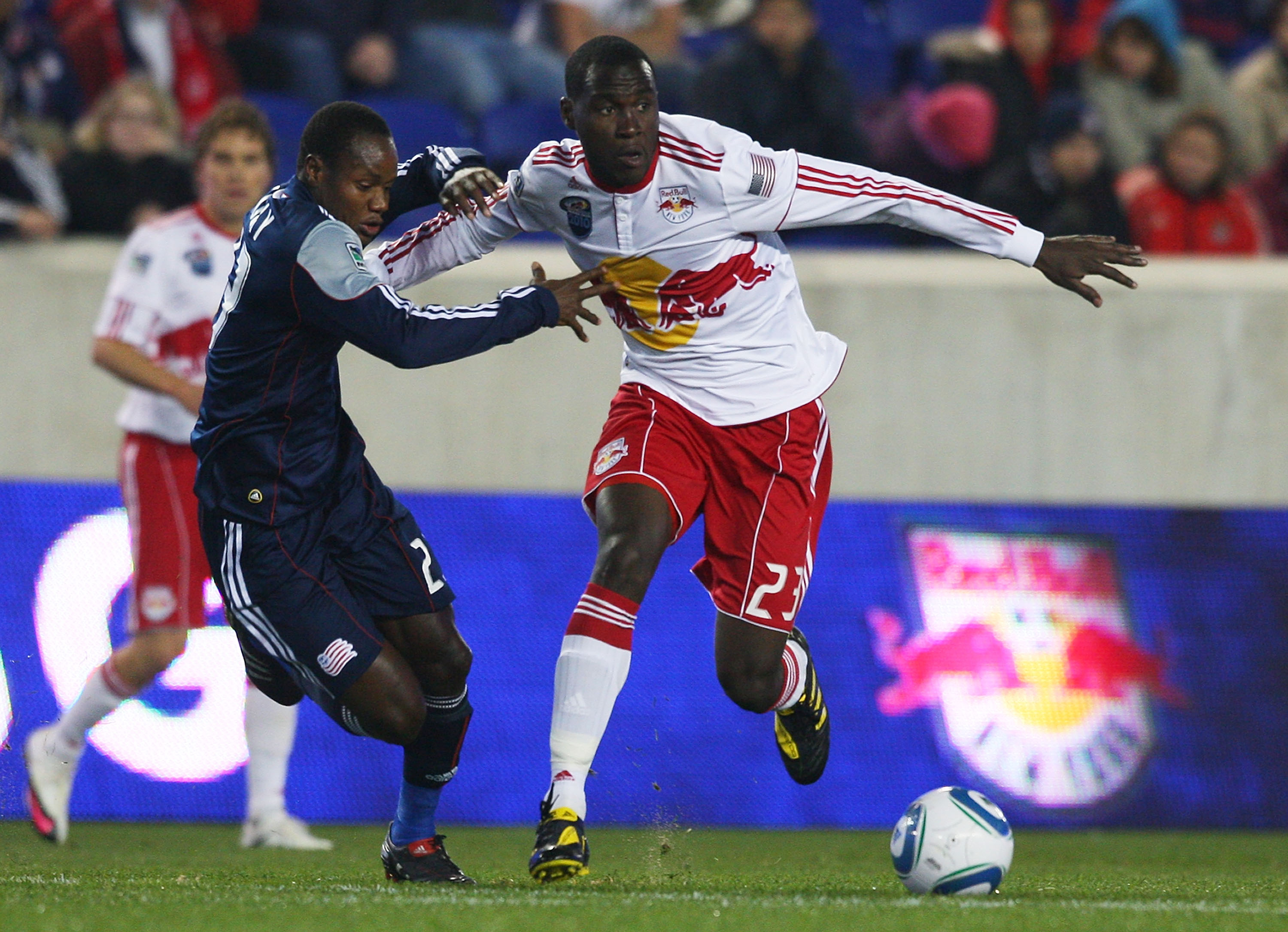
Tony Tchani (23) of the New York Red Bulls battles for the ball against Joseph Niouky (23) of the New England Revolution during last year's MLS qualifying tournament. | Photo: RBNY/Getty Images

For the fifth year in a row, Major League Soccer (MLS) will conduct a play-in tournament to narrow the number of teams that enter the Lamar Hunt US Open Cup. Beginning on June 28, eight MLS clubs will join the 98th edition of the tournament in the third round, with the top six MLS teams based on the 2010 league standings automatically qualifying. The 10 remaining US-based clubs are left to fight for the last two spots.

Below are the matchups as well as which team will host each match, as determined by a coin flip at MLS headquarters. The dates, times and locations will be announced at a later date.

Automatic qualifiers: Columbus Crew, FC Dallas, Los Angeles Galaxy, New York Red Bulls, Real Salt Lake, Seattle Sounders FC

2011 MLS qualifying bracket

First Round

(8) Chivas USA 0:2 (10) Portland Timbers – RECAP
Tuesday, March 29 – 10 p.m. EST | Merlo Field (Portland, Ore.)

(7) Philadelphia 2:2 (9) DC United – RECAP
DC advances 4-2 in PKs
April 6, 7:30 p.m. | Maryland Soccerplex (Boyds, Md.)

Second Round

(2) San Jose Earthquakes 1:0 (10) Portland Timbers – RECAP
After Extra Time
May 3, 10:30 p.m. EST | Jeld-Wen Field (Portland, Ore.)

(6) New England 3:2 (9) DC United – RECAP
April 26, 7:30 p.m. EST | Maryland Soccerplex (Boyds, Md.)

(1) Colorado Rapids 1:2 (4) Chicago Fire – RECAP
March 30, Shea Stadium (Peoria, Ill.)

(3) Sporting Kansas City 1:0 (5) Houston Dynamo – RECAP
After Extra Time
April 6, 8 p.m. EST – Aggie Soccer Stadium (College Station, Tx.)

Third Round*

(4) Chicago Fire 2:2 (2) San Jose Earthquakes – RECAP
Chicago qualifies for the 2011 US Open Cup, 5-4 in PKs
May 24, 10:30 p.m. EST – Buck Shaw Stadium (Santa Clara, Calif.)

(6) New England Revolution 0:5 (3) Sporting Kansas City – RECAP
Kansas City qualifies for the 2011 US Open Cup
May 25, 8:30 p.m. EST – Blue Valley District Activities Complex (Overland Park, Kan.)

MLS qualifying team profiles

Chicago Fire: The MLS team with the most Open Cup titles (4) only had to qualify one time and only had to play one game to qualify for that tournament in 2008. They defeated the Columbus Crew 3-2 and they would advance to the quarterfinals that year, losing to DC United.

Chivas USA:
Has never had to qualify for the US Open Cup

Colorado Rapids:
The Rapids share the unfortunate distinction with Real Salt Lake as the club who has played the most qualifying matches over the last four seasons. Which only means a lot of heartbreak for their fans, as Colorado has a 3-2-2 record (1-1 in PKs) and after advancing in 2007, the Rapids have fallen one game short in each of the last three years. In 2010, they lost to the New York Red Bulls, 3-0.

DC United:
In two years (2009, 2010), DC has never lost a qualifying match, with a perfect 4-0 record. Last year, United advanced to the semifinals where they lost to the Columbus Crew, and in 2009, they joined fellow qualifying survivor Seattle Sounders FC, by reaching the championship game. Seattle won the final 2-1 at RFK Stadium.

Houston Dynamo:
Houston has never had to qualify for the US Open Cup.

New England Revolution:
Last year was the first time New England has had to qualify for the Open Cup, and they lost in the semifinals, 3-0, to the New York Red Bulls.

Philadelphia Union:
In their inaugural season last year, the Union lost their first qualifying match, 2-1 to the New York Red Bulls.

Portland Timbers:
2011 MLS expansion club

San Jose Earthquakes:
The Earthquakes have never won a qualifying match (0-2-1), failing to advance each of the last three years. The closest they came was last year, when they drew 3-3 with Real Salt Lake, but fell short in the shootout.

Sporting Kansas City:
The club formerly known as the Wizards have also never won a qualifying game (0-2-1, 1-0 in PKs). The only time they advanced was when they defeated the Colorado Rapids in a penalty kick shootout to qualify for the 2008 US Open Cup.

Hosting MLS qualifying games (2007-2010)

Chicago:
1 game, 1 home, 0 away (1-0)
Colorado: 7 games, 2 home, 5 away (3-2-2, 1-1 in PKs)
Columbus: 3 games, 2 home, 1 away (1-2-0)
DC United: 4 games, 4 home, 0 away (4-0-0)
FC Dallas: 2 games, 0 home, 2 away (0-2-0)
Los Angeles: 4 games, 2 home, 2 away (2-1-1, 0-1 in PKs)
New England: 1 game, 0 home, 1 away (0-1-0)
New York: 6 games, 3 home, 3 away (4-2-0)
Philadelphia: 1 game, 0 home, 1 away (0-1-0)
Real Salt Lake: 7 games, 2 home, 5 away (2-4-1, 1-0 in PKs)
San Jose: 3 games, 2 home, 1 away (0-2-1, 0-1 in PKs)
Seattle: 2 games, 2 home, 0 away (2-0-0)
Sporting Kansas City: 3 games, 2 home, 1 away (0-2-1, 1-0 in PKs)

More: USSF announces 2011 Lamar Hunt US Open Cup team allocations, dates

Filed Under: US Open Cup Tagged With: 2011 MLS Qualifying, 2011 US Open Cup, 2011 US Open Cup qualifying, Chicago Fire MLS, Colorado Rapids, Columbus Crew, DC United, FC Dallas/Dallas Burn, Los Angeles Galaxy, Major League Soccer, MLS, New England Revolution, New York Red Bulls/Metrostars, Philadelphia Union, Real Salt Lake, San Jose Earthquakes/San Jose Clash, Seattle Sounders MLS, Sporting Kansas City/Kansas City Wizards

2011 US Open Cup qualifying: Ike Opara’s late winner breaks Portland hearts, sends Earthquakes to final round

May 4, 2011 by Tavio Palazzolo

Ike Opara of the San Jose Earthquakes challenges for the ball with Adam Moffat of the Portland Timbers during Tuesday’s US Open Cup qualifying match. Photo: Craig Mitchelldyer | Portland Timbers

The faithful Portland Timbers fans at JELD-WEN Field witnessed their US Open Cup hopes crash with a thud as a header from San Jose striker Ike Opara in the 120th minute gave the Earthquakes a 1-0 victory after extra time. This came after 120 minutes of action that could be reminiscent of a play. It started slowly, threw in a few twists and turns, included plenty of drama, and built to a crescendo with Opara putting on the climactic act at the finish.

Both teams came out slow to start the match. This was to be reasonably expected, as Portland hosted league stalwart Real Salt Lake just three days before, while San Jose was coming off a cross-country trip from Philadelphia. The Timbers fielded a mostly reserve squad, with the addition of starting goalkeeper Troy Perkins, having recently come back from injury. This gave the Earthquakes the early advantage, as they pressured Portland quickly.

The game would turn chippy soon enough, as the first yellow card was issued to the Earthquakes’ Brad Ring for shoving Portland’s Spencer Thompson in the 7th minute. It was a sign of things to come. San Jose would continue pressuring throughout the first half, including a chance for Ring in the 35th minute. He received the ball just outside the 18 yard box, but sent a side volley over the crossbar. Not to say the Timbers didn’t have chances of their own. In the 38th minute, Steve Purdy headed a corner kick towards goal, only to see it finger-tipped away by Earthquakes goalkeeper Andrew Weber.

The second half started with the Quakes coming back to life for a few minutes, but nothing would come of their efforts. Portland slowly turned the tables, and by the 60th minute had full control. At that point, Thompson received a chip inside the box, but couldn’t quite redirect the ball towards the net, sending it high and wide. Soon after began the fouling of Timbers player Sal Zizzo. Whether the fouls he suffered throughout the game were card-worthy or not, that depends on who you ask. The first yellow card earned for fouling Zizzo was shown to Ramiro Corrales in the 63rd minute.

The teams started to warm up more, as by the 75th minute, Ryan Johnson received a pass from Chris Wondolowski inside the box and shot, but Troy Perkins was there to make a great tip over the crossbar to keep the match scoreless. The final five minutes of regulation saw both teams become energized and created an exciting few minutes. A long blast from the Timbers’ Adam Moffat was knocked down by Weber in the 86th minute. Just a couple minutes later at the other end, Bobby Convey was on a breakaway for the Earthquakes. Timbers defender Freddie Braun saved the day by bolting back and stripping the ball away in an impressive slide tackle near the top of the box. As the game entered stoppage time, Zizzo drew a second yellow card, this time to Moffat for knocking him over. The teams could not break through in regulation, invoking extra time.

Nine minutes into extra time, Zizzo was fouled yet again, this time by Steven Lenhart. After getting knocked around all match, Zizzo didn’t take kindly to it, and retaliated. However, this time no card was issued. Lenhart would make waves again in the 104th minute as he knocked the ball into the net off a Quakes free kick to the left of the box utilizing his hand. He earned himself a yellow card for his efforts. The final yellow card of the match earned during the run of play was given to Timbers midfielder James Marcelin for taking down Lenhart from behind in the 117th minute.

As the game approached the end of extra time, the Quakes bore down and took care of business. With the ball bouncing in and out of the box, Sam Cronin crossed it back in to find Ike Opara, who headed it home in the 120th minute. He too, however, would earn a yellow card after removing his jersey in celebration. Portland would pressure with every second they had left, culminating with an effort by Thompson at the top of the box in the 3rd minute of stoppage time, which harmlessly sailed over the goal.

With the win, the San Jose Earthquakes improved their record in all US Open Cup-related matches against the Portland Timbers to 3-0 (also having defeated them in the tournament proper in 2004 and 2005 when the Timbers were members of the second division). They advance to the third qualifying round, where they are scheduled to host a “Win and You’re In” match against the Chicago Fire. The date, time, and location is still to be determined. The loss by the Timbers was their first at JELD-WEN Field this season, and they will not compete in the tournament proper for the first time since 2003.

2011 US Open Cup qualifying (MLS)
San Jose Earthquakes 1:0 (AET) Portland Timbers

May 3, 2011 – JELD-WEN Field (Portland, Ore.)
Attendance: 11,412

Scoring Summary
SJE: Ike Opara (Sam Cronin) – 120th minute

Misconduct Summary
SJE: Brad Ring (caution) – 7th minute
POR: Ryan Pore (caution) – 50th minute
SJE: Ramiro Corrales (caution) – 62nd minute
SJE: Sam Cronin (caution) – 80th minute
SJE: Ryan Johnson (caution) – 91st minute+
SJE: Steven Lenhart (caution) – 104th minute
POR: James Marcelin (caution) – 114th minute
SJE: Ike Opara (caution) – 120th minute

Lineups
Portland Timbers:
Troy Perkins (GK), Freddie Braun, Kevin Goldthwaite (Mamadou Danso – 98th), David Horst, Steve Purdy, Sal Zizzo (Darlington Nagbe – 111th), James Marcelin, Adam Moffat, Rodrigo Lopez (Jeremy Hall – 110th), Ryan Pore, Spencer Thompson.

San Jose Earthquakes:
Andrew Weber, Steven Beitashour, Bobby Burling, Ike Opara, Ramiro Corrales, Khari Stephenson (Steven Lenhart – 83rd), Sam Cronin, Brad Ring, Bobby Convey (Justin Morrow – 94th), Ryan Johnson (Ellis McLoughlin – 111th), Chris Wondolowski.

Statistics
SJE:
Shots: 9; Shots on Goal: 4; Saves: 3; Fouls: 23; Offsides: 0; Corners: 7.
POR: Shots: 8; Shots on Goal: 3; Saves: 3; Fouls: 22; Offsides: 2; Corners: 6.

Filed Under: US Open Cup Tagged With: 2011 MLS Qualifying, 2011 US Open Cup qualifying, 2011 USOC Qualifying, Chicago Fire MLS, MLS, Portland Timbers, San Jose Earthquakes/San Jose Clash

  • « Go to Previous Page
  • Page 1
  • Page 2
  • Page 3
  • Go to Next Page »

Primary Sidebar

Follow Us on Social Media

  • Bluesky
  • Facebook
  • Instagram
  • Twitter
  • YouTube

U.S. Open Cup History

1935 National Challenge Cup Semifinals: After 29 days, Central Breweries win 3-game Western Final

The Western Final of the 1934/1935 National Challenge Cup featured one of Chicago’s best teams from the first 30 years of the tournament against a St. Louis team that would form their own dynasty.

  • 1995 US Open Cup: Rob Ukrop of Richmond Kickers voted TheCup.us Player of the Tournament
  • 1995 US Open Cup Final: Jeff Causey of Richmond Kickers voted TheCup.us Player of Round
  • 1995 US Open Cup Final: Richmond Kickers survive heat, beat El Paso Patriots in PKs to win title
  • 1995 US Open Cup Final Preview: El Paso Patriots hosting amateur Richmond Kickers in “El Sauna”
  • 1995 US Open Cup Semifinals: Jake Arrambide of El Paso Patriots voted TheCup.us Player of Round

Analytics powered by

Copyright © 2026 • Built by Jacob Martella Web Development