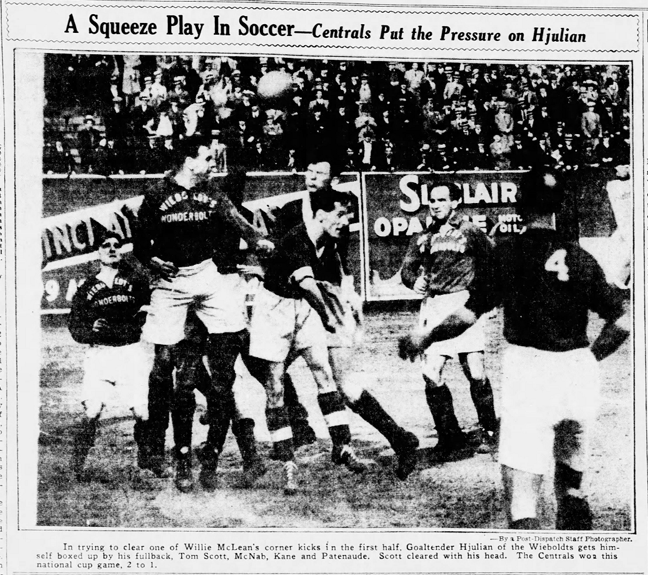
The Western Final (National Semifinals) of the 1934/1935 National Challenge Cup featured one of Chicago’s best teams from the first 30 years of the tournament against a St. Louis team that would form their own dynasty while some of its players continued the dominance they began 1,100 miles to the East in Fall River, Mass. What was scheduled to be a best of three games series played over three consecutive weeks turned into a five-game marathon encompassing 540 minutes and 29 days and would be one of the more memorable US Open Cup Semifinals in the competition’s history.
The Wieboldt’s Wonderbolts were originally the Bricklayers club from Chicago. Formally known as Bricklayers and Masons FC, the club got its start in 1914. The club participated in the second edition of the National Challenge Cup (1914/1915), falling in a Second Round game played in what was known as White Sox Park. The Bricklayers quickly became one of the strongest teams in the Midwest, though they were only able to reach the National Challenge Cup Final twice in 1928 and 1931. In 1934, the Bricklayers took on the name of Wieboldt’s, a Chicago area department store. “Wonderbolts” is what the store referred to its sale items in their ads.

Central Breweries got their start in 1929 as Hellrungs, sponsored by the Hellrung & Grimm House Furnishing Company. The team had little success under the Hellrung name, and in late 1931 found a new sponsor in Stix, Baer & Fuller, a St. Louis-area department store. In 1932, they would reach the National Challenge Cup Final, losing to the New Bedford Whalers. The core of the Whalers (formerly the Fall River Marksmen) would move to St. Louis in 1933 to join Stix. Future Hall Of Famers Bill McPherson, Werner Nilsen, Billy Gonsalves and Alec McNab would win five straight cup championships together from 1930-34, and Gonsalves and McNab made it six straight in 1935.
The format of the Western Finals was the best-of-three games series, something that was adopted for the Western Final in 1931. Drawn games after extra time would be replayed, which would have a major impact on the length of this series. The best-of-three format was scrapped after 1935 in favor of a more traditional two-leg aggregate goal series.
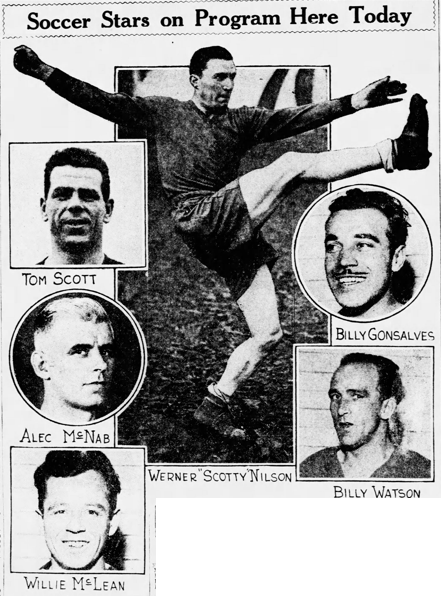
The teams met before in the 1934 Western Final, with Central (then Stix, Baer & Fuller) coming out on top 2 games to 1. In a year’s time, Werner Nilsen and Bill Watson would leave Stix to defect to the rivals in Chicago. No fewer than six future Hall of Famers were on the field during 1935 series: Werner Nilsen for Wieboldt’s, Jimmy Roe, Bert Patenaude, Billy Gonsalves and Alec McNab for Central, and former Ben Miller FC stand out Jimmy Dunn as one of the linesmen in the games played in St. Louis.
Game #1 – March 24, 1935 – Sportsman’s Park – St. Louis, Missouri
Over 4,000 spectators filed into St. Lous’ Sportsman’s Park for the opening game that Central would win 2-1. Willie McLean and Bert Patenaude scored in the opening half to give Central a 2-0 lead at halftime. It would wind up being the first of three separate 2-0 leads Central would have in the opening half and the only one it would hold on to. McLean was the first to score at the ten-minute mark. Central goalkeeper John Hamm kicked the ball downfield, which found its way to Bert Patenaude, who then crossed to an unmarked McLean who sent a shot out of the reach of Chicago goalkeeper Julius Hjulian. Five years earlier, Patenaude made history as the first player to ever score a hat trick at the World Cup when he scored three goals for the United States against Paraguay in the inaugural tournament in 1930.
Twenty-five minutes later it was Patenaude on the receiving end of a pass, this time from Alec McNab. Patenaude took a shot from just outside the penalty area and into the corner of the goal. The Wieboldt’s avoided the shutout with four minutes remaining when Bob Thompson took a free kick which dipped over the heads of the Central defenders and just under the crossbar. The Central defense shut down Werner Nilsen to the point that he hardly influenced the game.
Game #2 – March 31, 1935 – DePaul Field – Chicago, Illinois
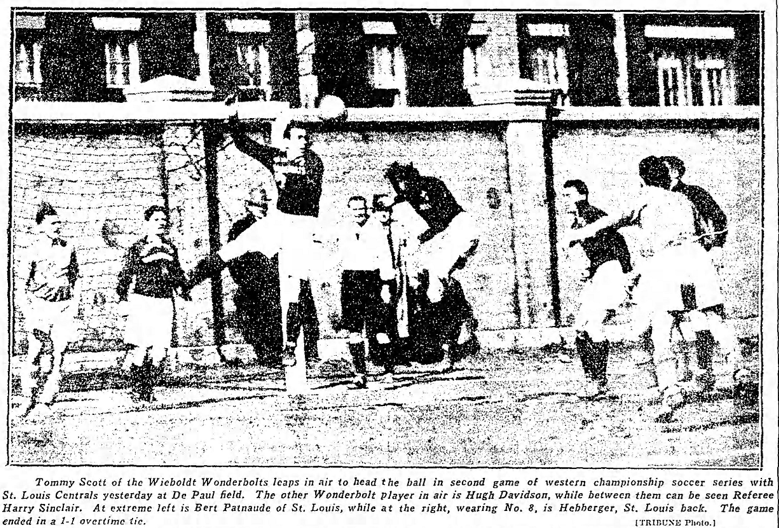
Game two is what stretched the series out to last nearly a month. The first attempt at the second game was played at Chicago’s DePaul Field a week later. Alec McNab told the St. Louis Post-Dispatch after the first game some Chicago players told the Central players “…that they were going to mop up on us up there in Chicago.” While striker Jimmy Lillie returned to the Wieboldt’s lineup, the home squad were forced to play without two other star forwards, Clem Cuthbert and Jimmy Munro. Central’s lineup was boosted by the return of Jimmy Roe, who had missed the opener due to the death of his father.
The only goals of the game came in the opening half, just minutes apart. Chicago struck first in the 28th minute when Jimmy Lillie scored after working the ball up the field with Hugh Hill and Bob Walker. Two minutes later, Alec McNab scored the tying goal for Central. The Chicagoans had chances from the penalty spot in each half, but each of Bill Watson’s attempts were stopped by Central goalkeeper John Hamm.
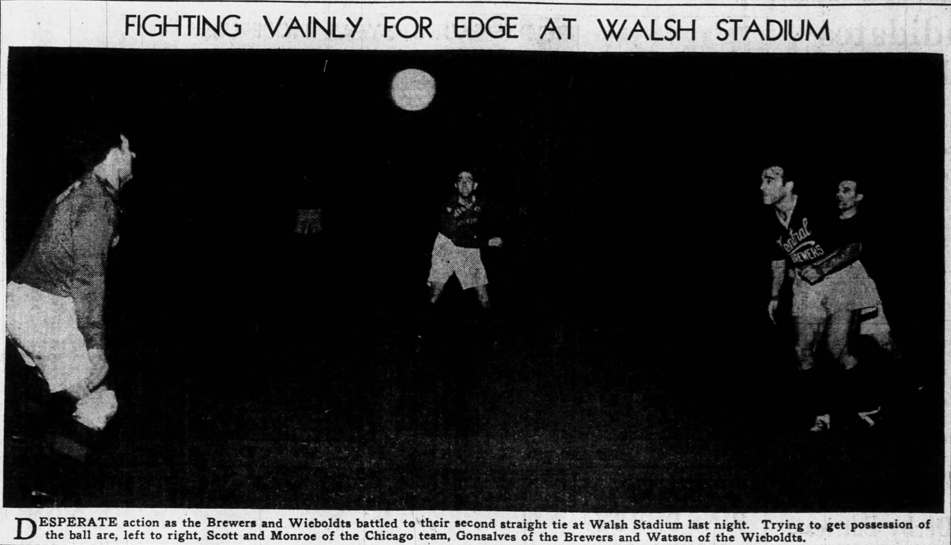
Game #2 Replay – April 6, 1935 – Walsh Memorial Field – St. Louis, Missouri
Due to Sportsman’s Park being in use by the St. Louis Cardinals baseball team, the replay of the second leg was set for an unusual Saturday night 8:15pm kickoff at Walsh Memorial Field in St. Louis. Davie Coutts of Wiebolt’s joined Cuthbert on the injured list, with Munro ready to return to action. Coutts injured a knee during the second game and had to be carried off the field.
Central raced out to a 2-0 lead midway through the first half when Bert Patenaude scored in the 28th minute, then sent a cross to Jimmy Roe a few minutes later to double the lead. About eight minutes before halftime Jimmy Munro crossed over to Bob Walker, who sent a hard shot past Hamm to halve the deficit.
Soon after the restart Jimmie Lillie tied the game off a pass from Werner Nilsen that left Lillie all alone in front of the goal when the Central defense was caught out of position. Central wasted no time regaining the lead when Billy Gonsalves intercepted a header from Hugh Davidson of Wieboldt’s and sent his shot past Chicago goalkeeper Julius Hjulian. Patenaude had a chance to score goal #4 for Central with a penalty kick but sent his shot well over the crossbar.
After assisting on the first tying goal, Nilsen did the honors to level the score once again. Just before full-time Nilsen took a pass from Bob Walker that left him two yards in front of goal, quickly taking a shot before a pair of Central defenders could close in. 30 minutes of scoreless extra time passed, and yet another replay would be needed for the second game.
Game #2, Second Replay – April 14, 1935 – Sparta Stadium – Chicago, Illinois
The second replay of the second game was set for Sparta Stadium in Chicago, a pitch that was larger and in better condition than DePaul Field. One major change was that the game was to be played to a finish, meaning additional extra time would be played if the game was still deadlocked after 120 minutes.
Just as they did in the previous game Central jumped out to a 2-0 lead in the opening half. Billy Gonsalves struck first after 30 minutes, picking up a loose ball 25 yards out and blasting a shot past Hjulian. Bert Patenaude followed with a goal about ten minutes later after a high pass from Alec McNab which was close to being offside.
Wieboldt’s came back again in the second half, this time through a pair of penalty kicks. The first came after Bill Lehman pushed Jimmie Lilie, after which Jimmy Munrocut cut the Central lead in half. About 15 minutes later, Harry Hebbedrger was called for a handball, and Munro once again scored from the spot.
After a scoreless 15 minutes of extra time, Wieboldt’s jumped in front in the 110th minute. Hugh Hill drove a hard shot Hamm, which appeared to be redirected by Central’s Bob Gregg and into the goal. The Chicago club nearly had a fourth goal, but it was nullified by an offside call.
Game #3 – April 21, 1935 – Walsh Memorial Field – St. Louis, Missouri
With each team holding a win in their pockets after 450 minutes of play over four matches the deciding game was finally at hand. Set for Walsh Stadium in St. Louis, the contest was once again ordered to keep going until one team won in an effort to end the marathon series.
Some off-the-field drama sprung up in the days leading up to Game 3. Wieboldt’s manager Billy Alexander claimed he was assaulted in the hotel room by Phil Riley of the Missouri State Football Association. Riley claimed the only other person in his room that night was his wife and no altercation took place. Referee Dave Evans was also attacked on the field after the last game. Talk of moving Game 3 to a neutral venue was put to rest by USFA Secretary James Armstrong, although police protection was promised for the Chicago club.
Both teams came prepared for a battle, and a battle it was. The St. Louis Star & Times described the game as one of the hardest-fought games seen in the Mound City, with a player knocked to the ground almost every five minutes. Central controlled most of the game, but the stout Wieboldt’s defense kept the Hall of Fame attack of Bert Patenaude, Billy Gonsalves, Alec McNab and Willie McLean at bay.
As the game continued scoreless midway through the second half, it seemed the teams would be destined to play forever. In the 68th minute, Bert Patenaude scored the goal that would ensure the marathon would end. With McLean to the left of the penalty area, he sent a high pass to Patenaude, who was waiting just in front if the goal. As goalkeeper Hjulian came out to try and kick the ball clear, Patenaude was able to outjump the netminder and deflect the ball with the back of his head into the corner of the goal.
Central held on for the remaining 22 minutes and after five games, 540 minutes and 29 days Central Breweries finally won the series two games to one and advanced to the Final, where they would have three more weeks of soccer ahead of them in defeating the Pawtucket Rangers to win their third championship in a row.
AFTERMATH
Wieboldt’s disbanded in mid-1936, and while a Bricklayers team would continue to compete in Chicago until 1947, the club bearing that name would never find prominence again.
Central Breweries would go on to win their third consecutive National Challenge Cup in 1935, defeating the Pawtucket Rangers of the ASL on a 7-6 aggregate over three games. The team would change names again to Shamrocks the following year, but their title reign would stop despite reaching the cup Final two more times in 1936 and 1937. Shamrocks would eventually disband in 1938, ending one of the most dominant runs in American soccer history.
Their run of six consecutive National Challenge Cup Final appearances is still a record, although the Seattle Sounders of Major League Soccer came close to matching it with five straight Finals appearances from 2009-2014. St. Louis’ dominance of the Open Cup would lay dormant until the 1950s, when Simpkins Ford Kutis Soccer Club would return St. Louis to the limelight.