• Skip to primary navigation
  • Skip to main content
  • Skip to primary sidebar
  • US Open Cup Central
  • US Open Cup Qualifying
  • US Open Cup History
  • Amateur Cup

Complete U.S. Open Cup Coverage

  • 2026 USOC Schedule
  • 2026 USOC Stat Leaders
  • 2027 USOC Qualifying Results
  • TheCup.us Awards
  • Join TheCup.us Patreon!
  • Contact Us

Dallas Roma FC

How amateurs Dallas Roma FC beat World Cup champs, an MLS team and it cost $75,000

June 14, 2018 by Adam Uthe

Dallas Roma FC poses for a team photo following the club's 1-0 home win over Miami FC in the Second Round of the 2006 US Open Cup. Photo: Dallas Roma FC
Dallas Roma FC poses for a team photo following the club’s 1-0 home win over Miami FC in the Second Round of the 2006 US Open Cup. Photo: Dallas Roma FC

Before NTX Rayados, There Was Dallas Roma FC.

There is something deep in the heart of (Dallas) Texas that seems to bring out the best of the Lamar Hunt US Open Cup. NTX Rayados, the Cinderella story of the 2018 tournament, have been an Open Division qualifier for the past seven years and they were finally able to tell their story on the national stage by winning three games, including a dramatic win over the Oklahoma City Energy, a pro team in the United Soccer League. Their story ended with a 5-0 loss to the Houston Dynamo of Major League Soccer (MLS).

But they are not the first Dallas-based amateur side to face an MLS team. That honor belongs to Dallas Roma FC, who not only faced a MLS team, but they eliminated one. Roma took down MLS’ Chivas USA on July 12, 2006, just three days after the conclusion of the 2006 FIFA World Cup. The two sides went to penalties after a scoreless 120 minutes and Roma won the shootout 4-2 behind two massive saves from goalkeeper Jesse Llamas. Dallas Roma would ultimately crash out in the next round against MLS’ Los Angeles Galaxy, but their entire 2006 run showed the country that there is talent at the grassroots level that, given the opportunity, could compete with the best MLS had to offer.

In the end, it was one of the greatest runs by an amateur team in the Modern Era of the US Open Cup.

Dallas Roma FC, which has evolved over the years into a youth club based in the Dallas suburb of Plano, first got started in 2000 when Michael and Dominic Schell got together with some local players who had aspirations of playing professionally and started playing competitively. The league they entered asked participating teams to name themselves after a popular European club and Michael went with his favorite Italian team at the time: A.S. Roma.

It wasn’t until 2005, when Dominic signed with the now-defunct DFW Tornados of the Premier Development League (PDL) and returned to Dallas after several stops around the professional scene, that Dallas Roma decided to take a shot at the US Open Cup. That year, Roma made it to the Second Round before being humbled by the USL’s Wilmington Hammerheads, 5-0. But the competition left the team hungry for more and they returned in 2006 with a belief that they were good enough to make some noise in the tournament.

After qualifying out of the USASA Region III tournament, the 2006 First Round saw Dallas Roma FC head south to take on the PDL’s Laredo Heat. They fell behind in the first half but equalized early in the second half when Dominic connected with Brad Flanagan in the 50th minute. In extra time, Laredo scored in the 106th minute, but Dallas second half sub John Calandro scored in the 116th minute to force the penalty shootout. Calandro, who earned the nickname “Little Johnny” because he was only a teenager at the time, really impressed Schell.

“I’ll never forget that goal,” he said, reflecting on the Round 1 result.

Goalkeeper Jesse Llamas, who saved five shots in the first 120 minutes, was ready to step up when his team needed him most.

“I always knew I was good at saving PKs,” Llamas said looking back on the win that started it all.

His teammates, however, made it easy for him as Matt Clark, Mark Rowland, Brad Flanagan, and Dominic Schell all converted their penalties. Jesus Sanchez and Steve Su missed their respective kicks on the back end and Dallas prevailed 4-2 in the shootout.
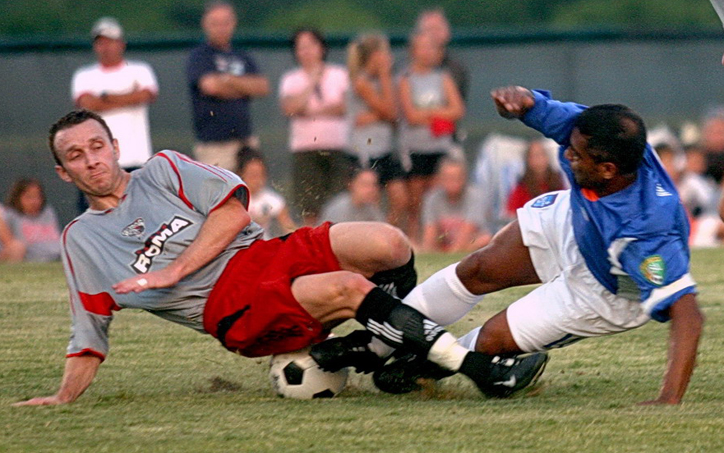
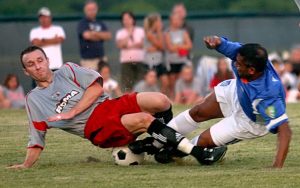
Kiley Couch of Dallas Roma FC (left) challenges for the ball against Romario of Miami FC during their Second Round match during the 2006 US Open Cup. Photo: Dallas Roma FC

Despite the fact that they were chosen to host in Round 2, the team faced a tall task in the next round as they prepared to take on USL side Miami FC, who trotted out the aging, but revered, World Cup champions from Brazil: Romario and Zinho. While the pair were well past their prime, they were still a force in the league, helping Miami qualify for the USL First Division playoffs. Romario, at the age of 40, tied for the league lead in goals with 18 and he, along with the 39-year-old Zinho, was named to the league’s Best XI.

Dominic recalls how the difference in conditioning stood out more than anything else against an older Miami FC squad.

“That was a gut-wrenching game,” said Schell. “We were trying to train as hard as we could. We were just not in shape the way they were. Conditioning-wise it was a different world.”

Llamas was confident the team could get the result.

“We knew they were going to have a really good team. If we could just keep the game in front of us … we’d be fine.”

Fortunately for Dallas, they earned a golden opportunity early in the first half when Dallas earned a 12th minute free kick. Dominic, who focused his limited training time on becoming the team’s designated set piece specialist, stepped up to take a free kick just outside the box. Romario blocked it, but was whistled for a handball and Dallas was awarded a penalty.

Dominic points out that the team had a rule in place that said the player who earns the penalty never takes it. He still uses that rule with the youth teams he coaches today. The logic behind it is that the player who earned the penalty is, presumably, feeling a burst of adrenaline and a cooler head is needed. The rule won out that day. Jon Waters, who had never missed a penalty kick in his entire soccer career to that point, stepped up to the spot. Waters converted to give the home side the early lead in front of roughly 350 fans at the University of Texas at Dallas.

Just as Llamas predicted, as the game wore on, the home side settled in and managed to keep Miami in front of them defensively. Despite a 15-1 advantage in corner kicks, Miami would only register nine shots, six of which Llamas was able to save. Llamas recalls feeling comfortable due to his own familiarity with Romario.

“I remember watching Romario, seeing him play. I’ve seen this guy. I know what he likes to do, his tendencies.”, he said while discussing several moves he remembers the Brazilian attempting throughout the match.

Like any good teammate, Llamas also credited his defense. In the Miami game specifically, he recalled Flanagan’s hustle at the left back spot helping to contain the Miami attack.

“He would just work his tail off,” Llamas said.

Dominic went so far as to say that by the 30th minute, Dallas had “figured them out”.
RomaThey may well have, but the box score also tells the story of a cagey affair; the kind typically associated with shocking Open Cup upsets. The two teams combined for 41 fouls and seven yellow cards. Then, Miami eventually came undone when Michael Erush and substitute Fabian Sandoval were sent off with straight red cards in the 77th and 82nd minutes, respectively.

For their effort, the entire Dallas Roma defense was awarded TheCup.us (formerly USOpenCup.com) Player of the Round award. The honor is normally reserved for individuals, but a rare exception was made considering the team effort that was required to shut out the top offensive team in the USL First Division.

With a two-man advantage, Dallas held on and a date with MLS’ Chivas USA awaited in Round 3.

With a shocking upset against a professional side under their belt, Dallas suddenly found themselves in unfamiliar territory. At that time, part of the process to apply for hosting a round included submitting a financial bid to help sway the USSF – almost as a tiebreaker in case of two valid bids. The Open Cup commissioner would then make a final decision. Michael Schell admits his team did not actually submit to host, but he was also pessimistic that USSF would actually take them seriously, especially after they’d spoiled the attractive prospect of Miami FC and Romario taking on a MLS side. As a result, he had to find a way to get his team to Santa Barbara, Calif. for the Round 3 showdown.

By now, the team had been training four days a week at 7 a.m. for several weeks. The early start time was meant to help the players, most of whom had full-time jobs and had to get to work on time. Dominic felt it was paying off as the team prepared to make history.

“We were well-prepared for that game, but we knew it would be very, very difficult.”, said Schell, who likely didn’t need the training as much as some of the other players.

Dominic Schell was drafted by the Columbus Crew in the fifth round of the 2000 MLS SuperDraft, but only made seven appearances in his rookie campaign and was ultimately loaned out twice that same year. In 2001, he signed with the Nashville Metros, but lasted just one year. In 2002, he came back to Texas and ended up finally settling down for three seasons with the El Paso Patriots before making his way back to Dallas.

Dominic doesn’t lament the path his career took, noting how paltry the MLS league minimum salary was back then. For him, it just wasn’t feasible to raise a family making less than $20,000 a year. By the time he ended up with Dallas Roma, he had carved out a steady career and was playing with Roma to stay in shape between seasons.

By the time the Third Round began, the entire team began to feel confident that they could go toe-to-toe with a team from the first division. And players like Dominic felt they had a chip on their shoulder.

This Chivas USA team, led by future US Men’s National Team coach, and two-time US Open Cup champion Bob Bradley, was not taking the amateurs from Dallas lightly.
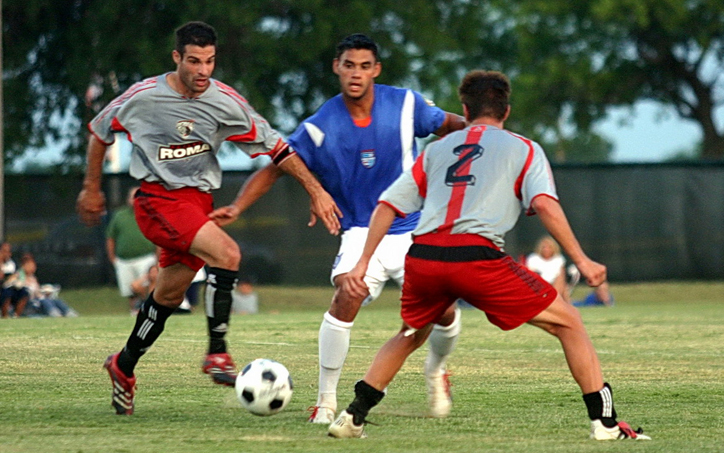
Dominic Schell of Dallas Roma FC dribbles the ball against Miami FC during the 2006 US Open Cup Second Round match as teammate Beau Brown (No. 2) looks on. Photo: Dallas Roma FC

A few role players are expected when a MLS team takes on an amateur team, but the Chivas starting lineup featured promising second-year goalkeeper Brad Guzan, who made his US National Team debut earlier in the year. A pair of World Cup veterans, Carlos Llamosa (United States) and Claudio Suarez (Mexico) anchored the backline and the rest of the starting eleven featured future US internationals like Jonathan Bornstein and Sacha Kljestan. Ante Razov, one of the most prolific strikers in MLS history led the front line. They even brought players like Tim Ream, Juan Francisco Palencia, and Jesse Marsch off the bench.

As the teams were preparing to start the game, one of Dallas Roma’s most experienced players, Juan Sastoque, had a surprise reunion before kickoff. Sastoque, who was the only player on the roster to win the US Open Cup (1997 Dallas Burn), noticed that on the other side of the field was Orlando Perez, a childhood friend. Sastoque said he had no idea that Perez had signed with Chivas USA, which made the game they were about to play a little more special.

As the game progressed, Michael Schell felt that he had outfoxed the MLS side. Although Chivas recorded 22 total shots in the game, Llamas was only forced into two saves. Dominic also chimed in, noting that he remembers most of the shots being rushed from well outside the box and, as a result, never really troubling his goalkeeper.

As for Llamas, he credits 38-year-old Todd Paulette, the wily veteran who played as both a defender and holding midfielder for Dallas, and whose performance, and his constant pressure frustrated Razov to the point where the star striker head-butted Paulette and earned himself a red card in the 57th minute.

That’s when everything seemed to turn for Dallas.

Michael confidently suggests that he outcoached Bradley on the sideline. He points specifically to Bradley waiting until after Razov’s red to make his first substitution. But Bradley didn’t just make one substitution; he used three of the four that the teams were allowed in Open Cup play. One of his subs was Mexican international Juan Francisco Palencia, who currently coaches UNAM Pumas in LigaMX. The other two were regular starters Jesse Marsch and Tim Regan.

Schell feels his team had the upper hand at that point and laments that they were unfortunate not to have gotten the win late in regulation or in extra time. With no late goals, the game went to a penalty kick shootout.

Dominic agreed that his brother was the better coach that day.
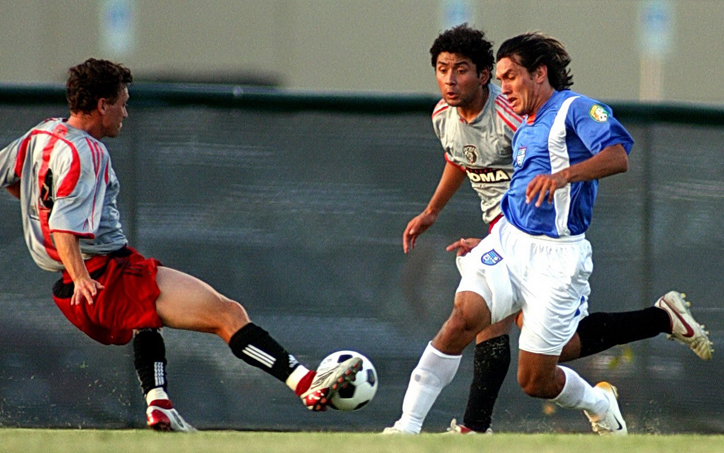
Wilco Ravestijn of Dallas Roma FC plays the ball against Miami FC as teammate Alex Funez looks on in their Second Round match in the 2006 US Open Cup. Photo: Dallas Roma FC.

“They didn’t really get behind our defense,” he pointed out in an interview separate from his brother’s.

Dominic went to oversee the coin toss for his side and made a mental note that Llamas was looking particularly confident. When Dallas won the coin toss, Schell looked at Llamas, who boldly told his captain to let Chivas shoot first so he could save their first shot. Llamas, who says he never made a habit of such demands during his career, did the same exact thing in Round 1. He hadn’t come through on his promise then, but it didn’t matter as his team still advanced. This time, however, something different was happening.

“It was just one of those nights where I knew I was going to save everything. It was just one of those special nights,” said Llamas about that fateful night.

Sure enough, Palencia stepped up to take the first shot and Llamas made good on his proclamation.

“I read him like a book,” said Lalmas, chuckling to himself as he describes the events of the shootout.

It was 2-1 after Paulette and Sastoque scored for Roma and Kljestan converted for Chivas. When Jesse Marsch, a three-time MLS Cup and four-time US Open Cup champion stepped up to take Chivas’ third penalty, Llamas felt less confident, but he still made the save.

“Somehow I got to it,” he said, noting that Marsch struck his attempt well and made it count.

That was all Llamas would have to do on his end. After Mark Rowland scored and Claudio Suarez cut the lead to one in the fourth round, Dominic Schell stepped to the spot the scored the winning penalty to advance by a 4-2 margin in the shootout.

After basking in the glow of the victory in the locker room, Roma went back to their hotel room only to discover that they were, by some coincidence, staying at the same hotel as their MLS opponents. According to Jon Waters, this made for an awkward encounter as some of the Roma players were out front of the hotel enjoying some celebratory beers when the Chivas USA team bus arrived to drop off the defeated players. Waters recalls that some a few comments were directed at the Chivas players but no additional drama carried over.

Up next was another trip to Southern California for a Fourth Round matchup against the Los Angeles Galaxy.

One of the biggest improvements in recent years to the US Open Cup has been US Soccer’s dedication to helping smaller clubs, like Dallas Roma and NTX Rayados, cope with the expensive travel costs. Schell laments the fact that he only got $7,500 of financial assistance for the entire tournament from US Soccer Federation back in 2006. He paid for the rest the only way he could think of: he put everything on a credit card. When asked for an estimate for how much the entire tournament cost him, he doesn’t even hesitate.

“I won’t forget – it was $75,000.”

He did get small donations here and there from individuals as the team went further into the tournament and generated more buzz, but he was more than willing to pay for the majority himself.

dallas-roma-fc-logo“The memories are worth more than the cost,” Schell said. “After it was all said and done I just slowly paid it off. I didn’t ask anyone for money. I didn’t receive any other cash after it was done.”

By now, the national media was starting to take note of Dallas Roma’s story. The New York Times was interviewing Michael Schell about Dallas Roma FC and shining a national spotlight the Open Cup itself. The timing was perfect, considering this all took place during the same summer as a World Cup, although the US was unceremoniously eliminated in group play that year. Still, everyone had soccer on their mind and Dallas Roma’s story was the perfect opportunity to raise the sport’s profile.

However, as the Times article noted, not everyone was excited about Dallas’ run. Former US international and current TV pundit/firebrand Alexi Lalas was the general manager of the Galaxy at the time and he told the team’s website exactly what he thought of his team’s upcoming opponent.

“We’ve all been captivated by the Cinderella story that is Roma F.C., but the fairy tale is about to come to an abrupt end. We look forward to hosting the overachievers from Texas in the next round and exposing them to a quality M.L.S. side.”

Schell, who still to this day has plenty of strong opinions about MLS, didn’t take kindly to the comments back then.

“He’s already talking trash,” Schell said, speaking to the Times. “They’re supposed to beat us, but a lot of our guys are out to prove a point that a lot of M.L.S. teams are not looking hard enough for the good players. They’re looking for the young players who will take $27,000 a year to start out.”

Schell’s feelings on that particular subject are the same today as they were 12 years ago.

“At that time, nobody was trying to play in MLS because there was no money there,” he Schell laments as he mentions his brother’s troubles after being drafted by the Columbus Crew.

Unfortunately, the Schells and Dallas Roma FC would not be able to stick it to Lalas and the Galaxy. Quevas Kirk and Alan Gordon scored in the first and second halves, respectively, and the MLS side prevailed. Dominic probably said it best when he tried to summarize the game.

“It was just a strange game.”

For starters, and what many Dallas Roma players would say was one of the biggest changes was that Jesse Llamas did not play in the game.

Llamas’ wife had gone into labor with their first child and even though he had actually prepared to take a separate flight and join his teammates in Los Angeles, the timing did not work out. The Llamas family welcomed a baby boy into the world on the same day that Dallas Roma’s fairy tale run ended.

To attempt to replace their standout performer from the first three rounds, Michael Schell and Co. turned to retired Argentine goalkeeper Nestor Merlo. Merlo, who was 46 at the time, had played hundreds of league games in his home country including for teams like Boca Juniors and had wrapped up his professional career five years earlier in 2001.

Merlo was still in excellent shape so he seemed like as good a choice as any for a last-minute replacement. But like Dominic said: it was a strange game.

While neither harbors any ill will toward Merlo, the Schell brothers both chalked up the loss to his performance.

The Galaxy opened the scoring in the 34th minute when Galaxy rookie Quavas Kirk floated a shot past Merlo from the top of the penalty box. In conversations with multiple players for this story, many of them expressed the opinion that it was a save that Llamas likely would have made.

To make matters worse, Merlo suffered an injury in the second half after crashing his head into one of the goalposts while making a save. He remained in the game but there was concern about his fitness.

Merlo claims that the blow to the head did not factor in the Galaxy’s second goal, but it was his mistake that gave the ball to the MLS side. Merlo received a back pass from one of his defenders and was immediately put under pressure by the Galaxy’s young forward Alan Gordon. Merlo tried to dribble out of trouble but had his pocket picked by Gordon and he put the ball into the back of the net.

Gordon described the the goal to the LA Times after the game.

“I thought he was going to kick it away,” Gordon said. “Maybe his legs aren’t as quick as they used to be.”

Outside of the first half goal and the mistake on the back pass, Roma held their own against the defending MLS Cup and US Open Cup champions. Los Angeles outshot them 20-8.

For many of the players, they just ran out of gas in the second half.

“Fitness was our biggest issue,” said Roma attacking midfielder Beau Brown. ”Many of us were so used to playing indoor soccer, so we were fit for the indoor game … but we were just a bunch of ex-pros and coaches and guys who had day jobs … so after we competed well for the first 45 minutes , we just ran out of steam.”

“That was a frustrating one. Out of all the games, that was the one game we should’ve won in regular time.”, Dominic sighed. “It was a hard game to lose.”

His brother Michael concurred.

“We probably would have won that game and gone even further – we were playing really well.”

Jon Waters’ also wonders what might have been.

“If Jesse was in there, the Galaxy game would have been interesting,” said Waters, who is currently a coach in the FC Dallas youth academy system. “I’m not saying we would have won, but it sure would have been interesting.”

Dallas Roma is largely viewed by many as one of the best Open Cup runs of the Modern Era. Many of the players credit Michael Schell for bringing together this team of so many strong personalities.

“There were so many coaches on that roster,” said Brown. “It was often a ‘too many cooks in the kitchen’ situation, but Michael made it work somehow.”

Today, the tournament awards a $25,000 cash prize to the open division team that advances farthest into the tournament. Back in 2006, the prize money was just $10,000, and that would have meant a solid consolation prize for Dallas Roma, but the rules were different back then. At that time, if multiple teams advanced to the same round, the prize money was awarded based on “strength of schedule”. Despite being the only amateur team to beat an MLS side, Dallas was forced to share the $10,000 prize with PDL’s Carolina Dynamo.

Both teams defeated a PDL team in Round 1, but Carolina also managed to win its games against the Richmond Kickers (USL Second Division) and the Seattle Sounders (USL First Division) in regulation, while Dallas Roma’s penalty shootout win over Chivas was officially recorded as a draw, as is common practice through the sport. As a result, US Soccer determined the two should split the money.

For what it’s worth, the money doesn’t bother Michael anymore.

“I’m not as mad about it anymore. It was 12 years ago.”

It’s the thought of what might have been that really haunts him to this day.

“The more (the Dallas Roma players) played, the more they started to feel it. You put a team like that together and all of a sudden you make a run. We were better than those teams (Chivas and LA Galaxy) individually.”, he said noting that he felt his side could’ve made the final that year.

Dominic concurred with that last part, revealing that several Galaxy players told him as much after the game. For the Schells, Michael especially, it was a missed opportunity to show the country that there’s more to American soccer than MLS.

He also notes that after their run ended, FC Dallas invited them to play in an “alumni match” against some former FC Dallas players. Dominic hoped the game would get some exposure for Dallas Roma players who still had a shot playing professionally. When they showed up for the match, FC Dallas was actually fielding some of their reserves and even a few first team players. Dallas Roma won the game 4-1 and, according to Michael, the FC Dallas staff did not take it well. That was the last time the two teams met in an organized match.

Dallas Roma did attempt to qualify in 2007, but it was largely a new group that did not include Llamas and they fell one game short of returning to the tournament. They lost a “Win & You’re In” group stage match 4-0 to Lynch’s Irish Pub (Fla.) and the team would fizzle out from there.

At that point, no one was willing to carry on.

“It just wasn’t the same.”, said Michael. “I personally, was like ‘I’m done’. It’s so much work .”

The two brothers have taken that same fire that once spurred them to compete directly against MLS and channeled it into the Dallas Roma FC youth club that exists today. They don’t just resent MLS for paying paltry entry salaries back in the day. They also believe the league has dropped the ball in terms of player development and they want to give every kid who comes to them a chance to develop into the next great American soccer player.

“It’s been pretty cool. We’re going into our fifth year and it’s still growing,” Michael said of the current setup.

Llamas, meanwhile, has also gotten into coaching. He’s a junior director with local mega club Solar and both of his sons are active in the youth scene and often play against other children of Dallas Roma FC players. They seem to have picked up right where their dad left off.

When asked about the current run by NTX Rayados, Llamas says he’s late to the party but very excited for them.

“Yeah I just heard about this last week ,” said Lalmas. “That’s pretty awesome.”

Dominic Schell had not heard the news, but also isn’t the least bit surprised given how involved he is in the local soccer scene in Dallas.

“I didn’t know it was here in Dallas, but I am not surprised,” said Schell. “There is phenomenal talent here in Dallas that doesn’t get seen.”

Michael Schell knew several players who used to play for NTX Rayados in the past, but doesn’t know anyone on the current squad. Speaking before the Rayados’ match against the Dynamo, he was hoping they could duplicate the magic Dallas Roma FC produced 12 years ago, but he also knows firsthand how much of an uphill task it is.

“I hope they can pull it off – that would pretty cool. It’s just not that easy.”

Josh Hakala also contributed to this story

Filed Under: Feature - History, Feature - Main, US Open Cup, US Open Cup History Tagged With: 2006 US Open Cup, Chivas USA, Dallas Roma FC, Laredo Heat, Los Angeles Galaxy, Miami FC

Things you should know about the Second Round of the US Open Cup (Modern Era)

May 17, 2016 by Josh Hakala


FC Cincinnati fans cheer on their team during a Second Round match in the 2018 US Open Cup against Detroit City FC. Photo: Brett Hansbauer | 4th Floor Creative

In 2002, no team below the Second Division advanced beyond the Second Round.

The Modern Era (1995-present) record for single-game attendance is held by FC Cincinnati when they had an announced attendance of 12,790 at Nippert Stadium (University of Cincinnati) when they defeated AFC Cleveland (NPSL) 1-0 in extra time on May 17, 2017. The record for average attendance in the Second Round is 3,019 (16 games) from the 2001 tournament.

The El Paso Patriots recorded the biggest rout in the Second Round since 1995, defeating the Arizona Sahuaros 9-1 in 1998. Kirk Wilson scored three times to lead the Patriots. Matching the eight-goal margin, the most lopsided shutout came in 2001 when DC United of MLS trampled the New Jersey Stallions of the D3 Pro League 8-0.

Kiley Couch of Dallas Roma FC (left) challenges for the ball against Romario of Miami FC during their Second Round match during the 2006 US Open Cup. Photo: Dallas Roma FC

From 1996-2013, only three Open Division Local clubs won Second Round games. Bavarian SC defeated the Reading Rage (D-3 Pro League) 1-0 in the Second Round of 2003. Dallas Roma FC became the first USASA team to defeat a second division team when they eliminated Miami FC (USL First Division) 1-0 in 2006. Cal FC traveled across the country and upset the Wilmington Hammerheads of USL Pro (Div. 3 pro) 4-0 to reach Round 3 in 2013. However, in 2014, that mark was blown out of the water, as a record five Open Division Local teams reached the Third Round: New York Greek American Atlas (Region I), RWB Adria (Region II), North Texas Rayados (Region III), Des Moines Menace (Region II), and PSA Elite (Region IV) who advanced after the San Diego Flash forfeited. The reason for this increase was due, in large part, to the change in format which saw an increase to 80 teams, and an abbreviated opening round (8 games). Of this group, only RWB Adria and PSA Elite began in the First Round, so the rest of the teams only had to win one game.

Open Division teams winning Second Round games doesn’t happen often, but it’s not unheard of during the Modern Era. 41 USL League Two (formerly PDL) teams have made it to the Third Round in the Modern Era. The Flint City Bucks (formerly Michigan Bucks) have done it more than anyone else, advancing to Round 3 six times. 19 Open Division Local teams have reached the Third Round. The NPSL has had nine teams win Second Round games, with four of them all coming in 2018: Brooklyn Italians (2014), Chattanooga FC (2014, 2015, 2016), Elm City Express (2018), Miami United (2018), FC Wichita (2018), Jacksonville Armada (2018), Orange County FC (2019).

The US Soccer Federation increased the number of teams to 80 in 2014, creating the largest Second Round in the Modern Era (and quite possibly of all time) with 24 games on the schedule. One of the games was forfeited, and one was moved to May 13, leaving a record 22 games to be played on May 14. That record was broken as the tournament continued to expand in 2017 when there were 26 games played, and then again in 2022 when 31 games were on the schedule.

In 2013, a record four Open Division clubs advanced to Round 3. The following year, due to a change in format and an increase in amateur entries, 12 amateur clubs reached the Third Round, which remains a Modern Era record.

1997: Central Coast Roadrunners
1999: Mid-Michigan Bucks
2000: Mid-Michigan Bucks, Chicago Sockers
2001: Seattle Sounders Select
2003: Mid-Michigan Bucks, Fresno Fuego
2004: Chicago Fire Reserves, Cape Cod Crusaders, Boulder Rapids Reserves, Carolina Dynamo
2005: Ocean City Barons, Des Moines Menace
2006: Michigan Bucks, Des Moines Menace, Carolina Dynamo
2009: Ocean City Barons
2011: Chicago Fire PDL, Kitsap Pumas
2012: Michigan Bucks, Ventura County Fusion,
2013: Des Moines Menace, FC Tucson, Ocean City Nor’easters, Reading United AC
2014: Reading United AC, New York Greek American Atlas SC, RWB Adria, Orlando City U23s, Brooklyn Italians, Laredo Heat, North Texas Rayados, Fresno Fuego, PSA Elite, Baltimore Bohemians, Chattanooga FC, Des Moines Menace
2015: Chattanooga FC, Chula Vista FC, Jersey Express, PSA Elite, Ventura County Fusion
2016: Chattanooga FC, Des Moines Menace, Jersey Express, Kitsap Pumas, La Maquina, Lansdowne Bhoys FC, Los Angeles Wolves FC
2017: Chicago FC United, Christos FC, GPS Omens, Los Angeles Wolves FC, Michigan Bucks, Reading United AC
2018: Elm City Express, FC Golden State Force, FC Wichita, Jacksonville Armada FC, Miami United, Mississippi Brilla FC, NTX Rayados, Ocean City Nor’easters, Sporting AZ FC
2019: Florida Soccer Soldiers, Orange County FC

Updated after 2019 US Open Cup

Filed Under: US Open Cup, US Open Cup History Tagged With: Arizona Sahuaros, Bavarian SC, Boulder Rapids Reserves, Cape Cod Crusaders, Carolina Dynamo, Central Coast Roadrunners, Chicago Fire PDL, Chicago Sockers, Dallas Roma FC, DC United, Des Moines Menace, El Paso Patriots, Fresno Fuego, Kirk Wilson, Miami FC, Michigan Bucks, New Jersey Stallions, Ocean City Barons/South Jersey Barons, Reading Rage, Seattle Sounders Select, Tampa Bay Mutiny, Things You Should Know, Worcester Wildfire

Fourth Round fun facts: Notable upsets, things you should know about Round 4

May 23, 2014 by Josh Hakala

Players from the Houston Dynamo (orange) and NTX Rayados battle for the ball in their Fourth Round match in the 2018 US Open Cup. Photo: Jose Castellanos | Prost Amerika

The US Open Cup has only had a Fourth Round (prior to the Quarterfinals) 12 times in the Modern Era (2003, 2004, 2005, 2006, 2012-22).

The first indoor game in US Open Cup history took place in the Fourth Round. On July 20, 2004, the Minnesota Thunder hosted the Los Angeles Galaxy at the Hubert H. Humphrey Metrodome in Minneapolis, Minn. The Thunder upset the Galaxy that day 1-0, in front of 5,505 fans. Defender Chris Brunt scored the game-winning goal in the 21st minute.

No Open Division team in the Modern Era has ever advanced beyond the Fourth Round

Only 7 USL League Two (PDL) teams have advanced to the Fourth Round, all but one have faced MLS teams
2018: FC Golden State Force (lost 3-1 at Los Angeles Galaxy)
2016: Kitsap Pumas (lost 2-0 at Seattle Sounders FC)
2014: Laredo Heat (lost 1-0 at Houston Dynamo)
2014: Orlando City U23s (lost 3-0 at Portland Timbers)
2012: Michigan Bucks (lost 2-1 AET vs. Dayton Dutch Lions)
2006: Carolina Dynamo (lost 4-2 vs. Houston Dynamo)
2005: Des Moines Menace (lost 6-1 vs. Kansas City Wizards)
2003: Fresno Fuego (lost 3-1 vs. Los Angeles Galaxy)

Only 6 Open Division Local (USASA) teams have advanced to the Fourth Round
2018: NTX Rayados (lost 5-0 at Houston Dynamo)
2017: Christos FC (lost 4-1 at D.C. United of MLS)
2016: La Maquina (lost 4-1 AET at Los Angeles Galaxy of MLS)
2015: PSA Elite (lost 6-1 at Los Angeles Galaxy of MLS)
2014: PSA Elite (lost 5-0 at Seattle Sounders of MLS)
2012: Cal FC (lost 5-0 at Seattle Sounders of MLS)
2006: Dallas Roma FC (lost 2-0 at Los Angeles Galaxy of MLS)

Only 2 NPSL teams have advanced to the Fourth Round
2019: Orange County FC (lost 3-0 at Los Angeles Galaxy)
2018: Miami United FC (lost 3-0 vs. Orlando City SC)

In 2006, only teams from Major League Soccer emerged from the Fourth Round.

The Harrisburg City Islanders (USL Pro) won a Fourth Round game in 2012 by upsetting the New York Red Bulls 3-1 after extra time. Photo: Harrisburg City Islanders

The Chicago Fire did not lose a Fourth Round game until 2019 when they lost to Saint Louis FC. Prior to that, they had a 7-0-2 (2-0 PKs) record.

Major League Soccer began playing in the tournament in the Fourth Round for the first time in 2014 as part of an expanded format.

The attendance record in the Modern Era was set in 2013 when Sporting Kansas City (MLS) hosted Orlando City SC (USL PRO) at Sporting Park in front of an announced attendance of 15,981. Thanks to that figure, the record for Fourth Round average attendance was broken with 6,887 across the eight games. Sporting Kansas City later broke their own record in 2015 when they hosted and defeated Saint Louis FC (USL) 1-0 on June 16, 2015 in front of an announced crowd of 19,298. FC Cincinnati shattered that record in 2017 when they drew 30,160 to Nippert Stadium to watch them upset the Columbus Crew (MLS), 1-0.

In 2014, with Major League Soccer not entering the tournament until Round 4, a record three amateur teams (Laredo Heat, Orlando City U23s, PSA Elite) advanced beyond the Third Round, followed by five amateur teams reaching the Fourth Round in 2015.

Notable upsets in the Fourth Round

2003: Wilmington Hammerheads (PSL) 4:1 Dallas Burn (MLS)
2003: Seattle Sounders (A-League) 1:0 San Jose Earthquakes (MLS)
2004: Charleston Battery (A-League) 1:0 Metrostars (MLS)
2004: Rochester Raging Rhinos (A-League) 1:1 New England Revolution (MLS) (ROC advances on PKs 3-1)
2004: Richmond Kickers (PSL) 2:1 DC United (MLS)
2004: Minnesota Thunder (A-League) 1:0 Los Angeles Galaxy (MLS)
2005: Rochester Raging Rhinos (USL-1) 3:1 Metrostars (MLS)
2005: Minnesota Thunder (USL-1) 4:1 Colorado Rapids (MLS)
2006: None
2012: Harrisburg City Islanders (USL PROro) 3:1 (AET) New York Red Bulls (MLS)
2012: Charlotte Eagles (USL PRO) 2:1 (AET) San Antonio Scorpions (NASL)
2013: Carolina RailHawks (NASL) 3:1 (AET) Chivas USA (MLS)
2013: Orlando City SC (USL PRO) 1:0 Sporting Kansas City (MLS)
2014: Atlanta Silverbacks (NASL) 2:1 Real Salt Lake (MLS)
2014: Carolina RailHawks (NASL) 1:1 (3:2 PKs) Chivas USA (MLS)
2014: New York Cosmos (NASL) 3:0 New York Red Bulls (MLS)
2014: Rochester Rhinos (USL) 1:0 DC United (MLS)
2015: Charlotte Independence (USL) 1:0 New England Revolution (MLS)
2015: New York Cosmos 2:2 (4:3 PKs) New York City FC (MLS)
2016: New York City FC (MLS) 0:1 New York Cosmos (NASL)
2016: D.C. United (MLS) 0:0 (3:4 PKs) Fort Lauderdale Strikers (NASL)
2017: Columbus Crew (MLS) 0:1 FC Cincinnati (USL)
2017: Miami FC (NASL) 3:1 Orlando City SC (MLS)
2017: Sacramento Republic FC (USL) 4:1 Real Salt Lake (MLS)
2018: Louisville City FC (USL) 3:2 New England Revolution (MLS)
2018: Nashville SC (USL) 2:0 Colorado Rapids (MLS)
2018: Sacramento Republic FC (USL) 2:1 (AET) Seattle Sounders FC (MLS)
2019: Saint Louis FC (USL-C) 2:1 Chicago Fire (MLS)
2019: Colorado Rapids (MLS) 2:2 (2:4 PKs) New Mexico United (USL-C)
2022: None

Filed Under: Feature - Main, Featured Post - Main, US Open Cup, US Open Cup History Tagged With: Carolina Dynamo, Charleston Battery, Chicago Fire MLS, Colorado Rapids, Dallas Roma FC, DC United, Des Moines Menace, FC Dallas/Dallas Burn, Feature, Fourth Round, Fresno Fuego, Houston Dynamo, Los Angeles Galaxy, Minnesota Thunder, New England Revolution, New York Red Bulls/Metrostars, Richmond Kickers, Rochester Rhinos, San Jose Earthquakes/San Jose Clash, Seattle Sounders USL, Sporting Kansas City/Kansas City Wizards, Things You Should Know, Wilmington Hammerheads

Notable upsets in the Third Round of the US Open Cup

May 22, 2014 by Josh Hakala

The Michigan Bucks upset the Chicago Fire of MLS in 2012 Third Round. Photo: Kelly Haapala

MORE: Things you should know about the Third Round of the Lamar Hunt US Open Cup

2006 – Dallas Roma FC (USASA) 0:0 Chivas USA (MLS)
(Dallas advances 4-2 in PKs)

For all of you who ever wanted the #16 seed to win in the NCAA basketball tournament, we hope you are soccer fans.

Dallas Roma FC, from the North Texas Premier Soccer Association, made history defeating Chivas USA of Major League Soccer on penalties, after playing to a 0-0 draw after extra time. Not only did they defeat their second straight professional opponent in the US Open Cup, they became the first USASA club to eliminate a team from Major League Soccer in the US Open Cup. Chivas was dealt a major blow when their leading scorer, Ante Razov, was sent off in the 57th minute for a reckless foul on Roma defender Todd Paulette. Soon after, Chivas head coach Bob Bradley sent in more of his regular starters, Jason Hernandez, Tim Regan and Juan Francisco Palencia.

The Roma defense, named TheCup.us Players of the Round for their win vs. Miami FC, held firm yet again against the Chivas attack, holding the scoreless draw through 120 minutes, at times keeping all 11 players in their own end in extra time.

Roma had a few chances in the second half as well, most notably Dominic Schell hitting the crossbar after Mark Rowland’s shot was knocked away by Chivas goalkeeper Brad Guzan.

Chivas took the first spot kick in the penalty session, and Juan Francisco Palencia saw his attempt saved by Jessie Llamas. Roma’s Matt Clark and Mark Rowland converted the next kicks, as Sacha Kljestan for Chivas. Fortunes turned Roma’s way when Llamas came through again and saved Jesse Marsch’s kick, and Brad Flanagan scored for Roma to make it 3-1. After Claudio Suarez made it 3-2, Dominic Schell stepped up and put Roma in the history books. Previously, the closest a USASA side has come to defeating an MLS club was in 2000, when Florida’s Uruguay SC fell to the Tampa Bay Mutiny 1-0 in extra time.

1997 – Chicago Stingers (D3 Pro) 2:1 Colorado Rapids (MLS)
1997 – San Francisco Bay Seals (D3 Pro) 2:1 Kansas City Wizards (MLS)

The Modern Era of the Open Cup was still young, and Rochester caused a stir in ’96 with their amazing run to the final.

The San Francisco Bay Seals and Chicago Stingers were determined to top that, and top it they did.

Each team made their way to the third round, no small feat in itself. Both clubs defeated A-League sides in the second round, and now stepped up to face the daunting challenge of Major League Soccer. The Seals were first, taking on the Kansas City Wizards on July 24.

As if being the underdog wasn’t motivation enough, Seals forward Marquis White had something to prove of his own. White was dropped in 1996 by the New England Revolution, and he was eager to prove that he could play at the highest level. White didn’t waste any time, scoring in the very first minute of the game, taking a pass from Chris Davini and racing past the Wizards defenders and goalkeeper Chris Snitko for the goal. On the other end, the Seals defense kept the Kansas City forwards stifled and frustrated, but the Wizards eventually equalized in the 39th minute with a Frank Klopas goal.

Marquis White then stepped up a second time, taking another Davini pass home for the game-winning goal in the 55th minute, setting off celebrations at Negoesco Fiield once the final whistle blew. “I knew I could play, and this proves it” said an ecstatic White after the game. The Seals, as a team, also proved they could play, defeating the San Jose Clash in the quarterfinals to move on to the semifinals, eventually losing a close game to DC United 2-1.

Six days later, the Chicago Stingers took their turn at giant killing, knocking off the Colorado Rapids 2-1 in front of 4,730 fans at Chicago’s Forest View Park. Misfortune started early for Colorado, as the Rapids goalkeeper Paul Grafer was sent off after 17 minutes. The Stingers then took control, as Matt Hamnett and Chris Jahr scores goals before and after halftime to take a lead they would never surrender. Chris Henderson pulled one back for Colorado, but it wasn’t enough to overcome the upstart Stingers. Chicago were eventually overwhelmed by the Dallas Burn in the next round, 4-1, but the Seals and Stingers proved that the Open Cup would never be an easy walk for any MLS team.

2012 – Cal FC (USASA – 4th Div.) 1:0 (AET) Portland Timbers (MLS)

2012 – Michigan Bucks (PDL – 4th Div.) 3:2 (AET) Chicago Fire (MLS)

The Third Round of the 2012 Lamar Hunt US Open Cup was one of the craziest rounds in tournament history. 16 Major League Soccer teams joined the competition and only eight of them survived to play in Round 4. The two biggest stunners came from the Michigan Bucks (PDL) and newcomers Cal FC (USASA).

14 of the 16 games were played on Tuesday, May 29 and among those were the Michigan Bucks hosting four-time champion Chicago Fire indoors at the Ultimate Soccer Arenas in Pontiac, Mich. It was just the 4th US Open Cup game ever played indoors and the Bucks upset the Fire 3-2 in extra time.

The Bucks struck first just nine minutes into the match when Tommy Catalano received a pass from star veteran Kenny Uzoigwe to put the home team up 1-0. The Fire would equalize on a goal from Corben Bone in the 28th minute and take the lead in the 58th minute thanks to Frederico Puppo and it looked like the MLS team was going to take control, as they so often do in these underdog scenarios, but today wasn’t their day as a cross from Crnkic found the head of Nate Boyden in the box to tie the match at 2-2. The match would go into extra time and after play resumed, the Bucks wasted no time in putting the pressure on the Fire. What proved to be the eventual game-winning goal came just three minutes in when Crnkic ripped a shot toward the net. The goalkeeper got a hand on it but it wasn’t enough to keep it out as the Bucks would go on to win 3-2 to become the first amateur club in the Modern Era to defeat two MLS teams (They upset the New England Revolution back in 2000).[+]FULL MATCH RECAP

After seven MLS teams were eliminated on Tuesday, what could possibly be in store for the following day? It would turn out to be arguably the biggest upset of the Modern Era (1995-present).

Cal FC, led by their manager former US international Eric Wynalda, traveled from Southern California up to Portland, Ore. and upset the Portland Timbers 1-0 in extra time. After 90 minutes of scoreless soccer, Artur Aghasyan streaked down the middle of the field, easily beating a lopsided offside trap, collected a well placed through ball and calmly chipped goalkeeper Troy Perkins. It was the only goal they would need to become the first USASA team to defeat a Major League Soccer team (Dallas Roma FC in 2006 eliminated Chivas USA in a penalty kick shootout). A USASA team defeating a MLS team was rare enough, but there had only been four previous USASA teams that had advanced far enough to even play against the top division. In those four games, none of the USASA teams even scored a goal. They were also just the fifth amateur team to eliminate a MLS sidse, and the 12th USASA team to eliminate a pro team of any kind. [+]FULL MATCH RECAP

Other upsets in the Third Round
1997 – Long Island Rough Riders (A-League) 4:1 New England Revolution (MLS)
1998 – Nashville Metros (A-League) 3:1 Kansas City Wizards (MLS)
1999 – Rochester Raging Rhinos (A-League) 1:0 Chicago Fire (MLS)
1999 – Staten Island Vipers (A-League) 3:2 MetroStars (MLS)
1999 – Charleston Battery (A-League) 4:3 DC United (MLS)
2003 – Fresno Fuego (PDL) 5:2 El Paso Patriots (A-League)
2003 – Wilmington Hammerheads (PSL) 2:1 Atlanta Silverbacks (A-League)
2006 – Wilmington Hammerheads (USL-2) 2:1 Atlanta Silverbacks (USL-1)
2007 – Harrisburg City Islanders (USL-2) 1:0 DC United (MLS)
2007 – Richmond Kickers (USL-2) 1:0 Los Angeles Galaxy (MLS)
2007 – Carolina RailHawks (USL-1) 1:0 Chicago Fire (MLS)
2007 – Charleston Battery (USL-1) 1:0 (aet) Houston Dynamo (MLS)
2007 – Seattle Sounders (USL-1) 3:1 Chivas USA (MLS)
2008 – Crystal Palace Baltimore (USL-2) 2:0 New York Red Bulls (MLS)
2008 – Seattle Sounders (USL-1) 2:0 Chivas USA (MLS)
2009 – Harrisburg City Islanders (USL-2) 2:1 (aet) New England Revolution (MLS)
2009 – Rochester Rhinos (USL-1) 1:1 Columbus Crew (MLS) (Rochester advance 5-3 in PKs)
2009 – Wilmington Hammerheads (USL-2) 1:0 Chicago Fire (MLS)
2009 – Charleston Battery (USL-1) 3:1 Chivas USA (MLS)
2010 – Charleston Battery (USL-2) 0:0 Chicago Fire (MLS) (Charleston advance 3-0 in PKs)
2011 – Richmond Kickers (USL Pro – 3rd Div.) 2:1 Columbus Crew (MLS)
2012 – Harrisburg City Islanders (USL Pro – 3rd Div.) 3:3 (4:3 PKs) New England Revolution (MLS)
2012 – Carolina RailHawks (NASL – 2nd Div.) 2:1 Los Angeles Galaxy (MLS)
2012 – Dayton Dutch Lions (USL Pro – 3rd Div.) 2:1 Columbus Crew (MLS)
2012 – Charlotte Eagles (USL Pro – 3rd Div.) 2:0 FC Dallas (MLS)
2012 – San Antonio Scorpions (NASL – 2nd Div.) 1:0 Houston Dynamo (MLS)
2012 – Minnesota Stars FC (NASL – 2nd Div.) 3:1 Real Salt Lake (MLS)
2013 – Orlando City SC (USL Pro – 3rd Div.) 3:1 Colorado Rapids (MLS)
2013 – Charleston Battery (USL Pro – 3rd Div.) 1:0 San Jose Earthquakes (MLS)
2013 – Tampa Bay Rowdies (NASL – 2nd Div.) 1:0 Seattle Sounders (MLS)
2014 – Orlando City U23s (PDL – 4th Div.) 2:2 (12:11 PKs) Charleston Battery (USL PRO – 3rd Div.)
2014 – Laredo Heat (PDL – 4th Div.) 3:2 Fort Lauderdale Strikers (NASL – 2nd Div.)
2014 – PSA Elite (USASA – 4th Div.) 0:0 (3:1 PKs) Los Angeles Galaxy II (USL PRO – 3rd Div.)
2015 – Richmond Kickers (USL – 3rd Div.) 3:0 Jacksonville Armada (NASL – 2nd Div.)
2015 – Pittsburgh Riverhounds (USL – 3rd Div.) 1:0 Tampa Bay Rowdies (NASL – 2nd Div.)
2015 – Charlotte Independence (USL – 3rd Div.) 1:0 Carolina RailHawks (NASL – 2nd Div.)
2015 – Charleston Battery (USL – 3rd Div.) 3:2 Fort Lauderdale Strikers (NASL – 2nd Div.)
2015 – Louisville City FC (USL – 3rd Div.) 2:0 (AET) Indy Eleven (NASL – 2nd Div.)
2015 – Saint Louis FC (USL – 3rd Div.) 1:1 (3:1 PKs) Minnesota United FC (NASL – 2nd Div.)
2015 – Austin Aztex (USL – 3rd Div.) 2:0 San Antonio Scorpions (NASL – 2nd Div.)
2016 – Wilmington Hammerheads (USL – 3rd Div.) 2:1 Miami FC (NASL – 2nd Div.)
2016 – Oklahoma City Energy FC (USL – 3rd Div.) 2:1 (AET) Rayo OKC (NASL)
2016 – Kitsap Pumas (PDL – Open Div.) 3:1 Sacramento Republic (USL – 3rd Div.)
2017 – None
2018 – FC Golden State Force (PDL – Open Div.) 2:1 Las Vegas Lights (USL – 2nd Div.)

Filed Under: US Open Cup, US Open Cup History Tagged With: Atlanta Silverbacks, Carolina RailHawks, Charleston Battery, Chicago Fire MLS, Chicago Stingers, Chivas USA, Colorado Rapids, Columbus Crew, Crystal Palace Baltimore, Dallas Roma FC, DC United, El Paso Patriots, Fresno Fuego, Harrisburg City Islanders, Houston Dynamo, Long Island Rough Riders, Los Angeles Galaxy, Nashville Metros, New England Revolution, New York Red Bulls/Metrostars, Richmond Kickers, Rochester Rhinos, San Francisco Bay Seals, Seattle Sounders USL, Sporting Kansas City/Kansas City Wizards, Staten Island Vipers, Things You Should Know, Wilmington Hammerheads

Notable upsets in the Second Round of the US Open Cup

September 3, 2009 by Aaron Stollar

UPDATED 5/18/17

2000 – Mid-Michigan Bucks (PDL) 1:0 New England Revolution (MLS)

The Mid-Michigan Bucks have always been one of the lower division troublemakers of the US Open Cup, and this match against the New England Revolution at Foxboro Stadium helped build that reputation. Goalkeeper Eric Pogue was the early hero for the Bucks, saving a Shaker Asad penalty kick in the 7th minute to keep the game scoreless. The Bucks stayed with the Revolution for 90 minutes using a high-tempo style of play and eventually sent the sparse crowd of 1,857 Revolution fans home disappointed.

Three minutes into stoppage time, midfielder Chad Schomaker scored the winner on an assist from Boniventure Maruti. The win was the first time an amateur side defeated a Major League Soccer team. The Bucks, however, remain the only amateur club to upset an MLS team without the help of extra time or penalty kicks. Their Cup run would come to an end in the next round, when the Miami Fusion of MLS came to Saginaw, Mich., they needed a penalty kick shootout to eliminate the giant killers after a 3-3 draw in regulation.

2000 – Chicago Sockers (PDL) 0:0 Kansas City Wizards (MLS) (Chicago advances, 7-6 on PKs)

The Mid-Michigan Bucks weren’t the only team slaying MLS giants in the Second Round of the 2000 Open Cup. The Kansas City Wizards were leading Major League Soccer in points at the time of the match, but that didn’t matter to the PDL’s Chicago Sockers, who were the defending champions of the fourth division league. Adam Throop of the Sockers put in a spectacular performance, keeping a clean sheet for 105 minutes despite 23 shots from the Wizards. Both teams slugged though extra time scoreless as well, and the 3,140 on hand at Forest View Park in Chicago eagerly awaited the penalty kick session to decide the game. Throop came though again, saving Uche Okafor’s penalty to give Chicago the win.

The Sockers, like the Bucks, went on to put a scare into their next MLS opponents. In the Third Round, the Sockers took on the Chicago Fire and only a Josh Wolff goal in the 22nd minute seperated the two clubs in a rare Open Cup derby match.

2006- Dallas Roma FC (USASA – Region III) 1:0 Miami FC (USL-1)

Dallas Roma FC pulled off one of the biggest upsets in the Modern Era of the US Open Cup (1995-present), defeating the USL First Division’s Miami FC 1-0 in front of their home fans in Dallas. Roma scored the lone goal of the match early in the game, when Miami midfielder Zinho was called for a handball in the penalty area. John Waters stepped to the spot and converted the penalty for the 1-0 lead.

The Roma defense, led by goalkeeper Jessie Llamas, held World Cup winners Romario and Zinho in check all night, only allowing Miami to attack from the side, instead of up the middle. Roma head coach Michael Schell did not start three of his regulars for disciplinary reasons, making the 1-0 lead that much more remarkable. When he eventually brought in the likes of Patrick Shamu and Mark Rowland, Schell said the Miami players began to get frustrated.

“They (Miami) realized these guys were better then the ones they replaced”, Schell said. It was during this time that both Michael Erush and Fabian Sandoval were sent off, leaving Miami with just nine men to finish the game. Schell was also quick to point out that the visitors did not take his team lightly, as they constantly put pressure on Roma’s defense throughout the night.

The win marked the first time a USASA club had beaten a team from the USL First Division. Roma are also only the second USASA team since 1995 to advance to the Third Round of the US Open Cup. “I don’t think I’m going to go to sleep tonight!” said an ecstatic Schell after a post-match dinner with his team.

Other Second Round upsets

1997 – San Francisco Bay Seals (D3 Pro) 1:0 Seattle Sounders (A-League)
1998 – Orlando Nighthawks (D3 Pro) 2:1 Milwaukee Rampage (A-League)
1998 – Chicago Stingers (D3 Pro) 3:2 Hershey Wildcats (A-League)
1999 – Mid Michigan Bucks (PDL) 2:1 Minnesota Thunder (A-League)
1999 – Carolina Dynamo (D3 Pro) 2:0 Orange County Zodiac (A-League)
2000 – Richmond Kickers (A-League) 3:0 Colorado Rapids (MLS)
2001 – Connecticut Wolves (MLS) 3:2 Tampa Bay Mutiny (MLS)
2001 – Charleston Battery (A-League) 4:1 Metrostars (MLS)
2001 – Seattle Sounders Select (PDL) 3:2 Dallas Burn (MLS)
2001 – Pittsburgh Riverhounds (A-League) 3:0 Colorado Rapids (MLS)
2003 – Bavarian SC (USASA) 1:0 Reading Rage (PSL)
2006 – Michigan Bucks (PDL) 2:1 Cincinnati Kings (USL-2)
2006 – Des Moines Menace (PDL) 1:0 Minnesota Thunder (USL-1)
2006 – Carolina Dynamo (PDL) 1:0 Richmond Kickers (USL-2)
2008 – Cleveland City Stars (USL-2) 2:0 Minnesota Thunder (USL-1)
2009 – Ocean City Barons (PDL) 1:0 (AET) Real Maryland Monarchs (USL-2)
2012 – Michigan Bucks (PDL) 1:0 Pittsburgh Riverhounds (USL Pro)
2012 – Cal FC (USASA) 4:0 Wilmington Hammerheads (USL Pro)
2012 – Ventura County Fusion (PDL) 3:1 (AET) Los Angeles Blues (USL Pro)
2013 – Reading United (PDL) 1:0 Harrisburg City Islanders (USL Pro)
2013 – Ocean City Nor’easters (PDL) 1:0 Pittsburgh Riverhounds (USL Pro)
2013 – Des Moines Menace (PDL) 1:0 Minnesota United FC (NASL)
2013 – FC Tucson (PDL) 2:2 (4:3 PKs) San Antonio Scorpions (NASL)
2014 – Fresno Fuego (PDL) 2:0 Orange County Blues (USL Pro)
2014 – Chattanooga FC (NPSL) 3:1 Wilmington Hammerheads (USL Pro)
2017 – Reading United AC (PDL) 3:2 New York Cosmos (NASL)
2017 – Christos FC (USASA) 1:0 Richmond Kickers (USL)
2017 – Charlotte Eagles (PDL) 3:2 Charlotte Independence (USL)
2017 – Michigan Bucks (PDL) 1:0 Indy Eleven (NASL)
2017 – Chicago FC United (PDL) 3:1 Pittsburgh Riverhounds (USL)

Filed Under: US Open Cup, US Open Cup History Tagged With: Adam Throop, Bavarian SC, Carolina Dynamo, Chad Schomaker, Charleston Battery, Chicago Sockers, Chicago Stingers, Cincinnati Kings, Cleveland City Stars, Colorado Rapids, Connecticut Wolves, Dallas Roma FC, Des Moines Menace, Eric Pogue, FC Dallas/Dallas Burn, Hershey Wildcats, Jesse Llamas, Josh Wolff, Miami FC, Michael Schell, Michigan Bucks, Milwaukee Rampage, Minnesota Thunder, New England Revolution, Orange County Zodiac, Orlando Nighthawks, Pittsburgh Riverhounds, Reading Rage, Richmond Kickers, Romario, San Francisco Bay Seals, Seattle Sounders Select, Seattle Sounders USL, Sporting Kansas City/Kansas City Wizards, Tampa Bay Mutiny, Things You Should Know, Zinho

Things you should know about the First Round of the US Open Cup

September 1, 2009 by Josh Hakala

David Geno and the Seattle Sounders Under-23s celebrate one of the club's five goals in a 5-1 win over Doxa Italia in the First Round of the 2013 US Open Cup. Photo: Chris Coulter | SoundersPhotos.com
David Geno and the Seattle Sounders Under-23s celebrate one of the club’s five goals in a 5-1 win over Doxa Italia in the First Round of the 2013 US Open Cup. Photo: Chris Coulter | SoundersPhotos.com

A total of 40 clubs took part in the first Lamar Hunt US Open Cup (then known as the National Challenge Cup) tournament in 1913/14, a majority of whom came from the Northeast region of the country.

In 2008, the Seattle Sounders USL franchise became the first club in the Modern Era to advance to the Semifinals in consecutive seasons after beginning play in the First Round.

Since 1996, only five teams have advanced to the Semifinals after beginning play in the First Round. The Charleston Battery (2008), Carolina RailHawks (2007), San Francisco Bay Seals (1997) and the Seattle Sounders who did it twice in 2007 and 2008. San Francisco remain as the only third division club to advance to the final four (after beginning in Round 1) during that span.

Since 1995, an Open Division Local team has failed to advance past the First Round only three times (1995, 1998, 2002). Uruguay SC from Florida made the Second Round in back-to-back years (2000, 2001), and Mexico SC (Fresno, CA) joined them in 2000. Dallas Roma FC advanced in consecutive seasons in 2005 and 2006 and Bavarian SC (Milwaukee, WI) moved on to the next round in 2003 and 2007. From 2008-2010, only one USASA club survived the opening round each year (Hollywood United – 2008, Sonoma County Sol – 2009, Arizona Sahuaros – 2010). After the tournament expanded in 2012, it has become more common.

In 1999, the Wilmington Hammerheads saw two players score hat tricks in their First Round match. Ryan Walker and Luke Griffith both scored three times in Wilmington’s 8-1 rout of Los Lobos, a USASA team from Oklahoma.

The Atlanta Silverbacks (USL First Division, Div. 2 pro) embarrassed Azzurri, an Open Division Local club from North Texas, 10-0 in the First Round of the 2007 tournament. It was the biggest route in the Modern Era, topping the Chicago Stingers’ (USL D3 Pro) 8-0 win over SAC Wisla (USASA) in 1997.

2007 marked the first year that all non-MLS teams began the tournament in the First Round. It was also the first year that any Division 2 pro teams started in Round 1.

In 2013, David Geno of the Seattle Sounders U-23s (USL League Two) became the first player from an Open Division team to score four goals in one game, and just the 10th player from any division to pull off the feat. He did this in Seattle’s 5-1 home win over Doxa Italia, and he scored all four of his goals in the first half.

The First Round in 2013 marked the first time that four different players scored a hat trick in the same round. Prior to that year, no more than two players had ever done it in the same round in the Modern Era (1995-present).  David Geno of the Sounders U23s scored four against Doxa Italia (USASA), while Hakan Ilhan (Carolina Dynamo), Kwadwo Poku (Georgia Revolution) and Argjent Duka (Icon FC) each scored a trio of goals in their respective games.

The attendance record for the First Round of the US Open Cup (Modern Era) is 5,816, when the Arizona Sahuaros (D3 Pro League) hosted the San Gabriel Valley Highlanders (PDL) at Peoria Sports Complex in Peoria, Arizona on June 12, 1998.

The record for highest average attendance in the First Round (Modern Era) is 1,247, but there were only four games scheduled that year (and one of them was forfeited).

The record for the biggest Second Round in the Modern Era is 2017 when there were 28 games played.

Updated after the 2019 Lamar Hunt US Open Cup

Filed Under: US Open Cup, US Open Cup History Tagged With: Argjent Duka, Arizona Sahuaros, Atlanta Silverbacks, Azzurri, Bavarian SC, Carolina Dynamo, Carolina RailHawks, Charleston Battery, Chicago Stingers, Dallas Roma FC, David Geno, Georgia Revolution, Hakan Ilhan, Hollywood United, Icon FC, Kwadwo Poku, Los Lobos, Luke Griffith, Mexico SC, Milford International, Reggae Boyz FC, Ryan Walker, SAC Wisla, Salinas Valley Samba, San Francisco Bay Seals, Seattle Sounders U23s, Seattle Sounders USL, Sonoma County Sol, Things You Should Know, Uruguay SC, Wilmington Hammerheads

2008 Quarterfinals: Sounders’ Chris Eylander unanimous as Player of the Round

July 9, 2008 by

Chris Eylander’s 421 consecutive minutes without allowing a goal is a Professional Era record for an individual goalkeeper, and a team record for a single tournament. Photo: George Holland
Chris Eylander’s 420 consecutive minutes without allowing a goal is a Professional Era record for an individual goalkeeper, and a team record for a single tournament. Photo: George Holland

Seattle Sounders goalkeeper Chris Eylander was a unanimous selection as the TheCup.us Player of the Round for the Quarterfinals. The award was voted on by the TheCup.us staff and members of the North American Soccer Reporters.

Eylander was challenged for the award by Jamie Moreno of DC United, along with goalkeepers Doug Warren of the New England Revolution and Eric Kronberg of the Kansas City Wizards.

The University of Washington alum helped the Sounders earn their fourth straight shutout in the tournament (a Professional Era single-tournament record of 421 shutout minutes), while holding Major League Soccer’s Kansas City Wizards to a scoreless draw through 120 minutes of play. After extra time, Seattle earned their second straight trip to the Semifinals with a 6-5 win in the penalty kick shootout.

Eylander made 13 saves in the match, including two stops (Jimmy Conrad, Tyson Wahl) in the shootout to send the Sounders to a date with fellow USL First Division club, the Charleston Battery on August 12 at Blackbaud Stadium.

The goalkeeper took some time to talk with TheCup.us following his Quarterfinal performance.

TheCup.us: First of all, congratulations on the win on Tuesday and for being named “Player of the Round.” The Wizards definitely put some pressure on your net, forcing you to make 13 saves. Was there a moment for you personally, or a particular defensive stop, where you felt like your defense was going to keep this shutout streak going.

Eylander: Thanks a lot for congratulating me. I don’t remember there being a distinct moment where I knew we were going to shut out the Wizards in regular play. We were under pressure in spells throughout the entirety of the game. Playing in any game a breakdown can occur at any time. I was very determined to do everything I could to keep the ball out of the net and help communicate with the players in front of me to dissallow any unnecessary opportunities on goal.

TheCup.us: In the penalty kick shootout, or any penalty kick shootout, do you just guess, or do you try to read the shooter? What’s your approach?

Eylander: PK tactics can always vary. I don’t think any goalkeeper would like to give out their secrets to how they approach penalties. In general, if you can determine any information from the player’s approach to the ball, this is a whole lot better than a random guess.

TheCup.us: Some MLS teams rest their starters for Open Cup games, but even the ones who field strong lineups are still getting knocked off the last couple of years. Do you feel like the talent gap is closing between the USL-1 and MLS or is the motivation for the USL-1 teams greater?

Eylander: Regardless of who the MLS teams are fielding, you can’t look at the last couple of years in Open Cup play and not see that the USL teams are competing very well with them.

TheCup.us: Sebastien Le Toux has already secured a place on the Seattle MLS roster. Is the prospect of getting a contract with the MLS Sounders creating some extra pressure for the rest of the players on the roster? Is that something that’s talked about among your teammates?

Eylander: I think every one of the players on the team would love the oppurtunity to play at the next level up. It may add a bit of pressure for the players. Playing well consistently thoughout the USL season and performing well against other MLS teams would add a lot of credibility for those looking to play at the MLS level. It isn’t something that I have noticed to be talked about much amongst the players. We understand that taking care of business in league and Open Cup play is the most important area of concentration for the team.

TheCup.us: Do you feel like you will be wearing a Seattle uniform next season?

Eylander: I would very much like to be wearing a Seattle uniform next season.

TheCup.us: Looking ahead to the next round, you’ve got Charleston at Blackbaud Stadium on August 12. Is there a different level of pressure when facing a team you’re familiar with rather than a team you rarely play, or have never played? What’s your outlook for the semifinal matchup with Charleston?

Eylander: The good thing about playing in Charleston for the Semifinals is that we have already played there twice this year. We will be much more familiar with the pitch, the environment and the team as opposed to if we were playing an unknown team for the first time away from home. We will also have more time this round to prepare and get players healthy. The semifinals will be a very challenging game. Charleston has a strong team and will give us a tough match.

About the NASR
The North American Soccer Reporters (NASR) are a group that consists of members of print, television, radio and online media. More information and membership information can be found at www.soccerreporters.com.

———————————————

The 2008 Seattle Sounders now hold the record for the longest single-tournament shutout streak, but D.C. United have the high mark for longest streak over multiple competitions.

D.C. United (1996-1997, 564 mins.)
09/04/96 2-0 vs. Carolina Dynamo (GK – Jeff Causey) 90 mins.
10/27/96 2-0 vs. Dallas Burn (GK – Mark Simpson) 90 mins.
10/30/96 3-0 vs. Rochester Raging Rhinos (GK – Mark Simpson) 90 mins.
08/06/97 0-0 (PKW 3-2) vs. Hershey Wildcats (GK – Scott Garlick) 120 mins.
08/19/97 2-0 vs. Tampa Bay Mutiny (GK – Scott Garlick) 90 mins.
09/03/97 2-1 vs. San Francisco Bay Seals (GK – Scott Garlick) 84 mins.

Seattle Sounders (2008, 421 mins.)
09/04/07  1-2 vs. FC Dallas (GK – Chris Eylander) 1 min.
06/10/08  1-0 vs. Arizona Sahuaros (GK – Chris Eylander) 120 mins.
06/24/08  6-0 vs. Hollywood United (GK – Chris Eylander) 90 mins.
07/01/08  2-0 vs. Chivas USA (GK – Chris Eylander) 90 mins.
07/08/08  0-0 (PKW 6-5) vs. Kansas City Wizards (GK – Chris Eylander) 120 mins.

Colorado Rapids (1999, 381 mins.)
07/30/97 1-2 vs. Chicago Stingers (GK – Paul Grafer) 46 mins.
07/13/99 1-0 vs. Seattle Sounders (GK – Ian Feuer) 90 mins.
08/13/99 1-0 vs. Tampa Bay Mutiny (GK – Ian Feuer) 90 mins.
09/01/99 3-0 vs. Charleston Battery (GK – Ian Feuer) 90 mins.
09/13/99 0-2 vs. Rochester Raging Rhinos (GK – Ian Feuer) 65 mins.

Carolina RailHawks (2007, 329 mins.)
06/12/07 4-1 vs. RWB Adria (GK Chris McClellan) 14 mins.
06/26/07 4-0 vs. Bavarian SC (GK – Chris McClellan) 90 mins.
07/15/07 1-0 vs. Chicago Fire (GK – John O’Hara) 90 mins.
08/07/07 1-0 vs. Richmond Kickers (GK – Chris McClellan) 90 mins.
09/04/07 1-2 vs. New England Revolution (GK – Chris McClellan) 45 mins.

Charleston Battery (2007, 324 mins.)
08/02/06 3-3 (PKL 3-5) vs. FC Dallas (GK – Dusty Hudock) 1 min.
06/12/07 3-0 vs. Central Florida Kraze (GK – Keith Wiggans) 90 mins.
06/26/07 1-0 vs. El Paso Patriots (GK – Dusty Hudock) 90 mins.
07/10/07 1-0 vs. Houston Dynamo (GK – Dusty Hudock) 120 mins.
08/07/07 1-2 vs. FC Dallas (GK – Dusty Hudock) 23 mins.

San Jose Earthquakes (2000-2001, 292 mins.)
08/09/00 0-2 vs. Los Angeles Galaxy (GK – Joe Cannon) 9 mins.
06/27/01 6-0 vs. Central Coast Roadrunners (GK – Jon Conway) 90 mins.
07/11/01 0-0 (PKW 7-6) vs. Milwaukee Rampage (GK – Jon Conway) 120 mins.
07/24/01 1-1 vs. Los Angeles Galaxy (GK – Jon Conway) 73 mins.

Dallas Roma FC (2006, 259 mins.)
06/14/06 2-2 (PKW 4-2) vs. Laredo Heat (GK – Jesse Llamas) 14 mins.
06/28/06 1-0 vs. Miami FC (GK – Jesse Llamas) 90 mins.
07/12/06 0-0 (PKW 4-2) vs. Chivas USA (GK – Jesse Llamas) 120 mins.
08/01/06 0-2 vs. Los Angeles Galaxy (GK – Nestor Merlo) 35 mins.

Longest Shutout Streak in Professional Era (1995 – present)
DC United (1996-97)  564 mins.
SEATTLE SOUNDERS (2008)  421 mins.
Colorado Rapids (1999)  381 mins.
Carolina RailHawks (2007)  329 mins.
Charleston Battery (2007)  324 mins.
San Jose Earthquakes (2000-01)  292 mins.
Dallas Roma FC (2006)  259 mins.

Filed Under: US Open Cup Tagged With: 2008 Quarterfinals, Carolina RailHawks, Chris Eylander, Chris McClellan, Colorado Rapids, Dallas Roma FC, DC United, Doug Warren, Dusty Hudock, Eric Kronberg, Ian Feuer, Jaime Moreno, Jeff Causey, Jesse Llamas, Joe Cannon, John O'Hara, Jon Conway, Keith Wiggans, Mark Simpson, Nestor Merlo, New England Revolution, Paul Grafer, Player of the Round, San Jose Earthquakes/San Jose Clash, Scott Garlick, Seattle Sounders USL, Sporting Kansas City/Kansas City Wizards

Primary Sidebar

Follow Us on Social Media

  • Bluesky
  • Facebook
  • Instagram
  • Twitter
  • YouTube

U.S. Open Cup History

1935 National Challenge Cup Semifinals: After 29 days, Central Breweries win 3-game Western Final

The Western Final of the 1934/1935 National Challenge Cup featured one of Chicago’s best teams from the first 30 years of the tournament against a St. Louis team that would form their own dynasty.

  • 1995 US Open Cup: Rob Ukrop of Richmond Kickers voted TheCup.us Player of the Tournament
  • 1995 US Open Cup Final: Jeff Causey of Richmond Kickers voted TheCup.us Player of Round
  • 1995 US Open Cup Final: Richmond Kickers survive heat, beat El Paso Patriots in PKs to win title
  • 1995 US Open Cup Final Preview: El Paso Patriots hosting amateur Richmond Kickers in “El Sauna”
  • 1995 US Open Cup Semifinals: Jake Arrambide of El Paso Patriots voted TheCup.us Player of Round

Analytics powered by

Copyright © 2026 • Built by Jacob Martella Web Development