• Skip to primary navigation
  • Skip to main content
  • Skip to primary sidebar
  • US Open Cup Central
  • US Open Cup Qualifying
  • US Open Cup History
  • Amateur Cup

Complete U.S. Open Cup Coverage

  • 2026 USOC Schedule
  • 2026 USOC Stat Leaders
  • 2027 USOC Qualifying Results
  • TheCup.us Awards
  • Join TheCup.us Patreon!
  • Contact Us

San Francisco Bay Seals

San Francisco Bay Seals, the ‘amateur’ pro team that reached 1997 US Open Cup Semifinals

September 6, 2022 by Thomas Hodul

San Francisco Bay Seals 1997
Graphic by Tom Arnison

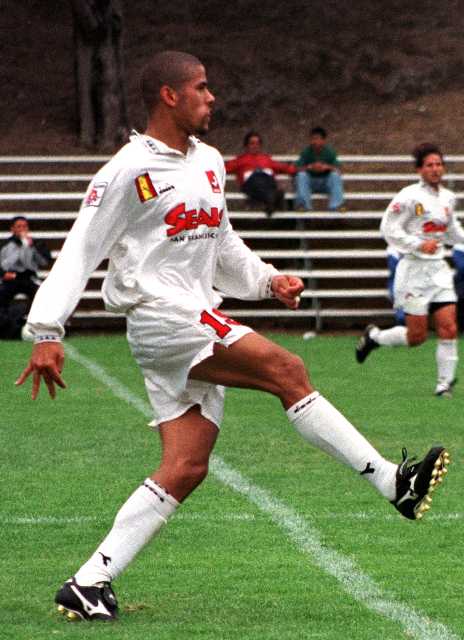
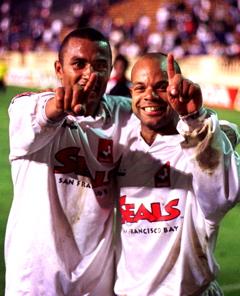
Shani Simpson and Shane Watkins of the 1997 San Francisco Bay Seals. The 1997 Seals are one of two Division 3 clubs to reach the Semifinals in the Modern Era. Photo: San Francisco Bay Seals

One of the most overlooked and dramatic runs in the history of the Lamar Hunt US Open Cup occurred in 1997. That year, the San Francisco Bay Seals, who competed in the USISL’s D-3 Pro League, upset two MLS teams and the defending A-League champions to earn a spot in the Semifinals. While a Division 3 pro team reaching the final four of the US Open Cup is not unheard of (it has happened twice in the Modern Era), there was something unique about those “pros” from San Francisco.

“No one was getting paid,” said Seals starting forward Marquis White. “We were just playing for passion and pride and playing for the city.”

THE ORIGIN STORY

Tom Simpson founded the club under the name “San Francisco United Soccer Club” in 1981. The goal was to create a club that would embody everything that is great about the beautiful game and the city they represented. Also, he wanted to give his talented sons and their friends a place to play after college since there were limited soccer-playing options after graduation.

“We were the players that no one wanted,” offered Kimtai Simpson, one of Tom’s two sons. “Nobody knew who we were and we all had funny names and we had a lot of minorities.”

Tom Simpson was a standout athlete in his own right, growing up playing multiple other sports outside of soccer at a very high level. This was his first venture into the game of soccer, however.

“He loves the camaraderie of a team, it was as much for him as it was for the kids,” said Kimtai.

When Tom founded the team, he was still in medical school and coached his sons and their friends on the side. By 1985, the team had become so successful as a youth club that they began seeking opportunities to play youth opponents at an international level. The first was a trip to the 1985 Gothia Cup, one of the biggest youth tournaments in the world held annually in Gothenburg, Sweden. Then came an appearance in the renouned Milk Cup in Ireland that same season. These tournaments were the catalyst that really propelled the club to the next level.

Everything began to grow.

“We were all pretty ambitious kids,” said Kimtai Simpson. “We all dreamt about playing outside the United States.”
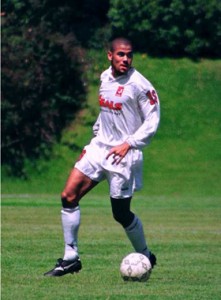
CJ Brown with the 1997 San Francisco Bay Seals. Photo: San Francisco Bay Seals

The club’s success attracted other players of a high caliber, building a powerhouse team in the northern Californian youth leagues, dominating many of the state tournaments.

“We inspired people to seek each other out,” mentioned Kimtai. Due to the lack of local youth competition, the team continued to travel to Europe in the summers seeking high-quality opposition. They again returned to the 1987 Gothia Cup, as well as participating in other European youth tournaments such as the Helski Cup, Dana Cup, and other Norway-based cup competitions. They also traveled to South America on a few occasions, including to Brazil where they beat Santos FC in their own stadium.

The club became so dominant that the term “super club” began to spread within the northern California youth soccer community. Many of the best players from around the Bay Area wanted to play together and thus ended up on San Francisco United.

By 1991, the club was regularly winning the Northern California State Cup as an adult men’s team. Part of this was due to participation in the highly-competitive San Francisco Soccer Football League. The SFSFL was founded in 1902 and remains the oldest continually-operating soccer league in the United States.

“We started playing early on against grown men,” boasted forward Marquis White, who played his college ball at the University of San Francisco before playing in the Netherlands and Bolivia. He was drafted by the New England Revolution in the 1996 MLS Inaugural Player Draft but injuries de-railed his time with the Revs and he returned to the Bay Area.

The San Francisco Bay Seals pose for a team photo before their 1997 US Open Cup Third Round match against the San Jose Clash at Spartan Stadium. Photo: San Francisco Bay Seals
The San Francisco Bay Seals pose for a team photo before their 1997 US Open Cup Quarterfinal Round match against the San Jose Clash at Spartan Stadium. Photo: San Francisco Bay Seals

At the time, the SFSFL was arguably the highest level of men’s soccer competition anywhere in the United States and the SF United youth club could compete with any team in the league.

“The environment in San Francisco certainly produced as many players as any other projects have. If you look at the guys from the ‘96 MLS draft how many guys came from the San Francisco league, it was imbalanced to the rest of the country,” commented midfielder Troya Cowell.

“We grew up playing against Dominic Kinnear, John Doyle, Troy Dayak, Eric Wynalda. We played them in the city league here,” said Shani Simpson, Tom’s other son who now runs the current Seals’ youth academy. “They put me in my place sometimes; they went at me hard, but never to the point where I thought I couldn’t compete with them.”

“There were guys in the men’s league we played against who played in the World Cup like Bernardez of Honduras,” Kimtai noted. “These guys were huge influences on us, they inspired us. There was no pro soccer at the time so the SFSFL was the professional soccer in the country.”

In 1992, Tom made the decision to join the US Interregional Soccer League (USISL), the league that would eventually become the current United Soccer Leagues (USL). They would become one of the league’s first West Coast teams.

“The kids had been successful and if we wanted to continue to play it was the only option. We weren’t looking to go professional, we were just looking for a place for these kids to play.”


The team would be rebranded as the “All-Blacks” for their inaugural USISL season in 1992. The same team that played together as children continued to play together and began to dominate the 3rd and 4th divisions of US Soccer leading up to their 1997 US Open Cup run.

“It felt like we all grew up together,” said Shani Simpson.
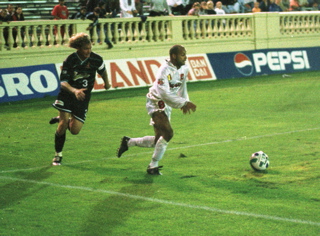
Shane Watkins of the San Francisco Bay Seals eludes San Jose Clash defender John Doyle during the Seals' 2-1 Quarterfinal upset at Spartan Stadium on August 20, 1997. Photo: San Francisco Bay Seals
Shane Watkins of the San Francisco Bay Seals eludes San Jose Clash defender John Doyle during the Seals’ 2-1 Quarterfinal upset at Spartan Stadium on August 20, 1997. Photo: San Francisco Bay Seals


“We weren’t the most talented team player-for-player, but we had been together for so long,” said forward Shane Watkins.

The team continued to seek out and play high-level competition including playing multiple scrimmages against international sides participating in the 1994 FIFA World Cup. For many member’s of the team, they felt the group could compete with just about any side in the world.

“Our international record is crazy, I mean we played against Brazil before the ’94 World Cup and we were in that game,” noted Troya Cowell. “We weren’t afraid of anyone and we had the record to back it up.”

The All-Blacks won the ‘94 Pacific Division of the USISL and the ‘95 Western Division. The club once again rebranded in 1996 becoming the San Francisco Bay Seals following a lawsuit from the New Zealand National Rugby team who are also known as the All-Blacks. That season they joined the USISL Premier, which would later become USL League Two.

They would reach the league final that year, losing to the Central Coast Road Runners (San Luis Obispo). The following season in 1997 they found themselves in the USISL D-3 Pro League, one level below the old USL-A League (Div. 2 pro).

Shani Simpson of the San Francisco Bay Seals dribbles the ball against the San Jose Clash in the 1997 US Open Cup Third Round at Spartan Stadium. Photo: San Francisco Bay Seals
Shani Simpson of the San Francisco Bay Seals dribbles the ball against the San Jose Clash in the 1997 US Open Cup Quarterfinal at Spartan Stadium. Photo: San Francisco Bay Seals

However, they were pros in name only. None of the players were paid during that 1997 season.

“Our team was very close and they understood the difficulty of financing a professional team,” said Tom Simpson. “We became ‘professional’ just so we could play at a higher level but the guys understood that there was no money involved. Even the following year when we were in the A-League we didn’t pay the players. I just didn’t make financial sense.”

Most of the players just had other jobs, but one of the biggest ways Tom was able to help his players was to help them find work.

“I can’t tell you how many of them worked at the hospital where I was practicing,” said Tom. “I had a good connection with the parking department. The wages were decent, about $14.00 per hour back then. Our team captain, Angelo Sablo, is still there, only now he’s the boss. I got help from Russ Murphy, a contractor and youth soccer coach, who had access to properties being developed. He would allow guys to stay for free in some cases. We did a lot of stuff like that.”

FAMILY ATMOSPHERE

The team chemistry and length the guys on the team had played together were the principle reasons for their success.

“We were a fearless, underestimated family,” expressed Kimtai.

“We had great chemistry on and off the field, that had a lot to do with our success,” said Shane Watkins.

The San Francisco Bay Seals celebrate with their fans during the 1997 US Open Cup Third Round match against the San Jose Clash. Photo: San Francisco Bay Seals
The San Francisco Bay Seals celebrate with their fans during the 1997 US Open Cup Quarterfinal match against the San Jose Clash. Photo: San Francisco Bay Seals

The team had a true family atmosphere and feeling about it. A lot of that had to do with the man in charge, Tom Simpson.

“Tom is a super gifted, intelligent man, he can do anything, he filled a father roll for most of us,” added Watkins. This was true to the point that the Simpsons often took in players to stay with them who were on that team.

“A lot of it was about this family aspect that had been built over the years. Tom was always looking after guys, even letting them stay at his house. He mentored us as young men and gave us a space to continue to play soccer some how,” Troya reminisced.

Shane Watkins, being one of them, lived with the Simpsons for three years claiming, “I was kind of an adopted son of Tom.”

Another Seals’ player, Chris Davini did as well.

“Chris Davini came to live with us and my dad was this guy always hugging him,” said Kimtai. “My father is very generous with his time. Sometimes as a kid I felt he loved these guys more than me. He was a lot harder on me and my brother .”

“My dad is Italian-Irish so he’s always been about family and about welcoming people. If someone needed some help both my mom and my dad were the type of people who were more than willing to help out. It was something that was part of the Seals’ culture. We had BBQ’s at Angelo’s (the team captain) house and my dad’s house, and the whole team would be there and we still do that today,” said Shani.

“You had to be honest about your commitment to the group. That’s why the group stayed pretty consistent over the years,” Troya Cowell agreed. “We all stay in touch pretty well, and it would never be hard to reconnect. It’s like no time has passed,” Shane Watkins summed up the relationship.

Courtesy of San Francisco Bay Seals

The practices were also very intense, with many players claiming that the practices were more intense than any game they ever played in.

“It was 5 to a side free-forming creative soccer,” Kimtai remembered.

Most of the players claim that was some of the top training atmospheres in the city.

“It was the best place to go train in a really competitive environment,” Troya Colwell said. “At that time there wasn’t much of an outlook if you weren’t going to play for the National Team. I pursued the best place in town to play soccer and that was with the All-Blacks at the time,”

“In practice we hated losing, we talked trash cause it was competitive, but we were always fighting for each other,” said Marquis White.

“You had to love to play together. It wasn’t about where we were going to go. We used to kill each other in practice. You couldn’t do anything to us in a game that we hadn’t done to each other on a terrible field, in the fog in San Francisco. We didn’t have this fear about not getting to the next level of our careers; we just really enjoyed training together day-in and day-out. None of us were thinking we could go to MLS… it was just for the joy of it,” said Cowell.

“Practices were so intense with a lot of good natured trash talk. We did enjoy it more than the game. There was so much trash talk and taunting. We’d bring a broom to practice cause we were going to sweep. It was heated, we get angry in practice, but afterward we were all good,” said Shane Watkins.

“My happiest moment wasn’t the Open Cup run, it was when I got to play with those guys from 6 p.m. to 10 p.m. ,” added Kimtai.

THE OPEN CUP RUN

The family atmosphere and intense training sessions contributed to the incredible Open Cup run by the Seals in 1997. That, along with the fact that Tom Simpson highlighted making a deep run and potentially winning the tournament before the first match ever took place, primed the team for success.

“I remember when we first started qualifying that year, Tom was adamant on making an Open Cup run. He put a lot of energy into it. Tom made it a priority,” said Shane Watkins.

At the same time however, the USISL season did not begin in a dominant fashion like the Seals had become used to. Despite only losing two games in league heading into the Open Cup competition was growing. Scores were less one sided and the West Division table was tight. This led to Tom changing the system in what he believes to be one of the keys to the success of the 1997 season.

Photo: San Francisco Bay Seals

“I had been talking with the guys for a few years about changing the style of play,” Simpson explained. “This was a time when using a sweeper was the standard of play and I wasn’t much of a supporter of that style of soccer. I wanted to play with four at the back and more of a zone defense. CJ and Tim Weaver (the starting center backs) were the key elements to this switch. I asked them to try it for one weekend and they won both games that weekend. I then asked if we can stay with it and we went on a run to win 17 games in a row, including all of the Open Cup matches. It was that change in the system of play that really triggered that run and the guys really grabbed onto it. They thought they were unbeatable. To my knowledge, the system hadn’t been used in the States, but after watching Brazil in the 1994 World Cup I became convinced that it was a viable system of play with the right players.”

The D-3 Pro League used regular season games to determine which teams would represent the league in the 1997 US Open Cup. Each team in the West Division would have two road games and two home games selected to double as qualifiers. The top team in each division and the top two second place teams league-wide would punch their ticket to the tournament. After a 3-1 win over the Los Angeles Fireballs and a 4-0 win over the Chico Rooks, the Seals were off to a positive start. The deciding win ended up being a 2-1 extra time win over the Sacramento Scorpions. The Seals fell 3-1 to the Stanislaus County Cruisers, but San Francisco had done enough to finish top of the table. With a 3-1-0 record, they would win the tiebreaker with the Rooks and the Cruisers. 

In the first round proper of the tournament, the Seals took on US Adult Soccer Association side and Western Amateur Champions, Inter SC, from the San Jose, California area in a match that was played at De Anza College in Cupertino, Calif. The Seals won quite comfortably, 4-0, with a brace from both the eventual tournament’s Golden Boot winner Marquis White and from Mike Black a player who would go onto only make one more appearance for the Seals in the 1997 Open Cup.

Shani Simpson recalls the dominance of captain Angelo Sabo in that game and the opposing coach saying about Angelo’s play during the match: “Can someone fucking stop that guy, the fuck!” The advanced the Seals, who would go up against a pro side in the next round.

HISTORIAN NOTE: Our historical records for that San Francisco Bay Seals vs. Inter SC game are incomplete. If anyone might be able to help us confirm any match details about that game, please CONTACT US HERE. All we have are that Marquis White and Mike Black scored two goals each and we have most of the starting lineup for both teams put together.

“After that game we realized now it was on,” said Shani Simpson. The referee that night was Brian Hall who would later referee games at the FIFA World Cup and spent time as the director of referees for CONCACAF. His role in this tournament for the Seals would become magnified in the later rounds.


In the next round, the Seals would be drawn at home in historic Negoesco Stadium on the campus of the University of San Francisco. There they would host the defending A-League champion Seattle Sounders. The Seals would upset the Sounders by a score of 1-0 in front of more than 600 fans. Marquis White scored his third goal of the tournament off of a beautiful feed from Troya Cowell.

“We really wanted to play an MLS team,” Shani Simpson recalls, noting just how important the result was.


While the first two rounds were important, the magic of the Cup for the Seals really began in the Third Round when they hosted the Kansas City Wizards at Negoesco Field. Once again Marquis White would open up the scoring inside of one minute off a ball over the top from midfielder Chris Davini to give the Seals the early lead and send the more than 1,400 fans at Negoesco that night into a frenzy. The Wizards would respond in the 40th minute with a goal from Frank Klopas, a player who played for the US National team just two years prior.

Klopas was just one of the well-known US soccer names on the pitch for KC that day. Other standout players for the Wizards included the 1997 MLS MVP Preki. The Wizards also featured Mo Johnston, a Scottish national team player.


Despite the strong Kansas City side, Marquis White would once again give the Seals the lead in the 59th minute off another fine assist from Davini. The 2-1 scoreline would be how the match ended, with the Seals pulling off another “cupset.”

Following the match, in the post game interview, Marquis White who in the previous season played in MLS before returning to the Seals, did not shy away from the confidence he had in himself and his team saying, “I felt we had a good chance because I felt we matched up well against their defenders and we just played with a lot of heart and that’s what beat them today.” He upped the ante saying, “We are going to win the next one, we are going all the way.”

“Beating the Seattle Sounders was fun, but beating KC was out of this world,” said Kimtai. “When you play against Mo Johnson and then you beat Mo Johnson when you are not expected to … all that hard work we had put in on our part paid off. Mo Johnston acted like this was a joke and he didn’t even care, in my opinion.”

This was also the first match where famous Belgium player turned scout Jean-Marie Pfaff showed up to watch the Seals hidden talents.

“Jean-Marie Pfaff would have never noticed us he showed up to the KC game,” Troya Cowell pointed out.


While beating KC at home was a huge win in the club’s history, it wasn’t anything compared to the next round when the Seals where matched up against local MLS rivals, the San Jose Clash, in a match up just down the road at Spartan Stadium in front of an announced crowd of 4,237 fans.

“That was a local rivalry whether the Clash knew it or not,” said Troya. “We felt like that was a big rival,” Shane Watkins recalled.

The end of this match is considered by some to be the greatest 17 minutes in San Francisco soccer history.

The Clash would field basically a first team line-up that night at home apart from US National Team forward Eric Wynalda, who did not play. The Clash fielded some of the best players MLS had to offer, like John Doyle, Dominic Kinnear, Ronald Cerritos and Eddie Lewis to name a few. Ronald Cerritos would open up the scoring in the 20th minute from the penalty spot to give the Clash the lead. The Seals battled hard for an equalizer that eventually came off the foot of Shani Simpson in the 77th minute.

“The ball just popped out and it hit me in the chest and someone said kick it and so I kicked it,” said Shani about the equalizing goal in his post match interview. “It was probably the most amazing feeling I’ve ever had.”


Then in the 86th minute, Shane Watkins would pick the pocket of John Doyle and beat the keeper to give the Seals the 2-1 lead late in the match. Shane said in his post match interview that “I just pressured … I knew I could pick him, I was talking about picking him all week.”

He then went on to reiterate what Marquis had said in the previous round, “We are going all the way.”

To most, this was the key win of the 1997 Cup run because it was guys that had grown up playing in the local leagues and it was the local MLS side that did not take any of the Seals players.

“It just shows, there are a lot of players in San Francisco, and basically our team that have been overlooked,” pronounced Shani Simpson in the post game interview. “That moment definitely stands out . I don’t even know how I got there. When athletes talk about being in the zone and everything just slows down, I was in that zone. I took the ball from John Doyle and I just thought I could. He’s a great player, but we didn’t feel like the gap was that big and I knew I was playing against a national team guy, but I just wanted to prove myself.”

Shane Watkins agreed years later. “The game against the Clash I think sums us up. It was pretty scrappy both ways and if any outsider looked at that game you couldn’t tell who was in the MLS and who was the other team,” said Troya Cowell.

“The only time anyone took us seriously is when we played D.C. United. I don’t think San Jose and Kansas City took us seriously at all,” Kimtai Simpson added. “

We knew the other teams would underestimate us. These guys had no idea how hard we were going to come at them,” said Shani Simpson.


The win against their local rivals set up a Semifinal match with what many considered to be the greatest MLS team of all-time. In the first two seasons of MLS (1996-1997), Bruce Arena and assistant coach Bob Bradley had led D.C. United to an MLS Cup title in 1996 and gotten even better in 1997, winning the MLS Supporters’ Shield and a second straight MLS Cup.

“That was the best MLS team of all time,” said Troya.

The defending MLS Cup champions were taking the Seals seriously, playing a complete first choice starting 11 that included John Harkes, Jaime Moreno, Marco Etcheverry, Tony Sanneh and Scott Garlick. Even still, the Seals felt like “… we were going to beat D.C.,” insisted Kimtai.

The game took place at University of the Pacific in Stockton, Calif. in front of 3,470 fans. Most Seals players who played in that game felt like they weren’t given a fair chance by Brian Hall, the referee on that night.

“D.C. United beat us, but we don’t believe they beat us … we left the field saying sometimes teams get lucky,” said Tom Simpson. “They got a gift PK in the first few seconds of the game and they won 2-1. As far as we were concerned we dominated the game and the statistics supported that. They really struggled in that game and in my mind they were lucky.”

The San Francisco Bay Seals and D.C. United battle for the ball in the 1997 US Open Cup Semifinals at Negoesco Stadium. Photo: San Francisco Bay Seals


“I don’t know if there was an biased referee in that game,” said Troya Cowell. “The penalty call was dubious, like right away. When a referee calls a penalty like that early on in a game it’s ‘cause he’s part of US Soccer. No ref should shape a semifinal with a penalty call 5 minutes into the game. If it’s gray, you just take it on your shoulders and don’t call a penalty five minutes into the game. It was a really soft call.”

“I felt it was Marco Etcheverry getting the celebrity call,” said Shane Watkins. “The big dogs are going to get the calls. CJ Brown was so adamant that he didn’t touch him and CJ is usually the silent giant, never really said anything or talked too much in training. He is a clean, honest defender. All I remember was feeling we got robbed in that game.”

Shani Simpson commented, “That was the only time I ever heard my dad question the referee. I’m suspicious of what Brian Hall was doing in that game. Etcheverry was known to flop. Nine times out of 10 no one ever calls . For one, it was early in the game. I had a one-on-one and got taken down in the box and I’m not one to dive and we didn’t get a PK. To this day I think something was happening, I don’t know if MLS said something. If we would have won and D.C. complain, maybe he’s not the top ref and not so coincidentally he was doing World Cup games soon after. It might have been a political move on his part. It would have been a great story, but not for MLS.”

“I think the MLS was very afraid of losing credibility, and I think they directed the referee to call it as tight as possible,” said Kimtai. “That’s the way I feel. That’s not to say D.C. United wasn’t an incredible team. The penalty early in the game just wasn’t a penalty. It happened in the Clash game as well.”

“It was suspect. It was way too early, I don’t even know if it was in the box,” said Marquis White. “A lot of things went on in that game that were a bit curious.”

Jaime Moreno would go on to score that penalty in the second minute of the match before Raul Diaz Arce would add another for DC United off a great run from Moreno to make the score 2-0 in the 62nd minute.

“They had elite players. Jamie Moreno set up the goal that won the game for them and you got to tip your hat to him,” said Tom Simpson about the second goal.

Marquis White of the San Francisco Bay Seals runs down the ball against the San Jose Clash in the 1997 US Open Cup Third Round. Photo: San Francisco Bay Seals
Marquis White of the San Francisco Bay Seals runs down the ball against the San Jose Clash in the 1997 US Open Cup Quarterfinals. Photo: San Francisco Bay Seals

Marquis White would pull a goal back late in the match to extend his Golden Boot lead in the tournament with his sixth goal of the competition.

“We all felt that Marquis was a proven goalscorer who should have been on the National Team” said Shane Watkins.

The one goal was not good enough in the end as the Seals fell by a score of 2-1.

“Bruce said afterward … The Seals team was emotionally better than us and he recognized that,” said Shane Watkins.

“John Harkes, I had played against being from New Jersey, so that match up mattered to me,” said Cowell about the match. “He was a little bit of a prick that game, trying to speak with a British accent.”

“John Harkes still talks about us, like who are these kids from San Francisco,” said Marquis White.

While the run had come to an end, the Seals players still were able to see the positives in the amazing amateur run they had made.

“The run with the Seals was the highlight of my career,” said Shane with fondness. “It effects soccer history in some small way,” said Kimtai. “The ‘97 Seals team was the culmination of who my dad is and who the Seals are. A bunch kids who were left over from the Vikings team,” said Shani.

“It was an incredible time,” said Marquis White.

Unique: The Swagger / The Street Ball Artist / The Ajax Approach / Completely SF

The Seals are a unique team to soccer in this country in more ways than one. They had American basketball / football style swagger and were one of the few street-ball style teams in the history of the game domestically. They were also built using a different approach than most US clubs, because they played the local youth kids together against the men.
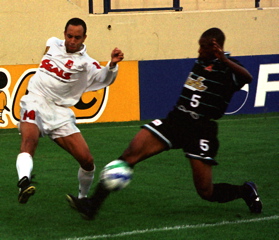
Angelo Sable of the San Francisco Bay Seals (left) battles for the ball with Michael Emenalo of the San Jose Clash in the 1997 US Open Cup Quarterfinals. Photo: San Francisco Bay Seals

“We had the Ajax approach,” said Troya Cowell. “You play your youth players and they will mature. We don’t profile the talent of 18-22 year olds in this country.”

Shani Simpson believes that it is something missing in today’s game because most clubs main “ …objective is to generate revenue instead of develop players.”

“Get those young kids on the field, you’re going to lose some games but let’s get them in these games, play the youngsters,” preached Marquis White about his approach to his coaching style today. Shane Watkins believes that “you are skipping steps” by bringing in pros from all around instead of growing local talent.

Due to the years playing together the team had a confidence in themselves and their abilities. This was highlighted by both Marquis White’s postgame interview after the KC game and Shane Watkins’ interview after the San Jose game. It was a big part of this team having just the right amount of ego without being cocky and it’s still something they maintain today.

“We really did believe . We really believed in one another, especially collectively. I knew I wasn’t the greatest player, but felt that in that group together with those guys we could get it done,” said Shane Watkins before going on to say, “We were a group of players that all thought we should have been selected for one of the MLS teams when that league started. We always had something to prove against the MLS teams. There wasn’t a big difference except 1 or 2 star players the MLS teams had.”

“We were all pretty confident in our abilities,” Kimtai Simpson said. “That entire team could have played in the MLS.” While Shani Simpson continued, “The years of playing together . We knew on a national level that we were a strong team. I don’t know if it was confidence or ignorance, or if it was a solid foundation of belief. Marquis was the vocal leader saying we are going to beat these guys. Me and Angelo were more the philosophical leaders when we spoke and said, you know what, bring on the US national team, bring on Barcelona. We weren’t scared of no MLS team.”
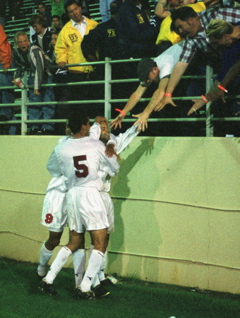
The San Francisco Bay Seals celebrate with their fans during the 1997 US Open Cup Third Round match against the San Jose Clash. Photo: San Francisco Bay Seals

The Seals were also one of the last manifestations of a more street-ball style, something that has led to the great success of players such as Maradona and Pele.

“That was a team of artist. We were a synthesis of styles. There are no street ballers anymore, that’s what we were. We were one of the last vestiges of street ball in the United States. You learn to play soccer now after school with a coach. We weren’t like that,” Kimtai Simpson reminisced.

Many of the players on that team would get together in the years following to play pick up games in the winter in the North Bay Area. Some even dubbed the meetings “The Rucker of Marin.”

“The most enjoyable soccer I’ve played since was in the winters when we played at Marin Academy,” Troya Cowell said. “If there was a game like that tomorrow I’d fly out.”

The 1997 Seals were a completely original team in terms of personalities and diversity, and they represented the city of San Francisco better than any other team possibly could.

“It was a homegrown team,” said Marquis White. “You got to have base, we had a base. You got to have local people.”

“The Seals were similar to the SF mentality we have all our diverse weird quirky people,” claimed Shani Simpson. “Six of the starters were African Americans. Back then it wasn’t something you saw a lot, and people thought we were a basketball team. The Seals were a multicultural team with a strong African American presence. It was a really good representation of the melting pot that is San Francisco.”

Most of the players also felt they had a player that represented the hippy culture in SF in Troya Cowell.

“I use to come out barefoot to practice at USF,” noted Troya.

The fans even had a song for other players that had long hair like Troya’s on opposing teams. “There is only one ponytail, so cut your hair, cut your hair.” Troya continued to say, “That team is forever part of our identity as soccer players.”

“Our team was built over years in that city. Me and my brother, we grew up in San Francisco, we could walk through and name the entire fan base,” added Kimtai. “It was a team with deep ties to The City.”

NEGOESCO FIELD

The atmosphere the Seals created is something that, at the time, had not yet been seen in The City and has arguably not yet been replicated in the more than 20 years since. Marquis White remarked “I just love when we were at USF playing, it was packed, it was foggy. The environment we had there had so many people. The Ultras came and connected with us and they believed in us. People had to see what the Seals were all about. USF was tiny and it was packed.”

Shane Watkins claimed, “That stadium was perfect if you get just 500 people in there, it was loud. We had the Seals hooligans, this group that started supporting us. They had a song about Marquis or one making fun of Preki when he didn’t make that National team. They were fanatical.”

Shani Simpson believed that the fans “… had a lot to do with creating a lively atmosphere. We would hang out with the fans drink beers with them and sing songs that they were singing at the game with them. We just had an open and welcoming team.”

THE 1997 LINEUP

The team during the Cup run for the most part set up with the same starting XI. Outside of the Inter SC game, the Seals put out the same starting lineup in the four matches with the four professional sides they faced. The team played a 4-2-2-2 or a version of a 4-4-2.

Support TheCup.us and its coverage of the US Open Cup by purchasing a "Champions" shirt, honoring the five clubs from the pre-Modern Era (1914-1994) to win four or more US Open Cup titles. Visit THECUP.US SHOP
Support TheCup.us and its coverage of the US Open Cup by purchasing a “Champions” shirt, honoring the five clubs from the pre-Modern Era (1914-1994) to win four or more US Open Cup titles. Visit THECUP.US SHOP

The key to this formation was the center back pairing of CJ Brown and Tim Weaver. CJ Brown would be selected first overall the following season in the MLS supplemental draft by the expansion Chicago Fire. CJ played the rest of his career for the Fire retiring in 2010 as the captain of the Club. CJ is currently an assistant coach with the Fire. His center back partner, Tim Weaver, was selected third overall in that same draft by the San Jose Clash, where he played for two seasons before returning to the Seals in 2000.

The keeper for the Seals in 1997 was JJ Wozniak. He had the top goals against average USISL league play that season due to his own ability and the tremendous backline in front of him.

The outside backs were Shani Simpson, the team’s second leading points getter in the 1997 Open Cup on the left side, and the team’s captain, Angelo Sabo, on the right side. Shani currently runs the Seals youth academy that still exists today. In front of them were Robert Gallow, the more defensive minded center midfielder, and Chris Davini, the man who often set up the goals for Marquis White in the ’97 Cup.

The two other more attacking midfielders were Troya Cowell and Kenny Folan. Troya would go on to play in Belgium and is currently coaching in the Maryland area. While Kimtai Simpson was not a starter, he was the first man off the bench in most games and was considered the teams “super sub”.

Up top were Shane Watkins and Marquis White. Marquis was the more attacking minded of the two, while Shane was seen as the playmaker. Marquis was part of the inaugural New England Revolution MLS squad in 1996 before returning to the Seals for the 1997 Season. He, like Weaver and Brown, was taken in the 1998 MLS draft fourth overall by the Colorado Rapids, meaning the Seals had three of the top four players taken in the MLS supplemental draft that year. He now coaches in the East Bay Area and has helped mentor players like Chris Wondolowski.

Shane Watkins was running his own currently runs his own Seals academy in Southern California, which he created because of what the Seals had meant to him. Many members of that Seals team are still involved with soccer and coaching the game locally.

“I absolutely enjoyed playing with this team more than any other group I was a part of,” said Troya Cowell. “I never would have gotten to Europe without the Seals.” Shane Watkins commented that, “I had a youth club in LA called the Seals. I called it that because that was one of the most important parts of my career.”

Tom Simpson was also named 1997 USISL Coach of the Year for all the success the team had that year.

UNBELIEVABLE SUCCESS LEADS TO HEARTBREAKING DOWNFALL

The Seals tremendous success led to a move up a division to the A-League, the second division of professional soccer in the US at the time, a move that the club might not have truly been ready for.
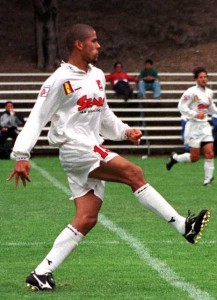
CJ Brown's first "professional" experience was with the San Francisco Bay Seals Photo: San Francisco Bay Seals
CJ Brown’s first “professional” experience was with the San Francisco Bay Seals Photo: San Francisco Bay Seals

However, it was not as if the USSF was looking out for a club like the Seals, who had developed their entire squad from local youth players. The move up to division two was somewhat of a forced move on the part of the USL, due to the Seals own high caliber of play and success both on and off the field. The move also forced the club into a venue change from Negoesco Field to Kezar Stadium due to venue size. Kezar, while historic, is a venue considered by many in the SF soccer community to be somewhat of a “black hole” for professional soccer in the city.

The stadium’s most recent victim was the San Francisco Deltas, the team that famously won the second division North American Soccer League during it’s inaugural 2017 season before folding a week later.

The following season, the Seals returned just two starters from that ‘97 team. Only Shani Simpson and JJ Wosniak from the first choice 11 returned to the field for the Seals in their inaugural A-League season.

“That’s when the reality in soccer sort of slapped us in the face. This country isn’t ready for us. They just stripped all of our players from us. We got nothing in return and they wanted us to move up as well. It’s a little bitter sweet in terms of the story because if this had happened in Europe our team would have been rewarded for our efforts. That was disheartening to go as far as we did, and realize hey this country isn’t ready for soccer. No one was out there trying to protect us,” said Simpson.

“We felt if we could keep that team together and move into MLS, we could have been contenders,” said Watkins.

The Seals developed quite a large number of players for MLS and basically got nothing in return.

“My dad and his friends had to pay for everything,” said Shani Simpson.

The Seals produced Brandon Cavitt (28th overall MLS college draft) and Marquis White (35th overall inaugural player draft) for MLS in 1996, Albertin Montoya (4th overall MLS college draft) and Chris McDonald (24th overall college draft) went to the MLS from the Seals in 1997 and in 1998. They lost CJ Brown (1st overall supplemental draft), Tim Weaver (3rd overall supplemental draft) and Marquis White (4th overall supplemental draft) to MLS.

“I think we changed US soccer forever, and we were rewarded for it by MLS picking apart our team. It was horrible for the Seals, but it was a compliment,” expressed Kimtai Simpson.

These were just the players who went to MLS. Many more ended up playing professionally overseas and in South America.

“Back then, MLS had positioned themselves politically in an unholy alliance with the USL that had a one-way beneficiary. We lost nine or our 1997 starters to MLS, A-League and one Belgian first division team. The soccer economy was essentially cannibalistic.”

Kimtai Simpson believes, “small clubs need to be financially rewarded for the players they develop for the MLS. My father spent a lot of money with no return. It’s an unhealthy situation. Just a gesture of a small amount of money would show these clubs that MLS cares.”

Tom Simpson had to say, “My secret agenda was to show that soccer could survive in this country if a solid grass roots, bottom up, approach was taken, (then pointed out that) we ultimately failed because the top down guys held all the cards, essentially funding and the power structure.”

Tom Simpson strongly believed that success could be reached in soccer domestically with a smart financial plan and community involvement.

Kenny Folan of the San Francisco Bay Seals (left) battles for the ball with Istvan Urbanyi of the San Jose Clash in the 1997 US Open Cup Quarterfinals. Photo: San Francisco Bay Seals

“If I felt there was a mission it was that if soccer wanted to be successful in this country it needs to start as a grassroots organization and it needs to rise to the top and that’s the model I thought had potential. This top to bottom thing was not the answer. Everyone was failing financially with this top to bottom approach. I believed that soccer did have a chance if you were able to bring it up from within the community and I think I did show that. The part that failed is that there is no structure in place in this country to support that kind of approach. I firmly believe that we are not going to be where we want to be with soccer in this country unless there are more experiences like ours,” Tom argued.

The team was profitable in their first A-League season before being pushed to spend more money by the USL front office.

“In 1998, our first season post the ‘run’ as an A-League team, we survived on a budget of $200,000.  No joke,” professed Simpson. “Our revenues were $202,000.  The USL guys scoffed at this meager financial success because they constantly prodded us to spend more money even if we didn’t have it. The following year, 1999 we spent $360K, and revenues were $300K.  That was the first year we lost money.”

Much of this was due to the move up to the A-League and the change in venue to Kezar Stadium.

“It wasn’t the same when we moved to Kezar. Negoesco was home,” recalled Shane Watkins. “Kezar is
just not a viable venue ,” he added.

When talking to other pro clubs since the Seals in San Francisco, Tom Simpson has said, “The only thing I
can say to you guys is ‘don’t play at Kezar’”.

THE MAGIC OF THE CUP

The Seals are one of the Bay Area and US soccer’s great Open Cup stories. Without the 1997 run many of the Seals players may never have gotten a shot at playing at the next level, whether that be in Europe or in MLS.

“It brings magic to the game and inspiration and that’s what you want out of it,” said Tom Simpson.

“I think the is the only thing that can demonstrate the depth of soccer talent in this country across the different levels. I think it is going to become more and more important, and that more people should focus on it,” said Troya Cowell.

Angelo Sable of the San Francisco Bay Seals (left) battles for the ball with Ramiro Corrales of the San Jose Clash in the 1997 US Open Cup Quarterfinals. Photo: San Francisco Bay Seals

“I just love how the Open Cup is open to everyone,” said Marquis White.

“I love the Open Cup. It’s such a great competition. It can have a huge impact in local communities on growing the game. The run with the Seals was the highlight of my career,” said Shane Watkins. “I really do think that the Open Cup is necessary. If it wasn’t for the Open Cup, the Seals would have never had the experience that we had. It would be nice if every year there was some type of run like that. With the right resources I think I can do the same thing with these SF kids now,” said Shani Simpson.

The Open Cup isn’t perfect yet in the minds of the Seals’ players until stories and clubs like theirs are truly embraced by USSF and the sports world in general.

“If you can put aside the veneer that is created by MLS that somehow they are the best teams in the country, which they have been promoting since 1996, that just isn’t true,” said Troya Cowell on what’s hurting the Open Cup from truly taking off.

“No competition pushes them. It is a huge problem in this country. “It’s the one format that does speak to the issues I’ve talked about, but there is no real follow through because there still is no solution for these teams that start out as grassroots teams to find support once they are successful,” claimed Tom Simpson.

“Our leadership does not know how to integrate this into a process that’s really going to be beneficial to all the people who are really working hard at the grassroots level.”

“The Open Cup plays its role well (in the development of US soccer). It’s a small role but important for teams like us working outside the status quo,” noted Kimtai.

THE SAN FRANCISCO BAY SEALS SINCE 1997 AND THE ACADEMY TODAY

The Seals Academy is still alive today and is predominately focused on youth development and growing the game and no longer has the aspirations to enter the wild west of US professional soccer. Shani Simpson currently does most of the work running the academy, while Tom oversees the club as its ambassador.
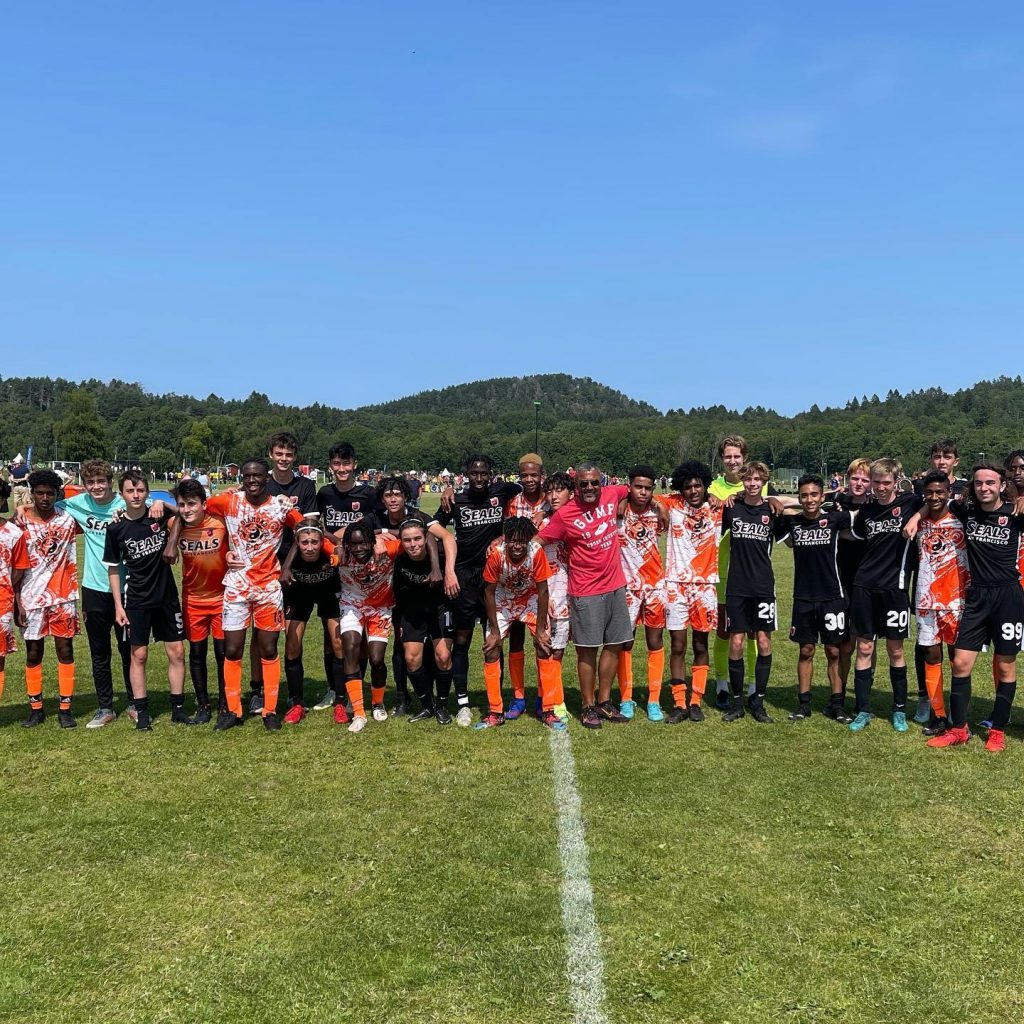
Shani Simpson (middle, red shirt) poses with San Francisco Bay Seals youth academy players after a match in Kenya. Photo: San Francisco Bay Seals

“I mostly fight the political battles now, and there are many in youth soccer, and San Francisco is a devastatingly awkward place for anything to do with soccer,” said Tom Simpson.

The Academy has grown to feature 36 teams and more than 300 kids. Shani currently operates an Under-20 and Under-23 club in the NorCal Premier League as well.

“The Seals grew for a reason. People wanted the Seals’ philosophy,” said Shani. “… it turned into 36 teams for a reason.”

The Seals have created a huge number of professional players over the years since the 1997 team as well. Those players include Joe Cannon, Stefan Frei, Wade Barrett, Joe Enochs, Espen Baardsen, Suamy Alvarez, and Calen Carr, just to name a few.

CONCLUSION

The Seals are a soccer club unlike any other past or present in America. They stood for everything American soccer should and could be. They were a community-based club that brought together the best of the diversity the city of San Francisco had to offer. They created a culture and family around the club, from the players to the supporters, built from the grassroots up and not the top down. The Seals were built on an Ajax approach mixed with street ball flair, two approaches that haven’t existed together in US Soccer before or since. The club embodied the spirit of the game, as well as San Francisco, but was torn apart by a system that is not set up to support a project like theirs. This club is everything that US soccer fans dream their club could become. The Seals 1997 US Open Cup run should have been a game changer for the way US soccer operates in several ways. Instead, this massive success story is just another memory. The Seals are the club that every Open Cup fan would have fallen in love with because they represented the absolute best of what the game of soccer is, and can be in the US and the world.

Filed Under: Feature - History, Feature - Main, Feature Right - US Open Cup History, Featured Post - Main, US Open Cup, US Open Cup Central, US Open Cup History Tagged With: 1997 US Open Cup, San Francisco Bay Seals

Who is the US Open Cup equivalent to Lincoln City FC and their magical FA Cup run?

May 26, 2017 by Josh Hakala

lincoln-city-fcIf you’re a soccer fan and love cup competitions, then you were likely enthralled with one of the great underdog stories in England’s FA Cup history: Lincoln City FC.

Apologies to Chelsea FC and Arsenal, this year’s FA Cup finalists, but Lincoln City was the story of this year’s tournament.

The semi-pro team that competes in England’s fifth tier, stunned the Premier League’s Burnley FC, 1-0 to become the first non-league team to reach the Quarterfinals since 1914. That year, World War I was under way, baseball icon Joe DiMaggio was born, and the Lamar Hunt US Open Cup (then known as the National Challenge Cup) had just crowned its first champion.

Following Lincoln City’s upset, American soccer fans on social media asked what is the US Open Cup equivalent to English minnow’s magical run?

For starters, there’s a lot of difficulty with properly comparing the two tournaments. First of all, American soccer has never had five tiers of professional soccer. Since Major League Soccer (MLS) joined the Open Cup in 1996, American soccer has had three tiers of professional soccer, followed by a fourth tier which includes all amateur clubs.

However, there have been plenty of incredible runs by underdog teams in the Modern Era of the US Open Cup (1995-present).

The 1999 Rochester Raging Rhinos (A-League, second tier) are the premier example as they are the only lower division team to win the tournament since 1996. The Rhinos upset four MLS teams, including the Colorado Rapids in the Final to lift the trophy at Columbus Crew Stadium. The Rhinos also reached the Final and lost in 1996, and the Charleston Battery (USL First Division, second tier) also fell short in the championship game in 2008. The Carolina RailHawks (now North Carolina FC), nearly added their name to that list of great lower division cup runs in 2007 when they advanced to the Semifinals as an expansion team, falling in extra time to the New England Revolution (MLS).

But let’s take a look at third tier professional teams (a level that does not exist this year since the United Soccer Leagues was awarded provisional Division 2 status). In the Modern Era there have been three teams from Division 3 or below who have made it to the Semifinals or beyond.

1995 Richmond Kickers
USISL Premier League, 4th tier amateur

1995 US Open Cup champions: Richmond Kickers
After playing the El Paso Patriots to a 1-1 draw, the Richmond Kickers captured the 1995 US Open Cup title by defeating the Patriots on penalty kicks 4-2. Photo: Richmond Kickers

Just because this cup run took place the year before Major League Soccer launched doesn’t make the Richmond Kickers’ 1995 US Open Cup championship any less impressive. Professional soccer had started to take shape in the form that we know it today (thus, the reason we include it in the “Modern Era”). There was not a league that qualified for Division 1 status, but there was the A-League in Division 2 and the United Systems of Independent Soccer Leagues Professional League (USISL) which was Division 3.

The Kickers were a part of the USISL Premier League, an amateur league which later evolved into the Premier Development League (PDL). As an amateur team, they were loaded with future professionals including U.S. international Richie Williams, and future MLS players Rob Ukrop, Brian Kamler, Jeff Causey, Todd Yeagley and Mike Clark. The team also featured the University of Richmond’s all-time leading scorer Leigh Cowlishaw who would play nearly 150 matches for the club before becoming the head coach, a position he still holds today.

They began their cup run with a 6-1 win over a shorthanded D.C.-area amateur side Spartans SC. Six different players scored for Richmond that day at Striker Park in Glen Allen, Va. (Rob Ukrop, Richie Williams, Leigh Cowlishaw, Brian Kamler, Jon Hall, Corey Turnage)

(Editor’s note: TheCup.us is trying to confirm who scored that goal for Spartans SC, contact us if you know someone associated with that team)

In the Quarterfinals, the Kickers hosted the Atlanta Ruckus of the A-League and came away with a 2-1 win at the University of Richmond Stadium. Ben Crawley assisted on both goals for the Kickers, a 13th minute tally by Ukrop and the game-winner in the 62nd minute by Scott Snyder. (U.S. international and the A-League’s Defender of the Year John Doyle scored for Atlanta). The Ruckus would lose in the A-League championship game that year to the Seattle Sounders, so this was no weak professional team.

The game of the tournament, and quite possibly of the Modern Era, was the Kickers’ dramatic Semifinal win over the USISL Pro’s (Div. 3) Chicago Stingers. Playing their second straight game at the University of Richmond, Kamler opened up the scoring for the Kickers 34 seconds into the match (one of the fastest goals of the Modern Era). Chicago answered with an equalizer 10 minutes later, but the game changed when future MLS player Matt Knowles threw a punch at Crawley and was ejected. Despite being a man down, the Stingers managed to take the lead on a 34th minute penalty kick by Steve Morris. Midway through the second half, Crawley and Snyder gave Richmond the lead back only to see Chicago tie it up with Don D’Ambra scoring his second goal of the game in the 88th minute. The late equalizer didn’t phase the home team as Crawley scored the game-winner from the penalty spot less than a minute later.

In the championship game, the Kickers hit the road for the first time, heading to El Paso, Texas to take on the Patriots of the USISL Pro League (Division 3). Ukrop scored for Richmond just after halftime only to have El Paso equalize in the final 10 minutes. After extra time, the match went to penalty kicks, marking just the second time in tournament history that the title would be decided from the spot. Causey made a pair of saves and the Kickers converted four of their five attempts to become the first Virginia club to win the US Open Cup title.

1997 San Francisco Bay Seals
D-3 Pro League, 3rd tier professional

Shane Watkins of the San Francisco Bay Seals eludes San Jose Clash defender John Doyle during the Seals' 2-1 Quarterfinal upset at Spartan Stadium on August 20, 1997. Photo: San Francisco Bay Seals
Shane Watkins of the San Francisco Bay Seals eludes San Jose Clash defender John Doyle during the Seals’ 2-1 Quarterfinal upset at Spartan Stadium on August 20, 1997. Photo: San Francisco Bay Seals

The San Francisco Bay Seals only qualified for the US Open Cup one time, but they made the most of it. The D-3 Pro League (3rd tier) team barely qualified, needing a tiebreaker just to get in. Once they got in, they cruised to a 4-0 win over the San Jose-based amateur club Inter SC. Marquis White and Mike Black had two goals each to lead the way.

(Editor’s note: TheCup.us is trying to confirm the scoring summary for that Inter SC game on June 20, 1997, contact us if you can help)

In Round 2, the Seals hosted the defending A-League champion Seattle Sounders at the University of San Francisco. The Seals defense, led by future MLS star CJ Brown, held the Sounders to just seven shots and White scored the lone goal to lead the home team to the upset.

White continued to shine when the Seals returned to the same stadium, but this time they had tougher opposition. The Kansas City Wizards of MLS came to town and took an early punch with White scoring in the first minute of the match. Frank Klopas tied it up before halftime, but White’s fifth goal in three matches would prove to be the game-winner in the 59th minute.

The Seals would claim a second straight MLS upset with another 2-1 win, this time on the road against the San Jose Clash (now the Earthquakes). Ronald Cerritos gave the home team an early lead, but San Francisco wouldn’t level the match until the 77th minute when Shani Simpson scored. Nearly 10 minutes later, they had their winner, courtesy of Shane Watkins.

San Francisco’s biggest challenge came in the Semifinals when defending MLS and Open Cup champion D.C. United came calling to the Stagg Memorial Stadium at the University of the Pacific. United fielded a mostly first-choice team and it paid off as Jaime Moreno scored an early PK and Raul Diaz Arce scored in the second half to give the champions a 2-0 lead. White cut the lead in half in the 84th minute but the Seals couldn’t find the equalizer and their one and, to date, only cup run would end.

2011 Richmond Kickers
USL Pro, 3rd tier professional

The Richmond Kickers and Columbus Crew met in the 2011 US Open Cup with the Kickers upsetting the Crew 2-1 at Crew Stadium. Photo: Columbus Crew

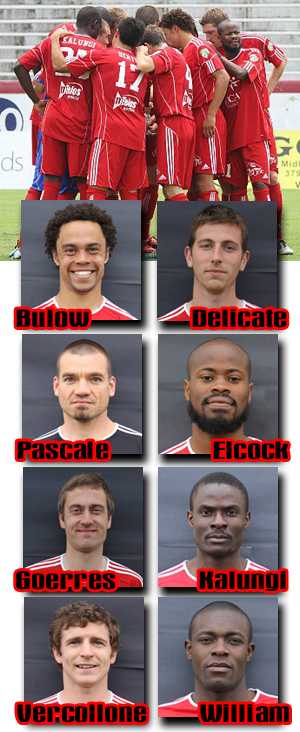
The Kickers had an easier path to start out their 2011 US Open Cup run. Thanks to a friendly draw, the Kickers ended up with fellow USL Pro side Dayton Dutch Lions in Round 1. Dayton would end up finishing the season with the worst record in the league at 2-16-6 and the difference in quality was clear in Richmond’s 4-1 home win. David Bulow scored a hat trick to help him climb up the Modern Era’s goalscoring chart. But he wasn’t done.

In Round 2, the Kickers drew another USL Pro team, the Pittsburgh Riverhounds. While the Hounds would end up making the playoffs, they finished with a losing record (7-11-6). Richmond handled them easily in front of their home fans, winning 4-1. Matthew Delicate and Bulow each scored a pair of goals in the victory.

After cruising through the first two rounds, the tournament got much more difficult after that starting with a Round 3 date on the road against the Columbus Crew (MLS). After trading first half goals, it was an 85th minute goal by Delicate that proved to be the game-winner, handing the Crew their first-ever loss to a third-tier team. The win also clinched the $10,000 prize for the Kickers as the third division club to advance the farthest in the tournament.

While the Crew would end up being a MLS playoff team, the Kickers’ next opponent would be a step up. The newly renamed Sporting Kansas City would eventually finish with the best record in the Eastern Conference, but it wasn’t too much for the Kickers who overcame a lightning delay to win 2-0. After the lightning delay ended, Shaka Bangura scored 30 seconds later and David Bulow scored the game-clinched penalty kick in the 83rd minute. Ronnie Pascale earned the clean sheet for the Kickers, along with TheCup.us Player of the Round as Richmond became the first lower division club to eliminate back-to-back MLS teams on the road. Bulow made history with his 13th career US Open Cup goal, which tied him for the Modern Era lead.

The Kickers would have to play a third consecutive MLS team on the road, as they traveled to Bridgeview to face the Chicago Fire. The run would come to an end by the score of 2-1. A first half PK by Sebastian Grazzini and a 61st minute goal by former Richmond Kickers Future (PDL) player Dominic Oduro gave the Fire a 2-0 lead. The Kickers would pull one back but the Fire were the better team and they held on for the win.

Filed Under: Feature - Main, US Open Cup Tagged With: fa cup, Richmond Kickers, Rochester Rhinos, San Francisco Bay Seals, US Open Cup History

Notable upsets in the Third Round of the US Open Cup

May 22, 2014 by Josh Hakala

The Michigan Bucks upset the Chicago Fire of MLS in 2012 Third Round. Photo: Kelly Haapala

MORE: Things you should know about the Third Round of the Lamar Hunt US Open Cup

2006 – Dallas Roma FC (USASA) 0:0 Chivas USA (MLS)
(Dallas advances 4-2 in PKs)

For all of you who ever wanted the #16 seed to win in the NCAA basketball tournament, we hope you are soccer fans.

Dallas Roma FC, from the North Texas Premier Soccer Association, made history defeating Chivas USA of Major League Soccer on penalties, after playing to a 0-0 draw after extra time. Not only did they defeat their second straight professional opponent in the US Open Cup, they became the first USASA club to eliminate a team from Major League Soccer in the US Open Cup. Chivas was dealt a major blow when their leading scorer, Ante Razov, was sent off in the 57th minute for a reckless foul on Roma defender Todd Paulette. Soon after, Chivas head coach Bob Bradley sent in more of his regular starters, Jason Hernandez, Tim Regan and Juan Francisco Palencia.

The Roma defense, named TheCup.us Players of the Round for their win vs. Miami FC, held firm yet again against the Chivas attack, holding the scoreless draw through 120 minutes, at times keeping all 11 players in their own end in extra time.

Roma had a few chances in the second half as well, most notably Dominic Schell hitting the crossbar after Mark Rowland’s shot was knocked away by Chivas goalkeeper Brad Guzan.

Chivas took the first spot kick in the penalty session, and Juan Francisco Palencia saw his attempt saved by Jessie Llamas. Roma’s Matt Clark and Mark Rowland converted the next kicks, as Sacha Kljestan for Chivas. Fortunes turned Roma’s way when Llamas came through again and saved Jesse Marsch’s kick, and Brad Flanagan scored for Roma to make it 3-1. After Claudio Suarez made it 3-2, Dominic Schell stepped up and put Roma in the history books. Previously, the closest a USASA side has come to defeating an MLS club was in 2000, when Florida’s Uruguay SC fell to the Tampa Bay Mutiny 1-0 in extra time.

1997 – Chicago Stingers (D3 Pro) 2:1 Colorado Rapids (MLS)
1997 – San Francisco Bay Seals (D3 Pro) 2:1 Kansas City Wizards (MLS)

The Modern Era of the Open Cup was still young, and Rochester caused a stir in ’96 with their amazing run to the final.

The San Francisco Bay Seals and Chicago Stingers were determined to top that, and top it they did.

Each team made their way to the third round, no small feat in itself. Both clubs defeated A-League sides in the second round, and now stepped up to face the daunting challenge of Major League Soccer. The Seals were first, taking on the Kansas City Wizards on July 24.

As if being the underdog wasn’t motivation enough, Seals forward Marquis White had something to prove of his own. White was dropped in 1996 by the New England Revolution, and he was eager to prove that he could play at the highest level. White didn’t waste any time, scoring in the very first minute of the game, taking a pass from Chris Davini and racing past the Wizards defenders and goalkeeper Chris Snitko for the goal. On the other end, the Seals defense kept the Kansas City forwards stifled and frustrated, but the Wizards eventually equalized in the 39th minute with a Frank Klopas goal.

Marquis White then stepped up a second time, taking another Davini pass home for the game-winning goal in the 55th minute, setting off celebrations at Negoesco Fiield once the final whistle blew. “I knew I could play, and this proves it” said an ecstatic White after the game. The Seals, as a team, also proved they could play, defeating the San Jose Clash in the quarterfinals to move on to the semifinals, eventually losing a close game to DC United 2-1.

Six days later, the Chicago Stingers took their turn at giant killing, knocking off the Colorado Rapids 2-1 in front of 4,730 fans at Chicago’s Forest View Park. Misfortune started early for Colorado, as the Rapids goalkeeper Paul Grafer was sent off after 17 minutes. The Stingers then took control, as Matt Hamnett and Chris Jahr scores goals before and after halftime to take a lead they would never surrender. Chris Henderson pulled one back for Colorado, but it wasn’t enough to overcome the upstart Stingers. Chicago were eventually overwhelmed by the Dallas Burn in the next round, 4-1, but the Seals and Stingers proved that the Open Cup would never be an easy walk for any MLS team.

2012 – Cal FC (USASA – 4th Div.) 1:0 (AET) Portland Timbers (MLS)

2012 – Michigan Bucks (PDL – 4th Div.) 3:2 (AET) Chicago Fire (MLS)

The Third Round of the 2012 Lamar Hunt US Open Cup was one of the craziest rounds in tournament history. 16 Major League Soccer teams joined the competition and only eight of them survived to play in Round 4. The two biggest stunners came from the Michigan Bucks (PDL) and newcomers Cal FC (USASA).

14 of the 16 games were played on Tuesday, May 29 and among those were the Michigan Bucks hosting four-time champion Chicago Fire indoors at the Ultimate Soccer Arenas in Pontiac, Mich. It was just the 4th US Open Cup game ever played indoors and the Bucks upset the Fire 3-2 in extra time.

The Bucks struck first just nine minutes into the match when Tommy Catalano received a pass from star veteran Kenny Uzoigwe to put the home team up 1-0. The Fire would equalize on a goal from Corben Bone in the 28th minute and take the lead in the 58th minute thanks to Frederico Puppo and it looked like the MLS team was going to take control, as they so often do in these underdog scenarios, but today wasn’t their day as a cross from Crnkic found the head of Nate Boyden in the box to tie the match at 2-2. The match would go into extra time and after play resumed, the Bucks wasted no time in putting the pressure on the Fire. What proved to be the eventual game-winning goal came just three minutes in when Crnkic ripped a shot toward the net. The goalkeeper got a hand on it but it wasn’t enough to keep it out as the Bucks would go on to win 3-2 to become the first amateur club in the Modern Era to defeat two MLS teams (They upset the New England Revolution back in 2000).[+]FULL MATCH RECAP

After seven MLS teams were eliminated on Tuesday, what could possibly be in store for the following day? It would turn out to be arguably the biggest upset of the Modern Era (1995-present).

Cal FC, led by their manager former US international Eric Wynalda, traveled from Southern California up to Portland, Ore. and upset the Portland Timbers 1-0 in extra time. After 90 minutes of scoreless soccer, Artur Aghasyan streaked down the middle of the field, easily beating a lopsided offside trap, collected a well placed through ball and calmly chipped goalkeeper Troy Perkins. It was the only goal they would need to become the first USASA team to defeat a Major League Soccer team (Dallas Roma FC in 2006 eliminated Chivas USA in a penalty kick shootout). A USASA team defeating a MLS team was rare enough, but there had only been four previous USASA teams that had advanced far enough to even play against the top division. In those four games, none of the USASA teams even scored a goal. They were also just the fifth amateur team to eliminate a MLS sidse, and the 12th USASA team to eliminate a pro team of any kind. [+]FULL MATCH RECAP

Other upsets in the Third Round
1997 – Long Island Rough Riders (A-League) 4:1 New England Revolution (MLS)
1998 – Nashville Metros (A-League) 3:1 Kansas City Wizards (MLS)
1999 – Rochester Raging Rhinos (A-League) 1:0 Chicago Fire (MLS)
1999 – Staten Island Vipers (A-League) 3:2 MetroStars (MLS)
1999 – Charleston Battery (A-League) 4:3 DC United (MLS)
2003 – Fresno Fuego (PDL) 5:2 El Paso Patriots (A-League)
2003 – Wilmington Hammerheads (PSL) 2:1 Atlanta Silverbacks (A-League)
2006 – Wilmington Hammerheads (USL-2) 2:1 Atlanta Silverbacks (USL-1)
2007 – Harrisburg City Islanders (USL-2) 1:0 DC United (MLS)
2007 – Richmond Kickers (USL-2) 1:0 Los Angeles Galaxy (MLS)
2007 – Carolina RailHawks (USL-1) 1:0 Chicago Fire (MLS)
2007 – Charleston Battery (USL-1) 1:0 (aet) Houston Dynamo (MLS)
2007 – Seattle Sounders (USL-1) 3:1 Chivas USA (MLS)
2008 – Crystal Palace Baltimore (USL-2) 2:0 New York Red Bulls (MLS)
2008 – Seattle Sounders (USL-1) 2:0 Chivas USA (MLS)
2009 – Harrisburg City Islanders (USL-2) 2:1 (aet) New England Revolution (MLS)
2009 – Rochester Rhinos (USL-1) 1:1 Columbus Crew (MLS) (Rochester advance 5-3 in PKs)
2009 – Wilmington Hammerheads (USL-2) 1:0 Chicago Fire (MLS)
2009 – Charleston Battery (USL-1) 3:1 Chivas USA (MLS)
2010 – Charleston Battery (USL-2) 0:0 Chicago Fire (MLS) (Charleston advance 3-0 in PKs)
2011 – Richmond Kickers (USL Pro – 3rd Div.) 2:1 Columbus Crew (MLS)
2012 – Harrisburg City Islanders (USL Pro – 3rd Div.) 3:3 (4:3 PKs) New England Revolution (MLS)
2012 – Carolina RailHawks (NASL – 2nd Div.) 2:1 Los Angeles Galaxy (MLS)
2012 – Dayton Dutch Lions (USL Pro – 3rd Div.) 2:1 Columbus Crew (MLS)
2012 – Charlotte Eagles (USL Pro – 3rd Div.) 2:0 FC Dallas (MLS)
2012 – San Antonio Scorpions (NASL – 2nd Div.) 1:0 Houston Dynamo (MLS)
2012 – Minnesota Stars FC (NASL – 2nd Div.) 3:1 Real Salt Lake (MLS)
2013 – Orlando City SC (USL Pro – 3rd Div.) 3:1 Colorado Rapids (MLS)
2013 – Charleston Battery (USL Pro – 3rd Div.) 1:0 San Jose Earthquakes (MLS)
2013 – Tampa Bay Rowdies (NASL – 2nd Div.) 1:0 Seattle Sounders (MLS)
2014 – Orlando City U23s (PDL – 4th Div.) 2:2 (12:11 PKs) Charleston Battery (USL PRO – 3rd Div.)
2014 – Laredo Heat (PDL – 4th Div.) 3:2 Fort Lauderdale Strikers (NASL – 2nd Div.)
2014 – PSA Elite (USASA – 4th Div.) 0:0 (3:1 PKs) Los Angeles Galaxy II (USL PRO – 3rd Div.)
2015 – Richmond Kickers (USL – 3rd Div.) 3:0 Jacksonville Armada (NASL – 2nd Div.)
2015 – Pittsburgh Riverhounds (USL – 3rd Div.) 1:0 Tampa Bay Rowdies (NASL – 2nd Div.)
2015 – Charlotte Independence (USL – 3rd Div.) 1:0 Carolina RailHawks (NASL – 2nd Div.)
2015 – Charleston Battery (USL – 3rd Div.) 3:2 Fort Lauderdale Strikers (NASL – 2nd Div.)
2015 – Louisville City FC (USL – 3rd Div.) 2:0 (AET) Indy Eleven (NASL – 2nd Div.)
2015 – Saint Louis FC (USL – 3rd Div.) 1:1 (3:1 PKs) Minnesota United FC (NASL – 2nd Div.)
2015 – Austin Aztex (USL – 3rd Div.) 2:0 San Antonio Scorpions (NASL – 2nd Div.)
2016 – Wilmington Hammerheads (USL – 3rd Div.) 2:1 Miami FC (NASL – 2nd Div.)
2016 – Oklahoma City Energy FC (USL – 3rd Div.) 2:1 (AET) Rayo OKC (NASL)
2016 – Kitsap Pumas (PDL – Open Div.) 3:1 Sacramento Republic (USL – 3rd Div.)
2017 – None
2018 – FC Golden State Force (PDL – Open Div.) 2:1 Las Vegas Lights (USL – 2nd Div.)

Filed Under: US Open Cup, US Open Cup History Tagged With: Atlanta Silverbacks, Carolina RailHawks, Charleston Battery, Chicago Fire MLS, Chicago Stingers, Chivas USA, Colorado Rapids, Columbus Crew, Crystal Palace Baltimore, Dallas Roma FC, DC United, El Paso Patriots, Fresno Fuego, Harrisburg City Islanders, Houston Dynamo, Long Island Rough Riders, Los Angeles Galaxy, Nashville Metros, New England Revolution, New York Red Bulls/Metrostars, Richmond Kickers, Rochester Rhinos, San Francisco Bay Seals, Seattle Sounders USL, Sporting Kansas City/Kansas City Wizards, Staten Island Vipers, Things You Should Know, Wilmington Hammerheads

Things you should know about the Semifinals of the US Open Cup

July 3, 2012 by Josh Hakala

The New York Red Bulls take on FC Cincinnati in the US Open Cup Semifinals at Nippert Stadium in Cincinnati, OH on Tuesday August 15, 2017. Photo: Ryan Meyer | New York Red Bulls

Since 1996, only 14 non-MLS teams have advanced to the Semifinals.

2022 – Sacramento Republic FC (USL Championship)*
2017 – FC Cincinnati (USL)
2011 – Richmond Kickers (USL Pro – 3rd Division)
2009 – Rochester Rhinos (USL First Division)
2008 – Charleston Battery (USL First Division)*, Seattle Sounders (USL First Division)
2007 – Carolina RailHawks (USL First Division), Seattle Sounders (USL First Division)
2005 – Minnesota Thunder (USL First Division)
2004 – Charleston Battery (A-League)
1999 – Charleston Battery (A-League), Rochester Raging Rhinos (A-League)*
1997 – San Francisco Bay Seals (USISL Division 3 Pro League)
1996 – Rochester Raging Rhinos (A-League)*

* Advanced to the Final

Since 1996, only seven teams have advanced to the Semifinals after beginning play in the First Round. The Richmond Kickers (2011), Rochester Rhinos (2009), Charleston Battery (2008), Carolina RailHawks (2007), San Francisco Bay Seals (1997) and the Seattle Sounders who did it twice in 2007 and 2008. San Francisco and Richmond are the only Third Division pro clubs to advance to the final four during that span.Ukrainian Nationals logo

When the Sacramento Republic eliminated Sporting Kansas City in penalty kicks in the 2022 Semifinals, they became just the fourth lower division club in the Modern Era (1995-present) to advance to the Final. They joined the Charleston Battery who eliminated the Seattle Sounders in the 2008 Semifinals, and the Rochester Raging Rhinos in 1996 and 1999. The Rhinos were the only non-MLS team (since 1996) to win the title when they defeated the Colorado Rapids 2-0 in 1999.

In 2008, the Charleston Battery and the Seattle Sounders ended in a 1-1 draw, and then went to penalties where the Battery moved on 4-3. It was the first time a Semifinal game went to penalties during the Modern Era and the first time two non-MLS teams met in the final four.

The Chicago Fire entered Major League Soccer as an expansion team in 1998, and won the US Open Cup (and MLS Cup) in their inaugural season. In total, they have advanced to the Semifinals 13 times, which is more than any team in the history of the tournament (1913-present).

After Major League Soccer debuted in 1996 (1996 doesn’t make sense to include, since every Semifinalist was in their inaugural season that year), only four teams have advanced to the Semifinals in their inaugural season. The Fire (1998), Houston Dynamo (2006 – although they were essentially the San Jose Earthquakes, but they were still technically a “new franchise”), Carolina RailHawks (2007). The Seattle Sounders were a new MLS franchise in 2009, but the club had existed in the USL for several years prior to joining MLS.

In 2010, the Seattle Sounders became the first MLS expansion team to win a Semifinal match in each of their first two seasons as a franchise. They also won a Semifinal match in their third year (2011), and their fourth year (2012).

The Houston Dynamo celebrate after defeated LAFC in a PK shootout in the 2018 US Open Cup Semifinals. Photo: Houston Dynamo
The Houston Dynamo celebrate after defeating LAFC in a PK shootout in the 2018 US Open Cup Semifinals. Photo: Houston Dynamo

The 2007 US Open Cup marked the first time that both Semifinal matches went to extra time. The New England Revolution edged the Carolina RailHawks 2-1, followed by FC Dallas eliminating the Seattle Sounders (USL-1) by the same scoreline. Since then, this has only happened one other time: 2017 US Open Cup when Sporting Kansas City needed penalty kicks to take out the San Jose Earthquakes and then the New York Red Bulls came back to beat FC Cincinnati, 3-2 in extra time. It happened again in 2017 when Sporting Kansas City eliminated the San Jose Earthquakes in penalty kicks while the New York Red Bulls edged USL side FC Cincinnati 3-2 in extra time.

Semifinal appearances by MLS teams:

Chicago Fire – 13 (6-7-0 record)
DC United – 9 (5-4-0)
FC Dallas – 9 (4-4-1, 0-1 PKs)
LA Galaxy – 7 (4-3-0)
New York Red Bulls – 6 (2-4-0)
Sporting Kansas City – 6 (3-1-2, 1-1 PKs)
Seattle Sounders – 5 (5-0-0)
Columbus Crew – 4 (3-1-0)
New England Revolution – 4 (3-1-0)
Philadelphia Union – 4 (2-1-1, 1-0 PKs)
Houston Dynamo – 4 (1-2-1, 1-0 PKs)
Real Salt Lake – 3 (1-2-0)
Chivas USA – 2 (0-2-0)
Colorado Rapids – 2 (1-1-0)
Orlando City SC – 2 (1-1-0)
Portland Timbers – 2 (0-2-0)
San Jose Earthquakes – 2 (0-1-1, 0-1 PKs)
Atlanta United FC – 1 (1-0-0)
FC Cincinnati – 1 (0-0-1, 0-1 PKs)
Inter Miami CF – 1 (0-0-1, 1-0 PKs)
Los Angeles FC – 1 (0-0-1, 0-1 PKs)
Miami Fusion – 1 (1-0-0)
Minnesota United FC – 1 (1-0-0)
Tampa Bay Mutiny – 0

Note: The New York Red Bulls (Metrostars) have the most semifinal appearances (six) without an Open Cup championship.

Semifinal appearances by non-MLS teams:

Charleston Battery – 3 (0-2-1, 1-0 PKs)
Rochester Rhinos – 3 (2-1-0)
Seattle Sounders – 2 (0-1-1, 0-1 PKs)
Carolina RailHawks – 1 (0-1-0)
FC Cincinnati – 1 (0-1-0)
Minnesota Thunder – 1 (0-1-0)
Richmond Kickers – 1 (0-1-0)
Sacramento Republic FC – 1 (0-0-1, 1-0 PKs)
San Francisco Bay Seals – 1 (0-1-0)

Most consecutive Semifinal appearances (all-time):

Ukrainian Nationals (Philadelphia) – 8 (1959-66) — champions: 1960, 1961, 1963, 1966
Seattle Sounders (USL/MLS) – 6 (2007-2012) — champions: 2009, 2010, 2011, 2012
Stix, Baer & Fuller (St. Louis) – 6 (1932-37) — champions: 1933, 1934, 1935
Bethlehem Steel (Bethlehem, Pa.) – 5 (1915-19) — champions: 1915, 1916, 1918, 1919
Chicago Fire – 4 (2003-06) — champions: 2003, 2006
Chicago Fire – 4 (2013-16) — champions: None
Los Angeles Galaxy – 4 (2000-03) — champions: 2001
Philadelphia Nationals (1949-52) — champions: None
DC United – 3 (2008-2010) — champions: 2008
Pawtucket Rangers – 3 (1933-35) — champions: 1941
Dallas Burn (FC Dallas) – 3 (1996-98) — champions: 1997
Maccabee AC (Los Angeles) – 3 (1980-82) — champions: 1973, 1975, 1977, 1978, 1981
NY Greek Americans (New York City) – 3 (1967-69) — champions: 1967-69
Brooklyn Hispano (Brooklyn, NY) – 3 (1943-45) — champions: 1943, 1944
Croatian SC (Chicago) – 3 (1979-81) — champions: None
Ponta Delgada (Mass.) – 3 (1946-48) — champions: 1947
Fall River Rovers (Mass.) – 3 (1916-18) — champions: 1917
Scullin Steel (St. Louis) – 3 (1921-23) — champions: 1922

The most popular Semifinal matchup in the Modern Era has been the Chicago Fire against the Los Angeles Galaxy who have played each other three times.

2000: Chicago Fire 2:1 (ASDET) Los Angeles Galaxy (at Los Angeles)
2001: Los Angeles Galaxy 1:0 (ASDET) Chicago Fire (at Los Angeles)
2003: Chicago Fire 3:2 Los Angeles Galaxy (at Chicago)

The highest attendance for a Semifinal match in the Modern Era was 16,117 set by Sporting Kansas City when they defeated Real Salt Lake 3-1 at Sporting Park in Kansas City on Aug. 12, 2015. Two years later, USL side FC Cincinnati more than doubled that record with an announced crowd of 33,250. At the time, according to TheCup.us records, this was the second-highest attendance ever recorded for a US Open Cup match.

The highest average attendance between two Semifinal matches came in 2013 when Real Salt Lake hosted the Portland Timbers and the Chicago Fire hosted DC United. The average was 12,889. Real Salt Lake drew a then-record 14,742 and Chicago had an announced crowd of 11,036. However, in 2017, FC Cincinnati’s record crowd of 33,250 pushed the average attendance to nearly double the previous record: 24,722.

The following states have never had a team advance to the Semifinals:
Alabama
Alaska
Arizona
Arkansas
Delaware
Hawaii
Idaho
Iowa
Kentucky
Maine
Mississippi
Montana
Nebraska
Nevada
New Hampshire
North Dakota
Oklahoma
South Dakota
Tennessee
Vermont
West Virginia
Wyoming

The longest current Semifinal drought is from the state of Rhode Island, who hasn’t had a time reach the Semifinals since 1942 when the Pawtucket Rangers reached the final four for the ninth and final time.

Filed Under: US Open Cup, US Open Cup History Tagged With: Carolina RailHawks, Charleston Battery, Chicago Fire MLS, Colorado Rapids, Columbus Crew, DC United, FC Dallas/Dallas Burn, Houston Dynamo, Los Angeles Galaxy, Miami Fusion, Minnesota Thunder, New England Revolution, New York Red Bulls/Metrostars, Rochester Rhinos, San Francisco Bay Seals, San Jose Earthquakes/San Jose Clash, Seattle Sounders USL, Sporting Kansas City/Kansas City Wizards, Things You Should Know

Notable Semifinal matches in US Open Cup history

August 27, 2011 by

4/18/14  Pawtucket, Rhode Island
New Bedford FC 1-2 Brooklyn Field Club

New Bedford – Beckton 24’
Brooklyn – Robert Millar (2)
Sent Off – Clark (Brooklyn) 34’, Chadwick (New Bedford) 34’

4/26/14  Olympic Park – Paterson, New Jersey
Brooklyn Celtic 6-2  Niagara Falls Rangers (3-0 HT)

Celtic – O’Hallaran (3), King (Campion), Campion, Lonie
Rangers – Kemp, Wallace

The very first Semifinal round of the US Open Cup (then called the National Challenge Cup) saw a pair of Brooklyn teams reach the Final. On April 18, the Brooklyn Field Club, which finished first in the National Association Football League, defeated New Bedford FC 2-1, on two goals by Hall of Famer Robert Millar, after Beckton had given the New Englanders a 1-0 lead. Both teams played much of the game with ten men each, after Clark of Brooklyn and Chadwick of New Bedford were sent off in the 35th minute for fighting.

In the other Semifinal on April 26 Brooklyn Celtic, eventual winners of the New York State Amateur Foot Ball League, easily defeated the Niagara Falls Rangers 6-2. O’Hallaran lead the way for Celtic with a hat trick.

3/17/29  Sportsman’s Park – St. Louis, Missouri
Madison Kennels 7-4 Sparta A & BA

Madison – Bud Grennon (3), Dinty Moore, Worden, Oster, Eddie Flavin
Sparta – Barger (2), Kratochvil, Oster (og)

St. Louis’s Madison Kennels and Chicago’s Sparta A & BA combine for 11 goals, setting a new Semifinal mark that would later be equaled in 1962. Madison’s Bud Grennon led all scorers with three goals, while Barger led Sparta with two.

3/16/30  Polo Grounds – New York, New York
Bethlehem Steel 1-1 Fall River Marksmen (Match Report)

Bethlehem – Sandy Dick
Fall River – Alex McNab 82’

Bethlehem – Fraser, Finlayson, McGregor, Reid, Carnihan, Pitt, Gillespie, Jaap, Stark, Massie, Dick

Marksmen – Reder, McGill, R. McAuley, McPherson, Priestley, Ballantyne, McNab, Gonsalves (Nilsen), Patenaude, J. McAuley, White

Att – 17,000   Referee – C. E. Creighton. Linesmen – F. DeGroof and M. Hutchinson

3/23/30  Battery Park – New Bedford, Massachusetts
(replay) Fall River Marksmen 3-2 Bethlehem Steel

Fall River – Billy Gonsalves 50’, Dave Priestley 67’, Bobby Ballantyne 71’
Bethlehem – Archie Stark 64’ 70’

Bethlehem Steel makes their final appearance in the National Challenge Cup, losing to the Fall River Marksmen 3-2 and ending the first great dynasty of the Cup. After a 1-1 draw at the Polo Grounds in New York, Fall River took the replay at New Bedford. Billy Gonsalves gave the Marksmen a 1-0 lead after 50 minutes, but Archie Stak put Bethlehem ahead with two goals in the middle of the half. Fall River snatched the lead for good on scored from Dave Priestly and Bobby Ballantine. Effects of the Great Depression forced Bethlehem Steel to stop fielding a team after 1930.

Bethlehem made the Semifinals a total of nine times from 1915-1930, including five in a row from 1915-1919, in which they reached the Final each time.

3/6/32  St. Louis, Missouri
(first leg) Stix, Baer & Fuller 3-2 Bricklayers FC

Stix – McCarthy (2), Willie McLean
Bricklayers – Lillie, Coutis

3/14/32  Sparta Field – Chicago, Illinois
(second leg) Bricklayers FC 2-0 Stix, Baer & Fuller

Bricklayers – Munro, Lillie

3/19/32  Sportsman’s Park – St. Louis, Missouri
(third leg) Stix, Baer & Fuller 1-0 Bricklayers FC

Stix – Jack O’Reilly 1’

Stix, Baer & Fuller, featuring Hall of Famers Billy Gonsalves, William Lehman, Alex McNab, Willie McLean, began their run of six straight appearances in the Open Cup Final by defeating Chicago’s Bricklayers SC over three legs in the 1932 Western Final. The team reached the 1932, 1933 & 1934 Finals under the sponsorship of Stix. Baer and Fuller, a St. Louis department store. The team switched sponsorship for the 1935 season, playing as Central Breweries. Sponsorship changed again, and the team reached the 1936 & 1937 finals under the name Shamrocks. The team finally folded after many of its players left to play for another St. Louis club, St. Patricks.

3/24/35  St. Louis, Missouri
(First leg) Central Brewery 2-1 Weiboldt Wonderbolts

4/1/35  De Paul Field – Chicago, Illinois
(Second leg) Weiboldt Wonderbolts 1-1 (aet) Central Brewery

Weibolt – Littie 28’
Central – McNab 30’

4/6/34  St. Louis, Missouri
(Second leg replay) Central Brewery 3-3 (aet) Weiboldt Wodnerbolts

4/14/35  Sparta Stadium – Chicago, Illinois
(Second leg – second replay) Weiboldt Wonderbolts 3-2(aet) Central Brewery (0-2 HT, 2-2 FT)

Weibolt – Monroe (2 PK), Hill
Central – Billy Gonsalves, Bert Patenaude

4/21/35  St. Louis, Missouri
(third leg) Central Brewery 1-0 Weiboldt Wonderbolts

Central – Bert Patenaude 68′

The longest Semifinal matchup was between Chicago’s Weiboldt Wonderbolts and Central Brewery of St. Louis. The three-leg Western Final actually lasted five games. Central won the first game 2-1 in St. Louis. The second leg in Chicago finished 1-1 after extra time. A week later in St. Louis, the second leg replay finished 3-3, meaning a second replay of the second leg would take place a week later in Chicago. That game also went to extra time, but the Wonderbolts managed to come out on top 3-2. Nearly a month after it started, the series finally ended when Central won the decisive leg 1-0.

4/23/44  Winnemac Park – Chicago, Illinois
(first leg) Viking AA 0-2 Morgan Strasser

Morgan – Elgie Grant 21′ 80′

5/7/44  Bridgeville Park – Bridgeville, Pennsylvania
(second leg) Morgan Strasser 9-0 Viking AA (Chi.) (4-0 HT)

Morgan – Aldo Donelli 15′ (Hart) n/a’ , Felix Mitchell (2), Pucker (2), Urbanic, Grant, Pietersek

The most lopsided Semifinal pairing was in 1944, when Pittsburgh’s Morgan Strasser demolished Chicago’s Viking AA 11-0 over two legs. Morgan won the first leg in Chicago 2-0, but the return leg in Bridgeville, Pennsylvania turned into a rout. Aldo Donelli, Felix Mitchell and Pucker each scored twice as Morgan ran away with a 9-0 win, a mark that still stands as the highest score by a single team in a single Semifinal game.

3/28/54  Rancho la Cienega Stadium – Los Angeles, California
Scots SC 0-1 Kutis SC
Att-4,000

The Scots SC of Los Angeles became the first team West of St. Louis to appear in a US Open Cup Semifinal, losing to Kutis SC 1-0. 1954 was also the first year teams from California participated in the US Open Cup, and the winner between Los Angeles and San Francisco went on to face the survivor between St. Louis and Chicago in the Semifinals.

6/10/62  St. Louis, Missouri
Kutis SC 5-6 (aet) San Francisco Scots 6-5

Scots – Tom Dawkins n/a’ 118′

The Scots and Kutis combine for 11 goals in the 1962 Western Final, equaling a mark set by Madison Kennels and Sparta A & BA in 1929 for the most combined goals in a single Semifinal game. Tom Dawkins scored twice for the Scots, including the winning goal with a minute left in extra time. The game was tied 3-3 after ninety minutes, and also marked the first time a club from San Francisco would reach the Open Cup Final.

3/6/71  Seattle, Washington
(1st Leg) Heidelberg Brewers (Sea.) 1-0 Yugoslav SC

3/14/71  Rancho la Cienega Stadium – Los Angeles, California
(2nd Leg) Yugoslav SC 2-0 Heidelberg Brewers

Yugoslav – Karlo Mertisek, Rade Savic

In the last two-leg Semifinal in Open Cup play, San Pedro, California’s Yugoslav SC edged out Seattle’s Heidelberg Brewers on a 2-1 aggregate.

5/27/73  Metropolitan Oval – Queens, New York
New York Greek Americans 1-3 Inter-Italia SC

NYGA – Joe Ognajac 31’
Inter – Valentino Stavole 3’, Vito Colonna 40’, Gianpietro Gasparin 41’)

Cleveland’s Inter-Italia SC halted a six-year streak of New York/New Jersey clubs appearing in the US Open Cup Final, thanks to a 3-1 victory over New York Greek Americans. Inter dominated play for the most part, and were lead by Gianpietro Gasparini, a priest by trade, who played a part in all three of Inter’s goals.

Cleveland started off right away, as Gasparini fed a pass to Valentino Stavole, who beat G-A goalkeeper Joe Canal from 15 yards out after just two minutes of play. The Greeks managed to draw the match level after 31 minutes however, as Joe Ognajac put in a header from close range.  Cleveland took the lead for good just before halftime, as Vito Colonna scored in the 40th minute, and Gasparini scored just a minute later. Cleveland kept up the pressure, but missed several chances to further grow the scoreline.

6/3/79  Norton Park – St. Petersburg, Florida
H. Brooks Dodge Chargers 0-3 Brooklyn Dodgers

The St. Petersburg, Florida-based Chargers are the first team from the Southern US to make an appearance in the Semifinals of the US Open Cup. By this time the tournament was split into four regions, and only three teams entered from the southern region.

6/20/87  St. Louis Soccer Park – Fenton, Missouri
Mitre Eagles 5-4(aet) Busch SC  (2-2 FT)

Eagles – John Klein 119’ (2), Eddie Kruger, Peter Klein, Andy Churlin
Busch- Steve Trittschuh 85’

St. Louis’s Busch SC tried the game at 2-2 in the 85th minute on a goal from Steve Tritschuh. The teams traded goals in extra time to make it 4-4, and John Klein sent the Eagles to the final with a 25-yard shot in the 119th minute.

6/25/94
Bavarian Leinekugel w/o McCormick Kickers

The Kickers are forced to forfeit since most of the team held tickets to a World Cup game in Orlando that fell on the same day. The team had purchased the tickets well in advance, and were assured the dates for the Open Cup would not conflict.

9/2/97  Stagg Memorial Stadium – Stockton, California
San Francisco Bay Seals 1-2 DC United

The Cinderella run of the San Francisco Bay Seals comes to an end with their Semifinal loss to DC United. The D3 Pro League Seals had upset two MLS teams (Kansas City and San Jose) on their way to becoming the only team from the third tier of US soccer to reach the Semifinals in the Professional Era (1995-present).

9/1/99  Virginia Beach Sportsplex – Virginia Beach, Virginia
Rochester Raging Rhinos 3-2 Columbus Crew

Rochester – Darren Tilley 68’, Scott Schweitzer 86’, Tom Hardy 90’
Columbus – Robert Warzycha 56’, Brian West 77’

9/1/99  Virginia Beach Sportsplex – Virginia Beach, Virginia
Colorado Rapids 3-0 Charleston Battery

Colorado – Jorge Daly Valdes 55’ 87’, Paul Bravo 82’

For the first time in Pro Era history, two non-MLS teams reach the Semifinals. Rochester’s 3-2 triumph over Columbus paved the way for the only time a lower league club would win the Open Cup title in the Pro Era. While Charleston fell 3-0 to Colorado, their run was catapulted by their famous 4-3 sudden death extra time win over DC United in the Fourth Round. Both games were played in Virginia Beach, Virginia due to the fact that they were scheduled to host the 1998 Open Cup Final, but a hurricane forced a venue change.

8/12/08  Blackbaud Stadium – Charleston, South Carolina
Charleston Battery 1-1 (aet) Seattle Sounders
Charleston advance on penalty kicks, 4-3

Charleston – Randi Patterson 32’
Seattle – Osvaldo Alonso 20’ (og)

For the only time in the Pro Era, a Semifinal match is contested between two lower league teams, ensuring the Final would feature at least one non-MLS team.

7/21/09 Starfire Sports Complex – Tukwila, Washington
Seattle Sounders FC 2:1 (aet) Houston Dynamo

The Seattle Sounders, in their inaugural season in Major League Soccer, advanced to the Final in dramatic fashion. Houston’s Ade Akinbiyi put the Dynamo up in the 32nd minute, but the home team wasn’t able to equalize until the 89th minute when Nate Jaqua sent the game into extra time. With all the momentum and the home crowd behind them at the Starfire Sports Complex in Tukwila, Wash., Stephen King scored what would prove to be the game-winner in the 95th minute on an assist from Sebastien Le Toux and the club would hold on to the 2-1 lead throughout extra time, despite defender Jhon Hurtado being sent off in the 110th minute. The Sounders become the first Seattle-based team to reach the Open Cup Final since the Mitre Eagles did it in 1987.

Filed Under: US Open Cup, US Open Cup History Tagged With: Baer & Fuller, Bavarian SC, Bethlehem Steel FC, Bricklayers FC, Brooklyn Celtic, Brooklyn Dodgers, Brooklyn Field Club, Busch SC, Central Brewery, Charleston Battery, Colorado Rapids, Columbus Crew, DC United, Fall River Marksmen, H. Brooks Dodge Chargers, Heidelberg Brewers, Houston Dynamo, Inter-Italia SC, Kutis SC, Madison Kennels, McCormick Kickers, Mitre Eagles, Morgan Strasser, New Bedford FC, New York Greek Americans, Niagara Falls Rangers, Rochester Rhinos, San Francisco Bay Seals, San Francisco Scots, Scots SC, Seattle Sounders MLS, Seattle Sounders USL, Sparta A & BA, Stix, Viking AA, Weiboldt Wonderbolts, Yugoslav SC

2011 US Open Cup: Richmond Kickers are ‘The Last Men Standing’

July 8, 2011 by Gerald Barnhart

Heading into the 2011 US Open Cup Quarterfinals the Richmond Kickers are the last men standing as representatives of the lower divisions in the tournament. As the lone underdog in the Elite Eight, the club will need to defeat three top flight Major League Soccer teams in order to become the second lower division team to win the championship since the 1996 launch of MLS.

Richmond coach Leigh Cowlishaw Photo: Suz Kitsteiner

And for Richmond, that would mark the second title for a team that was the last to win the tournament beforehand, capturing the double in 1995.

The ‘Last Men Standing’ club is a small group comprised now of seven sides that have been the solitary lower division team remaining in the tournament on nine occasions with the Rochester Rhinos and Charleston Battery being the only two to achieve that status twice. All but one lost their very next game. The lone victory by a Last Men Standing team came in the 1999 Open Cup championship when the Rhinos defeated the Colorado Rapids 2-0 at Columbus Crew Stadium as the Rhinos were one of two lower division teams in the Semifinals that year along with the Battery.

DC United defeated the last two Last Men Standing clubs, topping the Rhinos in the 2009 Semifinals and the Battery in the 2008 Championship by the same 2-1 scoreline. They also lost, 2-1, in the 1997 Semifinals to the San Francisco Bay Seals, the first club to claim Last Men Standing status.

Richmond’s Quarterfinal opponent Sporting Kansas City knocked out Last Men Standing side Milwaukee Rampage in the 2000 Quarterfinals, 2-0.

Last Men Standing History

2011 – Richmond Kickers – Quarterfinals – TBD
2009 – Rochester Rhinos – Semifinals – Lost 2:1 to DC United
2008 – Charleston Battery – Final – Lost 2:1 to DC United
2005 – Minnesota Thunder – Semifinals – Lost 5:2 to LA Galaxy
2004 – Charleston Battery – Semifinals – Lost 1:0 to Chicago Fire
2002 – Milwaukee Rampage – Quarterfinals – Lost 2:0 to Kansas City Wizards
1999 – Rochester Rhinos – Final – Won 2:0 versus Colorado Rapids
1998 – Nashville Metros – Quarterfinals – Lost 5:1 to Dallas Burn
1997 – San Francisco Bay Seals – Semifinals – Lost 2:1 to DC United

The Last Men Standing – The Team

The Kickers could probably best be described as a club of consistency. They are a team comprised of a high rate of return among its roster every year and are perennial contenders for the league championship.

Richmond has reached the league final six of the last nine campaigns, winning a pair of championships. The club has missed the postseason only once since its second season in 1994. In many markets around the country, that would make the Kickers stars of the community, but in Richmond they play in the regional shadow of DC United, stealing a little bit of the limelight on occasion in the US Open Cup with victories against MLS. But even in the Open Cup that has been a difficult task as DC has reached the semifinals four of the last five years.

Richmond coach Leigh Cowlishaw, however, disputes being in DC’s shadow. “DC United has limited impact in the Richmond market,” he says. “We have always focused on creating a club structure that will lead the way as the future for US Soccer.  Regardless of how the Kickers are perceived from the outside, we continue to work toward that goal.”

The Third Round victory against Columbus made the Crew the fourth MLS club that the Kickers have upset in the tournament having previously knocked out DC (2004), Colorado (2000) and the LA Galaxy (pre-Beckham 2007). All were at home.

With DC struggling in league play for a fourth consecutive season and missing the tournament for the first time since 2002, the Kickers are poised to step fully into the spotlight of the region should they defeat Kansas City at their newly unveiled LiveStrong Sporting Park to reach the semifinals for the first time since winning the title in 1995.

As for the roster stability, five of the players who started all three Open Cup matches this year are in their third season with the club.

Goalkeeper Ronnie Pascale leads the pack in his 12th campaign with a back line consisting of Sascha Gorres (7th season), Henry Kalungi (3rd season), Yomby William (3rd season) and Luke Vercollone (4th season) in front of him.

“It always makes the coaching staff’s job much easier when we work with players who are familiar with the tactics and systems we wish to implement,” said Cowlishaw, adding “We have always focused on signing players who we know can not only excel on the field but also act as positive role models for our youth players and surrounding community.”

Among the other veteran players on the side are strikers Matthew Delicate and David Bulow, who are both in their fifth season with the team. Bulow has played in all three games, starting the first round win against Dayton and the second round victory versus Pittsburgh before coming off the bench in Columbus. Meanwhile, Delicate started the past two games after sitting out the first match.

In addition to being great players in the air, Cowlishaw noted their ability to “lead the line defensively, and most importantly have the ability to score important goals when the team needs them most” as for their importance to the team.

Bulow is coming off of tallying a goal and an assist in their last league outing, a 3-1 victory at home on July 3 against Dayton that gave the club only its second win in its last eight league contests. After opening the season 6-0-1, the team has surprisingly struggled in USL Pro action with a record of 2-4-2, registering just as many wins against their own league foes in the US Open Cup along with their surprising victory in Columbus. They face Charlotte on back-to-back nights in league play Friday and Saturday in advance of their Quarterfinal contest in Kansas City.

And don’t consider for a second that having won numerous league championships has led to the club shifting focus to the tournament as a new challenge. According to Cowlishaw, a member of the team who won the 1995 US Open Cup, priority number one remains qualifying for the USL postseason.

The coach says their “eyes are definitely more focused on securing an USL playoff spot. Unfortunately our Open Cup success along with several injuries to important players and a small squad of players has made the congested schedule difficult to manage.”

“Our mentality is the same as it has been over the previous 20 years.  We have always strived to develop teams that can on their day compete with any professional team in the country.  The squad is not designed to win a regular season championship; however, we have a small squad of players who are confident and excited about upcoming Open Cup and USL matches.”

The Last Men Standing – The Players

Bangura, Shaka:  In only his second season as a professional player, Bangura joined the Kickers after playing for the Puerto Rico Islanders in 2010 and has a goal and assist in the 2011 tournament. He tallied both in his tournament debut, a 4-1 victory against league foe Dayton in the First Round, and has appeared in all three matches thus far. Although he did not see any action in the Puerto Rico’s CONCACAF Champions League campaign a year ago, he made 14 appearances in league play as a rookie.

Bulow, David
: The striker is quickly becoming a rising star not only in the current edition of the tournament with five goals, but also for the Professional Era (1995-present), sitting level with Jaime Moreno and Johnny Menyongar with 13 at the top of the goal scoring table. This is the fourth tournament which he has scored in playing for Richmond (2007, 08 & 09) and the sixth overall having also scored for the Cape Cod Crusaders (3 in 2004 & 2 in 2006).

Burke, Michael
: Likely only to be seen patrolling the sidelines as an assistant, the longtime midfielder is still on the roster and could be used in the future should an emergency arise. He has been with the club since 2000, scoring his lone Kickers Open Cup goal in 2001. He also tallied once in the 1999 tournament for the Charleston Battery.

Callahan, Michael
: He is in his first season with Richmond, but has plenty of US Open Cup experience from six appearances in the last two years of the tournament while playing for the Austin Aztex.

Delicate, Matthew
: Tied for eighth on the Professional Era goal scoring list for the tournament with nine goals, Delicate is having his best tournament statistically with three tallies in two appearances after sitting out the First Round match. The striker scored two goals in last year’s Open Cup campaign and also in the 2007 campaign while playing for Rochester, whom he also tallied one for in 2006. A product of the club’s former PDL team (2003-04), he spent two seasons in Richmond before spending three with the Rhinos prior to returning.

Dos Santos, Gerson
: In his third season with the club, Dos Santos has played in the tournament the past two years, but has yet to make an appearance in 2011 after suffering an injury June 17 versus Harrisburg. He is slated to return to the squad soon.

1995 US Open Cup champions: Richmond Kickers
After playing the El Paso Patriots to a 1-1 draw, the Richmond Kickers captured the 1995 US Open Cup title by defeating the Patriots on penalty kicks 4-2. Photo: Richmond Kickers

Elcock, Edson: The striker has become a regular for the Kickers in the Open Cup, setting up two goals in three appearances this year and playing in two contests a year ago. He joined the club in 2009 after stints with the Kansas City Wizards and Puerto Rico Islanders, but made his first appearance in the tournament in 2006 with the Virginia Beach Submariners in the PDL, playing in a first round loss to Wilmington.

Foglesong, Robert
: In his second season as a professional, the midfielder has played in one Open Cup match this season after making two appearances a year ago.

Gorres, Sascha
:  A member of the team since 2005, Gorres has been a staple in the club’s lineup for years. He played in two games last year and has seen action in all three this year. He is one of four players on the squad with two assists in the Open Cup campaign.

Harding, Evan: With the club up 3-1 in the Second Round versus Pittsburgh, Harding came on for only his second appearance overall on the season having only played one minute in the regular season prior to a halftime insertion July 3. The defender has been with the club since 2007.

Heins, Ryan
: Heins has had a limited role in the Open Cup campaign with one appearance in his first year with the team despite being a regular in league play. He spent the past three seasons in Rochester, registering his lone Open Cup goal in 2009. He also played in the tournament for Harrisburg in 2008 as well as in three tournaments (2004, 05, 07) while playing for the PDL’s Ocean City Nor’easters (formerly Barons).

Hertel, Dave
: In his second season with the club, the midfielder has made two appearances for the Kickers in the last two Open Cup campaigns. He also played in the tournament in 2008 as a member of the Michigan Bucks in the PDL.

Hiroyama, Nozomi
: New to the American game, the midfielder has made two appearances in the tournament and scored the opening goal of the club’s 2-1 victory in Columbus in the Third Round.

Kalungi, Henry
: In his third season with the club, the defender has increasingly become a part of the team’s Open Cup campaigns. He has played in all three matches this year after making two appearances in 2010 and one in 2009. His tournament debut, ironically came against Richmond in 2008 as a member of the Fredericksburg Gunners in a 3-0 first round loss.

MacKenzie, Ross
: Though the midfielder has seen limited action in league play, he has made the most of two appearances in the Open Cup with a pair of assists. In his third year with the team, he previously made an appearance in the 2009 tournament for the Kickers and made his Open Cup debut in 2008, coming off the bench for the Carolina RailHawks.

Nyazamba, Stanley
: One of four players on the team with two assists, the midfielder has played in all three games in the tournament this year in his return to the club for the first time since 2008 when he played in two Open Cup matches. He spent 2009 with the Columbus Crew, who he tallied one of the assists against, and made an appearance in the tournament last year while playing for FC Tampa Bay.

Pascale, Ronnie
: A member of the team since 2000, Pascale has been the number one netminder for the club since 2002 and has stepped aside on very few occasions in league and Open Cup play. He has played every minute of the 2011 Open Cup campaign, allowing only one goal per game with one coming via the penalty spot.

Vercollone, Luke
: A veteran professional that has played with the Kickers since 2008 after two years with Charleston Battery, the defender has played in all three Open Cup games so far this year, marking his sixth consecutive year of playing in the tournament. He scored two goals for the Battery in their 2007 Quarterfinal run.

Wallace, Jamel
: Despite limited time in the lineup on the season, Wallace has made two starts in the tournament, including against Columbus in the Third Round. He also played in the Open Cup a year ago with the Kitsap Pumas.

William, Yomby
: One of the leaders on the club, the defender has played in all three games of the current Open Cup campaign and made appearances in his previous two seasons with the Kickers. The defender developed his tournament acumen with the Puerto Rico Islanders in 2008, coming off the bench in the first leg of their Preliminary Round series of the CONCACAF Champions League in Costa Rica. He would go on to start in five of the six group stage matches as the Islanders advanced to the CCL Quarterfinals. He joined the Islanders on a transfer from Kansas City, where he did not make a first team appearance with the club despite being the 23rd overall pick by the then-named Wizards.

Filed Under: US Open Cup Tagged With: 2011 Quarterfinals, 2011 US Open Cup, 2011 US Open Cup Quarterfinals, Charleston Battery, Milwaukee Rampage, Minnesota Thunder, Nashville Metros, Richmond Kickers, Rochester Rhinos, San Francisco Bay Seals

Chicago Fire to Honor Open Cup great CJ Brown; TheCup.us takes a look back

June 22, 2011 by Gerald Barnhart

If one were to assemble a list of players to include in an inaugural group honored on a wall of fame or ring of honor dedicated to US Open Cup performances during the Professional Era, there is one name that would certainly come to the forefront. On Wednesday, with the Chicago Fire six days away from playing in its 14th consecutive appearance in the tournament, the club will honor standout defender CJ Brown, who played for the team each year since its 1998 launch before retiring last fall.

Brown with the 1997 Seals Photo: San Francisco Bay Seals

Brown was a staple for the club in the first 13 years of the Fire, which never missed the tournament and won a league-leading four Open Cup championships along the way. But it was a semifinal run in 1997 before the Fire even played a single game that kick-started it all.

Fresh out of college at San Jose State, the young back went undrafted by MLS and chose to remain with the San Francisco Bay Seals, whose talent-loaded side that was making the move up to the then-named D3 Pro League (USL Pro) after two years of dominating in the PDL. That was the first step on the path to greatness.

“In 1995 CJ was frequently a starter.  We had a very strong team with experienced defenders,” said Tom Simpson, the club’s longtime coach, general manager and owner. “We played the Richmond Kickers in the semifinals of the National Championship Final Four.  Though he didn’t start, he finished. And that game was the last match he didn’t start for us.”

The Seals would fall in that semifinal match 1-0 in the old 35-yard shootout tiebreaker and finish third. The following year they were runners-up.

“CJ was the defender of the year for the Seals in 1997,” said Simpson. “He and Tim Weaver played center backs for that season, after I dumped the sweeper position, and those two were the cornerstones of an incredible run that included 17 straight wins and a ride to the semifinals of the US Open Cup.  CJ blossomed once we dumped the sweeper and he was given the opportunity to lead the defense from the center back position.”

After a comfortable 4-0 win over Inter SC (San Jose, CA) of the USASA, the Seals edged the A-League’s (professional second division) Seattle Sounders 1-0 in the Second Round. San Francisco Bay then played host to the Kansas City Wizards (now Sporting KC) in a 2-1 Third Round upset, setting up a Bay Area showdown with the then San Jose Clash (now Earthquakes). Another 2-1 upset in the Quarterfinals brought DC United to California for the Semifinals where the Seals’ run came to an end in a close-fought 2-1 loss.

Even after the amazing Cinderella run in the Open Cup and a trip to the D3 Pro League semifinals after leading the league in defense (16 goals allowed in 18 games), there were still doubters among scouts if Brown was cut out for MLS.

There were “strong biases against him because his passing skills weren’t the finest. However, I pointed out that CJ’s passing, though not brilliant, never led to counterattacks or a goal.  He knew how to play within himself.  The bottom line was that no one was showing interest and no one called. We didn’t even know they knew about him until he was drafted No.1 in the supplemental draft.”

And that is when two people who have since become some of the most respected among American soccer circles took the chance.

“They took me when I was 22 years old. Nobody knew who I was, what I was about,” said Brown in his retirement conference call in October. “Bob Bradley gave me an opportunity. Peter Wilt brought me in.”

Wilt built the club into a powerhouse on the field and became beloved among the fans with his unique approach and success off it. Meanwhile, Bradley not only won championships, but has gone on to become a successful coach with the US Men’s National Team.

“CJ was the embodiment of the Fire spirit for more than a decade,” said Wilt, the former Chicago Fire President and General Manager.  “He was incredibly valuable to the organization both on and off the field.  CJ gave 100 percent effort every practice and game and made himself one of the most feared defenders in MLS.  That ability, and his commitment to the community made him one of the Fire’s most popular players of all time.”

The seed of his Fire career were planted in the Seals’ semifinal loss to DC and began to sprout later that fall at a pre-draft combine.

“Bob and I were aware of CJ from that incredible overachieving 1997 San Francisco Seals team that upset three higher league teams including two MLS teams,” added Wilt. “Bob saw him when his DC United team finally stopped the Seals run in the semifinals.  CJ stood out to Bob and me at the first day of the 1998 MLS player combine in Florida. After his first combine match, Bob and I went down to the field and spoke with him.  He was a gentleman and along with his strong physical play made it clear that he would be our first pick in the supplemental draft.”

A member of the inaugural Fire squad, Brown spent 13 seasons with Chicago Photo: Chicago-Fire.com

With Brown, the Fire not only won the double the first year with three further Open Cup titles, but reached the Open Cup Final once more as well as two more MLS Cup Finals along with a Supporters’ Shield. The team even reached the semifinals of the CONCACAF Champions Cup on two occasions.

“CJ transitioned rapidly in Chicago for a number of reasons,” said Simpson. “He was not just an extraordinarily gifted defender, who had size, quickness, strength, speed and a gutsy determination to win balls, he has tremendous leadership skills and is very intelligent.  His personality style is unassuming but his playing style is anything but.  He was the leader who led by example.  His major shortcoming was his verbalization on the field; however, he learned this quickly as a professional.  This is what most likely began the real polishing part of making him one of the best defenders in the league.”

Perhaps it was Brown’s steady, unassuming presence that also makes it a surprise in retrospect that he was rarely honored as being among the league’s best, not earning even the team’s Defender of the Year honor until 2006. But if you ask him, it is probably the three team Humanitarian of the Year awards that he won in the meantime that matter more. Despite that, his play led to an opportunity with the US National Team, earning a call-up for the 1999 Confederations Cup where he played in the team’s victory over Germany. As a byproduct, it marked the only time he missed the US Open Cup until 2008, when he began a series of Open Cup games in which he was a member of the 18 that would not see the field.

“He was put on the national team and what did surprise me is that he didn’t become a regular,” added Simpson. “Had Bruce shown the confidence in CJ that the Fire showed, our national team would have been a stronger team during those years because of the ‘CJ effect.’  What is that?  Air tight defensive work that is thoughtful and complete.  Just as we went to three national championship events in a row while playing for the Seals, the Fire was immediately a powerhouse in the MLS.  People will cite other names, like Armas, Thornton etc, but I cite CJ because I know how profound his play is in establishing defensive integrity.”

The transition did not take long in 1998. Brown started all 28 of the league contests he played in that year en route to the MLS Cup championship as well as all four games of the team’s Open Cup championship campaign, winning the double as an expansion side in just as stunning fashion as his rise to prominence.

“There are so many,” Brown said in response to a question about his favorite moment of his career on a Chicago Fire podcast shortly before retiring. “Obviously ‘98 is the biggest one, which is crazy. That was my first year. Yeah, you win the double, you get the MLS Cup. And the Open Cup championship, which was huge. You can’t just key on one. So many great players have come through here.”

His MLS career, and the accolades that came with it were born out of a time when playing the game in his eyes was just fun.

Brown's first professional experience was with the Seals Photo: San Francisco Bay Seals

“That was, soccer-wise, that was… we played for fun,” said Brown on the podcast. “We were playing because we enjoyed the game, we didn’t get paid. I would travel over an hour and a half just to get to practice. It was just a group of guys that loved to play the game and that was a lot of fun.

“We had a great year just before getting picked for the MLS. We ended up playing three MLS games. We ended up losing to DC United, who back then was one of the best teams in MLS,” he said of the Open Cup run.

“And I look at it as they didn’t like the fact that we were a USL team that made it that far, so they sent the big team after us,” he added with a chuckle.

“The experience and the level of soccer was very high. It was just fun to be a part of. I was very fortunate and lucky to be in the position that I was in. I wasn’t a college standout and I wasn’t in the national team list. I was lucky, very fortunate. I always say they were a big reason why I am in this league now. I have been very fortunate. I’ve been in the right place at the right time. I’ve been very blessed.”

While Brown was just enjoying the game, it was Simpson who was guiding the Seals to history and setting the stage for Brown to shine in the spotlight despite the club being in the dark when it came to preparing for the top flight clubs in the Open Cup.

“We took each of those matches one by one.  We didn’t really know how strong we were as a club, though we were quite aware that we were very strong defensively,” Simpson noted. “One of our problems was that information about the teams wasn’t that accessible.  We only knew what we had seen on TV and we didn’t have any dvds to review or study these opponents.  We flew by the seat of our pants.”

Flying in the dark proved to suit them well though.

“Seattle was powerless against us. That surprised us.  We didn’t think we would match up that well,” he said of the 1-0 win versus Seattle. “Kansas City was lucky to get away with a 2-1 loss.  We had four or five high quality opportunities to score in that match that could have led to a blow out.  They had one good opportunity and converted.  Mo Johnston did hit one exceptional set piece ball that hit the crossbar, but otherwise they were pretty ineffective against us and seemed quite intimidated.”

The club would rally against San Jose in the next round after allowing a penalty kick goal, equalizing through Shani Simpson and winning through unexpected hero Shane Watkins to face DC.

Leading from a controversial second minute Jaime Moreno penalty, “DC looked content to be conservative. We didn’t seem to have much of a problem with them until Moreno made an unbelievable run from midfield to deep in the attacking third,” said Simpson. “CJ got beat by Moreno.  It was the only time CJ was beaten by a striker in his three years with us.  Moreno got him with a stutter step, then sent the ball to the top of the box to Marco Etcheverry, who gave it to the El Salvadoran striker Raul Diaz Arce.”

The winning goal from the trio, who were top two in MLS scoring (Moreno first, Arce second) and among leaders in assists (Etcheverry sixth) ended the tournament for the Seals despite a late rally on a goal from Marquis White. But although it was over, in retrospect the club’s biggest victory may have been off the field in its final win, the local derby with San Jose.

“During the game we realized that the Clash fans weren’t rooting for the Clash nearly as much as they had been, and those rooting for us seemed to be getting greater in numbers and louder. Later people told us that the Clash fans stopped rooting for the Clash and began to root for the Seals.”

Normal 0 false false false MicrosoftInternetExplorer4

If one were to assemble a list of players to include in an inaugural group honored on a wall of fame or ring of honor dedicated to US Open Cup performances during the professional era, there is one name that would certainly come to the forefront. On Wednesday, with the Chicago Fire six days away from playing in its 14th consecutive appearance in the tournament, the club will honor standout defender CJ Brown, who played for the team each year since its 1998 launch before retiring last fall.

Brown was a staple for the club in the first 14 years of the Fire, which never missed the tournament and won a league-leading four Open Cup championships along the way. But it was a semifinal run in 1997 before the Fire even played a single game that kick-started it all.

Fresh out of college at San Jose State, the young back went undrafted by MLS and chose to remain with the San Francisco Bay Seals, whose talent-loaded side that was making the move up to the then-named D3 Pro League (USL Pro) after two years of dominating in the PDL. That was the first step on the path to greatness.

“In 1995 CJ was frequently a starter. We had a very strong team with experienced defenders,” said Tom Simpson, the club’s longtime coach, general manager and owner. “We played the Richmond Kickers in the semifinals of the National Championship Final Four. Though he didn’t start, he finished. And that game was the last match he didn’t start for us.”

The Seals would fall in that semifinal match 1-0 in the old 35-yard shootout tiebreaker and finish third. The following year they were runners-up.

“CJ was the defender of the year for the Seals in 1997,” said Simpson. “He and Tim Weaver played center backs for that season, after I dumped the sweeper position, and those two were the cornerstones of an incredible run that included 17 straight wins and a ride to the semifinals of the US Open Cup. CJ blossomed once we dumped the sweeper and he was given the opportunity to lead the defense from the center back position.”

After a comfortable 4-0 win over Inter SC of the USASA, the Seals edged the A-League (professional second division) Seattle Sounders 1-0 in the Second Round. San Francisco Bay then played host to the Kansas City Wizards (now Sporting KC) in a 2-1 Third Round upset, setting up a Bay Area showdown with the then San Jose Clash (now Earthquakes). Another 2-1 upset in the Quarterfinals brought DC United to California for the Semifinals where the Seals’ run came to an end in a close-fought 2-1 loss.

Even after the amazing Cinderella run in the Open Cup and a trip to the D3 Pro League semifinals after leading the league in defense (16 goals allowed in 18 games), there were still doubters among scouts if Brown was cut out for MLS.

There were “strong biases against him because his passing skills weren’t the finest. However, I pointed out that CJ’s passing, though not brilliant, never led to counterattacks or a goal. He knew how to play within himself. The bottom line was that no one was showing interest and no one called. We didn’t even know they knew about him until he was drafted No.1 in the supplemental draft.”

And that is when two people who have since become some of the most respected among American soccer circles took the chance.

“They took me when I was 22 years old. Nobody knew who I was, what I was about,” said Brown in his retirement conference call. “Bob Bradley gave me an opportunity. Peter Wilt brought me in.”

Wilt built the club into a powerhouse on the field and became beloved among the fans with his unique approach and success off it. Meanwhile, Bradley not only won championships, but has gone on to become a successful coach with the US Men’s National Team.

QUOTES FROM PETER WILT

With Brown, the Fire not only won the double the first year with three further Open Cup titles, but reached the Open Cup Final once more as well as two more MLS Cup Finals along with a Supporters’ Shield. The team even reached the semifinals of the CONCACAF Champions Cup on two occasions.

“CJ transitioned rapidly in Chicago for a number of reasons,” said Simpson. “He was not just an extraordinarily gifted defender, who had size, quickness, strength, speed and a gutsy determination to win balls, he has tremendous leadership skills and is very intelligent. His personality style is unassuming but his playing style is anything but. He was the leader who led by example. His major shortcoming was his verbalization on the field; however, he learned this quickly as a professional. This is what most likely began the real polishing part of making him one of the best defenders in the league.”

Perhaps it was Brown’s steady, unassuming presence that also makes it a surprise in retrospect that he was rarely honored as being among the league’s best, not earning even the team’s Defender of the Year honor until 2006. But if you ask him, it is probably the three team Humanitarian of the Year awards that he won in the meantime that matter more. Despite that, his play led to an opportunity with the US National Team, earning a call-up for the 1999 Confederations Cup where he played in the team’s victory over Germany. As a byproduct, it marked the only time he missed the US Open Cup until 2008, when he began a series of Open Cup games in which he was a member of the 18 that would not see the field.

“He was put on the national team and what did surprise me is that he didn’t become a regular,” added Simpson. “Had Bruce shown the confidence in CJ that the Fire showed, our national team would have been a stronger team during those years because of the ‘CJ effect.’ What is that? Air tight defensive work that is thoughtful and complete. Just as we went to three national championship events in a row while playing for the Seals, the Fire was immediately a powerhouse in the MLS. People will cite other names, like Armas, Thornton etc, but I cite CJ because I know how profound his play is in establishing defensive integrity.”

The transition did not take long in 1998. Brown started all 28 of the league contests he played in that year en route to the MLS Cup championship as well as all four games of the team’s Open Cup championship campaign, winning the double as an expansion side in just as stunning fashion as his rise to prominence.

“There are so many,” Brown said in response to a question about his favorite moment of his career on a Chicago Fire podcast shortly before retiring. “Obviously ‘98 is the biggest one, which is crazy. That was my first year. Yeah, you win the double, you get the MLS Cup. And the Open Cup championship, which was huge. You can’t just key on one. So many great players have come through here.”

His MLS career, and the accolades that came with it were born out of a time when playing the game in his eyes was just fun.

“That was, soccer-wise, that was… we played for fun,” said Brown on the podcast. “We were playing because we enjoyed the game, we didn’t get paid. I would travel over an hour and a half just to get to practice. It was just a group of guys that loved to play the game and that was a lot of fun.

“We had a great year just before getting picked for the MLS. We ended up playing three MLS games. We ended up losing to DC United, who back then was one of the best teams in MLS,” he said of the Open Cup run.

“And I look at it as they didn’t like the fact that we were a USL team that made it that far, so they sent the big team after us,” he added with a chuckle.

“The experience and the level of soccer was very high. It was just fun to be a part of. I was very fortunate and lucky to be in the position that I was in. I wasn’t a college standout and I wasn’t in the national team list. I was lucky, very fortunate. I always say they were a big reason why I am in this league now. I have been very fortunate. I’ve been in the right place at the right time. I’ve been very blessed.”

While Brown was just enjoying the game, it was Simpson who was guiding the Seals to history and setting the stage for Brown to shine in the spotlight despite the club being in the dark when it came to preparing for the top flight clubs in the Open Cup.

“We took each of those matches one by one. We didn’t really know how strong we were as a club, though we were quite aware that we were very strong defensively,” Simpson noted. “One of our problems was that information about the teams wasn’t that accessible. We only knew what we had seen on TV and we didn’t have any dvd’s to review or study these opponents. We flew by the seat of our pants.”

Flying in the dark proved to suit them well though.

“Seattle was powerless against us. That surprised us. We didn’t think we would match up that well,” he said of the 1-0 win versus Seattle. “Kansas City was lucky to get away with a 2-1 loss. We had four or five high quality opportunities to score in that match that could have led to a blow out. They had one good opportunity and converted. Mo Johnston did hit one exceptional set piece ball that hit the crossbar, but otherwise they were pretty ineffective against us and seemed quite intimidated.”

The club would rally against San Jose in the next round after allowing a penalty kick goal, equalizing through Shani Simpson and winning through unexpected hero Shane Watkins to face DC.

Leading from a controversial second minute Jaime Moreno penalty, “DC looked content to be conservative. We didn’t seem to have much of a problem with them until Moreno made an unbelievable run from midfield to deep in the attacking third,” said Simpson. “CJ got beat by Moreno. It was the only time CJ was beaten by a striker in his three years with us. Moreno got him with a stutter step, then sent the ball to the top of the box to Marco Etcheverry, who gave it to the El Salvadoran striker Raul Diaz Arce.”

The winning goal from the trio, who were top two in MLS scoring (Moreno first, Arce second) and among leaders in assists (Etcheverry sixth) ended the tournament for the Seals despite a late rally on a goal from Marquis White. But although it was over, in retrospect the club’s biggest victory may have been off the field in its final win, the local derby with San Jose.

“During the game we realized that the Clash fans weren’t rooting for the Clash nearly as much as they had been, and those rooting for us seemed to be getting greater in numbers and louder. Later people told us that the Clash fans stopped rooting for the Clash and began to root for the Seals.”

Filed Under: US Open Cup Tagged With: Chicago Fire MLS, CJ Brown, San Francisco Bay Seals, Tom Simpson

Notable upsets in the Second Round of the US Open Cup

September 3, 2009 by Aaron Stollar

UPDATED 5/18/17

2000 – Mid-Michigan Bucks (PDL) 1:0 New England Revolution (MLS)

The Mid-Michigan Bucks have always been one of the lower division troublemakers of the US Open Cup, and this match against the New England Revolution at Foxboro Stadium helped build that reputation. Goalkeeper Eric Pogue was the early hero for the Bucks, saving a Shaker Asad penalty kick in the 7th minute to keep the game scoreless. The Bucks stayed with the Revolution for 90 minutes using a high-tempo style of play and eventually sent the sparse crowd of 1,857 Revolution fans home disappointed.

Three minutes into stoppage time, midfielder Chad Schomaker scored the winner on an assist from Boniventure Maruti. The win was the first time an amateur side defeated a Major League Soccer team. The Bucks, however, remain the only amateur club to upset an MLS team without the help of extra time or penalty kicks. Their Cup run would come to an end in the next round, when the Miami Fusion of MLS came to Saginaw, Mich., they needed a penalty kick shootout to eliminate the giant killers after a 3-3 draw in regulation.

2000 – Chicago Sockers (PDL) 0:0 Kansas City Wizards (MLS) (Chicago advances, 7-6 on PKs)

The Mid-Michigan Bucks weren’t the only team slaying MLS giants in the Second Round of the 2000 Open Cup. The Kansas City Wizards were leading Major League Soccer in points at the time of the match, but that didn’t matter to the PDL’s Chicago Sockers, who were the defending champions of the fourth division league. Adam Throop of the Sockers put in a spectacular performance, keeping a clean sheet for 105 minutes despite 23 shots from the Wizards. Both teams slugged though extra time scoreless as well, and the 3,140 on hand at Forest View Park in Chicago eagerly awaited the penalty kick session to decide the game. Throop came though again, saving Uche Okafor’s penalty to give Chicago the win.

The Sockers, like the Bucks, went on to put a scare into their next MLS opponents. In the Third Round, the Sockers took on the Chicago Fire and only a Josh Wolff goal in the 22nd minute seperated the two clubs in a rare Open Cup derby match.

2006- Dallas Roma FC (USASA – Region III) 1:0 Miami FC (USL-1)

Dallas Roma FC pulled off one of the biggest upsets in the Modern Era of the US Open Cup (1995-present), defeating the USL First Division’s Miami FC 1-0 in front of their home fans in Dallas. Roma scored the lone goal of the match early in the game, when Miami midfielder Zinho was called for a handball in the penalty area. John Waters stepped to the spot and converted the penalty for the 1-0 lead.

The Roma defense, led by goalkeeper Jessie Llamas, held World Cup winners Romario and Zinho in check all night, only allowing Miami to attack from the side, instead of up the middle. Roma head coach Michael Schell did not start three of his regulars for disciplinary reasons, making the 1-0 lead that much more remarkable. When he eventually brought in the likes of Patrick Shamu and Mark Rowland, Schell said the Miami players began to get frustrated.

“They (Miami) realized these guys were better then the ones they replaced”, Schell said. It was during this time that both Michael Erush and Fabian Sandoval were sent off, leaving Miami with just nine men to finish the game. Schell was also quick to point out that the visitors did not take his team lightly, as they constantly put pressure on Roma’s defense throughout the night.

The win marked the first time a USASA club had beaten a team from the USL First Division. Roma are also only the second USASA team since 1995 to advance to the Third Round of the US Open Cup. “I don’t think I’m going to go to sleep tonight!” said an ecstatic Schell after a post-match dinner with his team.

Other Second Round upsets

1997 – San Francisco Bay Seals (D3 Pro) 1:0 Seattle Sounders (A-League)
1998 – Orlando Nighthawks (D3 Pro) 2:1 Milwaukee Rampage (A-League)
1998 – Chicago Stingers (D3 Pro) 3:2 Hershey Wildcats (A-League)
1999 – Mid Michigan Bucks (PDL) 2:1 Minnesota Thunder (A-League)
1999 – Carolina Dynamo (D3 Pro) 2:0 Orange County Zodiac (A-League)
2000 – Richmond Kickers (A-League) 3:0 Colorado Rapids (MLS)
2001 – Connecticut Wolves (MLS) 3:2 Tampa Bay Mutiny (MLS)
2001 – Charleston Battery (A-League) 4:1 Metrostars (MLS)
2001 – Seattle Sounders Select (PDL) 3:2 Dallas Burn (MLS)
2001 – Pittsburgh Riverhounds (A-League) 3:0 Colorado Rapids (MLS)
2003 – Bavarian SC (USASA) 1:0 Reading Rage (PSL)
2006 – Michigan Bucks (PDL) 2:1 Cincinnati Kings (USL-2)
2006 – Des Moines Menace (PDL) 1:0 Minnesota Thunder (USL-1)
2006 – Carolina Dynamo (PDL) 1:0 Richmond Kickers (USL-2)
2008 – Cleveland City Stars (USL-2) 2:0 Minnesota Thunder (USL-1)
2009 – Ocean City Barons (PDL) 1:0 (AET) Real Maryland Monarchs (USL-2)
2012 – Michigan Bucks (PDL) 1:0 Pittsburgh Riverhounds (USL Pro)
2012 – Cal FC (USASA) 4:0 Wilmington Hammerheads (USL Pro)
2012 – Ventura County Fusion (PDL) 3:1 (AET) Los Angeles Blues (USL Pro)
2013 – Reading United (PDL) 1:0 Harrisburg City Islanders (USL Pro)
2013 – Ocean City Nor’easters (PDL) 1:0 Pittsburgh Riverhounds (USL Pro)
2013 – Des Moines Menace (PDL) 1:0 Minnesota United FC (NASL)
2013 – FC Tucson (PDL) 2:2 (4:3 PKs) San Antonio Scorpions (NASL)
2014 – Fresno Fuego (PDL) 2:0 Orange County Blues (USL Pro)
2014 – Chattanooga FC (NPSL) 3:1 Wilmington Hammerheads (USL Pro)
2017 – Reading United AC (PDL) 3:2 New York Cosmos (NASL)
2017 – Christos FC (USASA) 1:0 Richmond Kickers (USL)
2017 – Charlotte Eagles (PDL) 3:2 Charlotte Independence (USL)
2017 – Michigan Bucks (PDL) 1:0 Indy Eleven (NASL)
2017 – Chicago FC United (PDL) 3:1 Pittsburgh Riverhounds (USL)

Filed Under: US Open Cup, US Open Cup History Tagged With: Adam Throop, Bavarian SC, Carolina Dynamo, Chad Schomaker, Charleston Battery, Chicago Sockers, Chicago Stingers, Cincinnati Kings, Cleveland City Stars, Colorado Rapids, Connecticut Wolves, Dallas Roma FC, Des Moines Menace, Eric Pogue, FC Dallas/Dallas Burn, Hershey Wildcats, Jesse Llamas, Josh Wolff, Miami FC, Michael Schell, Michigan Bucks, Milwaukee Rampage, Minnesota Thunder, New England Revolution, Orange County Zodiac, Orlando Nighthawks, Pittsburgh Riverhounds, Reading Rage, Richmond Kickers, Romario, San Francisco Bay Seals, Seattle Sounders Select, Seattle Sounders USL, Sporting Kansas City/Kansas City Wizards, Tampa Bay Mutiny, Things You Should Know, Zinho

Things you should know about the First Round of the US Open Cup

September 1, 2009 by Josh Hakala

David Geno and the Seattle Sounders Under-23s celebrate one of the club's five goals in a 5-1 win over Doxa Italia in the First Round of the 2013 US Open Cup. Photo: Chris Coulter | SoundersPhotos.com
David Geno and the Seattle Sounders Under-23s celebrate one of the club’s five goals in a 5-1 win over Doxa Italia in the First Round of the 2013 US Open Cup. Photo: Chris Coulter | SoundersPhotos.com

A total of 40 clubs took part in the first Lamar Hunt US Open Cup (then known as the National Challenge Cup) tournament in 1913/14, a majority of whom came from the Northeast region of the country.

In 2008, the Seattle Sounders USL franchise became the first club in the Modern Era to advance to the Semifinals in consecutive seasons after beginning play in the First Round.

Since 1996, only five teams have advanced to the Semifinals after beginning play in the First Round. The Charleston Battery (2008), Carolina RailHawks (2007), San Francisco Bay Seals (1997) and the Seattle Sounders who did it twice in 2007 and 2008. San Francisco remain as the only third division club to advance to the final four (after beginning in Round 1) during that span.

Since 1995, an Open Division Local team has failed to advance past the First Round only three times (1995, 1998, 2002). Uruguay SC from Florida made the Second Round in back-to-back years (2000, 2001), and Mexico SC (Fresno, CA) joined them in 2000. Dallas Roma FC advanced in consecutive seasons in 2005 and 2006 and Bavarian SC (Milwaukee, WI) moved on to the next round in 2003 and 2007. From 2008-2010, only one USASA club survived the opening round each year (Hollywood United – 2008, Sonoma County Sol – 2009, Arizona Sahuaros – 2010). After the tournament expanded in 2012, it has become more common.

In 1999, the Wilmington Hammerheads saw two players score hat tricks in their First Round match. Ryan Walker and Luke Griffith both scored three times in Wilmington’s 8-1 rout of Los Lobos, a USASA team from Oklahoma.

The Atlanta Silverbacks (USL First Division, Div. 2 pro) embarrassed Azzurri, an Open Division Local club from North Texas, 10-0 in the First Round of the 2007 tournament. It was the biggest route in the Modern Era, topping the Chicago Stingers’ (USL D3 Pro) 8-0 win over SAC Wisla (USASA) in 1997.

2007 marked the first year that all non-MLS teams began the tournament in the First Round. It was also the first year that any Division 2 pro teams started in Round 1.

In 2013, David Geno of the Seattle Sounders U-23s (USL League Two) became the first player from an Open Division team to score four goals in one game, and just the 10th player from any division to pull off the feat. He did this in Seattle’s 5-1 home win over Doxa Italia, and he scored all four of his goals in the first half.

The First Round in 2013 marked the first time that four different players scored a hat trick in the same round. Prior to that year, no more than two players had ever done it in the same round in the Modern Era (1995-present).  David Geno of the Sounders U23s scored four against Doxa Italia (USASA), while Hakan Ilhan (Carolina Dynamo), Kwadwo Poku (Georgia Revolution) and Argjent Duka (Icon FC) each scored a trio of goals in their respective games.

The attendance record for the First Round of the US Open Cup (Modern Era) is 5,816, when the Arizona Sahuaros (D3 Pro League) hosted the San Gabriel Valley Highlanders (PDL) at Peoria Sports Complex in Peoria, Arizona on June 12, 1998.

The record for highest average attendance in the First Round (Modern Era) is 1,247, but there were only four games scheduled that year (and one of them was forfeited).

The record for the biggest Second Round in the Modern Era is 2017 when there were 28 games played.

Updated after the 2019 Lamar Hunt US Open Cup

Filed Under: US Open Cup, US Open Cup History Tagged With: Argjent Duka, Arizona Sahuaros, Atlanta Silverbacks, Azzurri, Bavarian SC, Carolina Dynamo, Carolina RailHawks, Charleston Battery, Chicago Stingers, Dallas Roma FC, David Geno, Georgia Revolution, Hakan Ilhan, Hollywood United, Icon FC, Kwadwo Poku, Los Lobos, Luke Griffith, Mexico SC, Milford International, Reggae Boyz FC, Ryan Walker, SAC Wisla, Salinas Valley Samba, San Francisco Bay Seals, Seattle Sounders U23s, Seattle Sounders USL, Sonoma County Sol, Things You Should Know, Uruguay SC, Wilmington Hammerheads

Notable upsets in the Quarterfinals of the US Open Cup

September 1, 2009 by Josh Hakala

Shane Watkins of the San Francisco Bay Seals eludes San Jose Clash defender John Doyle during the Seals’ 2-1 Quarterfinal upset at Spartan Stadium on August 20, 1997. Photo: San Francisco Bay Seals

MORE: Things you should know about the Quarterfinals (Modern Era)

There have only been nine upsets in the Quarterfinal round of the Lamar Hunt US Open Cup since 1995, therefore all of them are, in fact, “notable.”

There have been one amateur team (albeit before MLS was launched) and two third division clubs to win a Quarterfinal games in the Modern Era (1995-present), and the rest are second division pro teams (A-League, USL First Division) knocking off Major League Soccer clubs.

Atlanta Ruckus (A-League) 1:2 Richmond Kickers (USISL Premier)
July 12, 1995
University of Richmond Stadium – Richmond, Virginia

The Richmond Kickers, the lone amateur team remaining in the tournament upset the A-League’s Atlanta Ruckus 2-1 to reach the semifinals. The Kickers took a 1-0 lead into halftime on a 13th minute goal by Rob Ukrop, but US international John Doyle answered for the Ruckus in the 52nd minute. The game-winning goal would be scored by Richmond’s Scott Snyder in the 62nd minute with Ben Crawley picking up his second assist of the game. Side note: While the Kickers were an amateur team, they featured a strong roster for future professional players including Richie Williams, Mike Clark, Brian Bates, Todd Yeagley, Brian Kamler and goalkeeper Jeff Causey.

Tampa Bay Mutiny (MLS) 3 : 4 (ASDET) Rochester Raging Rhinos (A-League)
September 7, 1996
Frontier Field – Rochester, NY

In front of more than 12,000 fans at Frontier Field, the Rochester Raging Rhinos knocked off Major League Soccer’s best team, the Tampa Bay Mutiny, in sudden death overtime. It’s known as one of the most exciting Open Cup games in the Modern Era. Henry Gutierrez and Doug Miller put the Rhinos up 2-0 at the half, but it was Roy Lassiter who began one of the most thrilling 10 minutes in modern Open Cup history. Lassiter’s goal in the 80th minute brought the Mutiny to within one goal, but two minutes later, Miller would score his second to make it 3-1.

The home crowd thought the game was over, but Tampa Bay would score two goals in two minutes (Carlos Valderamma PK in the 85th and Evans Wise in the 86th on an assist from Lassiter) to send the game into overtime. 23 minutes of sudden death overtime saw the Rochester crowd whipped into a frenzy when substitute, and Rochester native, Chris Kennell scored the game-winner in the 113th minute. The first-year franchise would advance to the Open Cup Final that year, falling to DC United in the championship game.

San Francisco Bay Seals (D3 Pro League) 2 : 1 San Jose Clash (MLS)
August 20, 1997
Spartan Stadium – San Jose, CA

Ronald Cerritos converted an early first half penalty kick to put the San Jose Clash up 1-0, but the Bay Seals, the darlings of the 1997 tournament, got a pair of late goals from Shani Simpson (77th minute) and Shane Watkins (86th minute) to put them in the Semifinals. San Francisco was the first third division club to reach the Semifinals during the Modern Era. It was an achievement that wasn’t matched until 2011.

Dallas Burn (MLS) 1 : 2 (ASDET) Rochester Raging Rhinos (A-League)
August 11, 1999
Frontier Field – Rochester, NY

After a 71st minute goal by Mauro Biello put Rochester in front 1-0, the Rhinos were five minutes away from pulling off the upset in regulation when Jason Kreis tied the game up thanks to an assist by Paul Broome. After 20 minutes of extra time, Michael Kirmse scored the golden goal (assisted by Darren Tilley) to send the Rhinos to the Semifinals, on their way to winning the tournament.

Minnesota Thunder (USL-1) 3 : 1 Kansas City Wizards (MLS)
August 24, 2005
Julian Field – Parkville, Missouri

In the midst of a disappointing run of league form, the Minnesota Thunder continued their run in the US Open Cup with a road win over the Kansas City Wizards. It was the third MLS team Minnesota had eliminated in a row (Real Salt Lake, Colorado Rapids). Johnny Menyongar scored two goals and was a part of the third when his shot was re-directed by the Wizards’ Shavar Thomas and past goalkeeper Will Hesmer.

Colorado Rapids (MLS) 0 : 5 Seattle Sounders (USL-1)
August 7, 2007
Qwest Field – Seattle, Washington

Chris Eylander stops a penalty kick against the Kansas City Wizards during the 2008 US Open Cup. Photo: George Holland

Seattle completely dominated the Colorado Rapids in the worst loss ever suffered by a MLS team in the Open Cup. After two goals by Sounder defenders midway through the first half, Colorado’s Ugo Ihemelu put the ball into his own net to make it 3-0 Seattle at the half. The game was all but over, but when Colorado defender Facundo Erpen was sent off in the 49th minute, the Sounders poured it on in the second half to return to the Semifinals for the first time since 1995.

Charleston Battery (USL-1) 3 : 1 FC Dallas (MLS)
July 8, 2008
Pizza Hut Park – Frisco, Texas

After a weather delay, the Charleston Battery eliminated FC Dallas 3-1 in front of the Dallas faithful. Former Dallas player Lazo Alavanja opened the scoring, followed by Ian Fuller and Randi Patterson. Kenny Cooper added a score in second half stoppage time but it was too little, too late. The Battery got their revenge after being knocked out of the tournament by Dallas the last two years in a row.

Kansas City Wizards (MLS) 0:0 (5:6 PKs) Seattle Sounders (USL-1)
July 8, 2008
Qwest Field – Seattle, Washington

David Bulow of the Richmond Kickers tied the Modern Era record for most US Open Cup goals in a career with 13. Photo: Richmond Kickers / Suz Kitsteiner

After playing 120 minutes of scoreless soccer, Kansas City’s Eric Kronberg and Seattle Chris Eylander found themselves facing a penalty kick shootout. Both goalkeepers had played well in regulation and extra time, but Eylander had been busier, stopping 12 shots to Kronberg’s four. Eylander would get the best of Kronberg in the shootout, 6-5, saving attempts by Jimmy Conrad and Tyson Wahl to send the Sounders to the final four.

Richmond Kickers (USL Pro) 2:0 Sporting Kansas City (MLS)
July 12, 2011
LiveStrong Sporting Park – Kansas City, Kansas

The Richmond Kickers continued their Cinderella run through the 2011 Lamar Hunt US Open Cup with a 2-0 upset of Sporting Kansas City at LiveStrong Sporting Park. After a lengthy lightning delay sent the players into the locker rooms in the 66th minute, once they emerged,  Shaka Bangura scored less than 30 seconds after play re-started to give the Kickers the lead. David Bulow would add a history-making penalty kick in the 83rd minute to seal the deal. Bulow’s goal gave him a tournament-high six tallies and put him on top of the Modern Era’s goalscoring chart with 13 in his career. He was tied with Jaime Moreno and Johnny Menyongar. With the win, Richmond became only the second Third Division team to reach the Semifinals. The only other team to do it was the San Francisco Bay Seals in 1997.

Filed Under: US Open Cup, US Open Cup History Tagged With: Carlos Valderamma, Charleston Battery, Chris Kennell, Colorado Rapids, Doug Miller, Evans Wise, FC Dallas/Dallas Burn, Henry Gutierrez, Ian Fuller, Jason Kreis, Johnny Menyongar, Kenny Cooper, Lazo Alavanja, Mauro Biello, Michael Kirmse, Minnesota Thunder, Randi Patterson, Rochester Rhinos, Ronald Cerritos, Roy Lassiter, San Francisco Bay Seals, San Jose Earthquakes/San Jose Clash, Seattle Sounders USL, Shane Watkins, Shani Simpson, Sporting Kansas City/Kansas City Wizards, Tampa Bay Mutiny, Things You Should Know, Ugo Ihemelu, Will Hesmer

Primary Sidebar

Follow Us on Social Media

  • Bluesky
  • Facebook
  • Instagram
  • Twitter
  • YouTube

U.S. Open Cup History

1935 National Challenge Cup Semifinals: After 29 days, Central Breweries win 3-game Western Final

The Western Final of the 1934/1935 National Challenge Cup featured one of Chicago’s best teams from the first 30 years of the tournament against a St. Louis team that would form their own dynasty.

  • 1995 US Open Cup: Rob Ukrop of Richmond Kickers voted TheCup.us Player of the Tournament
  • 1995 US Open Cup Final: Jeff Causey of Richmond Kickers voted TheCup.us Player of Round
  • 1995 US Open Cup Final: Richmond Kickers survive heat, beat El Paso Patriots in PKs to win title
  • 1995 US Open Cup Final Preview: El Paso Patriots hosting amateur Richmond Kickers in “El Sauna”
  • 1995 US Open Cup Semifinals: Jake Arrambide of El Paso Patriots voted TheCup.us Player of Round

Analytics powered by

Copyright © 2026 • Built by Jacob Martella Web Development