• Skip to primary navigation
  • Skip to main content
  • Skip to primary sidebar
  • US Open Cup Central
  • US Open Cup Qualifying
  • US Open Cup History
  • Amateur Cup

Complete U.S. Open Cup Coverage

  • 2026 USOC Schedule
  • 2026 USOC Stat Leaders
  • 2027 USOC Qualifying Results
  • TheCup.us Awards
  • Join TheCup.us Patreon!
  • Contact Us

National Challenge Cup

US Open Cup, National Challenge Cup history: Year-by-year

May 15, 2015 by Josh Hakala

The Dewar Trophy
The Dewar Trophy

The National Challenge Cup was born in 1913 and crowned its first champion in 1914 (Brooklyn Field Club) and since then is the second-oldest continually operating soccer tournament in the world. With over a century of history, here are links to all of the results we have tracked down. Our list of results is a work in progress. If you are a history buff and enjoy digging through archives and tracking down historical information, send us an email. We need all the help we can get.

1913/1914
1914/1915
1915/1916
1916/1917
1917/1918
1918/1919
1919/1920
1920/1921
1921/1922
1922/1923
1923/1924
1924/1925
1925/1926
1926/1927
1927/1928
1928/1929
1929/1930
1930/1931
1931/1932
1932/1933
1933/1934
1934/1935
1935/1936
1936/1937
1937/1938
1938/1939
1939/1940
1940/1941
1941/1942
1942/1943
1943/1944
1944/1945
1945/1946
1946/1947
1947/1948
1948/1949
1949/1950
1950/1951
1951/1952
1952/1953
1953/1954
1954/1955
1955/1956
1956/1957
1957/1958
1958/1959
1959/1960
1960/1961
1961/1962
1962/1963
1963/1964
1964/1965
1965/1966
1966/1967
1967/1968
1968/1969
1969/1970
1970/1971
1972
1973
1974
1975
1976
1977
1978
1979
1980
1981
1982
1983
1984
1985
1986
1987
1988
1989
1990
1991
1992
1993
1994
1995
1996
1997
1998
1999
2000
2001
2002
2003
2004
2005
2006
2007
2008
2009
2010
2011
2012
2013
2014
2015
2016
2017
2018
2019
2020
Filed Under: US Open Cup, US Open Cup History Tagged With: Lamar Hunt US Open Cup, National Challenge Cup

Biggest US Open Cup controversies, Part 2: NASL bails, World Cup tickets, buying home field and more

October 1, 2013 by Chuck Nolan Jr.

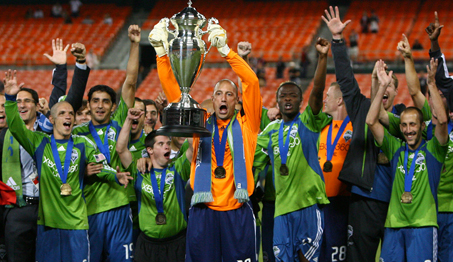
The Sounders won their first US Open Cup title in their inaugural season in 2009. Photo: Seattle Sounders FC

MORE: Read Part 1 of TheCup.us’ biggest US Open Cup controversies

Controversy.

Good or bad, controversies all have one thing in common, they get people talking. Over the years in the US Open Cup, there have been plenty of controversial moments. The problem is, not too many people know about them. Outside of the famous US-England match in 1950, US Soccer history isn’t romanticized like baseball, or made into epic tales like those in football.

Most soccer fans know little about the rich history of the Open Cup, particularly the games other than those of the championship finals. Over the past few years, TheCup.us has dug up the details of those pre-Final tournament games, many of which have never seen the light of day.

We’ve collected the 20 of these tales of dispute from the past 100 years of Open Cup play. This is not a complete list by all means. There is much, much more research to be done and along the way we are sure to find more controversies. For now, sit back and enjoy some of the more tabloid-worthy moments in US Open Cup history.

Note: As you read this, you’ll notice a lot of players with just one name. This is not an oversight on our part, but rather, many of the sources of this information (newspapers, publications etc.) only use the last name of players in their stories.

Part 2: The last 50 years

Apr. 14 – May 2, 1971
Hamm’s Semifinal Forfeit

In 1971 St. Louis’ Hamm’s SC became the first team (but not the last) to forfeit a National Semifinal Open Cup contest.

On April 14, Open Cup secretary Joe Barriskill informed the four remaining teams (Hamm’s, Sparta A & BA of Chicago, Denver Kickers and Pabst Blue Ribbon of Milwaukee) in the Midwest half of the West bracket that the survivor would play Yugoslav American SC in Los Angeles on May 2, and that they should plan accordingly.

On April 19, Tony Morejon from Yugoslav American called both Sparta and Hamm’s (the remaining Midwest teams) requesting player and team info to use in publicity for the May 2 game. Hamm’s sent newspaper clippings.

After Hamm’s defeated Sparta 1-0, Hamm’s representative Jim Moore contacted Cup Chairman John O. Best on April 25 to ask how much the Yugoslav American team was going to guarantee Hamm’s to travel to Los Angeles. Best informed Moore that the away team was required to offer the home team travel expenses for 18 persons. Up until 1971, it was the host team’s obligation to offer the traveling team reimbursement for their travel costs.

Best received a telegram from John Schaper of Hamm’s informing him that Hamm’s were invoking Rule 29 of the USSFA Rules & Constitution and offering $2,000 to play the game in St. Louis. Morejon called to inform Best that they had received a telegram from Hamm’s stating they would not be able to play the game on May 2 in Los Angeles, and they would also file a protest with the Open Cup committee.

Barriskill then telephoned Moore with a proposal in which the USFA would waive their 15 percent cut of the gate receipts and include that with the percentage Hamm’s would receive as the away team, which would total an estimated $2,500. Moore agreed.

When Cup committee member Bob Guelker phoned Hamm’s to tell them the plan was set, he was told that Hamm’s could not make the trip because three of their players would be working on the day of the game.

After being informed of the proposal by the USFA, Morejon decided to call Guelker and was told that the Hamm’s team was apparently at the airport for a 6:30 pm flight to Los Angeles, but their coach and three players could not be located. Morejon seemed encouraged that Hamm’s would make it to LA for the game after all.

Rancho Cienega Stadium was opened to the public at noon on May 2, but Hamm’s were nowhere in sight. Signs were then posted at the stadium that the game was called off, and an exhibition game was played instead for the fans that showed up. The Cup committee concurred that Hamm’s did indeed forfeit by non-compliance and failure to appear for the scheduled game. A protest was received from Hamm’s, but they were informed that the cup committee’s decision was final.

Oct. 31, 1971
New York Greek American SC vs. Everest Merrich

Ladies and Gentlemen, this is a first round match in the Southern New York qualifying elimination tournament for the 1972 US Open Cup championship.

New York Greek American Atlas have won four US Open Cup championships (1967, 1968, 1969, 1974)

In one corner, a perennial heavyweight contender for the US Open Cup championship with a roster full of international players, from the famous German-American League of New York City: Greek American SC.

In the other corner, from the lightly regarded Long Island Soccer League, with a roster full of young American-born players: Everest Merrich.

The Greek American squad treated the match as a formality, as two of their regular players didn’t even bother to show up. What resulted was one of the most shocking scorelines in Open Cup history: Greek American SC 1, Everest Merrich 2.

The GASC immediately filed a protest alleging that two of the players Everest used were ineligible. Both players had in fact been in the GASC organization in the past. One player, who was part of a GASC Junior team at one time, jumped to Everest without getting a proper release and was under a two year suspension. The other player was supposed to be serving a three year suspension for the same offence, and was also ejected from a recent game for striking an opposing player.

Both players were indeed found to be ineligible to play for Everest. When the Open cup Committee ruled that a replay, and not Everest’s disqualification, was in order, the Greeks were furious.

“There is no reason we should have to replay the game,” GASC executive secretary Steve Pantios told Soccer America. The Greeks argued that the game should be forfeited to them, since Everest had knowingly used the ineligible players. With the replay date set for Nov. 17, Everest announced they would pull out of the competition and forfeit, but not due to the ineligible player.

What followed was a war of words between the two clubs. Everest club secretary Dennis Guglielmetti explained the stance taken by his team.

“Through no fault of ours this so-called ‘ineligible’ player was signed on and there is some doubt in my mind that he is indeed ineligible.” Guglielmetti continued, “When the Cup Committee ruled that a replay must be ordered we were shocked. We beat the Greeks fairly and I still feel that we can beat them again, but to play the game again in Cup competition would be unfair not only to our players, but to soccer fans as well.” Guglielmetti went on to also say that his club would be happy to play the game as a friendly, but not as a Cup game, since he felt a replay would “take away the glory which everyone knows we achieved in the first meeting between our two clubs.”

Greek American manager Aristos Vasiledes was not shy about his feelings when told of Guglielmetti’s statement.

“It’s just too bad that they didn’t want to go ahead with the replay since there is no doubt in my mind that the ire brought up in our men would have resulted in them getting one of the worst trouncings in the history of soccer in this country.”

The Greek American club fell out of contention two games later, dropping a 1-0 decision to New York Hota in the New York semifinals. According to TheCup.us records, Everest Merrich never entered the Open Cup again.

April 17, 1971
New York Hota players pull double duty

On their way to the club’s lone Open cup championship in 1971, the New York Hota team ran into a bit of controversy when some of their players pulled double duty with the New York Cosmos.

New York Hota from 1971

Hota were scheduled to face Taunton Sport of Massachusetts in the Eastern semifinals on April 17. The day before, five members of the team, including manager Gordon Bradley, played in the New York Cosmos NASL season opening game in St. Louis (the very first game in Cosmos history), a 2-1 win over the St. Louis Stars. The players then flew back to the east coast in time to help Hota defeat Taunton 4-1 in extra time and earn a spot in the Eastern Final versus Cleveland’s Danube Schwaben.

While Taunton did not file a formal protest, they did lodge a complaint over the players’ appearance for two different teams. The argument was that the Hota players had not been cleared to play for the Cosmos while still registered with Hota.

In the report of the annual USFA meetings, it was decided that the double signing of the players had not violated any Cup rules, and was “done in the spirit and best interests of the game displaying for the first time cooperation between a local organization and the professional league to get the game off the ground and moving.”

Cosmos GM and Vice President Clive Toye absolved Hota of any wrong doing, and pointed out that had the Cup schedule been completed as planned, the conflict would have been avoided. In the same report the USFA recommended that rules be set in place to keep players from appearing for one club while their registration with another team is in effect.

Hota would go on to defeat Danube Schwaben 3-1 in the Eastern Final, and win the Open Cup with a wild 6-4 extra time win over Yugoslav American SC of Los Angeles.

March 19, 1972-March 25, 1972
Willy Roy gets arrested, Croatians get angry

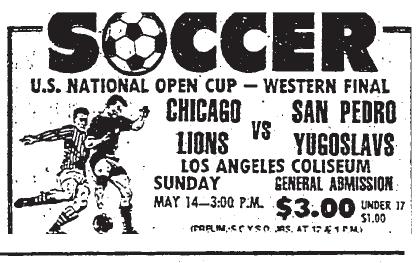
It began with a player being arrested during the game, and ended with a walk-off protest in a separate competition and $100,000 worth of lawsuits. Such was the 1972 Illinois Open Cup Final between the UASC Lions and Croatian SC.

After the Croatians scored the tying goal, a fan ran on to the field in celebration. A while later, the fan claimed he was struck by Lions forward and future Hall of Famer Willy Roy, resulting in the arrest of Roy after regulation time was completed.

The Croatians won the game 2-1 in extra time, but the Lions protested that they were put at an unfair disadvantage by not having Roy on the field for extra time. A ruling was handed down in favor of the Lions, and the game was ordered replayed the next week.

The Lions won the replay 2-1. After the game, Illinois Open Cup Commissioner George Meyer was confronted by several people associated with the Croatian team. However, the trouble did not end there.

The next day the Croatians were set to play Schwaben in the playoffs of the yearly Chicago indoor winter league. During the game one of the Croatian players was sent off for remarks made to the referee. This led to the entire Croatian SC team walking off the field. A few minutes later two of the referees were attacked by three individuals believed to be associated with the Croatian team.

The Illinois State Soccer Association demanded the names of those responsible for the attack. A hearing was called by the National Soccer League, were Croatia SC played. While the ISSA declined to attend the meeting, they handed down their own decision: the team was suspended for one year, club officials for 3 years, and some players for one year.

The NSL protested the decision, arguing that the Croatian SC had not been given a hearing, and that the NSL had not had a chance to announce their decision on the matter. The Croatian SC then attempted to get a court injunction to stop the Lions from playing further Cup games, arguing not only the lack of a hearing from the ISSA, but that they were not given proper amount of notice of the replay.

The Croatians wound up filing a lawsuit against Open Cup Commissioner George Meyer, as well as a $100,000 lawsuit against the ISSA for punitive damages. What became of the lawsuits is unclear, but the Lions went on to the Open Cup Semifinals, where they lost to Los Angeles’s Yugoslav-American SC 2-1.

Jan. 5 and Feb. 2, 1975
A Funny Thing Happened on the Way to the Replay……

On Jan. 5, 1975, New York Hungaria and Inter-Giuliana faced each other at the Metropolitan Oval in Queens in a Southern New York preliminary round game. After 90 minutes of play and the score knotted at two, both teams agreed that it was too frigid to continue, so the match was halted.

On the same day at George Washington High School in Manhattan, Doxa and defending Open Cup champions NY Greek American SC had also finished 2-2 after full time, but were able to play the full 30 minutes of extra time. With the penalty tiebreaker at 4-4, the referee called a halt to the game due to darkness.

A month later all four teams gathered at Metropolitan Oval, assuming full replays of their matches were in order. Doxa and the Greek Americans took the field first, but officials quickly informed them that instead of a replay, they would resume the penalty tiebreaker were they left off in January. This ruling infuriated both teams, who felt the only true solution was a full replay of the match. Roberto Illenis was up first for the Greek Americans, and sent his shot over the bar.

When Doxa’s Nick DeKoste converted his kick the match was over, in less then three minutes. “Let it be known that even before we took the field I told them (Doxa) that if we were the winners it was not a victory I would be proud of.” Greek American manager Kyrikis Fitilis told Soccer America reporter Joe Marcus. Even Doxa supporters were not pleased with how their team advanced.

“This is no way for us to win a match and gain in Cup play,” said George Andredis, a Doxa fan. “There was no real soccer skill involved and I am not proud that my club won the game that way.”

Next up was Hungaria and Inter-Giuliana, and as you might guess, instead of a replay, officials simply ordered the teams to continue play where they left off in January. After 17 minutes of extra time, Ringo Contilla, reigning MVP of the American Soccer League, scored for Inter-Giuliana and they hung on for a 3-2 victory.

Doxa and Inter would eventually meet in the Southern New York final, with Inter prevailing 4-1. Inter Giuliana made it all the way to the Open Cup final, falling to Los Angeles’s Maccabee AC 1-0.

May 29-July 2, 1983
FOE Eagles/GAAC dispute

What do you get when you mix ineligible players, court injunctions, replays, and a threat of an on-field protest? An Open Cup controversy for the ages.

The saga between Seattle’s FOE Eagles and the Greek American AC of San Francisco began simply enough. The two clubs met in the 1983 Region IV Final on May 29 at San Francisco’s Balboa Stadium for the right to travel to Houston, Texas for the National Semifinals. John Kline scored the lone goal in the 19th minute to give the Eagles a 1-0 victory. After it was discovered the Eagles used an improperly registered player (ex-Seattle Sounder Pepe Fernandez), the match was forfeited to the Greek Americans, and they made plans to go to Texas.

The Eagles did not give up easily however. On June 27, the club’s attorney was able to obtain a court order from a Seattle judge declaring the Eagles the winner of the match. The owners of the Greek American AC, John and Jim Rally, were furious when they learned that there was no official USSF representation at the court hearing. USSF volunteer Jo Anderson was present for the hearing, but was turned away because she was not an official USSF representative. The USSF appealed the ruling, and a compromise was reached in which the game would be replayed, with Fernandez eligible. The Rallys arranged to have an attorney of their own investigate the matter, but the replay was still on.

As a result, the Eagles and GAAC were scheduled to kick off their replay in Houston the night before the National Semifinals were to begin. At 10:20 p.m. the game began, and almost 40 minutes later, Peter Fewing gave the Eagles another insurmountable 1-0 lead. At the stroke of midnight the FOE Eagles were once again Region IV champs, set to play the New York Pancyprian Freedoms in the next day’s semifinal.

The next day the Rally brothers announced they would file a lawsuit against the USSF, and also threatened to have their team take the field against the Freedoms in protest of the result from the night before. Delmar Stadium security and Houston police were informed that the Greek American players were to be ejected from the stadium if they tried to take the field. In the end none of the GAAC players showed up, and the Rallys watched as the Freedoms defeated the Eagles 4-2.

John Rally again stated that once he and his brother got back to San Francisco, they would file a $50,000 lawsuit against the USSF for the team’s travel expenses to Houston. “Of course, it’s a great expense for us to come all the way down here and not be able to play in the semifinal.” Rally said. “The USSF never showed the power to dictate and follow their rules.”

Rally also asserted that the USSF should be prepared to present their case in a court in order to explain the rules. “We went to a great expense. The USSF told us to have an attorney investigate the situation in Seattle.” Rally said. “The USSF told us we would have to pay the attorneys, which we aren’t going to do. We’re not going to do their work, it’s their job to do it.”

While the USSF asserted that they believed their original ruling in favor the Greek American team was correct, they admitted that further action was not taken to fight the court order because they wanted the semifinals to run smoothly and be played on time. ‘There was nothing we could do about it, unless we wanted to go to jail or be fined.” USSF rep Milton Aimi said of the Seattle court order.

1970-1984
The NASL Snubs the Open Cup

In the 100-year history of the US Open Cup, there is one very large and noticeable gap in the history of the tournament, the lack of participation from clubs in the North American Soccer League. While no definitive reason has been given, there are many theories as to why the league stayed out of the cup.

One suggestion is that the league didn’t want to risk being embarrassed by losing games to semi-pro teams. The most likely reason is that the NASL simply ignored the Open Cup, seeing it as a competition for amateur teams. Most of the team owners in the league were attracted by the large crowds that were showing up to watch the league games, surely they were not worried about competing against lower level teams.

Despite this, there have been a few times when the NASL was close to participating in the tournament.

In the very early days of the NASL, the teams of the league seemed to have every intention of participating in the Open Cup. In the fall of 1969, the National Soccer News announced that the four U.S. NASL clubs, The Atlanta Chiefs, Dallas Tornados, Kansas City Spurs and St. Louis would participate in the tournament. The four teams would ultimately withdraw in early 1970, citing conflicts with the NASL schedule.

In 1981 the reserve team of the Los Angeles Aztecs, who were playing in the Greater Los Angeles Soccer League at the time, took part in the Open Cup. The team reached the final of the Los Angeles preliminary tournament before falling to Maccabee AC. It is the only known time that a team affiliated with a NASL club took part in the Open Cup.

In the dying days of the NASL, a team finally showed interest in participating in the tournament. In April of 1984, defending NASL champion Tulsa Roughnecks made a formal request to enter the 1984 Open Cup. The initial plan was to allow the Roughnecks to step in and compete in the South region finals in San Antonio on May 19-20 of that year, with the winner moving on to the National finals on June 23-24 in St. Louis.

That plan had to be scrapped because the Roughneck’s NASL schedule interfered with the Regional and National finals, but there was optimism that Tulsa and perhaps other NASL clubs could plan ahead and participate in the 1985 tournament. Unfortunately, the NASL folded before the 1985 season could begin, eliminating the possibility for any kind of Open Cup participation from the North American Soccer League.

The NASL wasn’t the only professional league to stay away from the Open Cup. As the American Soccer League began to expand outside of its traditional territory of New York, New Jersey and New England in the early 1970s, fewer and fewer of the league’s clubs took part in the tournament.  A few years after the death of the NASL and ASL, the American Professional Soccer League continued the tradition of professional teams avoiding the cup.

In fact, the APSL went as far as to create its own competition in 1992 called the Professional Cup.  The tournament was contested by all five of the APSL’s clubs, as well as the Vancouver 86ers and Montreal Supra from the Canadian Soccer League and the Chicago Power from the indoor NPSL. By this time the Open Cup was seen more of an amateur competition, and the APSL clubs may have been more concerned about their own league’s survival, as it has shrunk to five teams by this point.

One national league that did see some of its clubs participate in the early 90s was the USISL. A handful of clubs from the league took part in the cup, including a round robin qualifying tournament in 1991 for the leagues Tex-Oma Conference clubs. That same year the Richardson Rockets and New Mexico Chiles faced off in the semifinals, with Richardson representing the league in the final.

In 1995, teams from both APSL and USISL would face off against the USASA clubs, and with the debut of Major League Soccer in 1996, the top leagues in the country were once again represented in the Open Cup.

June 25, 1994
’94 World Cup keeps McCormick Kickers from Open Cup Semifinal

It’s one thing to miss out on the final because your opponent outplayed you, or even if the game had a controversial ending. To miss a final without stepping on the field brings with it a new level of frustration.

The chance to watch the world’s best players without traveling outside your borders does not come along very often. Thus, the United States hosting the 1994 World Cup was huge for many soccer fans and players. For the McCormick Kickers, it cost them a chance at a national championship.

The Kickers, from St. Petersburg, Fla., were forced to forfeit their National Semifinal match against Milwaukee’s Bavarian SC because the date conflicted with a World Cup game in Orlando the Kickers had purchased tickets to well in advance.

The semifinal was originally set to be played on June 12, but for reasons that were not explained to team sponsor Brooks McCormick, the date was changed to June 19. Due to the tournament sponsor having a contract that stipulated the two finalists must be known a month before the Cup final, the weekend of June 25-26 were the only other option. Since the Bavarian SC was the hosts, they held the right to select the date.

The Bavarian team itself had purchased a large quantity of tickets for the Greece-Bulgaria game on the 26th in Chicago, so June 25 was the only option for them. Kickers manager Steve Gogas had sent a letter to the Cup committee in mid-April, long before the Kickers even qualified for the semifinal, explaining that the team would not be able to play on either June 19 or 25.

“It’s a shame for the kids who worked so hard. It’s not fair for the players. It’s not fair for the sport,” Gogas told the St. Petersburg Times. In protest, Gogas resigned from his position as Kickers manager.

Gordon Redshaw, the chairman of the National Cup committee, said the Kickers “wrongfully assumed we were willing to change the date. We gave them an extra week and that’s the best we could do.”

“It’s a joke,” said Kickers defender Craig Fossett. “The World Cup isn’t something you pass up. And they told us two months ago this wouldn’t be a problem.”

Aug. 20 – Sept. 15, 1996
In the Quarterfinals, Kansas City is playing the Colorado……WHO?!

1996 was a big year for the US Open Cup, with teams from Major League Soccer entering the competition in the debut season of the league. All of the lower division clubs were lining up to take their shot at the new big boys of American soccer. What the APSL’s Colorado Foxes did not count on was being part of the first big controversy of the Open Cup’s Modern Professional Era.

After dispatching the USISL’s El Paso Patriots 5-1 in the second round, the Foxes looked forward to a chance to upset the then named Kansas City Wiz, who was one of the stronger teams in the first summer of MLS play. Before the APSL upstarts could face their MLS goliath, another team’s World Cup aspirations derailed them.

On Aug. 20, US Soccer held a conference call to sort out the details of the Quarterfinal matches. As hosts, Kansas City offered two dates to play the game, Sept. 14 or 15. APSL commissioner Richard Groff objected to both dates, citing the Foxes APSL match on Aug. 13 against Rochester. After Kansas City refused to move the game to Denver, the Foxes GM eventually agreed to play the match on Aug. 15, with the thought that the team would have their full roster available to handle the one day of rest between games.

Two days later, the Jamaica Football Federation formally requested the release of five players (Walter Boyd, Anthony McCreath, Gregory Messam, Wolde Harris and Fabian Davis) on the Foxes roster for their Aug. 15 World Cup qualifying match against Honduras. The Foxes made a request with US Soccer to have the match rescheduled, but Kansas City refused to move the date, citing their own tight schedule in Major League Soccer. On Aug. 10, the US Open Cup committee told both clubs they would be allowed to add two players to their rosters, but the match had to be played on Aug. 15.

After considering their league schedule, loss of players and quality of players available, the Foxes took a vote and decided to forfeit the match to the Wiz.

”This was a tough decision, reached only after a hard-fought battle,” Foxes president and former Denver Broncos kicker Rich Karlis said in the forfeiture announcement. ”Unfortunately, it’s the result of many long discussions ending in an inability to reach a compromise.”

Instead of giving the Wiz a free ride to the semifinals, it was decided to allow the Colorado Rapids to take the Foxes’ place. At the time, the Rapids were dealing with a miserable first season, sitting in last place in the MLS Western Conference and long eliminated from playoff contention. To make matters more interesting, right about the time the Rapids were thrust into the Open Cup, they fired manager Bob Houghton and general manager Rich Levine.

Rapids forward Roy Wegerle was named the interim manager, and he seemed optimistic about the Rapids chances against the Wiz, who were in first place in the MLS Western Conference.

“It’s some way of salvaging a somewhat disappointing season,” Wegerle told the Rocky Mountain News. “We’re not as bad as we showed this season.”

Wegerle’s optimism was rewarded with a 3-2 victory over the Wiz on the strength of two Chris Henderson goals. Nearly a month later on Oct. 12 the Rapids would fall in the semifinals to the Rochester Raging Rhinos 3-0. The very next night the Wiz were eliminated from the MLS playoffs by the Los Angeles Galaxy. The Colorado Foxes went on to drop their first round APSL playoffs series to the Seattle Sounders.

June 4 – July 10, 2003
Chesapeake Dragons vs. Bridgeport Italians vs. New Hampshire Phantoms

New Hampshire Phantom logoOn June 4, 2003, the USASA’s Bridgeport Italians pulled off a 1-0 win over the Chesapeake Dragons of the USL Premier Development League. A Ruben Fernandez goal in the 25th minute was all the amateurs from Connecticut needed to move on to Round 2 where they would face the New Hampshire Phantoms of the USL Pro Soccer League.

On June 25,  they lost to the Phantoms 3-0, but the match ultimately wouldn’t count because Chesapeake filed a late protest that meant if Bridgeport won they had to play Chesapeake again but if they didn’t win, New Hampshire had to play another second round game against Chesapeake.

With the second round match a week away, Chesapeake filed a protest with US Soccer on June 18, alleging that Bridgeport had provided “inaccurate” information about two players on the roster that was submitted prior to the June 4 match. The main focus of the protest was Darin Lewis, a former Trinidad and Tobago national team member who Chesapeake alleged was listed as Lewis Daria on Bridgeport’s roster. Chesapeake later dropped their complaint about the other player, Carlos Silva, since he never entered the game.

During the conference call hearing regarding the matter on June 23, Bridgeport representative Boris Medvedev confirmed that the player in question was in fact Darin Lewis, but maintained that his club did not knowingly attempt to deceive, as they believed Lewis was properly registered with the Connecticut State Soccer Association.

At the conclusion of the conference call, the US Open Cup Adjudication and Discipline Panel ruled that Lewis was ineligible to play due in the Open Cup for Bridgeport due to being registered as a professional player with US Soccer.

The panel also ruled that while Bridgeport did not knowingly attempt to deceive, they were “responsible for not insuring the accuracy and proper handling of its player registration process.” With a 3-2 vote, the panel decided the match was to be replayed on July 2. The only problem was the second round game between Bridgeport and New Hampshire was to kick off on June 25, just two days after the hearing.

What resulted was a Twilight Zone-type of situation. It was decided that the New Hampshire-Bridgeport game would go off as planned, with the following stipulations: If Bridgeport won, they would have to go back and replay their first round game with Chesapeake to advance to the third round. If Chesapeake won the replay, New Hampshire would have to play another second round match to determine who advances to the third round.

Chesapeake would also get to play New Hampshire in the second round if New Hampshire defeated Bridgeport in the second round.

Get all that?

The final scenario was the one that won out, as the Phantoms won 3-0 over Bridgeport on June 25, resulting in a July 10 game that saw the Phantoms prevail 3-2 over Chesapeake in sudden death extra time.

After all that, what did New Hampshire get for winning two second round games? A match against the Rochester Raging Rhinos, in which the Phantoms were pounded 5-1.

2002-2011
Buying Home Field Advantage

When professional clubs joined the Open Cup in 1995, the USSF implemented a bidding process for later round matches to determine who would host tournament games. In the early rounds, the Open Cup commissioner would announce the hosts for each game, taking into account factors such as travel, venue quality and availability while also making sure that one team did not host too many consecutive games. Prior to 1995, the cup commissioner, backed by a committee, would determine who hosted every game of the tournament.

Photo: Seattle Sounders FC

George Mellis, the long-time general manager for the New York Greek American Atlas, a four-time Open Cup champion founded in 1941, said, in his experience, the decisions by the cup commissioner were almost always fair. Very simple logic was involved in the decisions, such as, if both venues were equal and you hosted the last round, then you wouldn’t host the next round.

In 2002, the USSF expanded the bidding process to include all games of the tournament, in an effort to remove subjectivity from the decision-making process and to help with the costs associated with the competition.

The process evolved slightly since 2002, but for the 2011 US Open Cup, the system for determining home games began with the USSF setting a deadline of May 26 for qualified teams to submit their bids for the first and second rounds.

Part of the bidding process allowed interested teams to declare two different venues (e.g. Seattle Sounders used both Starfire Sports Complex and CenturyLink Field in 2011), and submit an application declaring which venue they plan to use, and answering questions that would help the USSF determine if that venue meets their minimum standards (lights, locker rooms, field size etc.).

In addition to meeting those standards, each team was encouraged, not required, to commit to a financial bid to the federation. Assuming the team’s proposed venue was acceptable, the criteria came down to who wrote the biggest check. The team who bid the most, got to host. While the amounts of the bids were kept a secret, sources told TheCup.us that the amounts range from $500 to as much as $200,000 to host the championship game.

Writing a check isn’t the only option. In fact, according to the Open Cup handbook distributed by the USSF to teams, the proposals can vary.

“The parameters for such proposals are open-ended and may include a financial guarantee to US Soccer, a guarantee plus percentage of the gate, or a percentage of the gate alone,” the 2011 handbook read. “Teams may consider a financial guarantee paid in advance to strengthen their proposal, although this is not a pre-requisite. However, U.S. Soccer will take the absence of a check at the time of submitting a Hosting Proposal into consideration in the selection process.”

The teams submit their checks in advance, but only the winning bids have their checks deposited, with the losing bids getting theirs sent back.

After the Second Round, the stadium standards increase, but the same procedure is followed with USSF setting a deadline in advance, and teams bidding to host the Third Round and the Quarterfinals, and later the Semifinals and the Final.

The heart of the controversy of the bidding process was the lack of transparency. It doesn’t take long to find quotes from team officials criticizing the process, but the situation that received the most attention was a war of words in 2009 between the Seattle Sounders and DC United. After United was chosen to host the 2009 Final, a disappointed Sounders general manager Adrian Hanauer took the opportunity to criticize the secret process and to suggest that the defending champions were given favortism over the first-year MLS franchise from Seattle.

“I do still feel like the bidding process could be more transparent and better understood by fans, owners, general managers,” Hanauer told the Seattle Times. “Now, it’s purely financial. I don’t know if that’s the best way to , especially if you want a major tournament. There are other ways to do it. You can do a draw, like they do for other major tournaments around the world.”

Hanauer also suggested that the defending champions were given special treatment, but since no one knows the amount that each team bid, DC general manager Kevin Payne felt the cricism was baseless.

“We participated in the process, and we won,” Payne told the Seattle Times. “I was a little offended that because I am on the board of the US Soccer Federation, that my team was shown favoritism.”

If Seattle would have been chosen, the game was going to be played in the afternoon and Payne felt that the prospect of an afternoon broadcast in the middle of the week on Fox Soccer Channel may have played a role in the decision.

Regardless of what happened behind the scenes, the spat between Hanauer and Payne created some extra buzz for the game and may have been the first step toward the changes that came for the 2012 and 2013 tournament. In 2012, the secret bidding process was eliminated and as long as both teams met the federation’s venue standards, then both clubs are entered into a blind draw.

Filed Under: Feature - History, US Open Cup, US Open Cup History Tagged With: National Challenge Cup, US Open Cup

Biggest US Open Cup controversies of last 100 years, Part 1: The Soccer War, boycotts, the ultimate sister kiss and more

September 30, 2013 by Chuck Nolan Jr.

MORE: Read Part 2 of TheCup.us’ biggest US Open Cup controversies

Controversy.

Good or bad, controversies all have one thing in common, they get people talking. Over the years in the US Open Cup, there have been plenty of controversial moments. The problem is, not too many people know about them. Outside of the famous US-England match in 1950, US Soccer history isn’t romanticized like baseball, or made into epic tales like those in football.

Most soccer fans know little about the rich history of the Open Cup, particularly the games other than those of the championship finals. Over the past few years, TheCup.us has dug up the details of those pre-Final tournament games, many of which have never seen the light of day.

We’ve collected 20 of these tales of dispute from the past 100 years of Open Cup play. This is not a complete list by all means. There is much, much more research to be done and along the way we are sure to find more controversies. For now, sit back and enjoy some of the more tabloid-worthy moments in US Open Cup history.

Note: As you read this, you’ll notice a lot of players with just one name. This is not an oversight on our part, but rather, many of the sources of this information (newspapers, publications etc.) only use the last name of players in their stories.

Part 1: The first 50 years

Nov. 30, 1913 – Jan. 18, 1914 Niagara Falls Rangers vs. MacNaughton Rangers

Niagara Falls Rangers from the 1913/14 season

Not only did the first ever National Challenge Cup tournament in 1914 crown the first true United States soccer champion, it also provided the first major controversy of the century-old tournament.

In a second round game between the Niagara Falls Rangers and MacNaughton Rangers of Rochester, New York on November 30, 1913, the Rochester club won the game 1-0 on a goal from Stille, despite being dominated by Niagara Falls for the bulk of the contest, and seemed headed for a third-round match up with Roses FC of Detroit.

On December 4 the Niagara Falls Gazette reported that the losing Rangers had filed a protest with the USFA over the game. Two members of the Niagara Falls management committee stayed in Rochester an extra day and discovered that MacNaughton’s left full back, Bliss, has signed an amateur form for the Cup game. It was also revealed that Bliss served as a high school coach in Rochester for which he was receiving a salary, which according to the rules of the time would make him a professional. Bliss was no ringer for the Macs, having played for the team during the season leading up to the game.

At the USFA meeting on December 14 it was decided the matter would be held over while more evidence could be provided. MacNaughton had argued that the protest should have been brought forth when the teams exchanged rosters prior to the game, but USFA President Dr. G. Randolph Manning ignored their protest by ordering an inquiry into the playing status of Bliss. Finally on Jan. 5 during an emergency meeting of the USFA, the Niagara Falls team was granted a replay of the game, to be played in Niagara Falls.

McNaughton Rangers in 1914

In addition to the question of Bliss’s eligibility to play, MacNaughton was also cited for how the game itself was conducted. All Cup games were to have an admission price of 25 cents. The Macs had been charging 15 cents for their games all season, and protested the additional 10 cents in admission because their field was not properly enclosed. The USFA refused to move on the matter.

The anticipation of the replay was stopped cold the day before the game when MacNaughton announced they would not make the trip to Niagara Falls due to widespread illness in the team.

As a result of the admission fee row, MacNaughton failed to provide an official at the gate until almost kickoff, and also neglected to fill gaps in the hedges that ran down one side of the field, which allowed hundreds of spectators to avoid paying any admission at all. Niagara Falls received only $28 ($619 adjusted for inflation) for their cut of the gate, despite newspaper reports that there were 3,000-5,500 in attendance. The MacNaughton Rangers were fined $15 ($331 today) for the game admission fiasco, and the replay was set for Jan. 18, 1914, with bad blood inevitable.

MORE: Relive the inaugural National Challenge Cup with our “First Cup” series

April 1-3, 1923
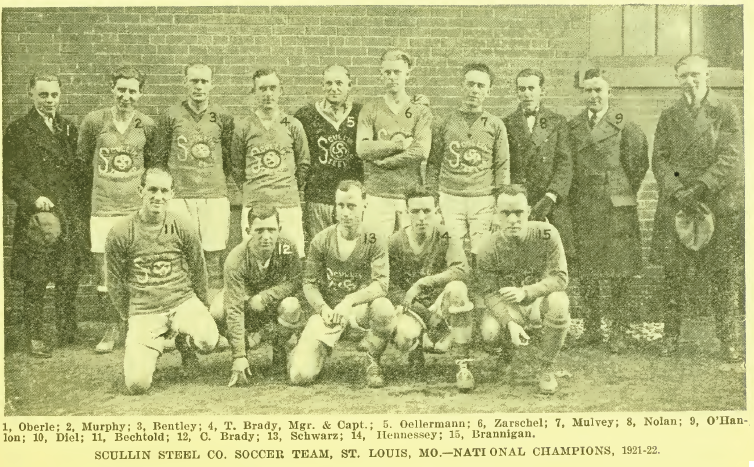
Scullin Steel forfeits the 1923 final

St. Louis’ Scullin Steel was making their third final appearance in a row, looking to defend the championship they had won in 1922 over Brooklyn’s Todd Shipyards. Scullins’ run to the Open Cup Final was part of a string of thirteen finals appearances by St. Louis clubs from 1920-1937. Their opponents, New Jersey’s Paterson Silk Sox, were wrapping up their first season in the American Soccer League, although they had played for years in the National Association Football League (NAFBL).

The final in Harrison, New Jersey turned out to be a thrilling affair. Scullin took a 2-0 lead after 57 minutes thanks to goals from Brannigan and Allie Schwarz. Paterson cut the score to 2-1 on Tommy Duggan’s goal eight minutes later, and John Heminsley tied the game with just six minutes remaining. Extra time failed to produce a winner, so a replay was in order.

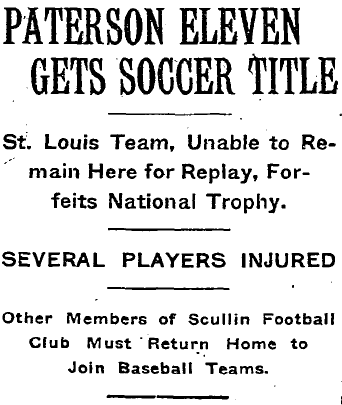
When the USFA decided the replay would be held in the East, the St. Louis club announced they would not be able to field a team for the rematch. Scullin players Oellerman, Brannigan, Mulvey and Rooney had departed for baseball training camps. Also, Nolan, Bechtold and Bentley were injured for Scullin and not able to play. Scullin management suggested that had the replay been set for St. Louis, the players could have made it to St. Louis in time for the game. Keep in mind in 1923 commercial travel by air was still in its infancy, and interstate highways were still decades away. Travel by train was the only viable way across the country.

Scullin Steel

Oddly enough, instead of putting up a massive fight the have the game moved to St. Louis, Scullin management decided it would be best, and honorable, to forfeit the replay rather than field an inferior team. The club issued a statement detailing the decision and their reasons behind it. The final part of the statement read as follows:

“The Scullin Steel Club believes it is more honorable to surrender the National Cup and the title of which it is emblematic, under the circumstance, than to send into the playoff against Paterson a team wholly inadequate to compete for the championship of the United States and incapable of defending the title, which the Scullin F.C. hereby surrenders.”

With that, the first major controversy of the US Open Cup ended not with a heated argument, but with a whimper. Scullin fell early in the 1924 tournament, and eventually closed up shop in 1926. Paterson’s new owners for the 1923-24 ASL season moved the team to New York and called them the Giants. The Giants would later be at the center of another major controversy, the 1929 Soccer War.

Read the full story about the 1923 National Challenge Cup Final: Paterson FC claims New Jersey’s “tainted” first title

1925
ASL/St. Louis teams Boycott the Cup

From 1922-1937, teams from St. Louis or the American Soccer League won 14 out of 16 National Challenge Cup championships. A dispute centered on the way the cup was contested likely kept that total from reaching 15.

The Soccer War of 1928 & 1929 could very well have taken root in 1924, in the run-up to the National Challenge Cup tournament. American Soccer League clubs protested several issues which they felt put their clubs at a disadvantage as far as the Cup went.

One was that all of the ASL clubs were drawn into the tournament from the very beginning. Owners argued this forced them to play meaningless games against overmatched amateur clubs that had no realistic chance of winning. On top of that, the owners argued, if their teams were drawn to travel to play these preliminary games their clubs often lost money since the smaller gate receipts from their amateur hosts often failed to cover their travel costs. The ASL owners felt their teams should be exempt from these qualifying games and be allowed to enter later in the tournament.

Another of the major sticking points, perhaps the biggest one from the owners’ point of view, was the percentage of the gate the USFA took for cup games. The USFA took 33.3 percent of the gate receipts for Challenge Cup games, leaving the rest to be split between the two clubs. The ASL teams wanted to reduce the USFA’s cut to 15 percent.

When the tournament draw was released on Oct. 3, 1924, none of 12 ASL clubs, or the 4 professional teams from the St. Louis Soccer League, were included.

The USFA agreed to the ASL’s request on the tournament setup, and allowed 12 teams from the East and the West join in at a latter stage in the competition, with four clubs advancing from the preliminary rounds to make up a 16 team “first round proper” in each half. The USFA would not budge on the issue of gate receipts however.

While the Challenge Cup proceeded without them, the protesting clubs formed their own competition, the American Professional Soccer Championship. The St. Louis Soccer League proposed the idea that the champions of the two leagues meet in the spring of 1925 in a championship series. The ASL sent their Lewis Cup champion to face Ben Miller SC, winner of the SLSL. The three game series was won by Boston, and the games were played in front of crowds of at least 10,000 for each game.

On the Challenge Cup side, things were not looking so great. With the absence of the ASL teams, attendances took a nose dive in the rounds leading up to the final. The 1925 championship was contested by Chicago’s Canadian Club and the Shawsheen Indians of Andover, Massachusetts, two teams which had never reached the final before, and never would again. The fact that two newcomers were in the Cup final showed in the attendance numbers. The attendance for the final at Mark’s Stadium in North Tiverton, Rhode Island was a woeful 2,500, down from the 14,000 that saw Vesper Buick and Fall River Marksmen in St. Louis the previous year.

In May 1925, a month after the Challenge Cup final, the USFA saw the writing on the wall and gave in to the concessions demanded by the ASL, at least as far as the Challenge Cup was concerned. With the ASL and St. Louis clubs back in the tournament, the 1926 final drew 18,000 at Brooklyn’s Ebbets Field to watch Bethlehem Steel defeat Ben Miller 7-2.

1928 – Oct. 1929
The Soccer War

While the ASL/St. Louis boycott of the 1925 National Challenge Cup was still fresh in the memory of soccer fans, a more costly skirmish erupted in 1928. The reason given for the troubles was the ASL’s participation in the National Challenge Cup, but what was really at stake was control over the governing body of soccer in this country.

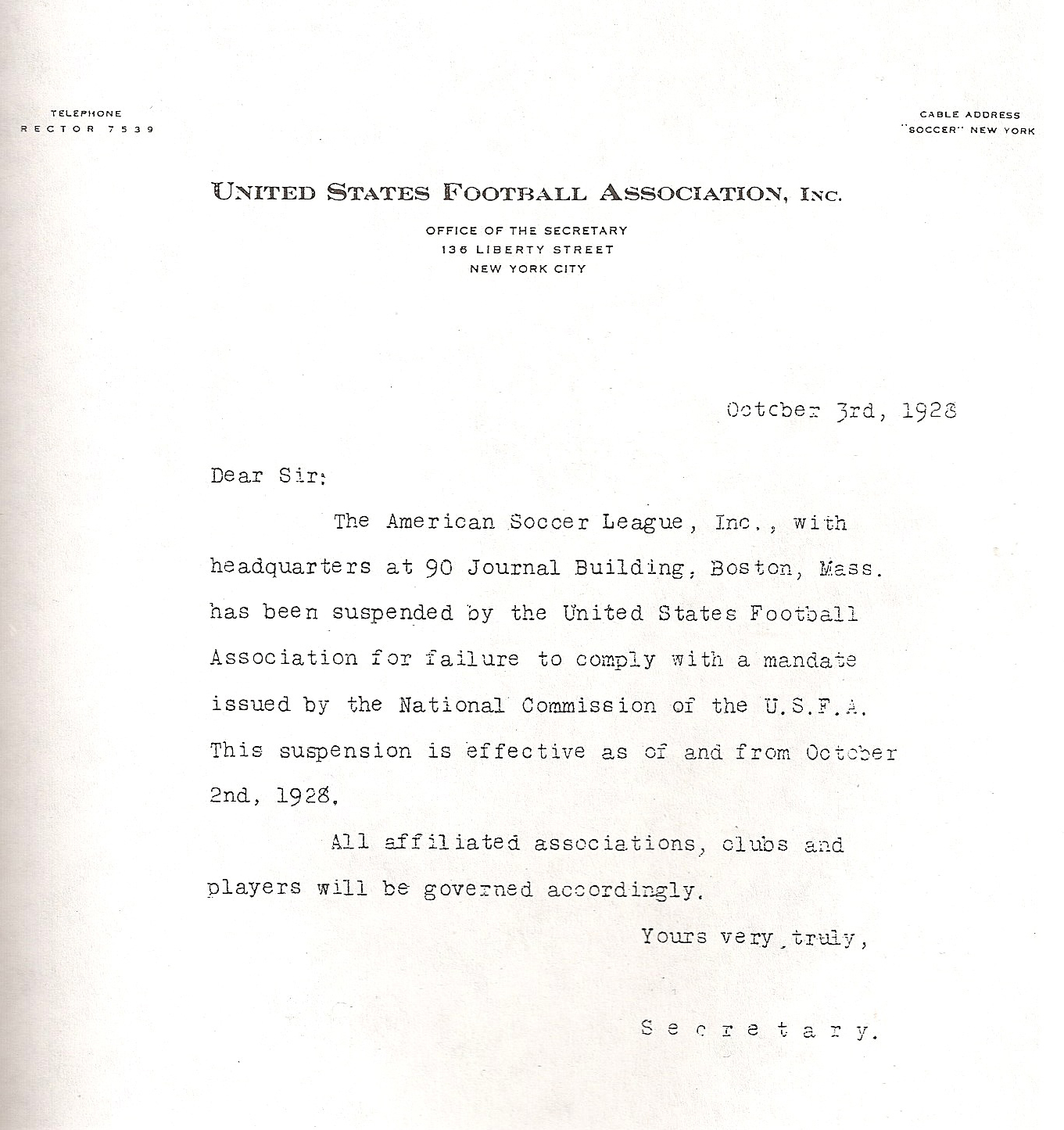
The letter informing the American Soccer League that they have been suspended by the U.S. Football Association

Trouble began to brew in 1927, when the USFA was nearly suspended by FIFA for ASL teams signing players still under contracts with European clubs. The USFA wriggled its way out of trouble by agreeing to a number of sanctions and limitations to keep European players from breaking contracts to play in the United States. Many of the ASL clubs were not happy with this development. The ASL owners, most of whom also owned baseball teams, looked to free themselves from the USFA’s control and run the league more like baseball, without being subject to a higher authority.

Even though their teams returned to the Cup for the 1926 edition, ASL owners were still bothered by the fact that cup games were played during the ASL season. While the 1925 boycott was over the USFA’s cut of the gate and playing preliminary games, this time the owners claimed the cup games disrupted the ASL season, confused fans, and wore their players out, predating by decades modern complaints of fixture congestion.

New York Nationals owner Charles Stoneham, who also owned the New York baseball Giants, proposed that the other ASL owners remove their teams from the Challenge Cup, create a Midwest division of the ASL, and create a final match between the division winners that would eclipse the Challenge Cup Final. Most of the ASL owners agreed to Stoneham’s plan, except for three teams. Bethlehem Steel, Newark Skeeters and the New York soccer Giants defied the other ASL clubs and entered the Cup anyway.

This led to the ASL suspending the three teams, after which the ASL was suspended by the USFA, making them an outlaw league. Bethlehem, Newark and the Giants, along with several semi-pro teams from New York, formed the Eastern Soccer League. Of the three, the Giants made it the furthest in the 1929 Cup, reaching the Eastern Final were they lost to fellow ESL club Hakoah All Stars, who went on to win the Cup.

Under pressure from the USFA and other national federations, the ASL realized their fight could not be won. By Oct. 1929 the ASL made peace with the USFA, and halted their 1929 fall season after a few games in order to restart with the Bethlehem, Newark and the Giants, playing under the name Atlantic Coast League.

While things were patched up between the country’s major soccer powers, trouble still loomed ahead. The infamous 1929 Stock Market Crash occurred just weeks after the truce. With the Great Depression under way, the first ASL succumbed in 1932, and was replaced by a smaller, semipro ASL in 1933. Gone were the days of luring English and Scottish players with higher wages. As a result, soccer fell to the back of the pack among the emerging professional sports in gaining popularity in the US, such as football and basketball.

1931
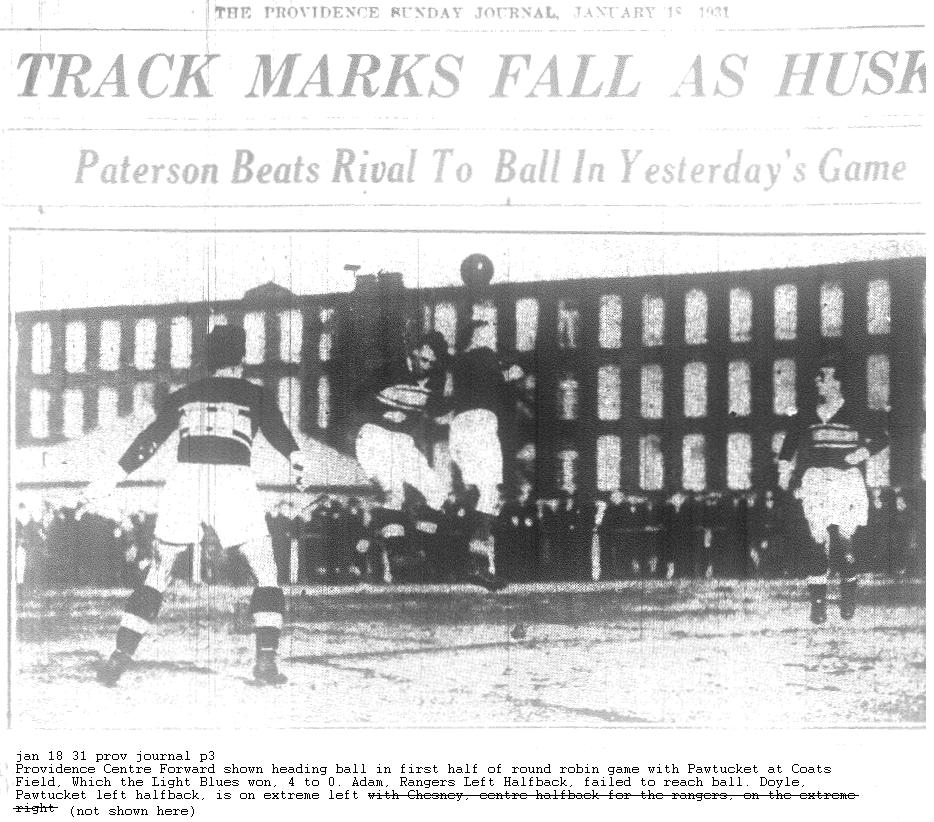
American Soccer League plays round robin qualifying

When the practice of Major League Soccer teams playing qualifying games to get into the Open Cup began in 2007, some fans and the teams themselves weren’t happy. Many questioned how the tournament could be taken seriously if all of the top flight teams are not involved.

76 years earlier, the same concerns were raised when the American Soccer League decided to have their teams play round robin qualifying for a spot in the Eastern Semifinals.

Just two years removed from their scrap with the USFA in the “Soccer War”, the ASL decided, apparently with the USFA’s approval, to have their clubs skip the early rounds of the knockout competition in order to engage in two qualifying groups. The ASL’s New England teams formed one group, while the teams in New York City comprised another. The ASL owners argued that playing the round robin qualifying matches would ensure the two best teams would reach the Eastern Semifinals.

However, most knew the real reason for the qualifying setup: more matches among ASL clubs meant more gate revenue for the owners. Plus, the clubs assumed that since the games were not proper cup games, the USFA could not take their 25 percent of the gate.

One dissenting voice was that of Boston Globe writer George M. Collins. In his Jan. 5, 1931 column, Collins stated his displeasure of the ASL qualifying scheme:

“Under What rules is this season’s National Cup series? Has this premier cup competition conducted by the United States Football (Soccer) Association become one of the celebrated “rackets?” What does this “round-robin” series which the American League clubs are to engage in mean

The “knockout” idea made the National Cup games attractive to the fans. Going to the game knowing that it was sure to be a case of “death or glory” made the boys anxious to see the tilt. This new idea of playing a “series of games” on a league system may produce more money and it may not. That remains to be seen.”

Collins again argued against the games in his January 12 column:

“Soccer fans refuse to be “kidded” with this year’s National Cup round-robin series. Attendances in New England prove it. Back in the days of the “knock out” tilts, a meeting between Fall River and Pawtucket or New Bedford would have packed in 10,000 fans.

The round robin series, even if it is only an experiment, should not have been arranged or permitted by the United States Football Association, because it’s not what the fans want. Nor is it according to the rules and regulations of the governing body.

The angle of the pro clubs is different. Who is going to pay the salary of the players if no games are to be played in January and February? One thing is certain and that is that unless the National Cup games are on the “knockout” plan, attendances will not increase.“

The Hakoah All Stars and Fall River Marksmen emerged as the two ASL survivors, and had mixed results in the Eastern Semifinals. Hakoah wound up losing to the Newark Americans, the lone ASL team to skip the round robin series. Fall River went on to win the 1931 Cup. In an interesting twist, the Marksmen had merged with another ASL team, New York SC, to become the New York Yankees. The team was required to play as the Marksmen for the remainder of the tournament, since they began cup play under that name.

The ASL teams resumed conventional Cup play in 1932, but returned to the round robin format again in 1933. By this time the ASL was a shell of its former self, having disbanded and reformed as a lower budget semi-pro league. The two group winners, Pawtucket Rangers and New York Americans, survived their semifinal games and met in the Eastern Final, which the Americans won on aggregate, 6-5. The Americans went on to drop the 1933 Final to Stix, Baer & Fuller of St. Louis.

May 5-June 13, 1940
Sparta and Baltimore share the championship

1940 US Open Cup Final

If playing to a tie is like kissing your sister, what would sharing a championship be like? That’s exactly what Chicago’s Sparta A & BA and Baltimore SC did in 1940 when they couldn’t agree on the details of a tiebreaking third match for the Open Cup Championship.

The first game of the two-leg aggregate series was on May 5 at Bugle Field in Baltimore. Sparta and Baltimore played to a scoreless draw. During the second leg the following week in Chicago, Baltimore took a 2-0 lead in the first half but Sparta came back with two goals in the second. Tied 2-2 after 90 minutes, the clubs played 30 minutes of extra time without settling anything. When referee Phil Fox ordered the teams to play another 30 minutes to break the draw, Baltimore refused to continue.

Speculation ran wild as to whether Baltimore would be disqualified. On May 22 it was reported that the USFA Challenge Cup Committee would take a mail vote to decide if the title would be awarded to Sparta, or if a third match would be scheduled.

When asked why his team refused to continue, Baltimore manager Fred Doyle claimed that his players’ health would be endangered due to the loss of sleep from traveling to Chicago, as well as playing two hours on a field made very dusty by high winds. Doyle also said that Fox admitted to him that he himself was in no condition to continue.

On May 29 the committees’ votes were tallied and a third game was ordered played. The game was to be played on June 16 at Starlight Park in New York City. Baltimore was also fined $50 (about $750 adjusted for inflation) for walking off the field in Chicago.

On June 6 it was reported that Sparta had appealed to the USFA to move the game to Chicago, claiming that many of their players would not be able to make the trip, as well as the loss of star forward Jimmy McDermott through a suspension. Also complicating matters was Baltimore’s request that they receive double the normal amount for travel expenses.

With no middle ground in sight, the USFA announced on June 11 that the third game was postponed, and on June 13 the game was cancelled all together. As a result, Sparta and Baltimore became the only co-champions in Open Cup history.

Sparta Ogden Dairy vs. Chrysler SC
Mar. 1 – 31, 1942

Just two years after Chicago’s Sparta were forced to share the Open Cup championship when the Baltimore SC walked off the field refusing to play extra time, Sparta would cause controversy as the team walking off the field.

In the late 1930s/early 40s, Chicago’s Sparta Ogden Dairy (one of many sponsor names tacked onto Sparta’s name in those days) and Detroit’s Chrysler SC were two of the better teams in the Western half of the Open Cup bracket each year. Sparta represented the West in the 1940 Open Cup final, and Chrysler reached the final in 1941. When they were slated to meet in the 1942 Western Quarterfinals, it looked to be one of the showcase matches of the tournament that year. In the end, the Chrysler team disbanded as a result of what unfolded.

The first game in Chicago went smoothly enough, as Sparta and Chrysler played to a dramatic 3-3 extra time draw. Neil Campbell had scored what looked to be the winning goal for Chrysler in the 88th minute, only to see Sparta’s Jerry Rezak convert a penalty kick in the final minute to send the game to extra time.

Things got messy in the replay a week later in Detroit.

Once again the game went to extra time, this time on the dramatics of George Hay scoring from the penalty spot for Chrysler in the 90th minute. After the teams played a scoreless 30 minutes, referee Jack Wilson called for an additional 30 minutes. Wilson claimed he was instructed by the USFA that the game had to end with a winner (penalty kicks were not used as a tiebreaker until the early 1970s).

Sparta manager Ray Schwarzkopf pulled his team off the field, claiming they were physically unable to continue. Schwarzkopf also argued that since Chrysler were not required to keep playing in Chicago, he saw no reason why his club should do the same in Detroit. Some in the Detroit crowd felt this was simply a ploy by the Chicagoans to avoid defeat since two of their players, Jimmy Wolf and Joe Janezic, were playing with injuries.

After hearing that Chrysler manager McInnis would refuse a replay of the game, Schwarzkopf seemed unconcerned. “You don’t think that the USFA would let Chrysler win that way, when it can order a replay to get another 25 per cent cut of the gate,” the Sparta manager told the Chicago Daily Tribune.

After referee Wilson initially awarded the replay to Chrysler via forfeit, the USFA upheld an appeal by Sparta and insisted a replay was to be scheduled, seemingly contradicting the very orders given to Wilson. While not happy with the decision, Chrysler relented and accepted a replay, on the condition that the date pushed back. Chrysler secretary William Hay claimed the club had been informed of the replay date a mere five days before the game was to be played, and that they could not possibly get all of their players off of their World War II defense jobs on such short notice.

In addition to refusing to push back the replay date, the USFA more or less gave Chrysler a “show up or else” threat. USFA Secretary James Armstrong informed the club that “failure to appear in Chicago would mean forfeiture of the game and would also result in further drastic action”. This proved to be the last straw for the Detroit club, as Hay announced that not only would Chrysler withdraw from the competition, they would also disband their team.

“We played one-half hour extra session in Chicago,” Hay told the Chicago Daily Tribune, “and that’s all we were asked to play. But the game here (in Detroit) was to have been to a finish and the USFA instructed referee Jack Wilson to that effect,” Hay continued. “The Sparta team knew that before the game started. Thus, the USFA’s order for a replay seemed to be unjustified in the first place.”

A few days later the Chrysler team reconsidered and filed an appeal to play the match on April 5, but the USFA turned down the appeal and Chrysler was out of luck. Sparta would go on to the Western Final, were they lost to Pittsburgh’s Gallatin by a 4-3 aggregate score.

March 1948-October 1949
St. Louis expense protest

A year and a half before the most famous victory in United States soccer history, a dispute over expenses led the defending Open Cup champions to withdraw from the 1949 tournament.

The trouble began in April of 1948, when two Chicago clubs, Sparta and Schwaben, visited St. Louis for Open and Amateur Cup games, respectively. It was after these matches that the Chicago clubs took exception to the expense report submitted by the St. Louis teams, Simpkins Ford (Open) and Steamfitters SC (Amateur). The Windy City teams claimed Simpkins and Steamfitters expense claims were “outlandish” and high above what has allowable under the National Cup rules.

The teams from Chicago’s National Soccer League voted unanimously to boycott future National Cup competitions unless the matter was straightened out by the USFA. They also demanded to be reimbursed their proper share of the gates after the proper expenses had been deducted.

Six months later, the topic of expense reports popped up once more, again involving Simpkins Ford. This time it centered on the travel bill for New York’s Brookhattan to play the 1948 Final in St. Louis. The joy felt by Simpkins after winning the Final 3-2 on an 89th minute strike from Henry Merlo soon faded when Brookhattan made an appeal to the USFA that the St. Louis club owed them $1,550 (about $13,000 adjusted for inflation) in travel expenses.

Simpkins took exception to this, stating that they followed the letter of the USFA rulebook by offering to pay Brookhattans train fare, but not the more expensive airline flight. Brookhattan claimed that flying instead of coming in by train saved time away from work for their players. Perhaps adding to their frustration after the close loss, Brookhattans return flight was delayed for 22 hours in Columbus, Ohio after a forced landing.

Just two weeks after the 1948 final, and another few weeks away from the start of preliminary games for the 1949 tournament, the representatives of the four clubs from the St. Louis Major Soccer League announced they would not participate in the upcoming tournament.

“We haven’t been able to establish harmonious relations with the USFA in cup game matters.” explained Eddie Murphy, president of the St. Louis league.

Murphy hoped to work out some kind pf championship final between the St. Louis league winner and the champion of the American Soccer League, just as in 1925 when the clubs from both leagues boycotted the Cup tournament that year. Nothing came of the proposed championship showdown.

St. Louis was left to be represented in the 1949 cup by four teams from the city’s amateur Municipal League. Zenthrofer Furs managed to reach the Western semifinals, but to get there only needed to defeat the other St. Louis amateurs and a club from Dallas, Texas making its first Open Cup appearance. The St. Louis pro clubs would return for the 1950 competition, which was won by Simpkins. The 1949 boycott kept the team from having the chance to become the second team (at the time) to win three Open Cup titles in a row.

1955-1957
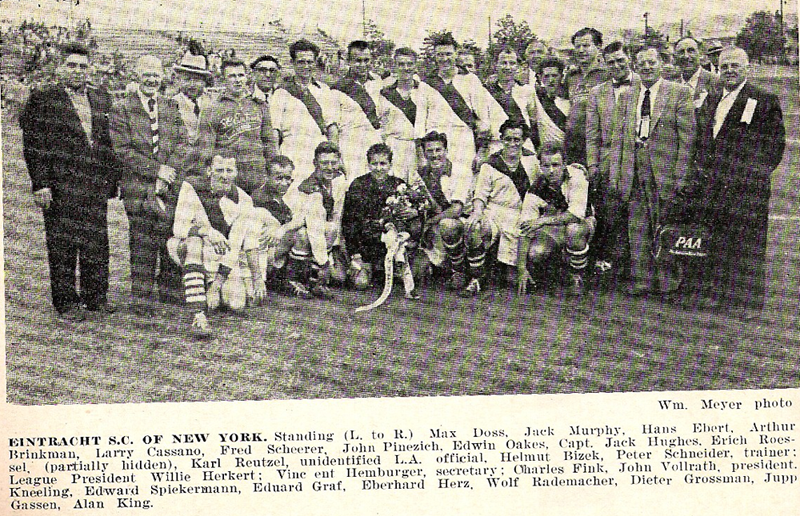
Eintracht can’t defend their title

Just seven years after defending champion Simpkins Ford decided to withdraw from the 1949 Open Cup in protest over expense reports, 1955 cup winner Eintracht SC were prevented from defending their title because of a dispute between the USSFA and the GASL.

Eintracht SC from New York in 1956

In 1955 Eintracht was caught in the middle of a dispute between the United States Soccer Football Association (USSFA) and the German American Soccer League, the league Eintracht was a part of. The league had been suspended by the USSFA in 1955 when other member leagues of the New York State Soccer Football Association accused the GASL of having an unfair balance of power within the organization.

The GASL had developed a habit of paying the NYSSFA membership dues of its clubs in a lump sum, while other leagues left the matter up to the individual clubs. The result was a lopsided representation of the GASL at the annual NYSSFA meeting, as the dues for clubs in other leagues were still coming in. With a voting majority in hand, a number of GASL loyalists were elected to NYSSFA leadership positions.

After the USSFA upheld a protest from the other member leagues, a three person panel was set up to administer to the affairs of the NYSSFA. After the GASL refused to cooperate, the panel gave up. The USSFA then appointed former USSFA president Tom Sager as the commissioner of a new organization, the New York State Comission.

As the GASL affiliated officers continued to bicker on petty issues, the league announced they would pull out of the NYSSFA. The USSFA declared the GASL an outlaw league, meaning anyone playing in the GASL would face a worldwide ban. The USSFA declared all the leagues players free agents and suggested that join other teams in league in good standing with the USSFA.

With the NYSSFA still heavily influenced by the GASL, the organization was not recognized by the USSFA. The NYSSFA filed a lawsuit seeking to overturn the USSFA’s actions, but was dismissed in court. The GASL played the 1956 season as an “independent” league, and their clubs were not allowed to participate in any competitions sponsored by the USSFA.

The fight between the GASL and the USSFA had actually began while Eintracht was still playing games in the 1955 competition, and the USSFA’s declaration that the GASL was an outlaw league had to wait until Eintracht was finished with the tournament. One irony of the controversy was that Eintracht and Swiss FC, the final two New York clubs left alive in the 1955 cup, were members of the GASL. With the absence of the GASL clubs, entries from New York in 1956 dropped to a mere 6 teams, where clubs numbering in the high teens were the norm.

The dispute was not settled until 1957, causing the GASL clubs to miss two successive Open Cup tournaments. Upon returning to cup competition in 1958, Eintracht picked up were they left off, reaching the Eastern semifinals were they dropped a wild 9-8 aggregate series to eventual runner up Pompei SC from Baltimore.

Filed Under: Feature - History, US Open Cup, US Open Cup History Tagged With: National Challenge Cup, US Open Cup

1921-1922 National Challenge Cup Results

January 17, 2009 by Josh Hakala

1921-1922 National Challenge Cup champion Scullin Steel


Preliminary Round
Connecticut
10/9/21 Danersk FC 2 : 2 Stamford FC
10/16/21 R Danersk FC 5 : 0 Stamford FC
Southern New York
10/9/21 Franco Swiss 4 : 1 Spanish American FC
10/9/21 Glen Cove 5 : 0 Hempstead House
New Jersey
10/9/21 Carlton Hill 5 : 1 Palisade Park
Northern New England
10/9/21 West End Polish FC 2 : 2 Esmond Cortex
10/15/21 Esmond Cortex 2 : 1 West End Polish FC
Northwestern New York
10/9/21 Camera Works FC 2 : 1 Kodak Park FC
   
First Round
Eastern Bracket
Connecticut
10/16/21 Bridgeport City 3 : 1 Ansonia
10/22/21 Danersk FC 2 : 3 St. George’s
Western New England
10/15/21 Chicopee Rovers 1 : 1 Hartford FC
10/23/21 R Hartford FC 1 : 0 Chicopee Rovers
10/16/21 Manchester FC 0 : 2 Falco AA
Eastern Pennsylvania
10/15/21 M.E. Smith 3 : 0 Canadian War Vets
10/15/21 Hibernains 0 : 1 Fleischer Yarn
10/15/21 Philadelphia FC 8 : 2 Kingessing
10/15/21 Bethlehem Steel 4 : 0 Ascension FC
10/22/21 Fairhill 3 : 0 Disston Saw
New Jersey
10/16/21 Babcock & Wilcox 4 : 3 Sprague FC
10/16/21 Carlton Hill 2 : 3 (aet) Antler FC
10/23/21 Harrison FC 4 : 0 Napier FC
10/23/21 Celtics FC 5 : 0 Federal FC
Southern New York
10/16/21 Glen Cove 1 : 1 (aet) Yonkers Thistle
10/23/21 R Glen Cove 0 : 3 Yonkers Thistle
10/16/21 Greenpoint 1 : 1 Franco Swiss
10/23/21 R Greenpoint 1 : 0 Franco Swiss
10/16/21 Todd Shipyards 8 : 2 Brooklyn FC
10/16/21 Viking AC 8 : 2 Brooklyn Hibernian
10/16/21 New York FC 7 : 0 West Harlem Catholic
Northwestern New York
10/16/21 Rochester City Moose 3 : 1 Camera Works
10/16/21 Rochester Celtic 2 : 1 General Electric
Northern Massachusetts
10/5/21 Arlington Mills 0 : 3 American Woolen Co.
10/15/21 Massachusetts Cotton Mills 0 : 1 Abbot Worsted
10/15/21 Charlestown w/o General Electric
10/15/21 Grey & Davis 2 : 0 Fore River FC
10/22/21 Roxbury 1 : 6 Smith & Dove
Southern New England
10/12/21 Prospect Hill 0 : 5 Fall River FC
10/15/21 J & P Coats 3 : 0 Fall River Rovers
10/15/21 Ashton & Berkley 3 : 1 Clan Cameron
10/15/21 Sayelsville 2 : 0 British Canadian FC
10/15/21 St. Michael’s 5 : 1 Crompton
10/22/21 Fairlawn Rovers 3 : 0 Westerly United
10/22/21 Lonsdale Mills 4 : 0 Esmond Cotex
   
Western Bracket
Illinois & Wisconsin
10/16/21 Gary FC 2 : 1 Sparta Union
10/16/21 Thistles FC 4 : 1 Norwegian American FC
10/30/21 Harvey FC 0 : 0 Alverno AA
11/6/21 R Alverno AA 1 : 3 Harvey FC
Missouri
10/16/21 Johnston City 1 : 0 West Frankfort
10/16/21 Prendergast 0 : 3 Paulian K of C
10/16/21 Gillespie Moose 2 : 1 Wilsonville United
Ohio
10/16/21 Goodyear FC 0 : 4 Firestone FC
10/16/21 Lorain Eagles 0 : 1 Magyar American FC
10/23/21 Kenmore FC 1 : 3 White Motors
Michigan
10/16/21 Caledonian FC 2 : 1 Walkerville
10/16/21 Ulster 4 : 2 Conubians
10/23/21 Roses FC 3 : 0 Magyar FC
10/23/21 Detroit FC 1 : 2 Scarlet Runners
Western Pennsylvania
10/16/21 Cuddy AC 1 : 0 Carnegie FC
10/16/21 Madison FC 0 : 3 Moon Run
10/16/21 Curry FC 1 : 3 Dunlevy
   
Second Round
Southern New York
11/5/21 New York Field Club 5 : 1 Fairhill
11/5/21 Todd Shipyards 6 : 1 Yonkers Thistle
11/6/21 Viking AC 2 : 1 Greenpoint
New Jersey
11/5/21 Jersey City Celtics 1 : 3 Harrison SC
11/6/21 Antler 2 : 0 Babcock & Wilcox
Connecticut
11/6/21 Bridgeport City 1: 3 St. George’s
Western New England
11/5/21 Hartford 2 : 8 Falco AA
Eastern Pennsylvania
11/5/21 Philadelphia FC 4 : 1 M.E. Smith
11/5/21 Fleisher Yarn 4 : 1 (aet) Bethlehem Steel
Northwestern New york
11/6/21 Rochester Celtic 1 : 2 Rochester City Moose
Northern Massachusetts
11/5/21 Abbot Worsted 2 : 0 American Woolen
11/5/21 Grey & Davis 4 : 2 Smith & Dove
Southern New England
11/5/21 Saylesville 9 : 0 Ashton & Berkeley
11/5/21 Fall River FC 6 : 0 Lonsdale Mills
11/5/21 Fairlawn Rovers 2 : 0 Charlestown
11/5/21 St. Michaels 0 : 2 J & P Coats
Western Bracket
Illinois & Wisconsin
11/6/21 Swedish American FC 2 : 3 Johnston City
11/6/21 Thistles FC 0 : 1 Pullman
11/3/21 Gary 0 : 3 Simmons SC
11/6/21 Bricklayers FC 1 : 0 Olympia
11/20/21 Harvey FC 2 : 4 Rangers
Missouri
11/13/21 Springfield 0 : 1 Paulian
11/13/21 Gillespie 1 : 1 St. Leo’s
11/24/21 R St. Leo’s 3 : 4 Gillespie
11/20/21 DeAndreis 1 : 2 Ben Miller FC
11/20/21 St. Louis Screw 1 : 2 Scullin Steel
Michigan
11/6/21 Industrial FC 1 : 0 Scarlet Runners
11/6/21 Pontiac City 3: 3 Roses FC
11/13/21 R Roses FC 3 : 2 Pontiac City
11/6/21 Caledonia FC 4 : 1 Ulster
Ohio
11/13/21 Firestone FC 1 : 2 Magyar American FC
Firestone protest upheld, replay ordered
11/27/21 R Firestone FC 1 : 3 Magyar American FC
11/13/21 White Motors 4 : 2 Cuddy
Curry protest upheld, replay ordered
12/4/21 R White Motors 0 : 0 Cuddy
Match awarded to White Motors
   
Third Round
Eastern Bracket
11/26/21 Fall River FC 1 : 2 J & P Coats
11/26/21 Holyoke Falco 5 : 2 St. George’s
12/11/21 Todd Shipyards 5 : 3 New York Field Club
11/26/21 Grey & Davis 0 : 2 Abbot Worsted
11/24/21 Fairlawn Rovers 1 : 0 Sayes Finishing Plant
12/11/21 Harrison SC 5 : 0 Antler S.C.
12/18/21 Viking FC 4 : 3 Moose FC
11/26/21 Fleisher Yarn 5 : 0 Philadelphia Field Club
Western Bracket
11/31/21 Simmons FC 4 : 2 Bricklayers FC
12/4/21 Pullman FC 2 : 0 Rangers FC
12/4/21 Scullin Steel 2 : 0 Johnston City
12/4/21 Arden 3 : 0 Dunlevy
12/4/21 Industrial FC 1 : 1 Roses FC
12/11/21 R Roses FC 1 : 2 Industial FC
12/11/21 Ben Miller FC 3 :1 Paulian K of C
12/11/21 White Automobile 0: 0 (aet) Magyar American FC
12/18/21 R White Automobile 1 : 0 (aet) Magyar American FC
12/11/21 Gillespie 1 : 1 Caledonian FC
12/18/21 R Caledonian FC 6 : 0 Gillespie
   
Fourth Round
Eastern Bracket
12/24/21 J & P Coats 3 : 4 Hoyloke Falco
12/25/21 Vikings FC 2 : 6 Harrison S.C.
12/26/21 Philadelphia Field Club 1 : 4 Todd Shipyards
12/24/21 Fairlawn Rovers 1 : 1 Abbot Worsted
1/8/22 R Abbott Worsted 2 : 0 Fairlawn Rovers
Western Bracket
12/26/21 Arden FC 2 : 0 White Automobile
12/25/21 Caledonia FC 1 : 0 Industrial FC
12/25/21 Pullman FC 3 : 2 (aet) Simco FC
12/18/21 Scullin Steel 3 : 0 Ben Miller FC
   
Quarterfinals
1/1/22 Scullin Steel 3 : 0 Pullman FC
1/15/22 Caledonia FC 3 : 2 Arden FC
2/5/22 Abbot Worsted 3 : 1 Holyoke Falco
2/12/22 Harrison SC 0 : 1 Todd Shipyard
   
Semifinals
1/22/22 Scullin Steel 4 : 0 Caledonia FC
2/25/22 Todd Shipyards 2 : 1 Abbot Worsted
   
Final
    at High School Field – St. Louis, Missouri
3/19/22 Scullin Steel 3 : 2 Todd Shipyards
KEY – w/o – Walkover, R – Replay

Filed Under: US Open Cup Tagged With: 1922, Abbot Worsted, Arden FC, Cledonian FC, Harrison SC, High School Field, Holyoke Falco, National Challenge Cup, Pullman FC, Scullin Steel, Todd Shipyard

1920-1921 National Challenge Cup Results

January 16, 2009 by Josh Hakala

Robins Dry Dock won the 1920/1921 National Challenge Cup title.
First Round
Eastern Bracket
Northern Massachusetts
10/16/20 Lynn Gas & Electric 7 : 1 Trimo FC
10/16/20 Fore River FC 1 : 2 General Electric FC
*replay orderd due to rules violations by General Electric FC
10/30/20 R Fore River FC 5 : 0 General Electric FC
10/16/20 Arlington Mills 1 : 2 Boston City
10/16/20 Abbot Worsted 9 : 0 Chicopee Rovers
10/16/20 Hendee Indians 4 : 1 Smith & Dove FC
10/16/20 Farr Alpaca 4 : 2 United Shoe
Southern New England
10/16/20 St. Michael’s 1 : 1 Saylesville FC
10/30/20 R St. Michael’s 1 : 1 Saylesville FC
11/7/20 R St. Michael’s 3 : 1 Saylesville FC
10/16/20 J & P Coats 1 : 1 Fall River Rovers
10/30/20 R J & P Coats 1 : 2 Fall River Rovers
10/16/20 Ashton & Berkeley 3 : 2 Clan Cameron
Connecticut
10/17/20 Hartford S.K.F. 1 : 0 New Departure FC
Southern New York
10/17/20 New York FC 0 : 1 Tebo Yacht Basin
New Jersey
10/17/20 Erie Juniors FC 0 : 5 Erie AA
10/17/20 Federal Shipyards 8 : 2 Athenia Steel
10/17/20 Babcock & Wilcox 2 : 4 Sprague FC
10/17/20 Bunker Hill 1 : 4 Paterson FC
Eastern Pennsylvania
10/16/20 J & J Dobson 4 : 3 Wolfenden Shore
10/16/20 North End FC 0 : 6 Disston AA
10/16/20 Hibernains FC 1 : 6 Bethlehem Steel
Western Bracket
Michigan
10/17/20 Solvay FC 1 : 5 Pontiac City
Ohio
10/16/20 Firestone FC 0 : 1 Goodrich FC
Western Pennsylvania
10/17/20 Dunlevy S.C. 2 : 0 H.R. Gieb Trainworks
   
Second Round
Eastern Bracket
Northern Massachusetts
11/6/20 Maple Leaf FC 0 : 3 Gray & Davis
11/6/20 Farr Alpaca 0 : 2 Boston City
11/6/20 Lynn Gas & Electric 3 : 2 Hendee Indians
11/20/20 Abbot Worsted 0 : 1 Fore River Rovers
Southern New England
10/30/20 Potter & Johnson 3 : 2 Colonial FC
11/6/20 Fairlawn Rovers 3 : 0 Ashton & Berkley
11/13/20 Greystone FC 1 : 8 Fall River Rovers
11/13/20 Young Thornton 2 : 4 St. Michael’s
Connecticut
11/7/20 Columbia Gramaphone 4 : 1 Hartford S.K.F.
11/7/20 Ansonia FC 3 : 1 Stamford FC
Southern New York
11/2/20 Tebo Yacht Basin 2 : 1 Brooklyn FC
11/7/20 Robins Dry Dock 4 : 0 Clan MacDuff
New Jersey & Eastern Pennsylvania
11/6/20 Erie AA 4 : 3 Bethlehem Steel
11/6/20 Disston AA 1 : 1 J & J Dobson FC
11/13/20 R J & J Dobson FC 1 : 1 Disston AA
11/20/20 R Disston AA 1 : 3 J & J Dobson FC
11/7/20 Paterson FC 4 : 1 Sprague FC
11/7/20 Cedar Cliff FC 1 : 7 Federal Ship FC
Western Bracket
Northwestern New York
11/7/20 Rochester City Moose 1 : 0 Rochester Celtic
11/7/20 McNaughton Rangers 3 : 1 Camera Works FC
11/14/20 Oneida Community FC 0 : 1 Kodak Park FC
Western Pennsylvania
11/7/20 Madison FC 2 : 1 Dunlevy FC
Ohio
11/7/20 Goodrich FC 2 : 1 White Motors FC
11/7/20 Greyhounds FC 1 : 1 Goodyear FC
11/14/20 R Goodyear FC 1 : 1 Greyhounds FC
11/21/20 R Greyhounds FC 1 : 3 Goodyear FC
Michigan
11/7/20 I.F.L. FC 0 : 0 Roses FC
11/14/20 R Roses FC 2 : 1 I.F.L. FC
11/7/20 Magyar FC 0 : 2 Ulster FC
11/7/20 Pontiac City 5 : 0 One and All FC
11/7/20 Walkerville FC 2 : 4 Caledonian FC
Illinois & Wisconsin
11/7/20 Simco FC 2 : 0 Pullman FC
11/7/20 Rangers FC 0 : 2 Thistles FC
11/7/20 Swedish American AA 0 : 0 Harvey FC
11/14/20 R Swedish American AA 3 : 1* Harvey FC
  *Harvey FC protested, replay ordered
11/21/20 R Harvey FC 1 : 0 Swedish American AA
11/7/20 Norwegian American AA 1 : 8 Bricklayers FC
Missouri
11/25/20 Ben Miller FC 2 : 5 Innisfall FC
11/25/20 St. Louis Screw 3 : 3* Scullin Screw
  *St. Louis Screw disqualified for ineligible players, Scullin Screw awarded match
   
Third Round
Eastern Bracket
11/25/20 Tebo Yacht Basin 8 : 2 Ansonia S.C.
11/27/20 Potter & Johnson 0 : 1(aet) Fairlawn Rovers
11/27/20 Grey & Davis 0 : 3 Fore River FC
11/27/20 Lynn Gas & Electric 3 : 1 Boston City
11/27/20 J & J Dobson 2 : 1 Paterson FC
11/28/20 Erie AA 3 : 1 Federal Shipyards
11/28/20 Robins Dry Dock 3 : 0 Columbia Graphophone
12/4/20 St. Micheal’s Club 0 : 4 Fall River Rovers
Western Bracket
11/28/20 Pontiac City 2 : 3 Caledonian FC
11/28/20 Goodrich FC 2 : 1 Goodyear FC
11/28/20 McNaughton Rangers 0 : 4 Kodak Park FC
11/28/20 Madison S.C. 3 : 1 Rochester City Moose
11/28/20 Harvey FC 2 : 1 Thistles FC
11/28/20 Simco FC 0 : 2 Bricklayers FC
11/28/20 Roses FC 3 : 0 Ulster FC
12/12/20 Innisfall FC 1 : 3 Scullin Steel
   
Fourth Round
Eastern Bracket
12/18/20 Fore River FC 3 : 1 Fall River Rovers
12/18/20 Fairlawn Rovers 3 : 1 Lynn Gas & Electric
12/18/20 Tebo Yach Basin 1 : 0 J & J Dobson
12/19/20 Robins Dry Dock 1 : 1 Erie AA
12/26/20 R Robins Dry Dock 5 : 3 Erie AA
Western Bracket
12/12/20 Caledonian FC 2 : 1 Roses FC
12/12/20 Harvey FC 1 : 1 Bricklayers FC
12/19/20 R Bricklayers FC 5 : 0 Harvey FC
12/25/20 Scullin Steel 3 : 0 Madison SC
12/26/20 Goodrich FC w/o Kodak Park FC
   
Quarterfinals
12/23/20 Caledonian FC 2 : 1 Goodrich FC
1/15/21 Tebo Yacht Basin 3 : 1 Fairlawn Rovers
1/23/21 Bricklayers FC 1 : 1 Scullin Steel
3/5/21 Robins Dry Dock 3 : 0 Fore River FC
1/30/21 R Scullin Steel 2 : 1 Bricklayers FC
*replay ordered after Bricklayers protest was upheld
3/6/21 R Scullin Steel 2 : 0 Bricklayers FC
   
Semifinals
3/12/21 Scullin Steel 2 : 1 Caledonia FC
3/27/21 Robins Dry Dock 3 : 0 Tebo Yacht Basin
   
Final
  at Fall River Athletic Field – Fall River, Massachusetts
4/19/21 Robins Dry Dock 4 : 2 Scullin Steel
KEY – w/o – Walkover, R – Replay

Filed Under: US Open Cup Tagged With: 1921, Bricklayers FC, Caledonian FC, Fairlawn Rovers, Fall River Athletic Field, Fore River Rovers, Goodrich FC, National Challenge Cup, Robins Dry Dock, Scullin Steel, Tebo Yacht Basin

1919-1920 National Challenge Cup Results

January 16, 2009 by Josh Hakala

Ben Miller FC - 1920 National Challenge Cup champions
Ben Miller FC – 1920 National Challenge Cup champions


First Round
Southern New York
11/2/19 Robins Dry Dock 3 : 2 Morse Dry Dock
11/2/19 Interborough Rapid Transit 1 : 0 Longfellows FC
11/2/19 Greenpoint FC 1 : 2 New York FC
  Clan McDuff 0 : 1 Newburgh Shipyards
New Jersey
11/2/19 American FC 5 : 3 Victor AA
  Bunker Hill 1 : 3 Paterson FC
  Haledon Thistles 1 : 2 Babcock & Wilcox
11//19 Malta FC 7 : 2 Edison AFC
  Erie AA w/o West Hudson FC
Southern New England
  Crompton FC 4 : 1 J & P Coats
  New Bedford Celtics 0 : 0 St. Michael’s FC
  Fairlawn Rovers 2 : 3 Greystone Life Savers
Northern Massachusetts
11/2/19 Abbot Worsted 3 : 2 Lynn Hibernains
  United Shoe 6 : 1 Andover United
  General Electric 0 : 2 Fore River FC
11/1/19 Lynn Thistles * Lawrence League
  Boston City 0 : 2 Squantum
Connecticut
  Sons of St. George vs. Bridgeport Thistles
11/2/19 Bridgeport City 2 : 1 Bridgeport Rovers
Eastern Pennsylvania
11//19 J & J Dobson AA 8 : 1 Viscose FC
11//19 New York Ship 3 : 0 Sun Ship AFC
11/2/19 Merchants Ship 5 : 1 Germantown Boys
11/15/19 Bethlehem Steel 7 : 1 Puritan YML
11//19 Wolfenden Shore 2 : 4 Wanderers FC
Western Pennsylvania
  Madison FC 4 : 2 Beadling
  Cuddy FC vs. Pittsburgh Terminal
Ohio
11/2/19 Magyar American FC 6 : 1 Goodrich FC
11/2/19 Goodyear FC 2 : 1 (aet) White Motor
11//19 Firestone FC 0 : 1 Bricklayers
Illinois
11//19 Harvey FC 0 : 1 Thistle FC
11/3/19 Magyar FC 0 : 6 Palmer Park
11/3/19 Bricklayers FC 3 : 1 Rangers AC
   
Second Round
Southern New York & New Jersey
11/27/19 New York FC 1 : 0 Paterson FC
11/23/19 Babcock & Wilcox 2 : 1 Interborough Rapid Transit
  Newburgh Shipyards 4 : 2 American FC
  Malta AC 0 : 2 Tebo Yacht Basin
  Erie AA 8 : 1 West Side AFC
11/30/19 Federal Ship 2 : 3 Robins Dry Dock
Eastern Pennsylvania
11/29/19 Bethlehem Steel 3: 0 Merchant Ship
  Wanderers 3 : 1 Disston AA
11//19 New York Ship 2 : 2 J & J Dobson AA
Southern New England
  Fall River Rovers 4 : 1 Greystone Life Savers
  New Bedford Celtics 1 : 3 J & P Coats
Northern Massachusetts
11//19 Chicopee Rovers 0 : 1 Fore River FC
  Lynn Thistles vs. Squantum FC
  United Shoe 2 : 1 Abbot Worsted
Connecticut
  New Haven FC 3 : 1 Bridgeport Swedish AC
  Sons of St. George 2 : 4 Bridgeport City
Western Pennsylvania
  Pittsburgh Terminal Coal FC 5 : 2 Madison FC
  McKeesport National Tube w/o Cuddy AA
Northwestern New York
  Oneida Community 1 : 1 McNaughton Rangers
  Rochester City Moose 1 : 0 Rochester Celtics
Ohio
  Ideal Tire & Rubber 1 : 2 Goodyear FC
11/30/19 Bricklayers FC 3 : 1 Magyar American FC
Michigan
  Packard FC 3 : 1 Bricklayers FC
  Pontiac City FC 7 : 0 Vikings FC
  Rising Star FC 0 : 0 Detroit SFC
  Caledonia FC 4 : 0 Roses FC
Illinois
  Palmer Park 5 : 1 Thistles AFC
  Lake Forest FC 1 : 4 Lincoln Park FC
11/23/19 Olympia FC 5 : 1 Thistle FC
11/23/19 Bricklayers FC 1 : 0 Swedish American FC
Missouri
  Ben Miller FC 6 : 1 Innisfalls FC
  Scullin Steel 3 : 1 St. Louis Screw
   
Third Round
Eastern Bracket
12/24/19 Robins Dry Dock 3 : 1 Tebo Yacht Basin
12/29/19 New York FC 1 : 1* Erie AA
  *match stopped after 70 minutes due to broken crossbar, replay ordered
1/6/20 R New York FC 2 : 1 (aet) Erie AA
12/27/19 Bethlehem Steel 1 : 0 New York Ship
12/28/19 Fore River Rovers 3 : 1 J & P Coats
1/1/20 Babcock & Wilcox 0 : 1 Newburgh Shipyards
1/1/20 Lynn Thistles 0 : 2 Fall River Rovers
1/1/20 United Shoe 3 : 1 New Haven
1/5/20 Bridgeport City 0 : 4 Wanderers FC
Western Bracket
12/25/19 Rochester City Moose 3 : 1 McNaughton Rangers
1/4/20 Ben Miller FC 2 : 1 Scullin Steel
1/5/20 Packard FC 2 : 1 Rising Star FC
1/8/20 Bricklayers FC (Cle.) 1 : 3 Goodyear FC
1/8/20 Pittsburgh Terminal 1 : 2 McKeesport National Tube
3/20/20 Olympia FC 3 : 3 (aet) Palmer Park
3/31/20 R Olympia FC 3 : 1 Palmer Park
3/29/20 Pontiac City 0 : 8 Caledonia FC
  Bricklayers FC (Chi.) w/o Lincoln Park FC
   
Fourth Round
Eastern Bracket
3/20/20 Bethlehem Steel 10 : 0 Wanderers FC
3/22/20 Robins Dry Dock 4 : 0 Fall River Rovers
3/27/20 Fore River Rovers 3 : 0 United Shoe
3/28/20 New York FC 2 : 1 Newburg Shipyards
Western Bracket
2/6/20 Goodyear FC 1 : 2 Rochester City Moose
2/10/20 Ben Miller FC 3 : 2 McKeesport FC
3/28/20 Bricklayers & Masons 1 : 2 Olympia FC
  Packard FC 3 : 2 Caledonia FC
   
Quarterfinals
4/4/20 Robins Dry Dock 1 : 0 Bethlehem Steel
4/5/20 Ben Miller FC 2 : 1 Olympia FC
4/5/20 Fore River Rovers 3 : 0 New York FC
4/23/20 Packard FC 5 : 1 Rochester City Moose
   
Semifinals
4/10/20 Fore River Rovers 2 : 0 Robins Dry Dock
4/25/20 Ben Miller FC 4 : 2 Packard FC
   
Final
at Handlan’s Park, St. Louis, Missouri
5/8/20 Ben Miller FC 2 : 1 Fore River Rovers
KEY – w/o – Walkover, R – Replay

Filed Under: US Open Cup Tagged With: 1920, Ben Miller FC, Bethlehem Steel FC, Fore River Rovers, Handlans Park, National Challenge Cup, New York FC, Olympia FC, Packard FC, Robins Dry Dock, Rochester City Moose

1918-1919 National Challenge Cup Results

January 15, 2009 by Josh Hakala

The Bethlehem Steel won the 1918/1919 National Challenge Cup title, 2-0 over Paterson FC in Fall River, Mass. It was the club's fourth National Challenge Cup title in the last six years.
The Bethlehem Steel won the 1918/1919 National Challenge Cup title, 2-0 over Paterson FC in Fall River, Mass. It was the club’s fourth National Challenge Cup title in the last six years.


First Round
New York
10/20/18 Morse Dry Dock 4 : 0 Standard Shipyard FC
10/20/18 Robbins Dry Dock 3 : 0 Longfellows FC
10/20/18 New York FC w/o Clan MacDuff FC
10/20/18 Viking FC w/o Tebo FC
New Jersey
10/27/18 Scottish American FC (NJ) 3 : 1 Crescent Ship FC
10/27/18 Federal Ship 1 : 1 Babcock & Wilcox
11/3/18 R Federal Ship 3 : 1 Babcock & Wilcox
10/27/18 Hog Island FC 0 : 1 Merchants Shipbuilding A
10/28/18 Paterson FC 8 : 1 Kinley FC
11/3/18 Jersey AC 1 : 0 Passaic Swedish AC
Southern New England
11/2/18 Pan American FC 1 : 3 J & P Coats
Northern Massachusetts
10/26/18 Boston Rovers 3 :6 Merrimac Valley FC
11/2/18 Fisk Red Tops 2 : 8 Fore River FC
Connecticut
10/20/18 Bridgeport Swedish AC 2 : 3 Bridgeport City AFC
Eastern Pennsylvania
11/2/18 Disston AA 5 : 7 Merchants Shipbuilding B
11/13/18 Bethlehem Steel 3 : 0 New York Shipbuilding
Illinois
11/10/18 Bricklayers & Masons FC 3 : 1 American Hungarian FC
   
Second Round
New Jersey & Eastern Pennsylvania
11/23/18 Bethlehem Steel 4 : 3 (aet) Merchants Shipbuilding A
12/1/18 Federal Shipbuilding 2 : 1* Merchants Shipbuilding B
  *Match ordered replayed after Merchants protest
12/25/18 R Federal Shipbuilding 3 : 2 Merchants Shipbuilding B
12/1/18 Scottish American FC (NJ) 6 : 0 Tietjen & Lang Dry Dock
12/1/18 Paterson FC 9 : 2 Jersey AC
Connecticut & New York
12/1/18 Robins Dry Dock 2 : 1 Bridgeport City AFC
12/1/18 Morse Dry Dock w/o Chinese Students FC
12/1/18 New York FC w/o Viking FC
Northern Massachusetts
11/23/18 Fore River FC 6 : 3 Merrimac Valley
Southern New England
11/16/18 J & P Coats 6 : 0 Olneyville Oaks FC
Western Pennsylvania
11/23/18 Homestead Steel w/o Pittsburgh FC
Pittsburgh FC withdraw due to World War I enlistments
Michigan
11/10/18 Roses FC 4 : 0 Solway FC
11/10/18 Detroit FC w/o Corinthian FC
Ohio
11/17/18 Magyar American FC 1 : 1 Hydraulic Pressed Steel Company
11/24/18 R Magyar American FC 3 : 2 Hydraulic Pressed Steel Company
11/18/18 Goodyear FC 8 : 1 Goodrich FC
Illinois
11/10/18 Scottish American FC (Chi.) 5 : 2 Harvey FC
11/17/18 Bricklayers & Masons FC 1 : 0 Lincoln Park
   
Third Round
12/21/18 J & P Coats 1 : 4 Fore River FC
12/22/18 Bricklayers & Masons 2 : 0 Scottish Americans
12/22/18 Roses FC 4 : 3 (aet)
Detroit FC
12/22/18 Goodyear FC 6 : 1 Magyar American FC
12/22/18 Paterson FC 2 : 1* Robins Dry Dock
*Match abandoned at 74th minute due to darkness
12/22/18 R Paterson FC 3 : 1 Robins Dry Dock
12/29/18 Scottish American FC 0 : 2 New York FC
1/5/19 Federal Shipyard 0 : 0 Morse Dry Dock
1/12/19 R Federal Shipyard 3 : 5 (aet) Morse Dry Dock
12/22/18
Bethlehem Steel w/o Homestead Steel Works
Homestead withdraw due to World War I enlistments
Quarterfinals
2/21/19 Fore River FC 0 : 0(aet) Paterson FC
3/2/19 R Paterson FC 2 : 1 Fore River FC
3/1/19 Bethlehem Steel 5 : 0 Goodyear FC
3/2/19 New York FC 0 : 2 Morse Dry Dock
3/9/19 Bricklayers & Masons 5 : 2 Roses FC
   
Semifinals
3/29/19 Bethlehem Steel 5 : 0 Bricklayers & Masons
3/30/19 Paterson FC 4 : 1 Morse Dry Dock
   
Final
  at Athletic Field – Fall River, Massachusetts
4/19/19 Bethlehem Steel 2 : 0 Paterson FC
KEY – w/o – walkover, R – Replay

Filed Under: US Open Cup Tagged With: 1919, Bethlehem Steel FC, Bricklayers & Masons FC, Fore River FC, Goodyear FC, Morse Dry Dock, National Challenge Cup, New York FC, Paterson FC, Roses FC

1917-1918 National Challenge Cup Results

January 15, 2009 by Josh Hakala

1917/1918 National Challenge Cup champion Bethlehem Steel


First Round
Eastern Bracket
New York & New Jersey
11/4/17 New York FC 2 : 0 Clan MacDuff
11/4/17 Alley Boys FC 3 : 0 Fulton AC
11/4/17 Clan McDonald 1 : 0 La Sultana FC
11/4/17 Jersey AC 0 : 7 West Hudson AA
11/4/17 Babcock & Wilcox 1 : 1 Scottish American FC
11/11/17 R Scottish American FC 1 : 1 Babcock & Wilcox
11/18/17 R Scottish American FC 2 : 1 Babcock & Wilcox
11/4/17 Interborough Rapid Transit w/o White Rose FC
Northern Massachusetts
11/4/17 Fisk Red Tops 1 : 2 Fore River Rovers
Connecticut
11/4/17 Bridgeport City 4 : 1 Bridgeport Rovers
Southern New England
11/3/17 Greystone AC 2 : 4 Lonsdale FC
11/4/17 New Bedford Celtics 0 : 2 Fall River Rovers
11/4/17 Crompton FC 2 : 3 Pan American FC
11/4/17 New Bedford FC 2 : 4 J & P Coats
   
Western Bracket
Eastern Pennsylvania
11/4/17 Disston AA 2 : 0 Wanderers FC
Northwestern New York
11/4/17 Rochester Celtic 4 : 0 Kodak Park FC
Western Pennsylvania
10/20/17 Castle Shannon FC 0 : 1 McKeesport FC
11/3/17 Beadling FC 0 : 3 Homestead Steel Works
Ohio
10/28/17 Thistle FC w/o Akron FC
10/28/17 Firestone Non-Skid 1 : 3 Goodyear FC
11/4/17 Cleveland FC 2 : 0 White Motors FC
Michigan
11/4/17 Rising Star FC 0 : 2 Corinthians FC
11/11/17 Roses FC 2 : 1 Bricklayers FC
Illinois
10/21/17 Bricklayers FC 1 : 2 Harvey FC
   
Second Round
Eastern Bracket
New York & New Jersey
12/2/17 Scottish American FC 1 : 1 (aet) New York FC
3/3/18 R New York FC 3 : 2 (aet) Scottish American FC
12/1/17 Clan McDonald 1 : 3 Interborough Rapid Transit
12/2/17 Paterson FC 6 : 2 Kinsley FC
2/17/18 West Hudson AA 4 : 0 Alley Boys FC
New England
12/3/17 Fall River Rovers 4 : 3 Bridgeport City
3/2/18 Pan American FC 3 : 0 J & P Coats
12/3/17 Lynn Hibernians 5 : 0 Lonsdale FC
12/3/17 Fore River FC 3 : 2 Lawrence Cricket & FC
Western Bracket
Illinois
12/2/17 Scottish American FC 2 : 2 Joliet FC
12/23/17 R Scottish American FC 2 : 9 Joliet FC
12/2/17 Harvey FC 1 : 0 Bohemian American FC
Ohio & NW New York
12/2/17 Thistle FC 0 : 3 Rochester Celtic
12/2/17 Goodyear FC 1 : 2 Cleveland FC
Eastern Pennsylvania
12/1/17 Disston AA 2 : 1 Puritan YML
12/1/17 Bethlehem Steel 2 : 0 Veteran AA
Western Pennsylvania
12/1/17 Homestead Steel Works 4 : 1* McKeesport FC
  *McKeesport protest upheld, replay ordered
12/15/17 R McKeesport FC 3 : 1 Homestead Steel Works
Michigan
12/2/17 Corinthians FC 3 : 2 Roses FC
   
Third Round
Eastern Bracket
1/5/18 Disston AA 1 : 2 (aet) Bethlehem Steel
3/3/18 Paterson FC 4 : 3 Interborough Rapid Transit FC
3/10/18 West Hudson AA 4 : 3 New York FC
3/23/18 Fall River Rovers 3 : 1 (aet) Pan American FC
Western Bracket
2/16/18 McKeesport FC 9 : 0 Rochester Celtic
2/23/18 Fore River FC 1 : 6 Lynn Hibernians
12/30/17 Cleveland FC 3 : 1 Corinthians FC
12/25/17 Joliet FC w/o Harvey FC
   
Quarterfinals
3/2/18 McKeesport FC 0 : 5 Bethlehem Steel
3/10/18 Joliet FC 4 : 2 Cleveland FC
3/17/18 Paterson FC 4 : 4 West Hudson AA
3/24/18 R West Hudson AA 5 : 1 Paterson FC
3/30/18 Lynn Hibernians 0 : 5 Fall River Rovers
   
Semifinals
3/30/18 Bethlehem Steel 4 : 0 Joliet FC
4/20/18 Fall River Rovers 3 : 1 West Hudson AC
   
Final
  at Coates Field – Pawtucket, Rhode Island
5/5/18 Fall River Rovers 2 : 2 (aet) Bethlehem Steel
  at Federal League Baseball Grounds – Harrison, New Jersey
5/19/18 R Bethlehem Steel 3 : 0 Fall River Rovers
KEY – w/o – walkover, R – Replay

Filed Under: US Open Cup Tagged With: 1918, Bethlehem Steel FC, Cleveland FC, Fall River Rovers, Federal League Baseball Grounds, Joliet FC, Lonsdale Avenue Grounds, Lynn Hibernains, McKeesport FC, National Challenge Cup, Paterson FC, West Hudson AA

1916-1917 National Challenge Cup Results

January 15, 2009 by Josh Hakala

Fall River Rovers - 1916/1917 National Challenge Cup champions
Fall River Rovers – 1916/1917 National Challenge Cup champions


Qualifying Round
Northwestern New York
  Rochester Celtic 4 : 1 McNaughton Rangers
Massachusetts
  Clan McLennan 3 : 2 Chicopee Rovers
10/21/16
New Bedford Celtic 4 : 0 Lawrence Cricket & FC
  Swedish American FC 4 : 1 Clan Sutherland
  Lawrence Olympics 4 : 1 St. George AC
  Methune FC 1 : 0 Lawrence Thistle
Rhode Island
  Greystone FC 3 : 2 Lonsdale FC
Eastern Pennsylvania
  Veteran AA 6 : 0 Victor Talking Machine Co.
Michigan
  Caledonia FC 1 : 0 Walkerville FC
  National SFC 4 : 0 Rising Star FC
Ohio
  White Auto 2 : 1 Cuyahoga Works FC
Illinois
  Slavia FC 3 : 1 Wanderers FC
   
First Round
Massachusetts
11/18/16 Andover United 4 : 1 Clan Sutherland
11/18/16 New Bedford FC 2 : 0 Pan American FC
11/18/16 Lawrence Olympic 5 : 0 Methuen FC
11/18/16 Fall River Rovers 4 : 0 General Electric FC
11/18/16 Clan McClennan 4 : 2 New Bedford Celtics
11/18/16 Lynn Hibernians 2 : 0 Fore River Rovers
New York & New Jersey
11/12/16 West Hudson AC 1 : 0 Greenpoint FC
11/19/16 New York FC 1 : 0 Interborough Rapid Transit FC
11/19/16 Jersey AC 4 : 0 Irish American FC
11/19/16 Brooklyn Celtic w/o Yonkers FC
Yonkers FC forfeit due to disbanding
11/19/16 Clan MacDuff 0 : 1 Bay Ridge FC
11/19/16 Scottish American FC 3 : 2 Babcock & Wilcox
11/19/16 Clan MacDonald 3 : 1 Continental FC
Northwestern New York
11/19/16 Rochester City w/o Rochester Celtic
Connecticut
11/12/16 British American FC 1 : 0 Remington City
11/19/16 Bridgeport City 5 : 1 Bridgeport Rangers
Rhode Island
11/4/16 Howard & Bullough 4 : 0 Greystone AC
11/18/16 Crompton FC 1 : 0 J & P Coats
Eastern Pennsylvania
11/11/16 Bethlehem Steel 5 : 0 Veteran AA
11/18/16 Disston AA 2 : 0 Wanderers FC
11/18/16 Putnam FC 3 : 0 Allentown YMCA
Western Pennsylvania
11/19/16 Juniata Pennsylvania Railroad FC w/o Treveskyn FC
11/18/16 Homestead Steel Works 1 : 0 Braddock Steel
Ohio
11/12/16 White Auto FC 2 : 1 Cleveland FC
11/19/16 Thistle FC 4 : 3 Akron FC
Michigan
11/12/16 St. George FC 3 : 1 Packard FC
11/15/16 Detroit FC 4 : 2 National FC
Illinois
11/19/16 Bricklayers FC 3 : 0 Hyde Park Blues
11/19/16 MacDuff FC 2 : 0 Pullman Professional FC
11/19/16 Caledonia FC 3 : 1 Roses FC
11/19/16 Joliet Steel Works 3 : 1 Slavia FC
11/26/16 Pullman Association FC 3 : 0 Chicago Americans
   
Second Round
12/16/16 Andover United w/o Clan McLennan
Clan McLennan forfeit due to suspension of club
12/17/16 Bridgeport City 4 : 0 British American FC
12/17/16 Homestead Steel Works 9 : 2 Juniata Pennsylvania Railroad FC
12/17/16 White Auto FC 1 : 0 Thistle FC
12/17/16 Rochester City 0 : 1 Detroit FC
12/17/16 Caledonia FC 3 : 1 St. George FC
12/24/16 Bricklayers FC 1 : 2 Joliet Steel Works
12/30/16 Fall River Rovers 3 : 1 New Bedford FC
12/31/16 West Hudson AC 2 : 1 Clan MacDonald
1/6/17 Disston AA 13 : 0 Jersey City AC
1/6/17 Lynn Hibernians 1 : 0 Lawrence Olympics
1/6/17 Bethlehem Steel 3 : 1 Brooklyn Celtic
1/20/17 Crompton FC 0 : 0 Howard & Bullough
2/25/17 R Howard & Bullough 5 : 2 Crompton FC
2/18/17 Scottish American FC 2 : 1 Bay Ridge FC
3/4/17 Pullman Association FC 1 : 3 MacDuff FC
   
Third Round
2/3/17 Homestead Steel Works 3 : 1 White Auto FC
2/4/17 Bridgeport City 0 : 1 Disston AA
2/4/17 West Hudson AA 0 : 3 Bethlehem Steel
2/25/17 Scottish American FC 4 : 6 New York FC
3/4/17 Caledonia FC 2 : 1 Detroit FC
3/17/17 Fall River Rovers 3 : 1 Lynn Hibernains
3/25/17 Joliet Steel Works 6 : 0 MacDuff FC
3/31/17 Andover United 2 : 5 Howard & Bullough
   
Quarterfinals
3/10/17 Disston AA 2 : 0 New York FC
3/3/17 Bethlehem Steel 2 : 1 Homestead Steel Works
4/8/17 Joliet Steel Works 4 : 0 Caledonian FC
4/7/17 Fall River Rovers 6 : 1 Howard & Bullough
   
Semifinals
4/21/17 Fall River Rovers 4 : 3 Disston AA
4/21/17 Bethlehem Steel 6 : 0 Joliet Steel Works
   
Final
  at Coates Field – Pawtucket, Rhode Island
5/5/17 Fall River Rovers 1 : 0 Bethlehem Steel
KEY – w/o – walkover, R – Replay

Filed Under: US Open Cup Tagged With: 1917, Bethlehem Steel FC, Caledonia FC, Disston AA, Fall River Rovers, Homstead Steel Works, Howard & Bullough, Joliet Steel Works, Lonsdale Avenue Grounds, National Challenge Cup, New York FC

1915-1916 National Challenge Cup Results

January 15, 2009 by Josh Hakala


Qualifying Round
Massachusetts
10/12/15 Cove Albions FC 3 : 2 Hose IX FC
10/12/15 New Bedford Cotton Mills 2 : 1 Beehive Rangers
10/23/15 Pan Americans 6 : 2 Gem AA
10/23/15 Boston Americans w/o Taunton City
10/23/15 Lynn Hibernian 1 : 0 St. George AA
10/23/15 Clan Macpherson 2 : 1 Clan Lindsay
10/23/15 Swedish American FC 0 : 2 Lynn Fosse
Connecticut
10/24/15 Naugatuck FC 4 : 1 Bridgeport Rangers
New York & New Jersey
10/14/15 Cameron FC 2 : 1 Greenpoint FC
10/14/15 Alley Boys FC 2 : 0 Clam McDuff FC
10/14/15 Clan MacDonald FC 3 : 1 New York Hibernian
10/14/15 Our Boys FC 4 : 1 Greenville FC
10/14/15 Paterson Thistles 0 : 2 I.R.T. Strollers
Rhode Island
10/23/15 Plainfield FC 0 : 6 Smithfield Avenue Men’s Club
10/23/15 Crompton FC 4 : 2 Greystone AC
Eastern Pennsylvania
10/23/15 Bethlehem East End 2 : 1 Nativity Men’s Club
Northwestern New York
10/24/15 Rochester City AFC 7 : 2 Celtic AFC
Western Pennsylvania
10/23/15 Treveskyn FC 2 : 1 Donora Steel Works
10/23/15 Braddock FC 3 : 0 Pittsburgh Rovers
Ohio
10/24/15 Woodland Rovers 6 : 2 Sons of St. George
Michigan
10/24/15 Detroit FC 5 : 0 Baudette United
10/24/15 Caledonian FC 1 : 2 St. George FC
Illinois
10/24/15 MacDuff FC 1 : 1 (AET) Chicago American FC
10/31/15 R MacDuff FC 2 : 0 Chicago American FC
10/31/15 Campbell Rovers 1 : 1 (AET) Hyde Park Blues
11/7/15 R Campbell Rovers 1 : 2 Hyde Park Blues
 
First Round
New York & New Jersey
11/14/15 Brooklyn FC 2 : 2 Yonkers FC
11/25/15 R Yonkers FC 1 : 0 Brooklyn FC
11/14/15 Brooklyn Celtic 5 : 1 Our Boys FC
11/14/15 West Hudson AA 1 : 1 Clan MacDonald FC
11/21/15 R Clam MacDonald FC 2:2 (AET) West Hudson AA
11/28/15 R West Hudson AA 2 : 1 Clan MacDonald FC
11/14/15 I.R.T. Strollers 5 : 1 Columbia Oval
11/14/15 Alley Boys FC 2 : 1 Babcock & Wilcox
11/14/15 Continental FC 5 : 0 Cameron FC
11/21/15 Jersey AA 2 : 1 Scottish American FC
Massachusetts
11/6/15 New Bedford Celtic 6 : 1 Brockton FC
11/13/15 New Bedford FC 5 : 2 Andover United
11/6/15 Pan American FC 8 : 2 Charlestown FC
11/13/15 Boston American FC 3 : 1 Cove Albion FC
11/13/15 Fore River FC 4 : 0 Lawrence FC
11/13/15 Fall River Rovers 3 : 0 Clan McPherson FC
11/13/15 New Bedford Cotton Mills 3 : 2 Lynn Hibernians
11/13/15 Farr Alpaca 1 : 0 Chicopee Rovers
11/13/15 Lynn Fosse 1 : 1 General Electric
11/20/15 R Lynn Fosse 0 : 2 General Electric
Connecticut
11/14/15 Bridgeport City 5 : 0 Naugatuck FC
Rhode Island
11/6/15 Howard & Bullough 2 : 1 Crompton FC
11/13/15 J & P Coats 4 : 0 Smithfield Avenue Men’s Club
Eastern Pennsylvania
11/13/15 Bethlehem East Ends 0 : 9 Bethlehem Steel
11/13/15 Disston AA 3 : 0 Wanderers FC
11/13/15 Hibernian FC 15 : 0 Peabody FC
11/13/15 Viscose FC 2 : 1 Putnam FC
Michigan
11/14/15 St. George FC 7 : 0 Roses FC
11/14/15 Packard FC 3 : 3 Detroit FC
12/5/15 R Packard FC 3 : 0 Detroit FC
Northwestern New York
11/11/15 Rochester City w/o General Electric FC
Western Pennsylvania
11/20/15 Treveskyn FC 0 : 2 Beadling FC
11/13/15 Homestead Steel Works 0 : 3 Braddock FC
Ohio
11/14/15 Cleveland FC 2:2 (AET) Woodlawn Rovers
11/21/15 R Cleveland FC 3 : 0 Woodlawn Rovers
11/7/15 Thistles FC 2 : 1 Akron FC
Illinois
12/5/15 Hyde Park Blues 2:2
(AET)
MacDuffs
2/20/16 R MacDuffs w/o Hyde Park Blues
Hyde Park Blues forfeit when they did not show
11/14/15 Pullman FC 2 : 1 Bricklayers & Masons
   
Second Round
New York, New Jersey & NW New York
12/12/15 West Hudson AA 0:0 (AET) Yonkers FC
1/2/16 R West Hudson AA 2 : 0 Yonkers FC
12/12/15 Babcock & Wilcox 8 : 0 Rochester City
12/12/15 Continental FC 3 : 0 I.R.T. Strollers
12/12/15 Brooklyn Celtic 5 : 4 Jersey AC
Massachusetts
12/11/15 New Bedford FC 1 : 0 New Bedford Celtic
12/11/15 Lynn Hibernian 1 : 1 Boston American FC
12/25/15 R Lynn Hibernian 3 : 0 Boston American FC
12/25/15 General Electric FC 2 : 1 Fore River FC
12/25/15 Fall River Rovers 1 : 0 Pan American FC
Connecticut
12/12/15 Bridgeport City 3 : 3 Farr Alpaca
1/5/16 R Bridgeport City w/o Farr Alpaca
Rhode Island
12/11/15 Crompton FC 2 : 1 J & P Coats
Eastern Pennsylvania
12/11/15 Bethlehem Steel 1 : 1 (AET) Disston AA
12/25/15 R Disston AA 0 : 3 Bethlehem Steel
12/11/15 Viscose FC 2 : 2 Hibernian FC
12/25/15 R Hibernian FC 3 : 3 Viscose FC
1/1/16 R Viscose FC 1 : 4 Hibernian FC
Michigan
12/12/15 Packard FC 2 : 2 St. George FC
12/19/15 R St. George FC 0 : 0 Packard FC
1/9/16 R Packard FC 2 : 1 St. George FC
Ohio
12/12/15 Thistles FC 1 : 0 Cleveland FC
Illinois
2/27/16 Pullman FC 3 : 1 MacDuff FC
Western Pennsylvania
12/11/15 Braddock FC 3 : 1 Beadlign FC
       
Third Round
1/15/16 Bethlehem Steel 6 : 0 Hibernian FC
1/16/16 Continental FC 1 : 0 Brooklyn Celtic
1/16/16 West Hudson FC 2 : 1 Babcock & Wilcox
1/15/16 Braddock FC 1 : 3 Thistles FC
1/22/16 Fall River Rovers 4 : 0 Lynn Hibernians
1/29/16 General Electric FC 2 : 7 New Bedford FC
1/16/16 Crompton FC 0 : 2 Bridgeport City
3/13/16 Pullman FC 2 : 0 Hyde Park Blues
   
Quarterfinals
3/5/16 Bridgeport City AFC 0:1 (AET) Continental FC
3/20/16 Thistles FC 1 : 3 Pullman FC
4/2/16 West Hudson AC 0 : 1 Bethlehem Steel
4/1/16 New Bedford FC 1 : 1 Fall River Rovers
4/8/16 R Fall River Rovers 6 : 0 New Bedford FC
   
Semifinals
4/15/16 Fall River Rovers 1 : 0 (AET) Continental FC
4/16/16 Pullman FC 0:0
(AET)
Bethlehem Steel
4/22/16 R Bethlehem Steel 2 : 1 Pullman FC
 
Final
    at Coates Field – Pawtucket, Rhode Island
5/16/16   Fall River Rovers 0 : 1 Bethlehem Steel
KEY – w/o – walkover, R – Replay

Filed Under: US Open Cup Tagged With: 1916, Bethlehem Steel FC, Bridgeport AFC, Continental FC, Fall River Rovers, Lonsdale Avenue Ground, National Challenge Cup, New Bedford FC, Pullman FC, Thistle FC, West Hundson AA

  • Page 1
  • Page 2
  • Go to Next Page »

Primary Sidebar

Follow Us on Social Media

  • Bluesky
  • Facebook
  • Instagram
  • Twitter
  • YouTube

U.S. Open Cup History

1935 National Challenge Cup Semifinals: After 29 days, Central Breweries win 3-game Western Final

The Western Final of the 1934/1935 National Challenge Cup featured one of Chicago’s best teams from the first 30 years of the tournament against a St. Louis team that would form their own dynasty.

  • 1995 US Open Cup: Rob Ukrop of Richmond Kickers voted TheCup.us Player of the Tournament
  • 1995 US Open Cup Final: Jeff Causey of Richmond Kickers voted TheCup.us Player of Round
  • 1995 US Open Cup Final: Richmond Kickers survive heat, beat El Paso Patriots in PKs to win title
  • 1995 US Open Cup Final Preview: El Paso Patriots hosting amateur Richmond Kickers in “El Sauna”
  • 1995 US Open Cup Semifinals: Jake Arrambide of El Paso Patriots voted TheCup.us Player of Round

Analytics powered by

Copyright © 2026 • Built by Jacob Martella Web Development