• Skip to primary navigation
  • Skip to main content
  • Skip to primary sidebar
  • US Open Cup Central
  • US Open Cup Qualifying
  • US Open Cup History
  • Amateur Cup

Complete U.S. Open Cup Coverage

  • 2026 USOC Schedule
  • 2026 USOC Stat Leaders
  • 2027 USOC Qualifying Results
  • TheCup.us Awards
  • Join TheCup.us Patreon!
  • Contact Us

Paterson FC

1918/1919 National Challenge Cup Semifinals & Final: Bethlehem Steel earn back-to-back shutouts to win 4th title

October 31, 2019 by Chuck Nolan Jr.

The Bethlehem Steel won the 1918/1919 National Challenge Cup title, 2-0 over Paterson FC in Fall River, Mass. It was the club's fourth National Challenge Cup title in the last six years.
The Bethlehem Steel won the 1918/1919 National Challenge Cup title, 2-0 over Paterson FC in Fall River, Mass. It was the club’s fourth National Challenge Cup title in the last six years.

100 years ago, the National Challenge Cup (now known as the Lamar Hunt US Open Cup) crowned its sixth national champion. Prior to the 106th edition of the US Open Cup Final last August, TheCup.us begins a five-part series that jumps in a time machine back a full century to see what obstacles the 1918/1919 tournament faced. The game and the world itself was very different 100 years ago. World War I was wrapping up in Europe and there was an outbreak of the Spanish Flu around the country. The United States and the game of soccer were likely unrecognizable to the modern fan, so we decided to take a look back to see how it all played out.

Editor’s note: As you read this, you’ll notice a lot of players with just one name. This is not an oversight on our part, but rather, many of the sources of this information (newspapers, publications etc.) only use the last name of players in their stories. If you have confirmation of any of their names, or any other details that would add to our historical records, feel free to reach out to us HERE. We are always looking for help with historical research.

Check out the past entries in this five-part series: Round 1 | Round 2 | Round 3 | Quarterfinals | Semifinals & Final

1918/1919 National Challenge Cup – Semifinals

The final four survivors in the National Challenge Cup were set to meet in Bethlehem, Penn. and Harrison, N.J., and both games turned out to be anti-climactic blowouts.

Bethlehem Steel players (from left to right) Fred Pepper, James Campbell and Brown. Photo: Fall River Daily Evening News - April 18, 1919
Bethlehem Steel players (from left to right) Fred Pepper, James Campbell and Brown. Photo: Fall River Daily Evening News – April 18, 1919

In a game some newspapers billed as a showdown of East versus West, Bethlehem Steel hosted Chicago’s Bricklayers & Masons FC at Taylor Stadium in Bethlehem on Mar. 29. The Chicagoans had not lost a game all season, scoring 40 goals and conceding only eight, while Bethlehem had lost just one game to an all-star team in St. Louis and scored an astounding 74 goals in 23 games while allowing 17. A remarkable 62 of those goals were scored by Bethlehem’s deadly squad of strikers. Among those five stars was a trio of future Hall of Famers in Harry Ratican (16 goals / 14 games), Tommy Fleming (12 goals / 20 games), and Bob Millar (8 goals / 13 games). Millar would not only play for the US National Team, but led the team as head coach at the inaugural FIFA World Cup in 1930. The fourth and fifth strikers were future Canadian international George Forrest (15 goals / 22 games) and George McKelvey (11 goals / 22 games), who would finish his career as one of the most successful players in US soccer history with five Open Cup titles and five more American Cup championships.

The visitors got off to a poor start before the game even kicked-off. Scheduled to arrive the evening before the game, the Bricklayers missed a train connection in Buffalo which delayed their arrival until the morning of the game itself.

High winds with gusts of 40 miles per hour swept over the stadium which forced the teams, which were both noted for their long passes, to change their normal tactics and favor shorter passes. About 5,000 spectators braved the chilly conditions, and after a few minutes, Bethlehem showed its superiority over their Chicago rivals. The Bethlehem Globe noted it was only a matter of how many goals the Steelmen would score.

Playing the first half with the strong wind at their backs, it didn’t take long for Bethlehem to score its first goal, and the wind played a direct role. Bethlehem won a corner kick in the third minute and McKelvey’s kick was blown just under the crossbar. Brickies goalkeeper Harry Holmes managed to tip the ball but was unable to stop it from entering the net. Seven minutes later, Bethlehem scored once again from a corner kick, this time from Fleming. His kick found the head of Forrest, who deflected the ball to Millar, who kicked it in from his position just about under the crossbar.

Bethlehem was well in charge of the game at this point and the Bricklayers first shot on goal did not come until 25 minutes had passed, a shot by Stewart that went over the crossbar. Bethlehem won corner after corner, and nearly added to their lead when another McKelvey corner kick struck the crossbar. Despite their dominance, Bethlehem failed to add to their advantage and the first half finished 2-0 in their favor.

Bethlehem’s dominant form continued in the second half, with Fleming shooting just wide of the goal, and then nearly scoring again when Holmes fumbled the ball in front of goal. The Chicagoans broke away for their only other good chance of the game, as forwards H. Stewart and Harold Hawke drove up-field, only to see Bethlehem goalkeeper William Duncan make a great save of George Herron’s shot. After this, Bethlehem began to add to their lead, as Millar scored his second and third goals to push the score to 4-0. Fleming finished the rout to give the defending tournament champions a 5-0 win and their fifth consecutive Finals appearance.

1918/1919 National Challenge Cup Semifinal #1
March 29, 1919
Bethlehem Steel 5:0 Bricklayers & Masons FC
Taylor Stadium – Bethlehem, PA

SCORING SUMMARY

Bethlehem: George McKelvey – 3rd min.
Bethlehem: Bob Millar – 12th min.
Bethlehem: Bob Millar – 2nd Half
Bethlehem: Tommy Fleming – 2nd Half

LINEUPS

Bethlehem: William Duncan, James Wilson, Jock Ferguson, Fred Pepper, James Campbell, Davie Brown, George McKelvey, George Forrest, Harry Ratican, Bob Millar, Tommy Fleming

Bricklayers: Harry Holmes, Charles Dixon, Jack Walker, H.F. Erickson, E.F. Bromley, James Shaw, John Parry, J.H. Heath, George Herron, Harold Hawke, H. Stewart

Attendance: 5,000

Referee: 
William E. Hinds | Linesmen: E. Waldron, J. H. Carpenter

The other semifinal was set for the next day, March 30, at Harrison Field (sometimes known as ‘Federal League Baseball Park’) in Harrison, N.J., and featured a rematch of a contest in a separate cup tournament earlier in the season. On Feb. 9, Paterson FC romped over Morse Dry Dock 5-1 in the Quarterfinals of the American Cup. The American Cup was a competition which began in 1885 and was confined to the northeastern part of the United States but in other respects was similar to the National Challenge Cup .

The Morse roster had been bolstered since that embarrassing defeat, and featured seven players who had played with 1917/1918 National Challenge Cup runners-up Fall River Rovers. For a while, it appeared Paterson would be without speedy forward Harry Bleich, who broke his nose the previous week in Paterson’s American Cup semifinal win over Merchants Ship. Despite being advised to sit out the match, Bleich insisted on playing.

Support TheCup.us and its coverage of the US Open Cup by purchasing a "Champions" shirt, honoring the five clubs from the pre-Modern Era (1914-1994) to win four or more US Open Cup titles. Visit THECUP.US SHOP
Support TheCup.us and its coverage of the US Open Cup by purchasing a “Champions” shirt, honoring the five clubs from the pre-Modern Era (1914-1994) to win four or more US Open Cup titles. Visit THECUP.US SHOP

As soon as referee James Walders blew his whistle to start the game, Paterson was off and running, bombarding the Morse goal from all angles. At one point Morse managed to get the ball to midfield, only for Paterson’s Amie Vandeweghe to recover possession, sending the ball back in the attacking end. A Morse defender cleared the threat away but gave Paterson a corner kick. The resulting corner from Harry Meyerdick found future Hall of Famer Archie Stark, who drove home the opening goal after 17 minutes.

The visitors from Brooklyn responded three minutes later as Harry Holgate sent a low twisting shot which Paterson goalkeeper Walter Healey saved. However, before he could clear the ball, an onrushing Sam Bell knocked Healey down, allowing future Hall of Famer Fred Beardsworth to recover the loose ball. Healey, still on the ground, managed to get a hand on the shot but was unable to stop it from going in to even the score at 1-1.

This counterattack sent Paterson into a frenzy and, as the Paterson Morning Call described it, the resulting Paterson attack kept Morse goalkeeper Jack Albion “busier than a one-armed paper hanger with the hives.” Albion kept the ball out of his goal for the moment, but Paterson would not be denied. In the 35th minute, Vandeweghe kicked the ball high and long, falling right at the feet of Bleich. Before the Morse defenders could respond, Bleich put Paterson back on top 2-1, which is how the first half ended.

In the second half, Paterson resumed their attack, peppering Albion with shots for about 20 minutes to no avail, until Stark got hold of the ball in a scrum inside the box and made the score 3-1 in favor of Paterson. In the process of scoring the goal, Paterson forward Rudy Hunziker had to be helped off the field with an injury. The Morse band, which had little chance of enthusiastic playing up to that point, smartly played a funeral dirge as Hunziker was helped off the field.

The band’s tactic backfired, as a seemingly irked Hunziker returned to the field and played like a demon. Hunziker took hold of the pass from Vandeweghe and raced down the field toward the goal. Before Morse fullbacks Frank Booth and Charles Burns could stop him, Hunziker sent a cross to Bleich who had no trouble beating Albion for Paterson’s fourth and final goal. With only a few minutes remaining, Paterson’s defense held Morse at bay, sending them to the championship game against the mighty Bethlehem Steel. They would be the first team to represent the Garden State in the National Challenge Cup Final.

1918/1919 National Challenge Cup Semifinal #2
March 30, 1919
Paterson FC 4:1 Morse Dry Dock
Harrison Field – Harrison, NJ

SCORING SUMMARY

Patterson: Archie Stark – 17th min.
Morse: Fred Beardsworth – 20th min.
Paterson: Harry Bleich (Amie Vandeweghe) – 35th min.
Paterson: Archie Stark – 65th min.
Paterson: Harry Bleich (Rudy Hunziker) – 2nd Half

LINEUPS

Paterson: Walter Healey, Poet, Murray, Tommy Stark, Amie Vandeweghe, Henry Meyerdick, Knowles, Archie Stark, Harry Bleich, Rudy Hunziker, Davey Brown

Morse: Jack Albion, Frank Booth, Charles Burns, Mackie, John McCann, Stone, Henry Holgate, Fred Beardsworth, Sam Bell, Morgan, McGreavey

Attendance: 5,000

Referee: James A. Walders | Linesmen: Thomas Cunningham, William Rowley

1918/1919 National Challenge Cup Final

Soccer enthusiasts must have felt a sense of déjà vu heading into the 1918/1919 National Challenge Cup Final on April 19. For the fifth year in a row, the juggernaut Bethlehem Steel had rumbled through the tournament and were once again in the Final. Winners in 1915, 1916 and 1918 and runners-up in 1917, the Steelmen were looking to win the Dewar Trophy for the fourth time in the Cup’s short six-year history. Standing in their way were fellow National Association Football League members Paterson FC, who had reached the Quarterfinals the previous season.

Headline from the Fall River Daily Evening News - April 21, 1919
Headline from the Fall River Daily Evening News – April 21, 1919

The teams met once in the 1918/19 season prior to the final, with Bethlehem emerging with a 4-0 victory in the opening game of the season. Heading into the Challenge Cup final game Bethlehem were riding an 11-game unbeaten streak in the tournament dating back to December of 1917 and had lost only once in all competitions and exhibitions (a 4-3 defeat to a St. Louis All-Star squad).

Paterson came into the final reeling from back to back shutouts, a 2-0 loss to Federal Ship in the New Jersey state cup semifinals, and a loss by the same score to Robins Dry Dock in an NAFL contest. In an odd twist, the teams were set to meet again a week later in Philadelphia in the American Football Association Cup Final.

Clear and cool weather greeted the approximately 10,000 spectators who filed into the Fall River Athletic Field in Fall River, Mass., some arriving as early as 9 a.m.. The crowd was overwhelmingly in favor of Paterson, and the Fall River police department dispatched 40 officers to control the crowd which, in some parts, were lined fifty-deep around the field, with many other fans sitting on top of fences. Before the game, Paterson goalkeeper Walter Healey, who years prior played with Fall River’s Pan American team, was presented with a handsome traveling bag by the Fall River admirers.

Bethlehem won the coin toss, and Paterson had the first good chance to score off a corner kick. Knowles delivered the ball to the goalmouth, but the resulting shot went wide of the right post. The pro-Paterson crowd was in a frenzy with the ball staying in the Bethlehem end, highlighted by Davey Brown’s shot that clattered off the goalpost. Bethlehem’s attacks were snuffed out quickly by Paterson, as Tommy Fleming and Harry Ratican were held in check. At one point Bethlehem’s George McKelvey and Paterson’s Harry Meyerdick collided, forcing McKelvey to leave the game for a couple of minutes. Brown again came close for Paterson, sending another shot off the crossbar and over.

Paterson won another corner, and Meyerdick sent a well-placed shot into the goalmouth, which went into a crown of players, rolled over goalkeeper William Duncan’s arm, and then found its way into the goal. As the crowd roared and Meyerdick celebrated with his teammates, protesting Bethlehem players followed referee George Lambie back to the center circle. Lambie then stopped and ran towards the linesmen to explain the goal was disallowed because Meyerdicks’s corner kick had not been touched by another player before going in the goal. The crowd howled in disapproval over the nullified score. On their way home after the game, Bethlehem’s Bob Millar reportedly admitted to someone that the ball struck him before passing the goal line. Paterson remained on the attack until the end of the half but suffered a setback for the rest of the game when star forward Rudy Hunziker was thrown to the ground and re-agitated an old knee injury.

At the start of the second half, the blinding sun shone directly into the faces of the Paterson defenders, and Bethlehem finally got their attack going. In the 58th minute, Harry Ratican sent a nice pass to McKelvey down the right flank, who slammed it past Healey for a 1-0 Bethlehem lead. Paterson resumed its attack, but the Bethlehem defense were up to the task. With five minutes remaining, a gimpy Hunziker had a good chance to pull Paterson level, but his shot went a few inches over the bar.

At this point, the Fall River crowd was anxious for Patterson to tie the score. Paterson gained another corner with a minute remaining, and Knowles sent the pass into a crowd of Paterson players in front of the goal. Brown’s header struck the crossbar yet again, and Duncan snatched the ball off the rebound and kicked it out to Fleming. Meyerdick attempted to steal the ball from Fleming and in doing so, sent it to Ratican who found himself all alone against Healey. Ratican avoided the netminder and scored the clinching goal, and referee Lambie blew the final whistle right after, securing Bethlehem Steel’s fourth National Challenge Cup title in five years.

A team photo of the Bethlehem Steel in 1919 ahead of their tour of Sweden. Photo: Spaulding Guide

In the rematch for the American Cup the following weekend, Bethlehem yet again came out as 2-0 winners. Paterson would ultimately be hurt by the loss of their injured star Rudy Hunziker, and Bethlehem’s George Forest scored the first goal ten minutes into the game off a Fleming corner kick followed by a Harry Ratican clincher in the 68th minute. Paterson’s fortunes were far different this time around, as they only won two corner kicks the entire game.

Following their cup triumphs, Bethlehem embarked on a tour of Sweden and Denmark from Aug. 10 to Sept. 24, winning seven, drawing five and losing just two games. Bethlehem were the first American club to make a trip to Europe, and the second team representing the United States after the National Team made a similar trip to Sweden and Norway in 1916.

Remarkably, Bethlehem Steel would reach the final just one more time before the team folded in 1930. In 1926, they defeated St. Louis’ Ben Miller SC 7-2 to win their fifth and final National Challenge Cup title. Paterson would eventually win the National Challenge Cup in 1923 in controversial fashion when Scullin Steel of St. Louis forfeited the replay of their 2-2 draw due to injuries and losing players who had left for spring training for their respective baseball teams. The forfeit was also complicated by the USFA’s decision to have the replay take place in the East (Harrison, NJ) instead of St. Louis. After the 1922-23 season the new owner moved the club from Paterson across the river to the Big Apple where they became the New York National Giants.

1918/1919 National Challenge Cup Final
April 19, 1919
Bethlehem Steel 2:0 Paterson FC
Fall River Athletic Field – Fall River, Massachusetts

Scoring Summary

Bethlehem: George McKelvey (Harry Ratican) – 60th min.
Bethlehem: Harry Ratican – 90th min.

Lineups

Bethlehem: William Duncan, James Wilson, Jock Ferguson, Fred Pepper, James Campbell, Davie Brown, George McKelvey, Butler, George Forest, Harry Ratican, Tommy Fleming

Manager: William Sheridan

Paterson FC: Walter Healey, Broadbent, Murray, Tommy Stark, Aimie Vandeweghe, Henry Meyerdick, Knowles, Harry Bleich, Archie Stark, Rudy Hunziker, Davy Brown

Manager: Tom Garside

Attendance: 10,000
Referee: George Lambie | Linesmen: Ed Pemberton, George Mitchell

Filed Under: Feature - History, US Open Cup, US Open Cup History Tagged With: 1919 US Open Cup, Bethlehem Steel FC, Bricklayers and Masons FC, Morse Dry Dock, Paterson FC

1923 US Open Cup Final: Paterson FC claims New Jersey’s “tainted” first title

September 20, 2017 by Chuck Nolan Jr.

Players and coaches from the 1923 Paterson Football Club. Photo: 1923-24 Spalding Soccer Football Guide

A little more than 94 years ago, in a New Jersey stadium located in what is now a parking lot near Red Bull Arena, Scullin Steel (St. Louis, MO) and Paterson FC (Paterson, NJ) met in the 1923 National Challenge Cup Final. To date, it remains the only time that Missouri club and a New Jersey club have met in the US Open Cup Final, although this year’s Final featuring Sporting Kansas City (which is based on the Kansas side of the city) and the New York Red Bulls is as close as you can get.

The outcome produced the only Open Cup championship won by forfeit and the controversy surrounding it launched a war or words between the two clubs.

This Sept. 2017 photo was taken from the top of a parking garage in Harrison, NJ that was the former site of Harrison Field, the site of the 1923 National Challenge Cup Final between Paterson SC and Scullin Steel. The parking garage is located near Red Bull Arena, the home stadium for the New York Red Bulls. Photo: Bob Larson

Paterson FC vs. Scullin Steel: A History of the Clubs

Paterson and Scullin were young clubs heading into the 1922-23 season, Paterson debuting in the National Association Football League (NAFBL) in the 1917-18 campaign, and Scullin beginning St. Louis Soccer League play a season later. Both clubs were successful in their debut seasons, Paterson won the NAFBL with a 12-1-1 mark, as well as reaching the quarterfinals of the National Challenge Cup.

As the debuting Scullin Steel were winning the St. Louis Soccer League with a 10-6-5 record in the following season, Paterson found success outside of the NAFBL. Despite a disappointing third place finish in the six-team league (reduced from eight because of losing players to World War I), Paterson finished runners-up in both the National Challenge Cup and the American Cup, both times losing to Bethlehem Steel.

The 1919-20 season was a low point for both clubs. Scullin dropped to last in the four-team St. Louis League, and Paterson finished fourth in the NABFL, well out of range of the top three. Paterson were also eliminated in the second round of the National Challenge Cup, while Scullin reached the third round in its Cup debut.

Players and coaches from Scullin Steel in 1923. Photo: 1923-24 Spalding Soccer Football Guide

Opposite fortunes awaited the clubs for the 1920-21 season. Paterson pulled out of the NAFBL early in the season, and only reached the third round in cup play. Scullin bounced back to the top in St. Louis in 1921, and more significantly, reached the final of the National Challenge Cup where they lost to Robins Dry Dock (New York) 4-2. While Paterson skipped the 1921-22 season, Scullin’s success grew. The Steel club not only repeated as St. Louis champions, but also defeated Todd Shipyards (a renamed Robins Dry Dock club) 3-2 to win the National Challenge Cup. Scullin came back from a 2-0 deficit after twenty minutes, with Allie Schwartz scoring the winner with three minutes remaining.

The 1922-23 season was a new beginning for Paterson, returning to play in the year-old American Soccer League (ASL). A middle of the road finish would await the Jersey club at the end of the season, finishing fifth in the eight-team league with a 9-4-7 record, 22 points behind champions J&P Coats. A league title also eluded Scullin in 1923, finishing second behind Vesper Buick in St. Louis Soccer League.

Road to the 1923 Final

Paterson FC

Round 1 (Oct. 15, 1922): Win by forfeit vs. Harrison FC
Round 2 (Nov. 5, 1922): Win by forfeit vs. Entre Nous FC
Round 3 (Nov. 26, 1922): 2-0 win vs. American AA
Round 4 (Jan. 7, 1923): 6-0 win vs. Hartford Rovers
Quarterfinals (March 11, 1923): 0-0 draw vs. New York Field Club
Quarterfinals Replay (March 18, 1923): 4-1 win vs. New York Field Club
Semifinals (March 25, 1923): 3-2 win vs. J&P Coats

Paterson opened their run to the 1923 final with a pair of forfeit wins over Harrison FC and Entre Nous FC. The Harrison FC forfeit was quite unusual, as the ASL club did not have enough players signed in time for the first round contest. Not surprisingly, Harrison finished the year with a 4-2-17 record. A 2-0 win over American AA and an easy 6-0 victory over Hartford Rovers led to a quarterfinal showdown with New York Field Club.

Action from the 1923 National Challenge Cup Western Final (National Semifinals) between Scullin Steel and Arden FC of Western Pennsylvania. Scullin Steel won 2-1 at High School Field in St. Louis. Photo; St. Louis Post-Dispatch

On a field full of mud and standing water in Harrison, N.J., the ASL rivals played to a 0-0 draw which featured a player from each team sent off and police needed stop the scuffle between the players. Paterson won the replay a week later, jumping out to a 3-0 second half lead before winning 4-1. In the Eastern Final (National Semifinals) Paterson met eventual ASL champions J&P Coats, and found themselves down 2-0 at the half. It was the first time they had trailed in the tournament. Two goals from Tommy Duggan pulled Paterson even, and Joseph Irvine’s goal with ten minutes remaining put Paterson in the cup final for the second time in club history (1919).

Scullin Steel

Round 1 (Oct. 29, 1922): 4-3 win vs. Ben Miller FC
Round 2 (Nov. 26, 1922): 4-3 win vs. West Frankfort FC
Round 3 (Dec. 17, 1922): 0-0 draw vs. Vesper Buick
Round 3 Replay (Jan. 1, 1923): 3-2 win vs. Vesper Buick
Round 4 (Jan. 14, 1923): 3-1 win vs. St. Leo FC
Quarterfinals (Jan. 28, 1923): 3-1 (OT) win vs. Bricklayers FC
Semifinals (Feb. 23, 1923): 2-1 win vs. Arden FC

The path Scullin took to the final was a bit more difficult, with four of their six victories won by a single goal, as well as needing to come from behind in each win. Scullin’s opening 4-3 win over Vesper Buick, a team that would reach the National Challenge Cup Final next year, came in dramatic fashion. Trailing 3-2 in the 70th minute, Tate Brady scored on a penalty and John Rooney scored what would prove to be the game-winner five minutes later. The second round featured another late 4-3 victory, this time over West Frankfort, Charlie Bechtold scoring the winner with 12 minutes remaining. In Round 3, Scullin played to a scoreless draw with Vesper Buick, and won the New Year’s Day replay in another comeback, scoring three second half goals to erase a 2-0 halftime deficit.

The Fourth Round saw Scullin forced into yet another comeback victory. Down 1-0 at the half to St. Leo of the amateur St. Louis Municipal League. Scullin dominated the game, outshooting St. Leo 32-8, before finally wearing down the amateurs for a 3-1 win. Scullin were taken to extra time by Chicago’s Bricklayers in the Quarterfinals before coming out 3-1 winners. In the Western Final (National Semifinals), Scullin, yet again, faced a 1-0 deficit before scoring two second half goals to defeat Western Pennsylvania’s Arden FC, 2-1.

The 1923 National Challenge Cup Final

Action from the 1923 National Challenge Cup Final between Paterson FC (Paterson, NJ) and Scullin Steel (St. Louis, MO). 15,000 fans were in attendance at Harrison Field on April 1, 1923. Photo: St. Louis Post-Dispatch

Heading into the game, Scullin were short several players through injury. Fullback George Bentley, midfielders Tommy O’Hanlon, Jimmy Nolan, and forwards Cliff Brady and Emmet Mulvey were all missing from the Scullin roster. Brady was considered Scullin’s best forward, and Nolan and Mulvey were regulars in the Scullin lineup. Paterson was without James Scott (suspension), William Murray (injury), and Peter Sweeney (illness). Days before the game a National Cup Emergency Committee refused to lift the suspension of Scott, who earned the ban due to his part in the melee with New York Field Club earlier in the tournament.

In a contrast that would come to define St. Louis clubs for decades, the majority of Scullin’s roster were American born. Paterson, like many teams in the East, were dominated by English and Scottish players. 11 of the 15 Paterson players came from the British Isles. St. Louis papers reported that early betting lines in the East favored Paterson with 10 to 5 odds, which dropped to 3 to 2 by kickoff.

In front of over 15,000 spectators at Harrison Field (also known as Newark Federal League Grounds), the light blue clad Scullins team took the field at 3:05 p.m., cheered on by 50 or so fans who made the trip from St. Louis. Adding to the Scullin support were members of the St. Louis Club from New York City. Soon afterward, Paterson took to the field in their maroon jerseys. As cameras were rolling, the game was kicked off at 3:15 by Paterson Mayor Frank J. Van Noort. In a weird twist of irony, the site of Harrison Field is now a parking lot for Red Bull Arena, just a few thousand feet apart.

Scullin maintained control of the game for the opening 15 minutes, but Paterson began to dominate play as the half wore on. After 28 minutes, Charlie Bechtold missed a golden opportunity to put Scullin ahead, but instead sent his shot well over the crossbar.

With seven minutes left in the first half, Scullin drew first blood. James Brannigan crossed to Allie Schwarz, who dribbled a bit before passing to John Rooney near the Paterson goal. With Paterson goalkeeper Pete Renzulli moving out of the goalmouth to defend, Rooney sent a quick cross over to Brannigan, who easily shot into the open goal. Even though the visitors jumped out to a 1-0 lead at halftime, the ball was in the Scullin half of the field for at least three quarters of the opening 45 minutes.

Ten minutes after the second half began, Allie Schwarz doubled the Scullin lead, managing to get a hold of the ball after a scrum in front of the goal, and firing a hard shot into the Paterson net. This would turn out to be the final threat from Scullin, as the rest of the game was played almost entirely in their own half of the field. Spectators began to leave their seats and line the field, referee James B. Stark declining to stop the game to clear the field. This would become an issue of contention from the St. Louis camp after the match.

Paterson finally got on the board after 63 minutes. After a corner kick sent the ball into a scrimmage in front of goal, the Scullin defenders attempted to clear the ball a half dozen times, only to see Paterson regain possession and continue their push. Tommy Duggan finally broke through the Scullin back line, taking a short pass from John Heminsley and sending a weak miss-hit shot that somehow eluded Oellerman and trickled in past the right upright. The St. Louis Times described it as “one of the cheapest national finals goals on record”. None the less it seemed to energize Paterson, and they were back in the game.

After pulling within one, the game became all Paterson, relentlessly bombing Oellerman, Tate Brady and the rest of the Scullin defense with shots only to be denied time and again. Finally, with seven minutes remaining, Bill Fryer sent a free kick into the goalmouth, and Tommy Duggan managed to send the ball to Hemingsley, who headed the ball into the upper right corner. Extra time brought more of the same, with Scullin managing to survive the Paterson attack for thirty more minutes to secure a 2-2 draw.

The Paterson Morning Call trumpeted the superiority of the Paterson team, claiming the only thing that saved Scullin from defeat was goalkeeper Harry Oellermann, whom they said, “stopped at least fifty shots”. The Paterson Press Guardian went as far as to claim the score could have very well been 8-2 in favor of the New Jersey side. While this may sound like home paper bravado, even the St. Louis Post Dispatch noted that the Scullin club did not play up to their normal standard. The proof was also in the statistics, as Paterson took a total of 29 corner kicks in the 120 minutes, with Scullin managing only one.

1923 National Challenge Cup Final: The Aftermath

Missouri Soccer Football Association president Winton E. Barker (left) and Paterson FC Owner/Manager Adolph Buslick. Photo: St. Louis Post-Dispatch & Spalding Soccer Football Guide

After debating the issue the following day, the National Cup committee of the United States Football Association (USFA) concluded that the replay would take place in the East, resulting in Scullin player/manager Tate Brady to declare that his team would forfeit the replay to Paterson. With four players (Harry Oellerman, James Brannigan, Emmet Mulvey (who missed the first game due to baseball commitments) and John Rooney leaving for minor league baseball training camps, and another three (Jimmy Nolan, Charlie Bechtold and George Bentley) out injured, Scullin were left severely short-handed. Scullin management contended that had the replay been set for St. Louis, their baseball players could have easily made the trip from their training camps. However, a long trip back East by these players was out of the question.

At the time, the USFA adopted a policy of alternating the hosting of the Cup Final, the East having the game one year and the West hosting the next one. Instead of holding to tradition that a replay would be hosted by the visiting team of the first game, the USFA held firm that since it was the East’s turn to host the final, the replay would be there.

Brady stated that the situation would have been no different in his city.

Paterson FC’s two-sport stars
Paterson’s Harry Oellerman, James Brannigan, Emmet Mulvey and John Rooney had to leave after the 1923 National Challenge Cup Final and would be unable to attend a replay if it was held on the East Coast because of the excessive travel that would be required. Oellerman was an outfielder for the Kalamazoo Celery Pickers of the Michigan-Ontario League while Rooney had to travel to Iowa to be an infielder for the Ottumwa Cardinals in the Mississippi Valley League. Brannigan was a second basemen for the Terre Haute (Ind.) Tots and the Moline (Ill.) Plowboys of the Three I League and Muley played outfield for the Mobile (Ala.) Bears in the Southern Association. 

“If the tie game had occurred in St. Louis, you don’t think for a minute St. Louis would allow the replay to be taken back east under any such interpretation of rules.” Brady admitted. He also seemed to acknowledge his team was outmatched versus Paterson. “We didn’t win, but I regard the result as the greatest victory we have ever attained.”

Everyone from the St. Louis Chamber of Commerce to St. Louis Mayor Henry Kiel sent telegrams urging the USFA to reconsider and give the replay to St. Louis. Harry McCarthy, manager of eventual 1923 St. Louis Soccer League champions Vesper Buick, went as far as to challenge Paterson to a game the following Sunday. This was quickly called off by Missouri Soccer Football Association President Winton E. Barker, who noted that any such game would likely end in a riot.

Paterson Owner & Manager Adolph Buslick seemed disappointed his team did not win the Cup on the field.

“I am glad to get the cup, as it is the first time it has been won by a New Jersey club, but I would rather have my boys win it in a real contest that have it handed to me”, Buslick lamented. However, the Paterson skipper could not resist the chance to rub salt in the wounds of Scullin. “It looks to me as though the St. Louis team knows that they could not beat Paterson and took the opportunity of forfeiting rather than take a beating which they were sure to get.”

New York Times: April 3, 1923

Barker did not hold back with his feelings, as he was quoted in Newark papers saying that if he were in Buslik’s place, he would not accept winning the cup by forfeit, and that Paterson’s national title was “tainted”.

On April 4, the Paterson Evening News published a letter sent to them from Buslick, explaining his side of the controversy, including his attempts to find a solution to the problem. In a meeting with USFA Secretary Thomas Cahill, Barker, and Brady, Buslick laid out three solutions, all of which were turned down by Brady and Barker:

1. Play the game on April 8 in Chicago, with all gate receipts going to the winner, or donated to charity.

2. Play the game in the East, but Paterson would take only 20% of the gate receipts (instead of the normal 33 1/3%), with the balance going to Scullins.

3. Allow Scullins to sign three players who were not cup-tied.

The following Saturday, while Paterson were preparing for an ASL game against Fall River, Barker announced he would make a proposal at the upcoming USFA meetings in Cleveland for a best of three cup final, with each team hosting a game and, if needed, a third game at a neutral field.

“The one-game championship has had a trial and has been found wanting. It is distasteful to all concerned to have to play just one game especially when it is in the enemy’s country, before hostile crowds, on a strange field,” Barker said.

Barker even made a pair of radical suggestions for St. Louis’ involvement in the cup. One would be that St. Louis would enter just two teams in the tournament, leaving the rest of the city’s professional players as a sort of reserve pool. The other was that each of the four St. Louis professional clubs would hold out two of their “star” players from cup play, that way should a St. Louis team reach the final and need reinforcements, there would be a pool of eight players to pick from. Barker reckoned that even without two of its better players, the St. Louis teams should have little problem navigating through the Western half of the tournament.

Another issue Barker took up was the lack of crowd control in Harrison. Spectators began to line the field in the second half, and were not forced back to their seats.

This Sept. 2017 photo was taken from the top of a parking garage in Harrison, NJ that was the former site of Harrison Field, the site of the 1923 National Challenge Cup Final between Paterson SC and Scullin Steel. The parking garage is located near Red Bull Arena, the home stadium for the New York Red Bulls. Photo: Bob Larson

“Referee Stark did not act in a sufficiently drastic manner.” Barker said of referee J.B. Stark’s lack of response toward the crowd. “‘What can I do?’ He complained, when I asked him to clear the field.”

Many from St. Louis felt the game should have been stopped until the crowd was cleared. Barker noted that the times St. Louis hosted the final there were no crowd problems, while Scullin also had trouble in the 1921 final against Robins Dry Dock in Fall River, Mass.

Nearly two weeks after the final, St. Louis newspapers reported of the possibility that a playoff would be ordered, based on the possibility that the USFA would rule that the Dewar Trophy could not change hands via forfeit. These hopes were dashed on May 24, when at the USFA annual meeting in Cleveland, Paterson were formally awarded the Dewar trophy. The proposal from St. Louis for a best of three championship series was discussed, but no changes were made. The cup final would eventually be played over two legs between 1928 and 1933.

In the years that followed, Scullin would never come close to regaining their championship form, finishing a distant third in the St. Louis Soccer League in 1924 and 1925, before finally disbanding at the end of the 1925 season.

After the 1923 season, Paterson FC was sold and moved to New York to play as the Giants, and stayed around until the original ASL folded in the spring of 1932. The New York Giants were one of three teams (along with Bethlehem Steel and Newark Skeeters) who defied ASL orders to boycott the National Challenge Cup, touching off the Soccer War in 1929.

The 1923 Final is only one of two Open cup championships not decided on the field of play, the other being the 1940 shared championship, when Chicago’s Sparta and Baltimore SC could not agree on the details of a deciding third game. Unless something comes up that only a fiction writer could foresee, it’s likely we will never see another forfeited Open Cup championship again.

1923 National Challenge Cup Final
April 1, 1923
Harrison Field – Harrison, New Jersey

Paterson FC 2:2 (AET) Scullin Steel

Scoring Summary

Scullin: James Brannigan – 38th min.
Scullin: Allie Schwarz – 57th min.
Paterson: Tommy Duggan – 65th min.
Paterson: John Heminsley – 83rd min.

Lineups

Paterson FC: Pete Renzulli, Joe Reynolds, Bill Whitehead, F. Adams, Bill Fryer, Billy Herd, Tommy Duggan, Jack McGuire, John Heminsley, Frank McKenna, Joseph Irvine

Scullin: Harry Oellerman, Al Oberle, Tate Brady, Joe Hennessy, Len Zarschel, Danny Murphy, Charlie Bechtold, John Rooney, Allie Schwarz, James Brannigan, Tommy Mitchell

Stats

Corner Kicks: Paterson 29, Scullin 1

Attendance: 15,000
Referee: James B. Stark
Linesmen: Charles E. Creighton, Robert McMahon

Filed Under: Feature - History, US Open Cup Tagged With: 1923 National Challenge Cup, Paterson FC, Scullin Steel

1918-1919 National Challenge Cup Results

January 15, 2009 by Josh Hakala

The Bethlehem Steel won the 1918/1919 National Challenge Cup title, 2-0 over Paterson FC in Fall River, Mass. It was the club's fourth National Challenge Cup title in the last six years.
The Bethlehem Steel won the 1918/1919 National Challenge Cup title, 2-0 over Paterson FC in Fall River, Mass. It was the club’s fourth National Challenge Cup title in the last six years.


First Round
New York
10/20/18 Morse Dry Dock 4 : 0 Standard Shipyard FC
10/20/18 Robbins Dry Dock 3 : 0 Longfellows FC
10/20/18 New York FC w/o Clan MacDuff FC
10/20/18 Viking FC w/o Tebo FC
New Jersey
10/27/18 Scottish American FC (NJ) 3 : 1 Crescent Ship FC
10/27/18 Federal Ship 1 : 1 Babcock & Wilcox
11/3/18 R Federal Ship 3 : 1 Babcock & Wilcox
10/27/18 Hog Island FC 0 : 1 Merchants Shipbuilding A
10/28/18 Paterson FC 8 : 1 Kinley FC
11/3/18 Jersey AC 1 : 0 Passaic Swedish AC
Southern New England
11/2/18 Pan American FC 1 : 3 J & P Coats
Northern Massachusetts
10/26/18 Boston Rovers 3 :6 Merrimac Valley FC
11/2/18 Fisk Red Tops 2 : 8 Fore River FC
Connecticut
10/20/18 Bridgeport Swedish AC 2 : 3 Bridgeport City AFC
Eastern Pennsylvania
11/2/18 Disston AA 5 : 7 Merchants Shipbuilding B
11/13/18 Bethlehem Steel 3 : 0 New York Shipbuilding
Illinois
11/10/18 Bricklayers & Masons FC 3 : 1 American Hungarian FC
   
Second Round
New Jersey & Eastern Pennsylvania
11/23/18 Bethlehem Steel 4 : 3 (aet) Merchants Shipbuilding A
12/1/18 Federal Shipbuilding 2 : 1* Merchants Shipbuilding B
  *Match ordered replayed after Merchants protest
12/25/18 R Federal Shipbuilding 3 : 2 Merchants Shipbuilding B
12/1/18 Scottish American FC (NJ) 6 : 0 Tietjen & Lang Dry Dock
12/1/18 Paterson FC 9 : 2 Jersey AC
Connecticut & New York
12/1/18 Robins Dry Dock 2 : 1 Bridgeport City AFC
12/1/18 Morse Dry Dock w/o Chinese Students FC
12/1/18 New York FC w/o Viking FC
Northern Massachusetts
11/23/18 Fore River FC 6 : 3 Merrimac Valley
Southern New England
11/16/18 J & P Coats 6 : 0 Olneyville Oaks FC
Western Pennsylvania
11/23/18 Homestead Steel w/o Pittsburgh FC
Pittsburgh FC withdraw due to World War I enlistments
Michigan
11/10/18 Roses FC 4 : 0 Solway FC
11/10/18 Detroit FC w/o Corinthian FC
Ohio
11/17/18 Magyar American FC 1 : 1 Hydraulic Pressed Steel Company
11/24/18 R Magyar American FC 3 : 2 Hydraulic Pressed Steel Company
11/18/18 Goodyear FC 8 : 1 Goodrich FC
Illinois
11/10/18 Scottish American FC (Chi.) 5 : 2 Harvey FC
11/17/18 Bricklayers & Masons FC 1 : 0 Lincoln Park
   
Third Round
12/21/18 J & P Coats 1 : 4 Fore River FC
12/22/18 Bricklayers & Masons 2 : 0 Scottish Americans
12/22/18 Roses FC 4 : 3 (aet)
Detroit FC
12/22/18 Goodyear FC 6 : 1 Magyar American FC
12/22/18 Paterson FC 2 : 1* Robins Dry Dock
*Match abandoned at 74th minute due to darkness
12/22/18 R Paterson FC 3 : 1 Robins Dry Dock
12/29/18 Scottish American FC 0 : 2 New York FC
1/5/19 Federal Shipyard 0 : 0 Morse Dry Dock
1/12/19 R Federal Shipyard 3 : 5 (aet) Morse Dry Dock
12/22/18
Bethlehem Steel w/o Homestead Steel Works
Homestead withdraw due to World War I enlistments
Quarterfinals
2/21/19 Fore River FC 0 : 0(aet) Paterson FC
3/2/19 R Paterson FC 2 : 1 Fore River FC
3/1/19 Bethlehem Steel 5 : 0 Goodyear FC
3/2/19 New York FC 0 : 2 Morse Dry Dock
3/9/19 Bricklayers & Masons 5 : 2 Roses FC
   
Semifinals
3/29/19 Bethlehem Steel 5 : 0 Bricklayers & Masons
3/30/19 Paterson FC 4 : 1 Morse Dry Dock
   
Final
  at Athletic Field – Fall River, Massachusetts
4/19/19 Bethlehem Steel 2 : 0 Paterson FC
KEY – w/o – walkover, R – Replay

Filed Under: US Open Cup Tagged With: 1919, Bethlehem Steel FC, Bricklayers & Masons FC, Fore River FC, Goodyear FC, Morse Dry Dock, National Challenge Cup, New York FC, Paterson FC, Roses FC

1917-1918 National Challenge Cup Results
January 15, 2009 by Josh Hakala

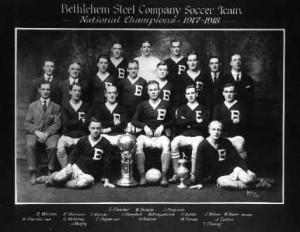
1917/1918 National Challenge Cup champion Bethlehem Steel


First Round
Eastern Bracket
New York & New Jersey
11/4/17 New York FC 2 : 0 Clan MacDuff
11/4/17 Alley Boys FC 3 : 0 Fulton AC
11/4/17 Clan McDonald 1 : 0 La Sultana FC
11/4/17 Jersey AC 0 : 7 West Hudson AA
11/4/17 Babcock & Wilcox 1 : 1 Scottish American FC
11/11/17 R Scottish American FC 1 : 1 Babcock & Wilcox
11/18/17 R Scottish American FC 2 : 1 Babcock & Wilcox
11/4/17 Interborough Rapid Transit w/o White Rose FC
Northern Massachusetts
11/4/17 Fisk Red Tops 1 : 2 Fore River Rovers
Connecticut
11/4/17 Bridgeport City 4 : 1 Bridgeport Rovers
Southern New England
11/3/17 Greystone AC 2 : 4 Lonsdale FC
11/4/17 New Bedford Celtics 0 : 2 Fall River Rovers
11/4/17 Crompton FC 2 : 3 Pan American FC
11/4/17 New Bedford FC 2 : 4 J & P Coats
   
Western Bracket
Eastern Pennsylvania
11/4/17 Disston AA 2 : 0 Wanderers FC
Northwestern New York
11/4/17 Rochester Celtic 4 : 0 Kodak Park FC
Western Pennsylvania
10/20/17 Castle Shannon FC 0 : 1 McKeesport FC
11/3/17 Beadling FC 0 : 3 Homestead Steel Works
Ohio
10/28/17 Thistle FC w/o Akron FC
10/28/17 Firestone Non-Skid 1 : 3 Goodyear FC
11/4/17 Cleveland FC 2 : 0 White Motors FC
Michigan
11/4/17 Rising Star FC 0 : 2 Corinthians FC
11/11/17 Roses FC 2 : 1 Bricklayers FC
Illinois
10/21/17 Bricklayers FC 1 : 2 Harvey FC
   
Second Round
Eastern Bracket
New York & New Jersey
12/2/17 Scottish American FC 1 : 1 (aet) New York FC
3/3/18 R New York FC 3 : 2 (aet) Scottish American FC
12/1/17 Clan McDonald 1 : 3 Interborough Rapid Transit
12/2/17 Paterson FC 6 : 2 Kinsley FC
2/17/18 West Hudson AA 4 : 0 Alley Boys FC
New England
12/3/17 Fall River Rovers 4 : 3 Bridgeport City
3/2/18 Pan American FC 3 : 0 J & P Coats
12/3/17 Lynn Hibernians 5 : 0 Lonsdale FC
12/3/17 Fore River FC 3 : 2 Lawrence Cricket & FC
Western Bracket
Illinois
12/2/17 Scottish American FC 2 : 2 Joliet FC
12/23/17 R Scottish American FC 2 : 9 Joliet FC
12/2/17 Harvey FC 1 : 0 Bohemian American FC
Ohio & NW New York
12/2/17 Thistle FC 0 : 3 Rochester Celtic
12/2/17 Goodyear FC 1 : 2 Cleveland FC
Eastern Pennsylvania
12/1/17 Disston AA 2 : 1 Puritan YML
12/1/17 Bethlehem Steel 2 : 0 Veteran AA
Western Pennsylvania
12/1/17 Homestead Steel Works 4 : 1* McKeesport FC
  *McKeesport protest upheld, replay ordered
12/15/17 R McKeesport FC 3 : 1 Homestead Steel Works
Michigan
12/2/17 Corinthians FC 3 : 2 Roses FC
   
Third Round
Eastern Bracket
1/5/18 Disston AA 1 : 2 (aet) Bethlehem Steel
3/3/18 Paterson FC 4 : 3 Interborough Rapid Transit FC
3/10/18 West Hudson AA 4 : 3 New York FC
3/23/18 Fall River Rovers 3 : 1 (aet) Pan American FC
Western Bracket
2/16/18 McKeesport FC 9 : 0 Rochester Celtic
2/23/18 Fore River FC 1 : 6 Lynn Hibernians
12/30/17 Cleveland FC 3 : 1 Corinthians FC
12/25/17 Joliet FC w/o Harvey FC
   
Quarterfinals
3/2/18 McKeesport FC 0 : 5 Bethlehem Steel
3/10/18 Joliet FC 4 : 2 Cleveland FC
3/17/18 Paterson FC 4 : 4 West Hudson AA
3/24/18 R West Hudson AA 5 : 1 Paterson FC
3/30/18 Lynn Hibernians 0 : 5 Fall River Rovers
   
Semifinals
3/30/18 Bethlehem Steel 4 : 0 Joliet FC
4/20/18 Fall River Rovers 3 : 1 West Hudson AC
   
Final
  at Coates Field – Pawtucket, Rhode Island
5/5/18 Fall River Rovers 2 : 2 (aet) Bethlehem Steel
  at Federal League Baseball Grounds – Harrison, New Jersey
5/19/18 R Bethlehem Steel 3 : 0 Fall River Rovers
KEY – w/o – walkover, R – Replay

Filed Under: US Open Cup Tagged With: 1918, Bethlehem Steel FC, Cleveland FC, Fall River Rovers, Federal League Baseball Grounds, Joliet FC, Lonsdale Avenue Grounds, Lynn Hibernains, McKeesport FC, National Challenge Cup, Paterson FC, West Hudson AA

Primary Sidebar

Follow Us on Social Media

  • Bluesky
  • Facebook
  • Instagram
  • Twitter
  • YouTube

U.S. Open Cup History

1935 National Challenge Cup Semifinals: After 29 days, Central Breweries win 3-game Western Final

The Western Final of the 1934/1935 National Challenge Cup featured one of Chicago’s best teams from the first 30 years of the tournament against a St. Louis team that would form their own dynasty.

  • 1995 US Open Cup: Rob Ukrop of Richmond Kickers voted TheCup.us Player of the Tournament
  • 1995 US Open Cup Final: Jeff Causey of Richmond Kickers voted TheCup.us Player of Round
  • 1995 US Open Cup Final: Richmond Kickers survive heat, beat El Paso Patriots in PKs to win title
  • 1995 US Open Cup Final Preview: El Paso Patriots hosting amateur Richmond Kickers in “El Sauna”
  • 1995 US Open Cup Semifinals: Jake Arrambide of El Paso Patriots voted TheCup.us Player of Round

Analytics powered by

Copyright © 2026 • Built by Jacob Martella Web Development