The history of the US Open Cup is full of rivalries between cities. Los Angeles vs. San Francisco, St. Louis vs. Chicago, Philadelphia vs. New York. Put these games in the late stages of the tournament and some “instant classics” are created.
Just as we did with Philadelphia vs. Pittsburgh, we thought it would be fun to look back at some of the notable Quarterfinal meetings between clubs from the Philadelphia area and New York and New Jersey. Despite being roughly 70 miles north of the City of Brotherly Love, we included the Bethlehem Steel FC in our list, so one could argue this is a list of the greatest Eastern Pennsylvania vs. New York/New Jersey matchups in the history of the Quarterfinals.
March 20, 1915
1914/1915 National Challenge Cup Quarterfinals
Bethlehem Steel 3:0 Scottish American FC
East End Field – Bethlehem, Pennsylvania
Scoring Summary
Bethlehem: Tommy Fleming 21’, Fred Pepper 78’, Bob Millar 85’
The first Quarterfinal meeting between Philadelphia and New York/New Jersey clubs took place in the second edition of the US Open Cup, then known as the National Challenge Cup. Bethlehem was on their way to their first National Challenge Cup title and would also go on to win Philadelphia’s American League of Association Football Clubs with an 11-0-3 record, scoring 64 goals while only allowing 11.
Bethlehem was fresh off a 2-1 Semifinal loss in the American Cup (a Northeast-based precursor to the National Challenge Cup) to the Brooklyn Celtics six days earlier. On the same day, the Scottish American FC defeated West Hudson 2-1 to book a spot in the American Cup Final against Brooklyn, who they would later defeat 1-0 to claim the 1915 American Cup championship.

Scottish American FC, better known today as Kearny Scots, were making their Cup debut. They would finish a respectable third in the 1914-15 National Association Football League season, but on this day they were no match for the emerging dynasty of American soccer, a trio of British imports made sure of that.
Played at Bethlehem’s East End Field, The Philadelphia Inquirer reported that while the Scots at times played well, “only twice in the first half and five times in the second” did the visitors threaten to score. The opening goal was driven in by Hall of Famer Tommy “Whitey” Fleming, a Scotsman who joined Bethlehem in 1913. After a shot by Bob Millar was turned away by Scots goalkeeper Joe Knowles, Fleming swooped in and hammered home the loose ball.

In the second half, Bethlehem easily withstood the handful of chances by the Scots, and in the 78th minute Englishman Fred Pepper scored off a pass from Millar. With five minutes remaining, Millar, a Scot who played in the 1914 Cup Final with winners Brooklyn Field Club and later managed the US Men’s National Team at the inaugural FIFA World Cup in 1930, scored a goal of is own.
Bethlehem would go on to win the first of their five Cup championships, while the Scots Americans would join the American Soccer League in 1933, winning the league title five years in a row from 1937-1941. The club would continue in the ASL until 1953 but is still active today as one of the oldest clubs in the United States, having been founded in 1895 and are currently playing in New Jersey’s Garden State Soccer League.
April 4, 1920
National Challenge Cup Quarterfinals
Robins Dry Dock 1:0 (AET) Bethlehem Steel
Todds Field – Brooklyn, New York
Scoring Summary
Robins: Johnny McGuire 119’
By the 1919-20 season the Bethlehem Steel express was a train charging downhill without breaks. The club had won five of the last six American Cups and four of the last five National Challenge Cups. Bethlehem finished the 1918-19 season as triple champions, adding the National Association Football League (NAFBL) championship along with the two cup titles. By the end of the 1919-20 season, Brooklyn’s Robins Dry Dock would stand in the way of Bethlehem’s quest to win both cup competitions for a third time in a row. In an ironic twist, a pair of former Bethlehem players would help Robins deny Bethlehem in that quest.
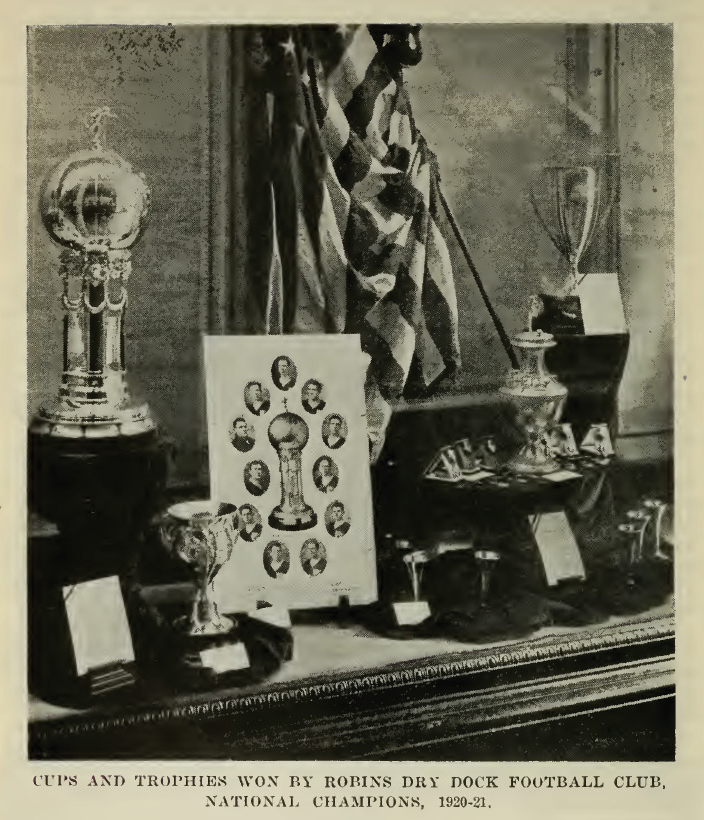
Robins Dry Dock began in 1918 as a team sponsored by the Robins Dry Dock and Repair Company. During World War I, ship manufacturing and repair companies sprang up along the Northeast and would begin backing soccer clubs. Robins Dry Dock played in the NAFBL along with Bethlehem, taking the place of the Scottish American FC during the 1918-19 season when the Scots were forced to pull out of the league due to a lack of players because of the war. Robins’ 10-2-2 record was good enough to finish third, but still three points behind league winners Bethlehem.

Over 5,000 fans packed Todd’s Field in Brooklyn on a rainy Sunday afternoon to watch the clash of two heavyweights of the NAFBL. Robins were on top of the league at 7-0-1, while Bethlehem had only played five league games due to Cup games and bad weather causing postponements. In the lineup for Robins were two players Bethlehem were very familiar with, future Hall of Famers Harry Ratican and Bob Millar, who have played the past few seasons for Bethlehem. Bethlehem was also missing one of their major stars, Tommy Fleming, who was out due to illness.
The game turned out to be a rough affair at times, with a few players showing battle scars at the end. Robins halfback Neil Clarke suffered a deep gash above his left eye, and Bethlehem midfielder George McKelvey finished with a cut on his cheek. Johnny McGuire, who wound up being the hero for Robins, was knocked unconscious for a brief spell at one point.

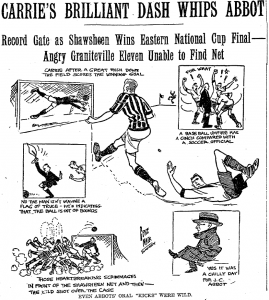
Defender John Ferguson played a big part in keeping Robins off the scoreboard throughout the game, and as time ticked by in the extra session, a replay between the two teams seemed certain. Finally, in the 118th minute, Ernie Garside sent a corner kick into the penalty area, where McGuire met it with a first-time shot that beat Bethlehem goalkeeper William Duncan and put Robins up 1-0. The remaining minute quickly ticked away, and the Brooklyn crowd rushed onto the field and carried McGuire off to the dressing room.
A month later Robins would get the better of Bethlehem once again in the American Cup Final, 1-0, this time the winning goal came when Bethlehem defender Thomas Murray’s attempted clearance went into his own goal. Bethlehem would gain a small bit of revenge later in the year, beating Robins 6-1 and 3-0 in the final two games of the NAFBL season to clinch the league championship. Robins would go on to win the National and American Cups in 1921, then disbanded in late 1921 when Todd Shipyards, the parent company of Robins Dry Dock, entered a team in the newly formed American Soccer League with many of Robins players filling the Todd roster.
March 3, 1929
National Challenge Cup Quarterfinals
New York Giants 2:2 Bethlehem Steel (1-0 HT)
Dexter Park – Brooklyn, New York
Scoring Summary
Giants: Shamus O’Brien 20’ (Stevens) 49’
Bethlehem: Jack Marshall 74’ (PK), Johnny Jaap 78’
REPLAY
March 9, 1929
Bethlehem Steel 3:6 New York Giants (2-1 HT)
Frankford Field – Philadelphia, Pennsylvania
Scoring Summary
Giants: Andy Stevens 48’ 58’ 2H, Davey Brown 1H 2H, Willie Ballantyne 90’
Bethlehem: Archie Stark 20′ (Robertson) 30′, Arthur Robertson 89’
By the Fall of 1928 a dark cloud began to envelop American soccer. Owners of American professional sports teams in this era were not used to dealing with governing bodies of their sport. For instance, professional baseball owners installed Judge Kenesaw Mountain Landis as commissioner in 1920 due to the worry that the 1919 “Black Sox” gambling scandal would drive fans away from their ballparks, rather than to oversee the owners. ASL owners had to answer to TWO governing bodies, the United States Football Association and FIFA. A few years earlier FIFA threatened to sanction the USFA over the ASL poaching players from Great Britain with salaries far above what the British teams could afford.
By 1928 the ASL owners wanted less oversight from the USFA and more control for themselves. When the USFA balked at their demands, just as it did in 1925 the ASL barred its teams from the National Challenge Cup.
Unlike 1925, three clubs, Bethlehem Steel, Newark Skeeters and the New York Giants defied the league and entered the Cup anyway. The ASL then suspended the three clubs, causing the USFA to remove sanctioning from the ASL, rendering it an outlaw league. The ASL continued with its season, while the three renegade clubs joined with several teams from the Southern New York Soccer Association to form the Eastern Soccer League.
Bethlehem and the Giants were easily the class of the new league early on, dominating the first half along with newcomers Hakoah All Stars, The Giants fell off the pace in the second half, leaving Bethlehem and Hakoah to battle for the second half championship. Bethlehem was also aiming for their sixth National Cup title, having won number five in 1927. With the heavy weights of the ASL absent Bethlehem or Giants were favorites to reach the Eastern Final, and as luck would have it, the pair met in the Quarterfinals.
7,000 fans filled Brooklyn’s Dexter Park, its pitch turned muddy from the late winter weather. Hall of Famer Shamus O’Brien struck first for the Giants, heading home a pass from Andy Stevens with twenty minutes elapsed. Later in the half Giants goalkeeper Jock Brown traded blows with Bethlehem’s Tom Gillespie, but both belligerents got off with a warning from referee Charles Creighton. Heading into the second half up 1-0, the Giants soon doubled their advantage. Three minutes into the second stanza, the Giants were awarded a free kick, which Pete McKinney sent to O’Brien to score his second of the game.
Down 2-0 Bethlehem turned up the pressure, earning a pair of corner kicks. At the 74th minute the Giants George Moorhouse was called for a handball in the penalty area, and Marshall converted the spot kick to cut the lead in half. Four minutes later Bethlehem stuck again, Johnny Jaap, Archie Stark and Alex Massie combined to break through the Giants defense, with Jaap netting the tying goal. No extra time would be played, as Bethlehem would host the replay the following Saturday at Frankford Stadium in Philadelphia. Frankford Stadium, not to be confused with Franklin Field at the University of Pennsylvania, was the home of the Frankford Yellow Jackets, an American football team that won the National Football League championship in 1926 (NOTE: The Yellow Jackets disbanded in 1931 and shortly after, the NFL awarded their franchise rights to a new ownership team that launched the Philadelphia Eagles in 1933).

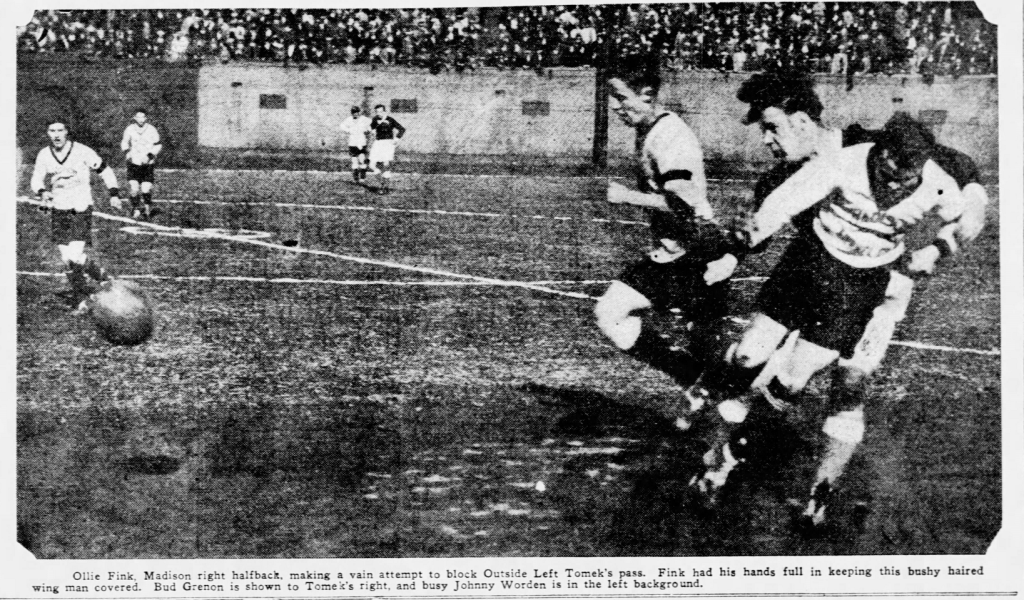
The replay started off splendidly for Bethlehem, as future Hall of Famer Archie Stark struck in the 20th and 30th minutes. Stark’s first goal came from a pass by former Preston North End player Tom Gillespie, while the second was the result of a Jack Marshall free kick, which Stark shot from 18 yards out.
Just before halftime, the Giants’ Davey Brown, another future Hall of Famer who played for the US National Team, pulled one back in somewhat controversial fashion. Andy Stevens sent a pass to Brown, who was initially offside, but before Brown received the ball Bethlehem goalkeeper Dave McClure charged to try and intercept but Brown was able to score. Furious Bethlehem players surrounded referee Charles Creighton in protest to no avail.
Just two minutes into the second half, Andy Stevens booted home a cross from Wiliam Findley to tie the game at 2-2. Ten minutes later, Stevens repeated his scoring efforts from a scrimmage in front of the goal, giving the Giants a 3-2 lead.
From then on, the New Yorkers continued to grow their lead. Davey Brown got his second goal of the game with an assist from Stevens, who completed his hat-trick soon after making it 5-2 for the Giants. For a full five minutes Bethlehem attacked the Giants goal, with Arthur Robertson eventually making it 5-3, but it was too little too late. Willie Ballantyne put the final nail in the Steelmen’s coffin in the final minute. It was the most lopsided Cup defeat ever suffered by Bethlehem.
The Giants run would stop at the Eastern Final with a 1-0 loss to Hakoah All Stars a new powerhouse in American club soccer. Hakoah was formed by former members of Vienna Hakoah who stayed in the U.S. after successful tours in 1926 and 1927. Hakoah would go on to defeat St. Louis’ Madison Kennels in the Final.
The 1929-30 season would be the last one for Bethlehem, when Bethlehem Steel vice president Horace Edgar Lewis, disheartened by the fight with the American Soccer League, gave up on soccer all together and disbanded the team. Bethlehem’s final Cup run in 1930 saw them reach the Eastern Final, where they lost 3-2 to their old rivals, the Fall River Marksmen. The ASL would change drastically as well, folding near the end of 1932 and re-emerging in 1933 as a scaled down semi-pro league.
February 22, 1942
National Open Cup Quarterfinals
Kearny Scots Americans 1:2 Philadelphia Americans
Starlight Park – Bronx, New York
Scoring Summary
Scots: Billy Gonsalves 6’
Americans: Jimmy Reid 5′, Bob Gormley 50’ (Swieconek)
Match abandoned in 87th minute due to crowd entering the field after a disputed non-call in the penalty area
REPLAY
April 19, 1942
National Open Cup Quarterfinals
Philadelphia Americans 3:2 Kearny Scots
Cambria Stadium – Philadelphia, Pennsylvania
Scoring Summary
Americans: Razzo Carroll 1H 2H, Bob Gormley 4’
Scots: John Wojciechowicz 30’ (Fisher), Billy Gonsalves 2H (Rae)
Heading into the 1942 Open Cup, the Kearny Scots were the dominant force in the American Soccer League, having won their fifth straight ASL championship in 1941. However, cup success did not follow the Scots’ league exploits, as they had only advanced as far as the Quarterfinals just once (1937) during their ASL championship years. 1942 would finally be the year Kearny broke through, defeating Bigelow Stanford (forfeit), Kearny Irish (2-0) and Baltimore SC (3-1) to finally reach the final eight.
The Philadelphia Americans, 1936 Open Cup winners as First German American SC, would end Kearny’s reign in the ASL by winning the league with a 12-2-5 record in 1942, while the Scots slipped to mid-table. Both the Scots and German American SC officially changed their names to American in 1942 due to the United States entering World War II.

The first meeting between the teams at Starlight Park in the Bronx, New York would start quickly and end in dispute. After the Scots turned away a Philly corner kick, Jimmy Reid gave the Americans an early 1-0 lead in the fifth minute.
Just a minute later, the ageless Billy Gonsalves, who had made his playing debut in 1926 and would continue playing until 1952, scored the equalizer from a scrum in front of the goal. Gonsalves would finish his career as one of the country’s all-time greats, playing in two World Cups (1930, 1934). Gonsalves won the US Open Cup eight times and to this day, no one has scored more career goals (14) in US Open Cup Final games than him.
After five minutes of the second half Philadelphia took a 2-1 lead on Bob Gormley’s goal, assisted by Ted Swieconek. In the latter half of the game, Kearny’s Ostowski and Gormley were sent off, but with three minutes remaining the real trouble began. Philly defender Werner Mieth handled the ball in the penalty area, but referee Phil Fox did not see it. After consulting his lineman Fox decided against awarding Kearny a penalty, causing some of the Starlight Park patrons to invade the pitch in protest. When the crowd failed to clear theh field after about 15 minutes, Fox called the game off, meaning a replay would be needed.
The next dispute would be where the replay should take place. The USFA ordered the game for Philadelphia, but Kearny argued that since the original game was not finished the replay should be at Starlight Park. At one point Kearny manager Willie Ballantyne suggested his team would not travel to Philadelphia for the game. Nearly two months after the abandoned game, the clubs finally met at Philadelphia’s Cambria Stadium and just like the first contest it was a close affair.
Bob Gormley opened the scoring for Philadelphia in the 5th minute, and the Scots briefly protested that referee Phil Fox’s white shirt too closely resembled what Philly was wearing. Philly’s Razzo Carroll scored another soon after to push the lead to 2-0.
Kearny cut that lead in half in the 30th minute when John Wojciechowicz (who the NY Irish American Advocate referred to as “What’s your hurry”) from a “perfect” pass from Frank Fisher. The clubs traded goals early in the second half, Razzo Carroll scoring for Philly and Billy Gonsalves keeping Kearny within, making it 3-2. The Scots continued to press for the equalizer, but Philly held on for the win.
Philadelphia’s run would stop in the Eastern Final, losing to the Pawtucket Rangers 5-2 on aggregate. They would continue to be one of the better teams in the ASL, winning seven ASL championships over the next 15 years. Kearny, on the other hand, would slip into mediocrity, regularly finishing in the lower half of the ASL standings and never advancing as far as the Quarterfinals of the Open Cup again.
May 27, 1945
National Challenge Cup Quarterfinals
Brooklyn Hispano 4:3 Philadelphia Americans
Starlight Park – Bronx, New York
Scoring Summary
Hispano: Billy Gonsalves 35’ (Pruha) 40’ (Bainlarde), Gonzalo Romero 2H’, Johnny Pruha 2H’
Americans: Steve Hritz 5’ (Nanoski), Jim Ried 2H’ (Brown), Ed Brown 70’ (Nanoski)
During the 1944-45 season, the Philadelphia Americans and Brooklyn Hispano were at opposite ends of the spectrum. Philadelphia would finish the season two points shy of Brookhattan for the American Soccer League (ASL) championship and boasted the highest scoring offence in the league with 64 goals over 19 games. Duke Nanoski and Ray Kelly would finish 1st and 3rd in the league goalscoring leaders with 22 and 16 respectively. Hispano, on the other hand, would finish 8th in the 10-team league, boasting a strong offence of their own with 49 goals in 20 games. However, the 46 goals they allowed was second worst in the league.
Led by the 37-year-old Billy Gonsalves, Hispano were the two-time defending Open Cup champions and were looking to add another Open Cup championship to make up for a disappointing league campaign.

Brooklyn and Philadelphia would meet in the 1945 Quarterfinals as the second game of an Open Cup doubleheader at Starlight Park, Brookhattan opening the day with a 3-2 win over the Baltimore Americans. Steve Hritz started things off early by scoring for the Americans after five minutes. Midway through the opening half Gonsalves made his presence known, scoring on a header off a pass from future Hall of Famer Fabri Salcedo, then kicking one in five minutes later with another assist from Salcedo
Up 2-1 at halftime, Hispano would extend its lead to 3-1 early in the second half through Gonzalo Romero. Romero was a bit of an inspirational player. Having fought in the Spanish Civil War as a Naval officer, Romero made his way to the U.S. and signed to play with Hispano. An accident involving a cement mixer caused Romeo to lose his right arm up to the shoulder, but after a few years he regained his strength and rejoined Hispano during the 1944-45 season.
Brooklyn continued to score, this time Salcedo assisted Johnny Pruha in making it 4-1 in favor of Hispano.
The Americans then began their comeback attempt, cutting the deficit to 4-2 on Jim Ried’s goal. With 20 minutes remaining Ed Brown scored off a cross by Duke Nanoski, but the Hispano defense kept Philly off the scoreboard the rest of the way for a 4-3 win.
Hispano would lose to Brookhattan in the Eastern Final 5-4 in extra time and would advance as far as the Quarterfinals just once more in 1949 before the team disbanded in late 1954. The Philadelphia Americans would continue to be competitive in league and cup play, changing their name to Uhrik Truckers after their new owners, and absorbing the failing Philadelphia Nationals. Uhrik would last until 1965 when it finally gave up the ghost and made way for a new club representing Philly, the Ukrainian Nationals.
April 12, 1964
National Challenge Cup Quarterfinals
Ukrainian Nationals 2:0 (AET) New York Hota
Cambria Stadium – Philadelphia. Pennsylvania
Scoring Summary
Nationals: Carl Yakovino 2H, Ismael Ferreyra 2H
By the 1963-64 season, the American Soccer League (ASL) lineup of teams was drastically different than it was a few years prior. Gone were most of the clubs that carried the league through the 1940s and 1950s, only Uhrik Truckers (formerly Philadelphia Americans) remained from the previous era, and their time was running out. On top of that, a new league burst onto the scene a few years earlier as competition. The International Soccer League had been established in 1960, but instead of American teams, European and South American teams were brought in to compete in a short league format.

Through all this, Philadelphia’s Ukrainian Nationals emerged as the latest dynasty of American soccer, winning the National Open Cup in 1960, 1961 and 1963, as well as the last three ASL championships.
Standing in their way in the 1964 Quarterfinals was New York Hota of the storied German American Soccer League (later known as the Cosmopolitan Soccer League, which still exists today). Hota was an organization of workers from the hotel and restaurant industry that was founded in 1922 and stands for “Hotel Association”. The Uke Nats met Hota in the 1963 Open Cup, defeating them 4-1 in the Eastern Quarterfinals on their way to a third Open Cup title.
Hota goalkeeper Hughie Schwart was credited for keeping Hota in the game, which ended scoreless after 90 minutes. Fourteen minutes before extra time, Hota was dealt a blow when inside right Gress was sent off for dangerous play.
In the 13th minute of extra time, the Ukrainians finally pulled ahead when Carl Yakovino’s long shot from the right side snuck under the crossbar. In the 113th minute, Ismael Ferreira scored from a free kick by future Hall of Famer Walter Czyzoswych to send “Tryzub” to the Eastern Final.

The Ukrainians would see their run end in the Eastern Finals, losing to Guiliana 5-3 on aggregate. The Uke Nats would win their fourth Open Cup title in 1966 in a two-leg 4-0 win over Southern California’s Orange County SC. Hota would also eventually win Open Cup honors in 1971, defeating Yugoslav American SC of Los Angeles 6-4 after extra time in what stands as the highest scoring Open Cup Final of all time. Hota is still active today as NY Hota Bavarian, and is focused more on youth soccer.
April 30, 1967
National Open Cup Quarterfinals
Ukrainian Nationals 0:2 Paterson Roma
Cambria Stadium – Philadelphia, Pennsylvania
Scoring Summary
Roma: Tony Verstrade 56’, Walt Marcolini 83’
After winning their fourth Open Cup championship in 1966, the Ukrainian Nationals were out to make history by joining Bethlehem Steel as the second Eastern Pennsylvania team to officially win five Open Cup titles.
In their path in the Quarterfinals was Paterson Roma, or simply Roma SC. Roma got its start in 1955 and joined the ASL after playing in the New Jersey State League and Garden State League. Roma had won the ASL title in 1966 and although they would finish 1967 a somewhat disappointing 5-3-1, they came into the game with the Ukrainians on a hot streak, winning their last seven league and cup games and scoring 33 times while allowing only 4.

Roma and the Ukrainians met in the Eastern Quarterfinals of the 1965 Open Cup, which saw the Nationals eke out a 2-1 extra time win. After a scoreless opening half at Philadelphia’s Cambria Stadium, Roma’s scoring prowess kicked in. At the 56th minute, Tony Verstrade made it 1-0 Roma with a roller that fooled the Ukrainian defenders. With seven minutes remaining, Walt Marcolini headed in a high-lofting shot that settled in the back of the goal for an insurmountable 2-0 lead, derailing the Nationals quest for title number five.
Roma’s Open Cup would end at the Eastern Final, were they lost 3-0 on aggregate to the team that would take the Ukrainian Nationals place as the powerhouse of American soccer, the New York Greek American SC. The Greeks, who are still active today, would win the Open Cup three years in a row from 1967-1969. The Uke Nats and Roma would take turns in 1968 and 1969 trying to dethrone the Greek Americans in the Eastern Final, the Nationals losing a 3-2 aggregate series in 1968, and Roma getting demolished 7-3 over two legs in 1969. Neither Roma nor the Ukrainians would reach the Eastern Final again. The Greek Americans would eventually win title number four in 1974 with a 2-0 win over Croatian SC (Illinois).
July 21, 2015
Lamar Hunt US Open Cup Quarterfinals
New York Red Bulls 1:1 (AET) Philadelphia Union
Philadelphia Union advance 4-3 on penalty kicks
Red Bull Arena – Harrison, New Jersey
Scoring Summary
New York Red Bulls: Lloyd Sam 90’+4
Philadelphia Union: Eric Ayuk 56’
In 2015 the six-year-old Union were finding success in the Open Cup while struggling in MLS play. Heading into the 2015 season, Philadelphia had just one MLS Cup playoff appearance while reaching the Open Cup Semifinals in 2012 and the Final in 2014. The 2015 campaign would be no different, missing the MLS Cup playoffs while reaching the Open Cup Final for a second year in a row.
In their way in the Quarterfinals were the New York Red Bulls, 12 years removed from their last Open Cup Final appearance as the MetroStars. The Red Bulls fortunes were opposite of the Union. While never winning MLS Cup, they were regular participants in the MLS Cup playoffs but found little success in the Open Cup, reaching just one Final (2003) in 16 attempts.
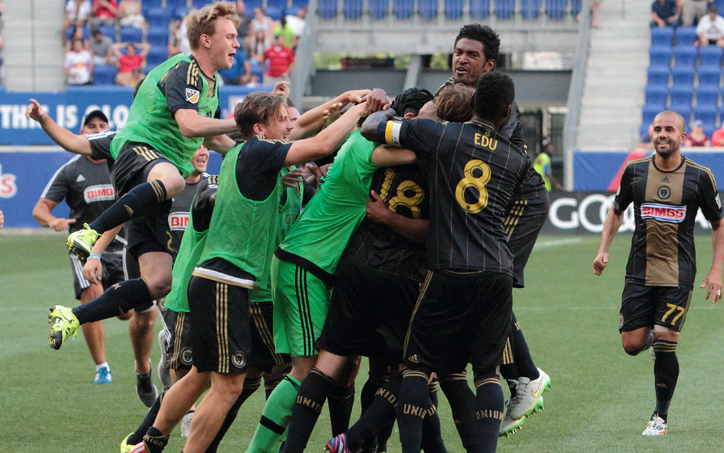
The Red Bulls put pressure on Philadelphia goalkeeper John McCarthy in the opening half, but the hometown netminder kept New York off the scoreboard, making a few of the nine saves he would finish with in an effort that would earn him TheCup.us Player of the Round honors. The Red Bulls gained an advantage just before halftime when Philadelphia’s Conor Casey was shown his walking papers after stomping on the calf of the Red Bulls’ Conor Lade.
Despite being down a man, Philly managed to take a 1-0 lead shortly after halftime when on a counterattack Vincent Nogueia passed to a wide-open Eric Ayuk, who easily beat Red Bulls goalkeeper Eric Robles. The Red Bulls continued to press for the equalizer, but McCarthy kept a clean sheet.

The hosts finally broke through in second half stoppage time. Mike Grella headed the ball near the goalmouth, where Lloyd Sam was able to control it, spin around, and finally beat McCarthy to send the game into extra time. McCarthy and the Union defense resumed keeping the Red Bulls off the scoreboard for the remainder of the match, meaning a penalty shootout would decide who advanced to the Semifinals.
The hosts got off on the wrong foot when Bradley Wright-Phillips struck the crossbar with his attempt. After three rounds Philly was up 3-2 when McCarthy got revenge on Sam by stopping his shot, then scrambling to just barely keep the ball from trickling over the goal line. With a chance to end the shootout, Philly’s Brazilian midfielder Fred saw his shot saved by Luis Robles to keep the Red Bulls temporarily alive. But then Fernando Aristeguieta converted Union’s final penalty kick to win the shootout 4-3.

Philadelphia would go on to reach the 2015 Open Cup Final, losing to Sporting Kansas City on penalties after a 1-1 draw. Philly would also go on to be one of the stronger clubs in MLS, regularly recaching the postseason, but have yet to win an Open Cup title.
The Red Bulls came close in 2017, reaching the Open Cup Final where they also lost to Sporting Kansas City.
 It’s no real surprise the 1920 Semifinals lacked teams with Finals experience, for many reasons. For the 1920 edition, there were many teams returning to the competition after a two-year absence. World War I enlistments had greatly reduced the field of teams for the 1918 and 1919 tournaments, as many teams had to suspend operations due to a lack of players. Detroit’s Packard FC was one of those clubs, having participated in the National Challenge Cup from 1915-17, the club skipped the 1917-18 and 1918-19 competitions. Packard had achieved moderate success in their previous cup runs, but never got as far as the Third Round.