• Skip to primary navigation
  • Skip to main content
  • Skip to primary sidebar
  • US Open Cup Central
  • US Open Cup Qualifying
  • US Open Cup History
  • Amateur Cup

Complete U.S. Open Cup Coverage

  • 2026 USOC Schedule
  • 2026 USOC Stat Leaders
  • 2027 USOC Qualifying Results
  • TheCup.us Awards
  • Join TheCup.us Patreon!
  • Contact Us

Dallas Burn

American soccer’s greatest modern underdog story: Rochester Raging Rhinos win 1999 US Open Cup

September 14, 2020 by Josh Hakala

The Rochester Raging Rhinos celebrate their 1999 US Open Cup championship after defeating the Colorado Rapids 2-0 at Columbus Crew Stadium in Columbus, OH. Photo: Rochester Rhinos

A version of this story by Josh Hakala originally appeared on FourFourTwo.com

Every sport has its go-to underdog story. Hockey has the “Miracle on Ice”, college basketball has N.C. State in 1983, baseball has the “Miracle Mets” in 1969, and boxing has Buster Douglas knocking out Mike Tyson. World soccer has plenty to choose from with Leicester City (2015/16 Premier League champions) being the most recent example.

For American soccer, it’s the 1999 Rochester Raging Rhinos, who became the first and, to date, the only lower division club to win the Lamar Hunt US Open Cup since Major League Soccer launched in 1996. Fans of domestic cup competitions like the FA Cup (England) know that anything can happen, and in 1999, the Rhinos of the A-League (Div. 2) upset four MLS teams en route to lifting the trophy.

The last team to come close to repeating their accomplishment was the 2008 Charleston Battery who reached the Final in 2008, but lost to D.C. United. More recently, FC Cincinnati, then of the USL, let a 2-0 lead on their home field slip away in the 2017 Semifinals, falling to the New York Red Bulls. If they would have held on for the win, they would have had a chance to join the Rhinos in the American soccer history books.

However, looking back at the 1999 Rochester Raging Rhinos (they dropped the “Raging” part of their name prior to the 2008 season), their magical Open Cup run almost didn’t happen. Multiple times.

Round 2: Rochester Raging Rhinos 2, New York Freedoms 1 (OT)

The Rhinos began the tournament in Round 2 and their opening game was against the New York Freedoms, an amateur team from the Premier Development League (PDL, now known as USL League Two). To put the mismatch in perspective, the US Soccer Federation assigned seedings to the teams for the 1999 US Open Cup and the Rhinos were the No. 9 seed and the Freedoms were 28th out of the 32-team field. 

Mauro Biello of the Rochester Raging Rhinos battles for the ball against the New York Freedoms in the Second Round of the 1999 US Open Cup. Photo: Democrat & Chronicle

The New York Pancyprian Freedoms were three-time US Open Cup champions (1980, 1982, 1983) and long-time members of the New York’s famed Cosmopolitan League. They launched a PDL team in 1999 under the name “New York Freedoms” and qualified for the Open Cup in their debut season.

More than 7,000 fans showed up at the Rhinos’ Frontier Field to cheer on the defending A-League (Div. 2 pro) champions. In the first half, it looked like it was going to be a one-sided affair when New York’s Ronan Wiseman, who was on loan from the Long Island Rough Riders, received a straight red card for a hard tackle in the 35th minute.

“I’m very disappointed,” Freedoms manager Tony Noto told the Democrat and Chronicle after the game. “The referee made a difference. He changed the destiny of the Freedoms. You don’t (throw) players out on the first foul.”

Despite being down a man, the Freedoms walked into the locker room at halftime scoreless against the Rhinos.

According to Rhinos head coach Pat Ercoli, his team’s smaller field dimensions at Frontier Field may have helped the visiting team stay in the game as they bunkered down once they were down a man.

In the 57th minute, New York’s Rodney Rambo stunned the announced crowd of 7,131 by giving the 10-man Freedoms the lead. The former University of Portland star stole the ball from Rhinos midfielder Kirk Dietrich near the Rochester penalty area, dribbled in and put the ball past goalkeeper Bill Andracki, who was filling in for injured starter Pat Onstad.

“ was certainly a wake-up call,” said Rhinos head coach Pat Ercoli. “When you’re playing the amateur teams, sometimes you take them for granted, just like the MLS teams have done in certain cases with lower division teams. The lower division teams tend to up their game and the higher division teams tend to play down to .”

That lead would be short-lived as Mauro Biello, the team’s top scorer, received a pass just outside the box from Doug Miller, the A-League’s 1997 MVP. Biello launched a shot from a little more than 20 yards out to tie the game in the 62nd minute.

The match would head into golden goal extra time where Biello played provider, delivering a corner kick to the head of Darren Tilley who nodded home the game-winner in the 110th minute. The Freedoms gave the Rhinos a scare despite Rochester outshooting New York 22-7 and earning 19 corners to the Freedoms’ four. New York’s goalkeeper Roberto Sir kept his team in the game, making seven saves over 110 minutes of action.

After the game, Tilley told Jeff DiVeronica of the Democrat and Chronicle that the team was just happy to advance.

“We didn’t play to our best, as I think everyone would acknowledge, but it’s all about winning in Cup competitions.”

The headline in the July 15, 1999 edition of the Democrat and Chronicle (Rochester, NY) after the Rochester Raging Rhinos upset the defending MLS Cup and US Open Cup champion Chicago Fire.

ROUND 3: Rochester Raging Rhinos 1, Chicago Fire 0

In the next round, the Rhinos found themselves in a battle worthy of a Final. Rochester, the defending A-League champions welcomed the defending MLS Cup and US Open Cup champions in the Chicago Fire. With two major trophies already added to Chicago’s trophy case after its inaugural season, the Rhinos were not intimidated.

Photo: Democrat & Chronicle archives

After Yari Allnutt headed home a Michael Kirmse corner kick to put the Rhinos ahead in the 51st minute, the more than 10,000 fans in attendance at Rochester’s Frontier Field saw the game’s physical play cranked up to another level.

“We had a mentality that we don’t care where you play, we’re going to come and take it to you and compete on any given day and make sure we’re going to be successful,” said Rhinos forward Doug Miller. “Other teams, they had given more respect and time for these guys to play … we were very hard-nosed and very chippy.”

That hard-nosed approach produced a tournament-high 45 fouls between the two teams, but the cards didn’t start coming out until about 20 minutes into the second half.

With roughly 15 minutes left in the game, Chicago’s Lubos Kubik got into a confrontation with multiple Rhinos players which led to him putting Rochester’s Scott Schweitzer in a headlock. Kubik and Schweitzer, who were the previous year’s Defender of the Year in their respective leagues, were both sent off.

Despite missing their top defender, goalkeeper Pat Onstad and the Rhinos were able to keep the Fire’s high-powered offense off the scoresheet. Rochester’s defense held Chicago to just eight shots with Onstad, a Canadian international, only needing to make three saves to earn the clean sheet. With the win, the Rhinos were moving on to the Quarterfinals, 1-0.

“We had that swagger where we knew we could win. They came in with their best team and we came in with our best team and it was a fight,” said Ercoli.

“Some of those things we did in that game, you wouldn’t get away with today. You would have seen four or five red cards ,” Ercoli added with a chuckle.

QUARTERFINALS: Rochester Raging Rhinos 2, Dallas Burn 1 (OT)

The sports page in the Democrat & Chronicle (Rochester, NY) on Aug 12, 1999 as the Rochester Raging Rhinos defeated the Dallas Burn in the Quarterfinals of the 1999 US Open Cup.

In the Quarterfinals, the Rhinos hosted the 1997 US Open Cup champion Dallas Burn in front of another crowd of more than 10,000 fans. This was nothing new for the Rhinos faithful who’s attendance figures had made Rochester a strong candidate to join Major League Soccer. The match against Dallas drew an announced crowd of 10,730, which was the seventh time that a US Open Cup match cracked the 10,000 mark in the Modern Era. Of those seven games, four of them were hosted by the Rhinos at Frontier Field, one of them was the 1998 Final, and the record of 20,376 was a Colorado Rapids game at Mile High Stadium against the Seattle Sounders (A-League) that was given a significant boost as being the opening match of a doubleheader with the US Men’s National Team playing against Derby County of the English Premier League.

After a scoreless first half, Mauro Biello opened the scoring by redirecting a Tim Hardy shot past Dallas’ All-Star goalkeeper Matt Jordan in the 71st minute. Jason Kreis, who would finish tied as MLS’ leading goalscorer that year and win the MLS MVP award, rescued the Burn with an 85th minute equalizer on a cross from Paul Broome.

Just like the match against the Freedoms in Round 2, it came down to extra time and another golden goal from the Rhinos. Michael Kirmse was at the right place at the right time. In the 110th minute, Biello sent in a free kick that Tilley headed off the crossbar. The rebound fell right to Kirmse who put it into the back of the net to send Rochester back to the Semifinals for the second time in four years.

The game was satisfying for the Rhinos because of the criticism directed at them by members of the Dallas Burn before the game. Chief among them was outspoken Dallas head coach Dave Dir saying that Rochester played like “11 Dennis Rodmans”, referring to the physical style of play of the NBA star. While Dir attacked the players’ style of play, Kreis mocked the size of the Rhinos’ Frontier Field, saying “when they play on a real field, they’re going to get their butts beat.”

“That was definitely fodder for the locker room,” said Ercoli. “Scott Schweitzer was one of the guys on our team that made sure everyone knew about it.”

SEMIFINALS: Rochester Raging Rhinos 3, Columbus Crew 2

The Rhinos played away from home for the first time as both Semifinals were scheduled at a neutral venue at the Virginia Beach Sportsplex (Va.) on Sept. 1. Both games featured an A-League vs. MLS match-up, however, the event was overshadowed, quite literally, by the weather as Hurricane Dennis was bearing down on the region. The game was able to move forward because Dennis was downgraded to a tropical storm, but it still brought high winds and heavy rain to the doubleheader.

Rochester Raging Rhinos head coach Pat Ercoli celebrates his club’s 1999 US Open Cup title. Photo courtesy of Pat Ercoli

Earlier in the evening, the Colorado Rapids (MLS), the team the Rhinos beat in the 1996 Semifinals, punched their ticket to the Final with a 3-0 win over the A-League’s Charleston Battery. All the scoring came in the second half with Jorge Dely Valdes accounting for two of them and Paul Bravo adding another. Wolde Harris assisted on two of the three goals, while Ian Feuer made four saves to earn the clean sheet. After the match, Rapids head coach Glenn Myernick had the quote of the night: “It was a great night, if you’re a duck.”

It was already announced that the tournament’s championship game two weeks later would be held at the Crew’s new soccer-specific stadium in Columbus. So when the Rhinos kicked off against a star-studded Crew team in the pouring rain, they would play spoiler in the most dramatic way possible.

With wind gusts up to 60 miles per hour, it was not a fun night for anyone but especially the goalkeepers.

“I’ve never played in wind like that before in my life,” said Rhinos goalkeeper Pat Onstad, who was the A-League Goalkeeper of the Year in his debut season the year before. “I would try to hit a goal kick as hard as I possibly could and it would get about 30 yards out and it would be coming back at our center backs and they would be heading it out. It was crazy.”

After a scoreless first half, the game opened up with the Rhinos answering everything the Crew fired at them. Despite facing 8 Rochester players in the wall, Columbus’ Robert Warzycha connected on a stunning free kick in the 56th minute to give the Crew, one of the top teams in MLS, a 1-0 lead. The Rhinos nearly equalized in the next few minutes as Darren Tilley had a goal disallowed for offside and Bill Sedgewick launched a shot from distance that hit the post.

Rochester would finally level the match in the 68th minute when Tilley headed home a Tommy Tanner cross. Just under ten minutes later, the Crew’s speedy winger Brian West put his team back in front, only to see Schweitzer take a rare free kick from 25 yards away that took a deflection off of Tanner and ended up in the back of the net.

It looked like Rochester was headed to its third extra time match in four matches, but three minutes into stoppage time, another Rhinos defender came to the rescue. Tim Hardy, cut inside his defender on the wing, took a shot that caught a gust of wind that carried into the corner of the goal, out of the reach of MLS goalkeeper wins leader Mark Dougherty.

It remains one of the most exciting finishes of the US Open Cup’s Modern Era (1995-present).

Mali Walton of the Rochester Raging Rhinos celebrates after winning the 1999 US Open Cup with a 2-0 win over the Colorado Rapids.

“At that point, we knew we were destined to win this thing,” said Ercoli.

FINAL: Rochester Raging Rhinos 2, Colorado Rapids 0

The hopes of a sold-out Crew Stadium for the Final were dashed as soon as the Rhinos eliminated Columbus in that rainy Semifinal in Virginia Beach. The vast majority of the announced crowd of 4,555 were cheering for the Rhinos against the Rapids, with many of those fans making the roughly 400-mile trip from Rochester on a Tuesday night. Those unable to make the trip were able to watch the game live on ESPN2, giving fans around the country a taste of the drama that the US Open Cup is capable of.

After three upsets of MLS teams, Rhinos beat writer Jeff Di Veronica wrote in his recap of the Columbus Crew game that “it might be time to stop calling Rochester’s wins over MLS teams upsets.”

After a scoreless first half, the Rhinos were struggling to create chances and needed to add some speed to the attack, so Coach Ercoli brought on a not-so-secret weapon in the 62nd minute. The club’s all-time leading scorer Doug Miller, who was frustrated because he had been the odd man out of the starting lineup in recent weeks, gave the Rhinos the spark they needed.

Rochester Raging Rhinos: 1999 US Open Cup champions

Three minutes after entering the game, Miller received the ball on the left wing, beat Rapids defender Peter Vermes and fired a shot through the legs of Colorado goalkeeper Ian Feuer to give the Rhinos the lead. Pat Onstad made some big saves down the stretch and Yari Allnutt put the game away with a goal in the 90th minute to kick off a long night of celebrations for the Rhinos and their traveling fans.

Miller used that moment to spark the rest of his season as he played a big role in the team’s playoff run as he scored six goals in the team’s seven playoff games as Rochester reached the A-League championship game before losing 2-1 to the Minnesota Thunder.

For Miller, looking back on his career, the US Open Cup title is something he will never forget.

“I’ve got four championships, two indoor, two outdoor, and I’ve got an amateur championship, but that ranks right up there at the top for many reasons,” said Miller. “To win the US Open Cup and to beat all those MLS teams in the fashion that we did was special.”


FULL MATCH REPLAY

“WHEN MLS DIDN’T WIN THE US OPEN CUP”

SOCCER SAM RECAP: 1999 US OPEN CUP FINAL

LOCAL NEWS HIGHLIGHTS

Filed Under: Feature - History, Feature - Main, US Open Cup, US Open Cup History Tagged With: 1999 US Open Cup, Chicago Fire, Colorado Rapids, Columbus Crew, Dallas Burn, new york pancyprian freedoms, Rochester Rhinos

US Open Cup history: A final four with teams without a title game appearance is rare

August 6, 2019 by Chuck Nolan Jr.

The 2019 US Open Cup Semifinals offer up a fresh and unique field of potential champions. Not only have none of the remaining teams ever won a US Open Cup championship, but none of them have ever been to a Final either. This is just the second time this has happened since MLS joined the competition in 1996, and it’s just the 10th time in the 106-year history of the tournament that fans are not only guaranteed a first-time champion, but none of the semifinalists have even reached a Final before.

We take a look back at the previous nine Semifinals that featured teams all seeking their first Open Cup title.

1920 National Challenge Cup
Robins Dry Dock (New York, NY) vs. Fore River FC (Quincy, MA)
Ben Miller FC (St. Louis, MO) vs. Packard FC (Detroit, MI)

It’s no real surprise the 1920 Semifinals lacked teams with Finals experience, for many reasons. For the 1920 edition, there were many teams returning to the competition after a two-year absence. World War I enlistments had greatly reduced the field of teams for the 1918 and 1919 tournaments, as many teams had to suspend operations due to a lack of players. Detroit’s Packard FC was one of those clubs, having participated in the National Challenge Cup from 1915-17, the club skipped the 1917-18 and 1918-19 competitions. Packard had achieved moderate success in their previous cup runs, but never got as far as the Third Round.
Fore River avoided the fate of many clubs and were able to field a team through the war since it’s home base of Quincy, Mass. was home to several shipyards, becoming an important employer during the war years. The Quincy shipbuilders had reached the Quarterfinals in 1919, where they fell to eventual runners-up Paterson FC (New Jersey) 2-1, in a replay of their scoreless draw.

Jimmy Miller of Ben Miller FC (Date unknown)

The 1920 tournament was just the second for Robins Dry Dock, as the team was put together at the start of the 1918-19 season. The Robins club also contributed to the inexperience of the Semifinals by eliminating the Fall River Rovers (4-0 in Round 4) and Bethlehem Steel (1-0 AET in Quarterfinals). Bethlehem had appeared in the previous five Cup finals, while Fall River joined the Steelmen in the title game from 1915-17. The elimination of these two powerhouses greatly increased the chance of new clubs reaching the final in 1920.


The final piece of the puzzle was the Ben Miller FC from St. Louis. 1920 was the first year that clubs from St. Louis entered the tournament, leading to the Gateway City becoming a dominant force in the national tournament for the next 17 years.

In the Semifinals, Fore River overcame a 1-0 halftime deficit to stage a dramatic 2-1 win over Robins, with Tommy Underwood and Jack Kershaw each scoring in the final 15 minutes. Ben Miller reached its maiden cup final with a 4-2 win over Packard FC. Rube Potee and Larry Riley each scored twice for the Millers. In the Final, at Handlan’s Park in St. Louis, Ben Miller and Fore River traded goals in the first half, Hap Marre for the home team and Kershaw for the visitors. Future National Soccer Hall of Famer Jimmy Dunn scored what proved to be the winning goal in the 63rd minute, giving St. Louis the National Challenge Cup crown in their debut year.

1920 National Challenge Cup Semifinals

April 10, 1920
Coats Field – Pawtucket, RI

Fore River Rovers 2:1 Robins Dry Dock

Robins: Harry Ratican – 45’
Fore River: Tommy Underwood (Farquar) – 75’
Fore River – Jack Kershaw (Underwood) – 85’

April 25, 1920
Federal League Park – St. Louis, MO

Ben Miller FC 4:2 Packard FC

Ben Miller: Rube Potee (PK) – 8’
Ben Miller: Larry Riley (Rooney) – 10’
Packard: Mercer – 30’
Packard: John Hunter – 43′
Ben Miller: Larry Riley (Rooney) – 68’
Ben Miller: Rube Potee – 2nd Half

1920 National Challenge Cup Final

May 9, 1920
Handlan’s Park – St. Louis, MO

Ben Miller FC 2:1 Fore River Rovers

Ben Miller: Hap Marre 22′ (Potee)
Fore River: Jack Kershaw 37′
Ben Miller: Jimmy Dunn 63′ (Potee)

***********************************

1925 National Challenge Cup Semifinals
Abbot Worsted (Fore Village, MA) vs. Shawsheen Indians (Andover, MA)
Thistles FC (Cleveland, OH) vs. Canadian Club (Chicago, IL)

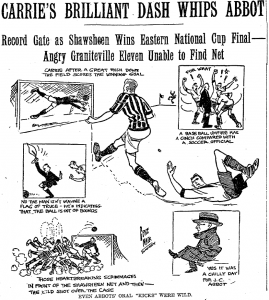
The 1925 National Challenge Cup Eastern Final. Newspaper archive: Boston Globe

If there ever was a tournament of underdogs, it was the 1925 National Challenge Cup. Not because of any overachieving clubs, but rather a lack of heavyweights in the field. Frustrated with how the tournament was being run, the owners of the American Soccer League teams decided to boycott the 1925 competition. One concern raised by the owners was the fact that their clubs were forced to play early round games against amateur clubs, in which the gate receipts sometimes did not cover the cost of travel if the ASL teams were drawn away. Perhaps the biggest issue for the owners was the 33 1/3% cut the USFA took from the gate receipts from each cup game. The four professional clubs from St. Louis also joined in the boycott, leaving the 1925 National Challenge Cup devoid of all the major contenders.

Abbot Worsted, sponsored by the Abbot Worsted Yarn Company of Fore Village, MA was easily the most experienced team among the semifinalists. Worsted reached the semifinals in 1922, and notched quarterfinal appearances in 1923 and 1924. The Shawsheen Indians of Andover, MA were a familiar opponent for Worsted, as the clubs met in the first round in 1924. After a 3-3 draw, Worsted eliminated Shawsheen two weeks later in the replay, 3-1. A year later, it was Shawsheen’s turn, as the Indians took a 2-0 lead through goals from Peter Purden and Alex Carrie in each half. Worsted’s Dan Cummings scored with two minutes remaining, but it was too late to catch the winners.

Chicago’s Canadian Club and Cleveland’s Thistles FC had a closer affair at DePaul Field in the Windy City. Thistles’ Swede Johnson scored in the 40th minute, but the Canadians answered two minutes later through a Bob Hannah penalty kick. With eight minutes remaining, Joe Phillips put the Canadians on top for good, 2-1.

Played at Mark’s Stadium, home of the boycotting Fall River Marksmen, the 1925 Cup Final was a dismal affair at the gate. Only 2,300 turned up, with a reported 953 paid. In contrast, the Boston Wonder Workers of the ASL and St. Louis’ Ben Miller FC played a three-game “American Professional Soccer Championship” series that drew 18,000 fans over three games. Back in Fall River, with goals from Edmund Smith, Peter Purden and Alex Carrie, Shawsheen lifted the Dewar trophy for the only time.

The new champs then achieved their overall goal of being included in the American Soccer League, but their story would not have a happy ending. The team struggled in league play, and in mid-season the teams’ backers, the American Woolen Company, pulled their support after company owner William Wood died. The team finished 10th out of 12 teams in the 1925-26 season and ceased operations in March of 1926.

1925 National Challenge Cup Semifinals

March 22, 1925
DePaul Field – Chicago, IL

Canadian Club 2:1 Thistles FC

Thistles: Swede Johnson 40′
Canadian Club: Bob Hannah 42′ (PK)
Canadian Club: Joe Phillips 82’

April 4, 1925
Balmoral Park  – Andover, MA

Shawsheen Indians 2:1 Abbot Worsted

Shawsheen: Peter Purden 17’ (PK)
Shawsheen: Alex Carrie (2nd half)
Abbot Worsted: Dan Cummings 88’

1925 National Challenge Cup Final

April 19, 1925
Mark’s Stadium, Tiverton, RI

Shawsheen Indians 3:0 Canadian Club

Shawsheen: Edmund Smith (Blyth) 35′
Shawsheen: Peter Purden (PK) 41′
Shawsheen: Alex Carrie 50′

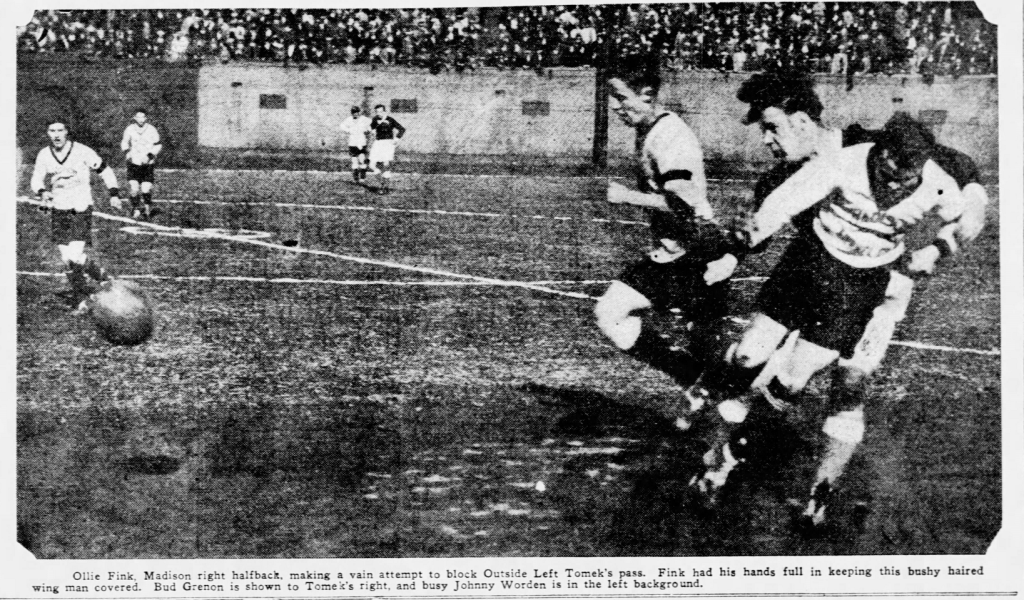
Madison Kennels and Sparta A&BA battle in the 1929 National Challenge Cup Semifinals. Newspaper archive: St. Louis Post Dispatch

1929 National Challenge Cup Semifinals
Sparta A & BA (Chicago, IL) vs. Madison Kennels (St. Louis, MO)
New York Giants (New York, NY) vs. Hakoah All Stars (New York, NY)

Just four years after the ASL and St. Louis pro clubs skipped the 1925 National Challenge Cup, the ASL once again skipped the competition. This time the St. Louis pro clubs did not join.

The rift began when the ASL owners looked to break away from the United States Soccer Football Association. In 1927, the league came under scrutiny from FIFA for poaching players from Great Britain, and the ASL owners did not agree with the limitations set by the USFA to satisfy FIFA. In retaliation, the ASL forbid its teams from entering the 1929 National Challenge Cup, but Bethlehem Steel, Newark Skeeters and the New York Giants broke ranks with the league and entered the Cup anyway. The ASL suspended the three teams, and in turn the USFA suspended the ASL. The three renegade teams joined five teams from the Southern New York Soccer Association’s Eastern Soccer League, while the remaining ASL clubs played on as an outlaw league. With that said, the previous two Cup champions, Fall River Marksmen (1927) and New York Nationals (1928) were out of the running for the 1929 title.

However, Bethlehem Steel wouldn’t be one of the teams representing the ESL in the semifinals, having been eliminated by the New York Giants in the Quarterfinals.  The Giants’ semifinal opponents were the Hakoah All Stars, also of the ESL. Hakoah was founded in the fall of 1928 by several former players from Hakoah Vienna. The Austrian club came to the United States for a tour in 1926, and several of the players decided to stay in the United States. Several of those players played for the Giants from 1926-28 before forming their own team. In front of 12,000 fans at Brooklyn’s Dexter Park, a 78th minute goal from Hungarian international Josef Eisenhoffer was just enough for Hakoah to edge the Giants and earn a sport in the Final.

In the Western final, two new teams from familiar locations squared off. St. Louis’ Madison Kennels were a “new” club in the St. Louis Pro League for the 1928-29 season, having changed sponsors when the Morgan Haulers were sold to new owners. Madison knocked off 1926 Cup champions Ben Miller FC in the first round and made their way to the semifinals as the latest threat from St. Louis. Their opponents were Sparta Athletic and Benevolent Association (A & BA for short). Founded in 1915 by Czech immigrants, the club made their debut in the Cup in 1922, and by 1927 became one of the strongest clubs in the west.

The game at Sportsman’s Park in St. Louis featured 11 goals in total. Madison took a quick 2-0 lead in the first ten minutes, and by halftime held a 4-2 advantage. Sparta and Madison alternated goals in the second half until the score was 5-4, but Madison eventually pulled away with two late goals for a 7-4 victory. Madison’s Buddy Grennon had a hat trick and assisted on two other goals.

The 1929 Final made history on many levels. It was the first Final to be scheduled for multiple games, a best-of-three format replacing the single game championship. The tournament’s attendance record also fell, as an estimated 15,000 (13,937 paid) fans witnessed the first game at Sportsman’s Park in St. Louis, setting a new mark for soccer in that city.  Madison held off Hakoah for most of the game, but in the 80th minute Josef Eisenhoffer broke through for the first score. Two minutes later, Siegfried Wortmann doubled Hakoah’s lead for a 2-0 win in the first leg.

A week later, 21,583 fans packed Dexter Park in Brooklyn for the second leg, an Open Cup Final attendance record that would stand until the 2010 Final in Seattle which saw a crowd of 31,311. Madison proved no match for Hakoah, as future US National Team manager Erno Schwarz, Max Gruenwald and Austrian international Mortiz Haeusler provided the home side with a 3-0 win and a National Challenge Cup title. The Hakoah squad would stay together until the collapse of the original ASL in the summer of 1933, but never reach the heights of an Open Cup championship again.

1929 National Challenge Cup Semifinals

March 17, 1929
Sportsman’s Park – St. Louis, MO

Madison Kennels 7:4 Sparta A & BA

Madison: Dinty Moore (Hanson) 1’
Madison: Johnny Worden (Oster) 8’
Sparta: Joe Kratochvil (Karbec) 18’
Madison: Buddy Grennon (Flavin) 1st half
Madison: Buddy Grennon (Hanson) 31’
Sparta: Adolph Berger (PK) 44’
Sparta: Adolph Berger (Karbec) 65′
Madison: Charley Oster (Grennon) 2nd half
Sparta: Charley Oster (Own goal) 2nd half
Madison: Eddie Flavin (Grennon) 2nd half
Madison: Buddy Grennon (Flavin) 88’

March 24, 1929
Dexter Park – Brooklyn, NY

Hakoah All Stars 1:0 New York Giants

Hakoah: Josef Eisenhoffer 78’

1929 National Challenge Cup Final

First Leg
March 31, 1929
Sportsman’s Park – St. Louis, MO

Madison Kennels 0:2 Hakoah All Stars

Hakoah: Josef Eisenhoffer (Nicholsburger) 80′
Hakoah: Siegfried Wortmann 82′

Second Leg
April 7, 1929
Dexter Park – Brooklyn, NY

Hakoah All Stars 3:0 Madison Kennels

Hakoah: Erno Schwarz (Gruenwald) 22′
Hakoah: Max Gruenwald (Haeusler) 50′
Hakoah: Moritz Haeusler (Gruenwald) 70’

***********************************

1941 National Open Cup Semifinals
German Hungarian SC (New York, NY) vs. Pawtucket SC (Pawtucket, RI)
Chrysler (Detroit, MI) vs. Gallatin-Dunlevy (Pittsburgh, PA)

By 1941, the landscape of American soccer had changed drastically. Ravaged by the effects of the Great Depression, the American Soccer League was forced to fold in the spring of 1933 and re-emerge as a semi-pro circuit by the fall. Teams from Philadelphia and Baltimore joined the league, and the New England teams had their own division with a separate schedule. Former cup champions such as Bethlehem Steel, Fall River Marksmen and New York Nationals faded away into history.

After the Stix, Baer & Fuller dynasty ended in 1938, St. Louis’ dominance of the Cup came to an abrupt halt and wouldn’t re-emerge until the 1950s. Teams from Detroit, Chicago and Western Pennsylvania filled the void in the west. With World War II looming on the horizon, only 71 clubs put their names in the hat, and the entry total would not surpass 100 clubs again until 1947. No teams from St. Louis even entered the 1941 Open Cup. On top of this, Philadelphia’s Passon SC was the only non-New England ASL club to enter, meaning none of the ASL teams that made Finals appearances in the past five years were in contention.

With most of the ASL clubs out of the competition, the door was open for teams from the German American Soccer League (GASL). The German Hungarian SC made their way to the Semifinals to represent the GASL and found themselves opposing the top club in the New England division of the ASL, Pawtucket FC. The New York amateurs proved to be no match for Pawtucket, as the ASL pros took the first leg 3-0 at Pawtucket and left Starlight Park in the Bronx with a 5-1 win in the second leg for an 8-1 aggregate victory.

In the Western half of the semifinals, Western Pennsylvania’s Gallatin-Dunlevy was making the most of an unusual partnership. At the start of the 1940-41 season, the managers of the two clubs agreed to combine their teams in order to field a contender in both cup and league play. Gallatin reached the National Amateur Cup final in 1939, but neither club had seen much success in the Open Cup. Detroit’s Chrysler SC had been participating in the Cup since 1934 but had only recently found success, reaching the Quarterfinals in 1940. Chrysler prevailed in convincing fashion over two legs, a 3-1 win at Bridgeville, Pa. followed by a 2-0 triumph at home. Having failed in their bid to win a league or cup championship, Gallatin and Dunlevy went their separate ways the following season.

The Pawtucket-Chrysler final turned out to be one of the more thrilling championships in the history of the Cup. Pawtucket won the first leg at home 4-2 on May 5. In the second leg a week later in Detroit, Chrysler held a 3-0 lead in the second half, and just as Detroit looks to claim its first Open cup title, Ed Valentine scored for Pawtucket to even the aggregate score at 5-5. Pawtucket dominated the 30 minutes of extra time, scoring three goals to push the aggregate to 8-5 to claim the Open Cup. Chrysler would only last one more season, disbanding after a lengthy and bitter controversy with Chicago’s Sparta A & BA in the 1942 tournament.

1941 National Open Cup Semifinals

Eastern Final – First Leg
April 13, 1941
Coats Field – Pawtucket, RI

Pawtucket Rangers 3:0 German Hungarian SC

Pawtucket: Ed Valentine – 1st half
Pawtucket: Dave McEwan (Florie) – 67’
Pawtucket: Walter Dick – 86’

Eastern Final – Second Leg

April 20, 1941
Starlight Park – Bronx, NY

German Hungarian SC 1:5 Pawtucket Rangers

German Hungarian: Eddie Zbuchalski
Pawtucket: Ed Valentine
Pawtucket: Mino Rebello
Pawtucket: Walter Dick

Pawtucket Rangers advance on 8-1 aggregate

Western Final – First Leg

April 6, 1941
Charleroi Stadium – Bridgeville, PA

Gallatin-Dunlevy 1:3 Chrysler FC

Chrysler: Tony Barra (Campbell) 20′
Gallatin-Dunlevy: Charley Lyons (Chislagi) – 23’
Chrysler: George Borg – 53′
Chrysler: Neil Campbell – 88′

Western Final – Second Leg

April 13, 1941
Chrysler Field – Detroit, MI

Chrysler FC 2:0 Gallatin-Dunlevy

Chrysler: John Lenard – 40′
Chrysler: Neil Campbell (Borg) – 81′

Chrysler FC advance on 5-1 aggregate


1941 National Challenge Cup Final

First Leg
May 4, 1941
Coats Field – Pawtucket, RI

Pawtucket Rangers 4:2 Chrysler SC

Pawtucket: Mike Souza – 3′
Chrysler: Tommy Ferrans (PK) – 1st Half
Pawtucket: Ed Valentine (Florie) – 1st Half
Pawtucket: Walter Dick – 1st Half
Chrysler: Tony Barra – 2nd Half
Pawtucket: Dave McEwan – 2nd Half

Second Leg
May 11, 1941
Chrysler Field – Detroit, MI

Chrysler S.C. 3:4 (AET) Pawtucket Rangers
(3-1 FT, aggregate 5-5 after full time)

Chrysler: Neil Campbell (Molly) – 1st Half
Chrysler: John Lenard (Molly) – 2nd Half
Chrysler: Tony Barra – 2nd Half
Pawtucket: Ed Valentine (McEwan) – 90’
Pawtucket: Dave McEwan (Anderson) – 97′
Pawtucket: Tommy Florie (Quinn) – 114’
Pawtucket: Dave McEwan – 119′

Pawtucket Rangers win National Challenge Cup 8-5 aggregate

***********************************

1958 National Challenge Cup Semifinals
UASC Lions (Chicago, IL) vs. Los Angeles Kickers (Los Angeles, CA)
Pompei SC (Baltimore, MD.) vs. Beadling (Beadling, PA)

Like the other Semifinals detailed so far, the 1958 National Open Cup final four featured four teams who had little previous success in the tournament or were newcomers to the competition. In addition to that, three of the heavyweight Cup contenders, Eintracht, Kutis and Harmarville, were eliminated ahead of the semis.

A scene from the 1958 National Open Cup Final between the Los Angeles Kickers and Pompei SC of Baltimore. Newspaper archive: Baltimore Sun

The Los Angeles Kickers got their start in 1951, but the teams from the state of California did not see Open cup action until 1954. The exclusion of California clubs in the cup prior to 1954 was largely a matter of travel costs, as commercial air travel was still in its infancy, and traveling to the west coast by train would take too much time. The LA Scots (1952) and McIlwaine Canvasbacks (1953) each had intentions of making their cup debuts before 1954, but both withdrew for financial reasons. In 1954, both Los Angeles and San Francisco held qualifying tournaments with the winners playing for a spot in the Semifinals. The Kickers dismantled AAC Teutonia 13-2 over two legs to reach the 1958 Semifinals.

The UASC Lions (Ukrainian American Soccer Club) were also a relatively new club, having been founded in 1949. The Lions cleared the path to its maiden semifinal berth by upsetting Kutis SC (St. Louis) 4-3 on aggregate over two legs in the Quarterfinals. In the matchup with the Kickers in Los Angeles, the Lions wilted in the 90 degree heat and fell 3-0. Future US international Willie Carson, Future US international and Hall of Famer Al Zerhusen and Pete Rumohr scored for Los Angeles.

Pompei SC began as the Baltimore Rockets in 1953 as a new American Soccer League club and changed its name to Pompei for the 1957-58 season. As the Rockets, the team found no real Open Cup success, but with the new name came new fortunes. Pompei outlasted perennial favorite Sport Club Eintracht (New York, NY) in a 9-8 aggregate Quarterfinal win. The second leg would go down as perhaps the longest game in US Open Cup history, as the teams played 180 minutes in an attempt to earn a semifinal berth. Bob Swinski put the game to rest with a 177th minute goal for Pompei.

MORE: 1958 US Open Cup Quarterfinals: Baltimore’s Pompei SC wins one of the longest, greatest Cup games of all-time

By far the longest tenured of the four clubs was Beadling, having been founded in 1898. While Beadling only had two quarterfinal appearances (1951 & 1955) in the years leading up to 1958, the club won the 1954 National Amateur Cup and were runners-up in the 1958 edition. Their path to the final four was opened up by an early round upset of by Rochester’s Redmonds SC over 1956 Cup champion Harmarville. Wins over Buffalo’s Simon Pure and Detroit’s Ukrainian SC led to a two leg affair with Pompei. The first leg went Beadling’s way, as two goals from Jerry Bressanelli cancelled Bob Lezenski’s 11th minute goal for Pompei in a 2-1 win. In the return game in Baltimore, the home club came out on top 3-1 on two goals in each half from Ray Surrock, and an additional score from Ed DeFonso. George Watson converted a penalty for Beadling in the first half. It was the first finals appearance by a Baltimore team since 1940, when Baltimore SC and Chicago’s Sparta A & BA infamously could not decide a winner when the clubs could not come to terms on a tiebreaking third game.

In the final at Kirk Avenue Stadium in Baltimore, 4,500 fans witnessed Pompei and the LA Kickers battle into extra time to determine a winner. Willie Carson drew first blood for the Kickers in the 8th minute, but just eight minutes later Joe “JoJo” DeFonso scored what sounds like a bicycle kick to tie the score. The Baltimore Sun described DeFonso’s goal as “a boot over his head with his back to the goal.” Neither team could score for the remaining 74 minutes, as each team’s leading scorers Al Zerhusen (Kickers) and Larry Surrock (Pompei) failed to find the net.  With ten minutes remaining in extra time Willie Carson struck again, pouncing on a rebound from a blocked shot to drive home the winning goal.

Pompei would go on to make one more quarterfinal appearance in 1960, but wound up folding early in the 1960-61 season. The Kickers would go on to win another Open Cup title in 1964 as the LA Kickers-Victoria after merging with the Victoria Soccer Club. The UASC Lions, Beadling and LA Kickers (now LA Soccer Club) are all still around today.

1958 National Open Cup Semifinals

Eastern Final – First Leg
May 4, 1958
Beadling, PA

Beadling 2:1 Pompei SC

Pompei: Bob Lezenski – 11′
Beadling: Jerry Beressanelli – 2nd Half

Eastern Final – Second Leg
May 18, 1958
Kahler’s Park – Baltimore, MD

Pompei SC 3:1 Beadling

Pompei: Ray Surock – 33’
Beadling: George Watson (PK) – 1st Half
Pompei: Ed DeFonso (Cross) – 2nd Half
Pompei: Ray Surock – 78’

Western Final
April 20, 1958
Sentinel Field – Los Angeles, CA

LA Kickers 3:0 UASC Lions SC

Kickers: Willie Carson (Zerhusen) – 1st Half
Kickers: Pete Rumohr (Tyrell) – 2nd Half
Kickers: Al Zerhusen – 2nd Half

1958 National Open Cup Final

June 8, 1958
Kirk Avenue Stadium – Baltimore, MD

Pompei SC 1:2 (AET) LA Kickers

Kickers: Willie Carson – 8’
Pompei: Joe DeFonso – 16’
Kickers: Willie Carson – 110’


New York Hota from 1971

1971 National Open Cup Semifinals
Hamm’s (St. Louis, MO) vs. Yugoslav American SC (Los Angeles, CA)
Danube Swabian (Cleveland, OH) vs. New York Hota (New York, NY)

By 1971, the American soccer landscape had changed yet again. The North American Soccer League was in it’s fourth season, but despite pressure from the US Soccer Federation, the NASL clubs were not entering the Open Cup. By 1971, the ASL, which was down to five teams, had moved to a spring/summer schedule a few seasons prior. As a result, almost none of the ASL teams entered the cup because many of their players were cup-tied with clubs they played for in the fall/winter months.

One major difference separated this semifinal field from all the others covered here: Only one of the two semifinals games were played. The western half of the semifinals came down to Hamm’s of St. Louis and the Yugoslav American SC of Los Angeles. The game was set to be played in Los Angeles, and the controversy arose due to a change the USSF made during the offseason. Previously, it was up to the hosts to pay for the visiting team’s travel and lodging, and the change was made that required the visiting team to handle their own expenses or offer a guarantee, or the visiting team could offer a travel guarantee to host the match. The Hamm’s club took issue with this, and after going back and forth with the USSF, failed to appear at Rancho Cienega Stadium in Los Angeles on May 2, forfeiting the match to Yugoslav American.

New York Hota’s path to the Semifinals also featured a bit of controversy. In their 4-1 quarterfinal win over Taunton Sport, the Massachusetts side protested the eligibility of several of Hota’s players. Manager Gordon Bradley and five other players had played for the NASL’s New York Cosmos the day before in their season opener in St. Louis, then flew to Fall River, Mass. for the Open Cup game the next day. Taunton argued that the players could not be registered with two separate teams, thus making them ineligible. Hota argued that had the Open Cup not been behind schedule, the conflict would have been avoided.

The USSF ruled in favor of Hota and they were off to face another surprise semifinal entrant, Danube Swabian of Cleveland, who had upset the Ukrainian Nationals in the Quarterfinals with a 2-1 extra time win. The game was originally set to be played in Cleveland, but for unknown reasons was switched to Franklin Square. New York held a 2-0 lead on goals from John Delano and Karl Minor before Paulo Ramos scored for Swabian in the 75th minute. Five minutes later, Cosmos player Ceyhan Yazar put the game away for Hota by converting a penalty kick. The Clevelanders also protested the eligibility of the Cosmos players, to no avail.

The Final at Rancho Cienega Stadium in Los Angeles proved to be a wild affair and remains the highest-scoring Open Cup Final in history. The Yugoslavs opened the scoring through Jose Bergitas but was soon answered by Paul Delano of Hota. Bergitas scored once again for a 2-1 lead, but Hota drew level before halftime on a Horst Kneissl goal. Felipe Ruvalcaba put the Yugoslavs back in front in the 60th minute on a free kick, but with less than a minute remaining Karl Minor scored for Hota to send the game into extra time.

Two minutes into the extra session Randy Mitrovic put Hota ahead 4-3, and Minor netted his second to extend the lead to 5-3. Bergitas got his third goal of the game to give the Yugoslavs a glimmer of hope, but Kneissl put the game to rest with his second of the game for a 6-4 Hota victory.

1971 National Open Cup Semifinals

Eastern Final
May 3, 1971
Park Stadium – Franklin Square, NY

NY Hota 3:1 Danube Swabian

Hota: John Delano – 14′
Hota: Karl Minor – 66′
Hota: Ceyhan Yazar (PK) – 80′
Danube: Paulo Ramos – 75′

Western Final
May 2, 1971
Rancho Cienega Stadium – Los Angeles, CA

Yugoslav American SC vs. Hamm’s

Hamm’s forfeit, failed to appear

Hamm’s did not show for game against San Pedro because of no travel guarantee (for a traveling party of 18) to Hamm.

Yugoslav American refused a $2000 bid by Hamm’s to play in St. Louis

1971 National Open Cup Final
May 16, 1971
Rancho Cienega Stadium – Los Angeles, CA

Yugoslav American SC 4:6 (AET) NY Hota

Yugoslav: Jose Bergitas – 1st Half
Hota: Paul Delano – 1st Half
Yugoslav: Jose Bergitas – 1st Half
Hota: Horst Kneissl – 1st Half
Yugoslav: Felipe Ruvalcaba – 60’
Hota: Karl Minor – 90’
Hota: Randy Mitrovic – 92’
Hota: Karl Minor – Extra Time
Yugoslav: Jose Bergitas – Extra Time
Hota: Horst Kneissl – Extra Time

***********************************

1987 National Open Cup Semifinals
Mean Green (Dallas, TX) vs. Club Espana (Washington D.C.)
Mitre Eagles (Seattle, WA) vs. Busch Under-22 SC (St. Louis, MO)

By 1987, the Open Cup had been contested exclusively by amateur and semi-pro clubs for almost 15 years. The ASL folded in 1983 and the NASL followed in 1984, although the teams for each league began to skip the tournament in the early 1970s. Clubs from “non-traditional” areas of the nation such as Texas, Florida, and Washington rose to prominence in the Open Cup. Another new twist was that the USSF had begun to play all of its cup semifinals and finals on one central location, and for a few years that would be the St. Louis Soccer Park in Fenton, Missouri.

This semifinal field included teams that had gone deep in the tournament before. The Mitre Eagles of Seattle, whose roster included a mix of former Settle Sounders and University of Washington players, made a few deep runs in the Open Cup prior to 1987. Starting with a quarterfinal appearance in 1982 when the team was known as Croatian SC. The Eagles followed up with quarterfinal runs in 1983, 1985 and 1986. Finally, in 1987, the team finally won the Region IV title with a 2-1 extra time win over San Francisco’s Greek American AC.

The Eagles opponents were another team that had some Open Cup success, sort of. The Busch Seniors Soccer Club had the bad luck to have to qualify from the same state as the powerful Kutis SC, who had made finals appearances in 1983, 1985 and 1986. The lone gap in that run was stopped by Busch with a 5-0 win in the Missouri qualifying final, although Busch fell in the national quarterfinals to eventual Open Cup runners-up Croatian SC of Chicago. In 1987, Busch would stop Kutis once again in the Missouri final, but it wasn’t the Seniors who took the honors, but Busch’s Under-22 team. The Seniors squad fell in the second round of qualifying, but the Busch-22s kept going. After nudging past Milwaukee Sport Club on penalties in the quarterfinals to set a date with the Mitre Eagles.

The game was a high-scoring, extra time affair, in which Busch tied the game on Steve Trittschuh’s 85th minute goal. They would rally from a 4-2 deficit in extra time to tie the game in the 118th minute on Kevin Hundelt’s second goal of the game. A minute later, John Klein scored his second goal of the game to send the Eagles to the Open Cup Final.

The other semifinal featured Mean Green a team from just outside of Dallas, who took their name from the University of North Texas, where many of the players played college soccer. The Mean Green started as an independent club in 1984 before joining the Lone Star Soccer Alliance in 1987. The team mad an immediate impact, winning the National Amateur Cup in 1984, and reaching the semifinals of the Open Cup in 1985.

Opposing them was Washington, D.C.’s Club Espana, the 1985 National Amateur cup champions and a team that had already made plans to join the third version of the American Soccer League in 1988 as the Washington Diplomats. The contest was all Espana, as two goals from Richard Burks and another from Fernando Iturbe sent the future pros to the final with a 3-0 win.

Despite coming from opposite sides of the country, Club Espana and Mitre Eagles were quite familiar with each other. The two teams previously met in the 1985 National Amateur Cup final that Espana won 2-1. In a nod to the club’s future, Espana wore their Washington Diplomats shirts for the game. Each team finished down a man as Abdulwhad Al-Khaldi (Espana) and Stephen Englebrick (Eagles) were sent off in the 54th minute. The teams pushed through regulation and extra time without a goal, the 75th edition of the Open Cup Final would be the first to finish scoreless, as well as the first final to be decided on penalty kicks. Espana only needed to convert on their first three shots, as the Eagles missed each of their attempts.

1987 National Open Cup Semifinals

June 20, 1987
St. Louis Soccer Park – Fenton, MO

Club Espana 3:0 Mean Green

Espana: Fernando Iturbe – 11′
Espana: Richard Burke (PK) – 55′
Espana: Richard Burke (PK) – 84’

Mitre Eagles 5:4 (AET) Busch U-22s

Eagles: John Klein – 1st Half
Eagles: Eddie Kruger – 1st Half
Busch: Unknown goalscorer – 1st Half
Busch: Steve Trittschuh – 85′
Eagles: Peter Klein – Extra Time
Eagles: Andy Churlin – Extra Time
Busch: Kevin Hundelt
Busch: Kevin Hundelt – 118’
Eagles: John Klein – 119’

*other goal times not available

1987 National Open Cup Final

June 21, 1987
St. Louis Soccer Park – Fenton, MO

Club Espana 0:0 (AET) Mitre Eagles

Club Espana wins National Open Cup, 3-0 on penalty kicks


1995 US Open Cup champions: Richmond Kickers
After playing the El Paso Patriots to a 1-1 draw, the Richmond Kickers captured the 1995 US Open Cup title by defeating the Patriots on penalty kicks 4-2. Photo: Richmond Kickers

1995 US Open Cup Semifinals
El Paso Patriots (El Paso, TX) vs. Seattle Sounders (Seattle, WA)
Richmond Kickers (Richmond, VA) vs. Chicago Stingers (Chicago, IL)

1996 US Open Cup Semifinals
Dallas Burn (Dallas, TX) vs. D.C. United (Washington D.C.)
Rochester Raging Rhinos (Rochester, NY) vs. Colorado Rapids (Denver, CO)

In 1995 and 1996 the US Open Cup underwent perhaps the most drastic change in its history. For the first time since 1973, teams from the top two professional leagues in the country entered the competition. For its entire existence, none of the NASL teams ever took part in the Open Cup, and the last confirmed entry of an American Soccer League club was in 1973.  Starting in 1991, teams from the newly-founded Southwest Independent Soccer League (later to become the USISL, and then the United Soccer Leagues), although teams from the American Professional Soccer League continued to skip the tournament until 1995.

With Major League Soccer’s debut season coming in 1996, the APSL (a Division 2 pro league known as the A-League at this point) entered the Open Cup in 1995, ready to clash with the up and coming USISL (Division 3 pro). All four quarterfinal matchups were A-League vs. USISL affairs, and the USISL emerged victorious in three of the games. For all four clubs it wasn’t just their debut in the semifinals, but their debut in the Open Cup as a whole.  The first contest took place on July 30 as the USISL’s El Paso Patriots played host to the Seattle Sounders, the last remaining A-League club. Playing in 103 degree heat, the Patriots’ Gabino Amparan scored the lone goal in the 36th minute to sweep away the Sounders and earn a spot in the final. A week later in Richmond, the amateur Richmond Kickers of the USISL Premier League (which later became the Premier Development League, and currently known as USL League Two), played host to the professional Chicago Stingers, both members of the USISL but in separate leagues.

Players from D.C. United celebrate the club's 1996 US Open Cup championship.
Players from D.C. United celebrate the club’s 1996 US Open Cup championship.

The Kickers got off to a quick start with an opening minute goal from Brian Kamler, but Chicago answered ten minutes later through Don D’Ambra. The Stingers went into halftime with a 2-1 lead thanks to a 38th minute penalty kick from Steve Morris. Ben Crawley and Scott Snyder struck for two quick goals for Richmond midway through the second half for a 3-2 lead, but Chicago tied the game yet again when D’Ambra scores his second in the 88th minute. With extra time looming, Richmond’s Rob Ukrop was brought down in the penalty area in the 89th minute, and Crawley stepped up for his second goal of the game to put an end to a wild semifinal. The 1995 final in El Paso was a tight affair. Rob Ukrop put Richmond ahead in the first half, and Gabino Amparan scored late in the game for El Paso to force extra time. After a scoreless extra time, the Kickers won the penalty shootout as goalkeeper Jeff Causey saved the final two penalty kick attempts from the Patriots.

In 1996, it was time for Major League Soccer to make its Open Cup debut. Only four MLS teams entered, all entering in the Quarterfinals. However, the Colorado Rapids made an impromptu debut when they replaced the A-League’s Colorado Foxes, who were forced to withdraw when five of their starters were called up to the Jamaican National Team for World Cup qualifying. Kansas City, Dallas and D.C. United advanced to the Semifinals, but Tampa Bay fell 4-3 in extra time to the new sensation of American soccer: the A-League’s Rochester Raging Rhinos. The Rhinos drew the Colorado Rapids and wound up blowing by their MLS competition. Two goals from Doug Miller and another from Lenin Steenkamp sent 12,179 at Frontier Field in Rochester home happy. On the other side of the bracket, D.C. United only needed a pair of goals from Jaime Moreno to overcome the Dallas Burn, 2-0.

In the Final on October 30, D.C. United put an end to the Rhinos’ fairytale run 3-0 behind behind goals from Raul Diaz Arce, Eddie Pope and Moreno. D.C. United would appear in four more Open Cup finals, but their next title wouldn’t come until 2008. The Rhinos would make another cinderella run in 1999, knocking off four MLS teams to become the only non-MLS club to win the Open Cup since 1996.

1995 US Open Cup Semifinals

July 30, 1995
Dudley Field – El Paso, TX

El Paso Patriots 1:0 Seattle Sounders

El Paso: Gabino Amparan (Lorenzo Baeza) – 36’

August 4, 1995
Univ. of Richmond Stadium – Richmond, VA

Richmond Kickers 4:3 Chicago Stingers

Richmond: Brian Kamler (Scott Synder) – 1’
Chicago: Don D’Ambra (Unassisted) – 11’
Chicago: Steve Morris (PK) – 30’
Richmond: Ben Crawley (Assist?) – 64’
Richmoond: Scott Snyder (Assist?) – 69’
Chicago: Don D’Ambra (Steve Morris) – 88’
Richmond: Ben Crawley (PK) – 89’

1995 US Open Cup Final

August 27, 1995
SISD Student Activities Complex – El Paso, TX

El Paso Patriots 1:1 (AET) Richmond Kickers

Richmond: Rob Ukrop (Leigh Cowlishaw) – 49’
El Paso: Gabino Amparan (Sal Mercado) – 80’

Richmond wins US Open Cup, 4-2 on penalty kicks

***********************************

1996 US Open Cup Semifinals

October 12, 1996
Frontier Field – Rochester, NY

Rochester Ragin’ Rhinos 3:0 Colorado Rapids

Rochester: Lenin Steenkamp (Hector Marinaro) – 32’
Rochester: Doug Miller (Henry Gutierrez) – 56’
Rochester: Doug Miller (Hector Marinaro) – 85’

October 27, 1996
Cotton Bowl – Dallas, TX

Dallas Burn 0:2 D.C. United

D.C. United: Jaime Moreno (Marco Etcheverry) – 12’
D.C. United: Jaime Moreno (Unassisted) – 82’

1996 US Open Cup Final

October 30, 1996
RFK Stadium – Washington, D.C.

D.C. United 3:0 Rochester Ragin’ Rhinos

D.C. United: Raul Diaz Arce (Unassisted) – 45’
D.C. United: Eddie Pope (Tony Sanneh) – 63’
D.C. United: Jaime Moreno (Tony Sanneh) – 89′


Filed Under: 2019 US Open Cup, Feature - History, Feature - Main, US Open Cup, US Open Cup History Tagged With: Abbot Worsted, Beadling, Ben Miller FC, Busch SC, Canadian Club, Chicago Stingers, Chrysler SC, Club Espana, Colorado Rapids, D.C. United, Dallas Burn, Danube Swabian, El Paso Patriots, FC Dallas, Fore River FC, Gallatin Dunlevy, German Hungarian SC, Hakoah All Stars, Hamm’s, Los Angeles Kickers, Madison Kennels, Mean Green, Mitre Eagles, New York Giants, New York Hota, Packard FC, Pawtucket SC, Pompei SC, Richmond Kickers, Robins Dry Dock, Rochester Raging Rhinos, Seattle Sounders USL, Shawsheen Indians, Sparta, Thistles FC, UASC Lions, US Open Cup History, Yugoslav American SC

Primary Sidebar

Follow Us on Social Media

  • Bluesky
  • Facebook
  • Instagram
  • Twitter
  • YouTube

U.S. Open Cup History

1935 National Challenge Cup Semifinals: After 29 days, Central Breweries win 3-game Western Final

The Western Final of the 1934/1935 National Challenge Cup featured one of Chicago’s best teams from the first 30 years of the tournament against a St. Louis team that would form their own dynasty.

  • 1995 US Open Cup: Rob Ukrop of Richmond Kickers voted TheCup.us Player of the Tournament
  • 1995 US Open Cup Final: Jeff Causey of Richmond Kickers voted TheCup.us Player of Round
  • 1995 US Open Cup Final: Richmond Kickers survive heat, beat El Paso Patriots in PKs to win title
  • 1995 US Open Cup Final Preview: El Paso Patriots hosting amateur Richmond Kickers in “El Sauna”
  • 1995 US Open Cup Semifinals: Jake Arrambide of El Paso Patriots voted TheCup.us Player of Round

Analytics powered by

Copyright © 2026 • Built by Jacob Martella Web Development