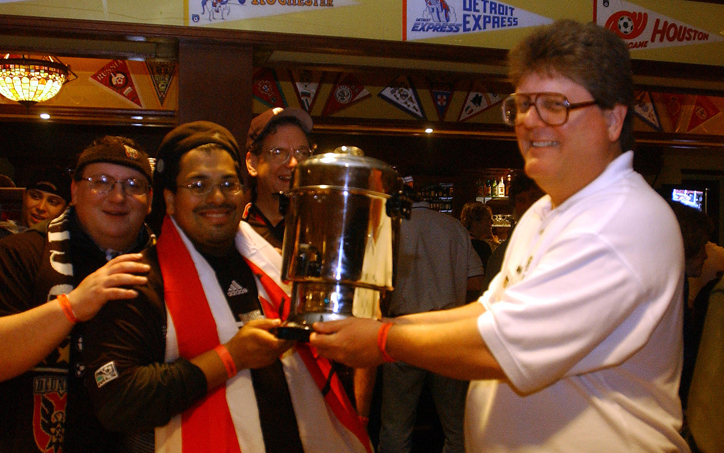
UPDATE (5/6/25 – 7:55pm ET) – The Coffee Pot Cup made its way to Audi Field for the Fourth Round match of the 2025 US Open Cup.
How do you like your Open Cup upsets? Lots of cream and sugar, or just plain black? On Aug. 4, 1999, D.C. United didn’t like the taste of the Charleston Battery’s upset brew and the events that followed gave birth to one of the oddest rivalries in American soccer: The Coffee Pot Cup.
It remains one of the greatest games of the US Open Cup’s Modern Era (1995-present), but what happened after the game gets more attention than the instant classic that took place on the field. The post-game chaos in the visitor’s locker room following the Battery’s dramatic 4-3 extra time win, led to American soccer’s first modern rivalry trophy.
When D.C. United hosts the Charleston Battery in the Fourth Round of the 2025 US Open Cup on Tuesday, the winner will not only advance to the Round of 16 but the fans in attendance could lift, and drink from, the Coffee Pot Cup. (If the Cup arrives at the stadium … more on that in a bit)
American Soccer in 1999
In 1999, the American soccer landscape looked much different than it does today. Major League Soccer was in its fourth season and was still on shaky ground financially. The league added the Chicago Fire and Miami Fusion in 1998 to increase to 12 teams, most of whom still played in tarped-off (American) football stadiums. Columbus would introduce the very first soccer specific stadium in MLS in 1999, now known as Historic Crew Stadium.
After limping through most of the 1990s with a roster of teams ranging from 5-8, the A-League, (formerly known as the American Professional Soccer League) merged with the USISL’s Select League in 1997 to expand to 24 teams. While the league tripled in size, many clubs still struggled financially.
The Open Cup was very different in 1999 as well. The three professional leagues, MLS, A-League and D3 Pro League only sent eight teams each into the tournament. The eight spots allotted to amateur clubs were split between the USASA and Premier Development League (now USL League Two) bringing the total tournament field to 32 teams.
The early years of the Open Cup with MLS involved created a rivalry between MLS and the A-League, spearheaded by the Rochester Raging Rhinos. Teams looking to prove their worth and players seeking attention for future MLS roster spots meant every MLS team had extra large targets on their backs. The Rhinos were one A-League club in particular who were constantly looking to prove they should be the next team to join MLS. The Rhinos regularly drew 10,000 plus for big home games, an exclamation mark in a league in which average attendance figures around 2-3,000 were considered great. Rochester staked their claim in the 1996 US Open Cup by knocking off the Tampa Bay Mutiny and the Colorado Rapids to reach the Open Cup Final, where they lost to D.C. United 3-0.
United vs. Battery
D.C. United were already two-time league champions and had reached the MLS Cup Final each of the league’s first three years (1996-1998). In addition, D.C. won the U.S. Open Cup in 1996 and reached the Final in 1997 (losing in PKs to the Dallas Burn). In 1998, United won the CONCACAF Champions Cup as well as the Copa Interamericana over Brazil’s Vasco da Gama. D.C. United truly were the giants in the early days of MLS.
The Charleston Battery were a few years older than D.C., getting their start in 1993 with the USISL (USL today), before joining the A-League after the merger.
Coming into the game, D.C. United were in a familiar position, first place in MLS Eastern Conference at 13-7, with last year’s trade acquisition Roy Lassiter leading the league in goal scoring with 15.
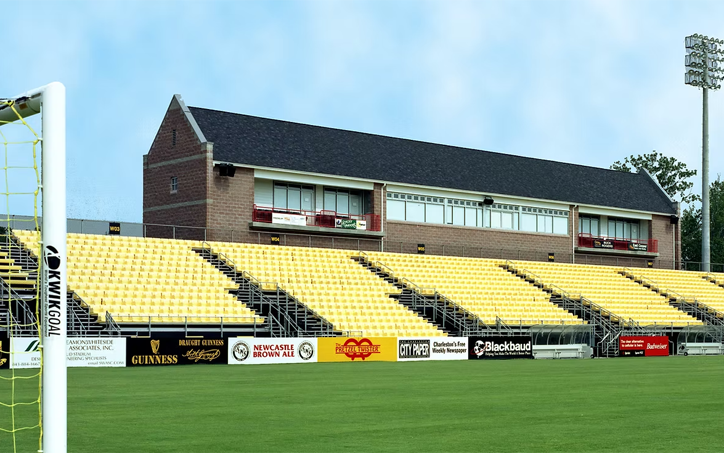
Charleston started the 1999 campaign by opening the new 5,000 seat Blackbaud Stadium, the first soccer-specific stadium built for a non-MLS club.
“We always knew Charleston wasn’t going to be an MLS market, but that never stopped us from aiming high,” said Battery president Nigel Cooper. “We just wanted to be the best we could be. Building the first privately-funded, soccer-specific facility in the U.S. was a huge point of pride. The Three Lions Club, packed with memorabilia and passion, was unique.”
The Battery were looking to rebound from a 11-15 finish in the 1998 season. It was just barely good enough to make the playoffs, but they suffered a 3-0 road loss to Rochester in the opening round. The Battery entered their matchup with D.C. with an 11-10 record in league play.
The Build-Up
While D.C. entered the ’99 Open Cup in the Third Round, Charleston started their inaugural entry in the tournament in the Second Round by hosting the D3 Pro League’s Wilmington Hammerheads. The Hammerheads, one of the strongest teams in their league, entered the game red hot. The Hammerheads were riding a 10-game winning streak on the strength of Ryan Walker, one of the league’s top goalscorers with 16.
While the Battery came away 2-1 winners, the going wasn’t easy. While the Battery were in control most of the way with a 2-0 lead through first half goals from Todd Miller (3rd minute) and Paul Conway (16th minute) they couldn’t seem to shake their D3 opponents. Wilmington stayed competitive throughout the second half, but their goal by Charles Panos in the 90th minute proved too little too late however, and Charleston began to prepare for the giants.
The next day’s sports section in the Charleston Post and Courier proclaimed, “Bring on the MLS”. It was called the biggest game in club history.
“We always felt we had a chance against MLS teams, much in the same way that lower level teams in the English Football League think they have a chance against Premier League teams in the cup competitions,” said Cooper. “There could always be an upset. The pressure was really on the MLS teams. They had to prove their superiority which wasn’t always the case. Many of our players felt they could go head-to-head with MLS.”

The Game
D.C. were playing the game shorthanded. United were missing four players (Jeff Agoos, Carlos Llamosa, Ritchie Williams and Ben Olsen) due to US National Team duty in the Confederations Cup. In addition, reigning MLS MVP Marco Etcheverry was ruled out due to a heel injury. Despite that, DCU still had a strong lineup full of stars with players like last year’s MLS MVP runner-up Jaime Moreno, and US internationals Roy Lassiter and Eddie Pope. Also, highly-touted 20-year-old prospect Chris Albright was coming off the bench.

After falling short of winning a third straight MLS Cup title the year before, United were on a mission to regain the league title in 1999.
“I think we blamed some of the extra competitions that we were in for 1998 for the loss in the (MLS Cup) final,” said Eddie Pope, who battled injuries throughout the 1999 season. “I don’t think we saw the Open Cup as a priority but more so as a burden or a distraction. Sad but true at the time. The Open Cup just didn’t have the importance that it does now. Therefore, I think we were always looking past our opponents with our minds on MLS Cup. That ended up being a mistake.”
An announced crowd of 5,456 – which remains a Battery home US Open Cup attendance record to this day – packed Blackbaud Stadium on a humid Wednesday evening. That sold out stadium would witness one of the more memorable nights in the club’s history.
“(The game was) a rollercoaster of emotions,” said Cooper. “It was a total mix of nerves and excitement before the game. New stadium, record crowd, playing one of the top teams in MLS. Everyone felt the pressure.”
No one on the field that night was feeling more emotions than the Battery’s new Bulgarian midfielder Ivaylo Ilarionov. The Open Cup game was just a culmination of what was an emotional ride for him personally. In the last few weeks, he learned that his green card had been approved. Then, just two days before the game, his wife gave birth to their second child, a son named Martin.
“Sometimes before big games you have a lot of pressure, a lot of stress, but myself, personally, I had so much excitement in my head that I just wanted to go out and play,” said Ilarionov. “Players often overthink the game, but I was just focused on proving to myself and to everyone else that I belonged on that field (against the best team in MLS).”

The Battery got off to a dream start. With just 12 minutes elapsed, Ilarionov delivered a cross from the left side, finding A-League All-Star Mike Burke in front of the goal, beating D.C. goalkeeper Tom Presthus to put the Battery up 1-0.
Just 12 minutes later, the Battery went up 2-0 on a solo effort from Dean Sewell, dribbling into the penalty area and beating Presthus with a shot that struck the underside of the crossbar and settled into the side netting.
Four minutes after Sewell’s goal, the Battery were awakened from their dream, as Jaime Moreno took a pass with his back towards the goal, swung around and floated a shot into the far post netting that was impossible for Battery goalkeeper Dusty Hudock to stop.
Charleston took a 2-1 lead into halftime, but United came out for the second half ready to put an end to the Battery’s “cupset” dreams.
“In the locker room (at halftime), there wasn’t a lot of talking. We were calm because we had nothing to lose against the MLS champions,” said Ilarionov. “We knew (D.C.) had the big stars, but we just went out in the second half and enjoyed it.”
“I remember the crowd because it was a packed house and it was loud,” said Hudock, who was selected for the A-League All-Star Game later that week. “I also remember the strikers we played against and how lethal they were.”
Roy Lassiter didn’t get his first shot of the game for United until the 56th minute when he headed a cross from A.J. Wood that was easily handled by Hudock.
Three minutes later, United would pull level on Chris Albright’s first professional goal, heading home a Jaime Moreno corner kick. Albright had come on as a sub for Diego Sonora eight minutes earlier.

“It was incredible,” said Albright. “At the time I was supposed to be something that I didn’t quite turn out to be. And so there was a lot of pressure on my signing and so there was certainly a microscope on me, like, is this kid any good? And to get that monkey off my back early on was fun.”
In the 84th minute the moment the Battery fans dreaded became reality, D.C. United took the lead for the first time. Jaime Moreno, who was involved in all three United goals, slipped a pass to A.J. Wood, who beat Hudock with a low shot at the post.
“Going up 2-0 early had us dreaming,” said Cooper, who took over as Charleston’s team president ahead of the 1999 season. “But then suddenly we’re down 3-2 and it felt like we’d lost a golden opportunity.”
For a moment it seemed like the MLS giants would survive the upset bid, but along came Ilarionov.
With just three minutes remaining, Ilarionov, who had been putting pressure on the United backline, took a pass from Rashad Miller, fought off a D.C. defender in the penalty area, and fired a shot past a charging Presthus to tie the game. Ilarionov celebrated by running to the sideline performing the “rocking the baby” in honor of the new addition to his family.
Golden goal extra time now awaited the teams. Instead of a full 30-minute extra time session, the match would end on the first goal scored by either team. On this night, it only took ten minutes to accomplish.

Ilarionov nearly ended the game minutes before that, as his 12-yard shot from a Derick Brownell pass went wide to the right of goal in the 97th minute.
Three minutes later, the dream became reality, as Dean Sewell found Ilarionov in the top corner of the penalty area. Virtually one-on-one with Presthus, Ilarionov beat the United ‘keeper with a well-placed left footed shot to send the Battery fans into a frenzy, and almost the entire Battery squad dog-piled Ilarionov in celebration. Once on his feet, Hudock picked Ilarionov up on his shoulders paraded around with Charleston’s new hero.
“I just couldn’t believe it was me that did it,” said Ilarionov. “But luckily for me, I was the one who got this golden opportunity, but it was a great team effort. Afterwards, I just had so many exciting things in my brain, with the goals, the win, my family, my new baby, it was overwhelming.”
For the fans in attendance, getting to witness a dramatic upset of that magnitude in their team’s new soccer-specific stadium, was special.
“I just remember the energy of the game was off the charts,” recalled TheCup.us contributor Forrest Wimberly who was in the stands at Blackbaud that night. “I’ve only been at a few matches in my life that matched that energy level. The fans were exhausted when it was all said and done. You just didn’t know what was gonna happen next and the way the Battery just hung around and then really put their stamp on the match really late to force extra time and then to get into the extra time and win it, it was just one of those magic cup moments.
“I probably would still rank this as the number one game I’ve attended all time,” added Wimberly.
For Ilarionov, as someone who was part of a CSKA Sofia (Bulgaria) team that beat Juventus 3-2 in the 1994-95 UEFA Cup, he says his heroics against D.C. United was the “top story” of his career.
After the win, Charleston was joined in the Quarterfinals by a pair of fellow A-League clubs: the Rochester Raging Rhinos and the Staten Island Vipers. (The Vipers beat the Metrostars – now New York Red Bulls – 3-2 in extra time.)
Charleston would advance to the Semifinals with a 2-1 win over the Vipers with a pair of early goals from Paul Conway (4’, 12’).
The Battery’s run would end in the Semifinals which was hosted in Virginia Beach, Va. as part of a doubleheader with the threat of Hurricane Dennis nearby. Charleston lost 3-0 to the Colorado Rapids in the first game, then the Rochester Rhinos would beat the Columbus Crew 3-2 on a 90th minute goal by Tim Hardy in the nightcap. The Rhinos would famously advance to the Final where they would become the only non-MLS team to lift the trophy in the Modern Era.
The Coffee Pot Cup
What happened in the D.C. United dressing room after the game would ensure the contest would be cemented in US soccer lore. Frustrated by the shock loss, some of the D.C. United players ripped shower heads out of the showers and smashed a pair of coffee pots. It was a moment that no doubt would have set today’s social media ablaze, but in 1999 “social media” was limited to chat rooms and message boards.
Attempts to confirm the players who committed the vandalism were fruitless. When asked about it, Eddie Pope and Chris Albright both said they didn’t remember the incident that happened 26 years ago.
The Battery sent United a bill for the damages and according to Cooper, the bill was paid.

The two teams would meet again the following year in the Second Round of the US Open Cup with D.C. getting revenge, 4-0. It was scoreless at the half, but United exploded with four second half goals, three of them scored by Raul Diaz Arce in a span of 17 minutes. Jaime Moreno also chipped in a goal and two assists.
In 2004, five years after the original “Coffee Pot” game, D.C. and Charleston were set to meet in the Battery’s inaugural Carolina Challenge Cup. Prior to the kickoff of the preseason tournament at Blackbaud Stadium, the supporters’ groups from both teams decided to have some fun with United’s destructive post-game behavior from that 1999 Open Cup classic.
On the BigSoccer.com message board, one of American soccer’s most popular online meeting places in the late 90s and into the 2000s, a thread was started called DC to play in the 1st Carolina Challenge Cup. The post announced the upcoming event and fans began talking trash and making travel plans.
The second response to that post was by a D.C. United fan with the user name “Sachin” who said “I’ll bring the coffeepots!”. That joke by Sachin Shah and the conversation that followed, led to the creation of the Coffee Pot Cup.

Shah, a Virginia native, had followed D.C. United since their inaugural season in 1996. He was an active member of the now-defunct La Norte supporters group and was even more active in Big Soccer’s online community.
He posted on Feb. 6, 2004: “Maybe the supporters of the DC-Charleston match should get a coffee urn as a ‘trophy’ for winning the match”
Shah took matters into his own hands. He looked at some traditional big box stores, like Walmart, but couldn’t find the right one. Finally, he decided to look on Ebay and his search came to an end.
He found a stainless steel coffee urn with a removable lid and a spigot to pour out whatever liquid is inside. It was estimated to hold about 13 pints of whatever beverage one can fill it with.
Final cost: $47
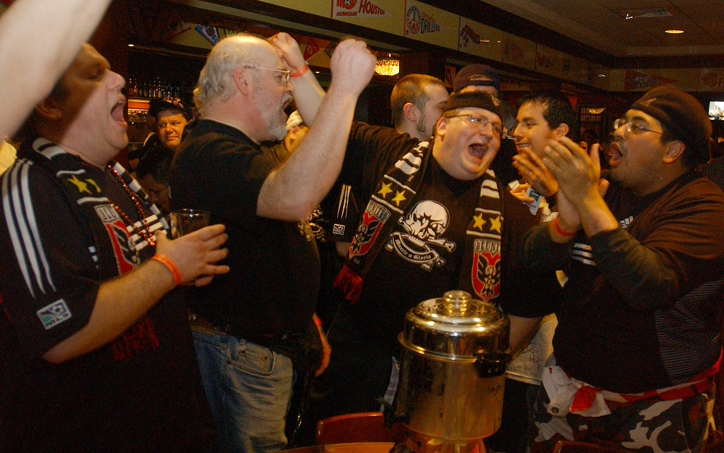
In the end, the name “Coffee Pot Cup” stuck and the rules were established by the members of both teams’ supporters groups. The losers would provide the drink of the winning team’s choice and fill up the urn. The winners would get first drinks.
When the two teams met on March 20, 2004 in the opening game of the Carolina Challenge Cup, D.C. came away with a 2-1 win. Teenage phenom Freddy Adu scored the opening goal in the 56th minute only to see Charleston’s Paul Conway equalize in the 75th. Another of United’s young up-and-coming players, Bobby Convey, scored the winning goal in the 83rd minute.

After the game, both fan groups gathered at the Three Lions Club, the pub located inside Blackbaud Stadium for the inaugural awarding of the Coffee Pot Cup. As the rules dictated, the Battery fans had to fill the cup with the beverage of the winning team’s choosing. In an act of sportsmanship, Battery president Nigel Cooper covered half of the cost of the Guinness that filled the urn. The United supporters got first drinks but by the end of the night, both supporters groups would refill and share the contents of the Cup.
2008 US Open Cup Final
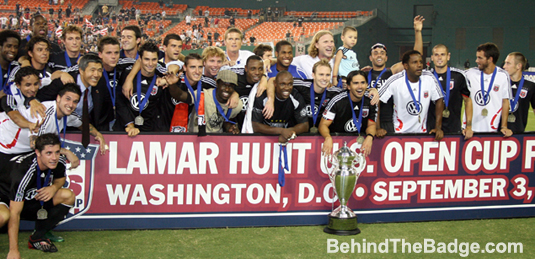
By far, the biggest game of the friendly rivalry came in 2008 when the Battery became just the second non-MLS club to make a run all the way to the Final. There they would face D.C. United at RFK Stadium.
The Battery made one of the most impressive Cup runs in recent history. The 2008 remains the only Modern Era team to reach the Final after starting the competition in the First Round. They advanced through five opponents, including eliminating two MLS teams (Houston Dynamo via PKs at home, 3-1 at FC Dallas), to reach the championship game.
| Charleston Battery vs. D.C. United (All games at Blackbaud Stadium unless noted) |
| 1999 US Open Cup – Round 3 (8/4/99) Charleston Battery 4:3 (AET) D.C. United 2000 US Open Cup – Round 2 (6/14/00) Charleston Battery 0:4 D.C. United 2003 Friendly (3/23/03) Charleston Battery 0:1 D.C. United 2004 Carolina Challenge Cup (3/20/04) Charleston Battery 1:2 D.C. United 2005 Carolina Challenge Cup (3/23/05) Charleston Battery 2:2 D.C. United 2006 Carolina Challenge Cup (3/25/06) Charleston Battery 1:1 D.C. United 2008 US Open Cup Final (9/3/08) D.C. United 2:1 Charleston Battery Site: RFK Stadium (Washington D.C.) 2009 Carolina Challenge Cup (3/14/09) Charleston Battery 0:2 D.C. United 2010 Carolina Challenge Cup (3/20/10) Charleston Battery 0:2 D.C. United 2011 Carolina Challenge Cup (3/5/11) Charleston Battery 1:2 D.C. United 2012 Carolina Challenge Cup (2/29/12) Charleston Battery 1:3 D.C. United 2014 Carolina Challenge Cup (2/26/14) Charleston Battery 1:1 D.C. United |
United had three straight home games before hosting the Final with wins over the Rochester Rhinos (USL) and the Chicago Fire at the Maryland Soccerplex (Germantown, Md.) and a 3-1 win over the New England Revolution at RFK.
The Final started fast and furious with D.C.’s Luciano Emilio opening the scoring in the 4th minute, only to see Charleston’s Ian Fuller equalize in the 10th minute. The game-winning goal would happen in the 50th minute when Brazilian midfielder Fred scoring on a Clyde Simms pass. Charleston’s Dusty Hudock and D.C.’s Jaime Moreno were the only players who played in the Final and also played in that original Coffee Pot Game back in 1999.
The Return of the Coffee Pot Cup
D.C. United and the Charleston Battery have met eight times since that preseason game in 2004. United have had the best of the series, winning eight times and drawing three since the 1999 Open Cup game. Most of those games have been in the Battery’s Carolina Challenge Cup tournament. After the 2008 US Open Cup Final, the two met five of the next six years in the Carolina Challenge Cup (2009-12, 2014).
The last time they played for the Coffee Pot Cup was in 2014 when they finished in a 1-1 draw. Davy Arnaud opened the scoring for United in the 71st minute only to see Drew Ruggles equalize in the 90th minute.
Over time, since it was a fan-created trophy, it needed to live somewhere. So what better person for it to live with than a long time D.C. United fan who grew up near Charleston, S.C.
That caretaker, to this day, is Lonnie Hovis.
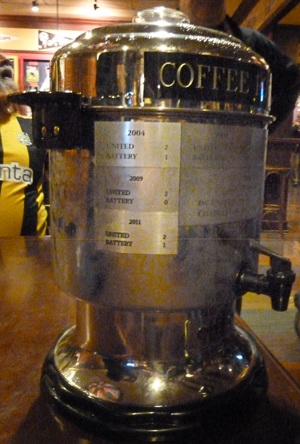
“It needed someone to keep and babysit it,” said Hovis, who was one of the few D.C. fans who attended the 1999 US Open Cup match at Blackbaud. “I was one of the first to hold it and I was also responsible for the plates showing the scores being updated later on. I may have been the first person to receive it, or it may just have been my willingness to be responsible for it after it almost got lost one time on a road trip.”

The plates Hovis refers to were added to the coffee urn that reflect the score of each game of the friendly rivalry.
“I didn’t put the first few on and they started to peel off because they were very rigid,” said Hovis. “I got new ones and had a local company replace the old plates with newer ones that were more flexible,” added Hovis.

On Tuesday, the Charleston Battery and D.C. United will meet for the 13th time in the Fourth Round of the 2025 US Open Cup and there’s a chance that the Coffee Pot Cup will not be in attendance.
At the time of this article being published the morning before the game, there was no plan in place.
“So far, no one has volunteered to meet me anywhere to pass off the (Coffee Pot) Cup so it can attend,” said Hovis, who lives near Winchester, Va., which is about a 90 minute drive away from the game. “Audi Field is too hard to get to and parking is too hard to find, and the Coffee Pot Cup is not easy to be carried on the Metro.”
At the time this article was originally published on Tuesday morning, Hovis was hoping that someone would come through to transport the Cup to the game so that the tradition could continue. Luckily, Stevan Fisher, a D.C. fan since the inaugural season and a Screaming Eagles member since 1998, answered the call. Fisher met Hovis halfway, received the Cup and delivered it to Screaming Eagles president Jimi Butler at the group’s pregame tailgate gathering.

“It’s pretty neat that the trophy still exists,” said Hovis. “ It seems to have fallen out of favor with the newer fans, since the teams haven’t played each other in quite a while and both teams have a newer crop of fans. Fewer of us older original fans, especially in D.C. So I am happy that it’s getting some attention this year.”
In the end, it’s a trophy created by the fans in an era when American soccer was seeking to establish traditions.
“The Coffee Pot Cup is awesome,” said Sachin Shah, reflecting on his Ebay purchase that is still in use more than two decades later. “It’s like the college football rivalry trophies. It’s an authentic, organic part of US Soccer. I’m thrilled to see it continuing on. Soccer has given me so much, so I’m happy to contribute a little bit back.”
Chuck Nolan Jr. significantly contributed to this article


