• Skip to primary navigation
  • Skip to main content
  • Skip to primary sidebar
  • US Open Cup Central
  • US Open Cup Qualifying
  • US Open Cup History
  • Amateur Cup

Complete U.S. Open Cup Coverage

  • 2026 USOC Schedule
  • 2026 USOC Stat Leaders
  • 2027 USOC Qualifying Results
  • TheCup.us Awards
  • Join TheCup.us Patreon!
  • Contact Us

2020 US Open Cup

US Open Cup Committee minutes: Foreign player limit gone; canceled 2020 plans

February 6, 2021 by Jake Sillick

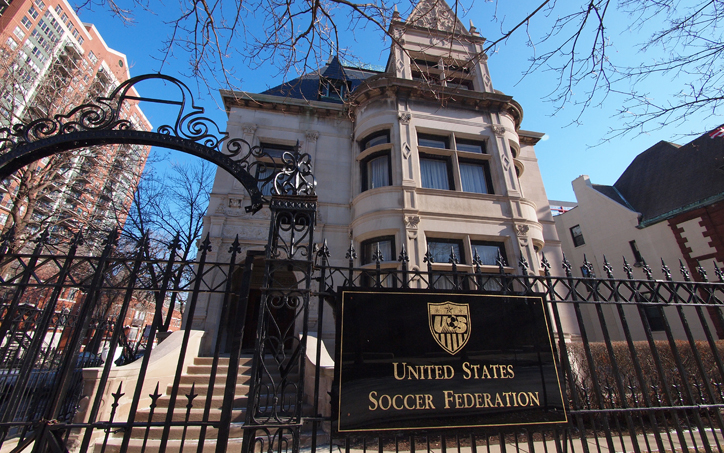
The Soccer House in Chicago, the headquarters for the US Soccer Federation.

In 2020, United States Soccer Federation Policy 414-1 Section 4 was amended to state that all meeting minutes of the Lamar Hunt US Open Cup committee shall be posted to the USSF website after approval of the committee. US Soccer has recently started to post minutes from the past year of these committee meetings, with all minutes available to view here. Most of the meetings in 2020 had been about the COVID-19 pandemic, but recently the committee has started planning for the 2021 US Open Cup, making a decision on one key policy change.

As the USSF policy amendment was approved at the 2020 US Soccer AGM, all meeting minutes from March 2020 and on will be posted on the website.

March 13, 2020 meeting

Just as all professional sports leagues were shutting down for the COVID-19 pandemic, so too did the Open Cup. In a 15-minute conference call, the committee voted to temporarily suspend the 2020 US Open Cup and with plans to reconvene once decisions on next steps are either required or advantageous to take.

May 25, 2020 meeting

In a meeting that was entirely conducted over email over a period of about two weeks, the committee approved a staff recommended, scaled down US Open Cup for 2020.

1. Tournament will be no more than five rounds involving no more than 32 teams (thus eliminating the first three rounds originally planned)
2. Earliest the tournament would restart is Sept. 22-23 (dates originally held for the Final)
3. At least one slot in the tournament will be reserved for a team from the Open Division with the team(s) determined via random draw from among those 38 qualified clubs who wish to and are able to participate in the Fall
4. Only those teams from the 100 originally qualified are eligible to participate

This measure was approved by four out of the five committee members, with the remaining member, Todd Durbin of MLS, not voting.

MORE: TheCup.us’s proposal to salvage the 2020 US Open Cup

July 31, 2020 meeting

In another meeting over email, the committee unanimously decided to
1. Cancel the 2020 tournament
2. Cancel the 2021 Open Division qualifying tournament
3. Conduct the 2021 tournament as normal, with those Open Division clubs who qualified for 2020 included in the 2021 competition
4. Have U.S. Soccer announce these decisions at the earliest opportunity.

In regard to No. 4, US Soccer would announce these decisions on Aug. 17, 2020.

December 15, 2020 meeting

This meeting was the first one to start planning for the 2021 US Open Cup. One major item was discussed and voted upon.

The committee voted unanimously to change Policy Section 203(a) and eliminate the pro team foreign-player limit for Open Cup competition.

The following part from Open Cup Section 203(a) was removed.

Professional teams may have no more than 5 foreign players listed. Amateur teams are not restricted as to the number of foreign players they may list. Foreign players shall be those players who are not protected individuals as defined in 8 U.S.C. § 1324b. (e.g., U.S. Citizens, lawful permanent residents, asylees and refugees). Any conflicting Outdoor Professional League roster rules shall not apply to the number of foreign players allowed to compete in the Open Cup.

Of note, this does not invalidate or override any roster rules set forth by the professional leagues themselves. Foreign player roster rules for each league are listed below.

MLS:
Eight player slots per team, and those slots can be traded intraleague in full season increments (with two permanent roster slot trades grandfathered in). All expansion teams receive 8 slots at the start. Homegrown foreign players do not take up a slot.

USL Championship:
Seven player slots per team. Those slots can be traded intraleague and expire at the end of the season. All teams start each league year with 7 player slots.

USL League One:
Seven player slots per team. No trades allowed.

NISA:
Seven player slots per team. No trades allowed.

Finally, the committee “engaged in an open-ended discussion regarding scheduling and format matters relating to the 2021 Open Cup. No decisions were made.”

The conference call lasted approximately 45 minutes total.

January 5, 2021 meeting

No matters were decided upon in this meeting. In a one hour and 20-minute conference call, the committee had another open-ended discussion regarding scheduling and format matters relating to the 2021 Open Cup with no decisions made.

There was another Open Cup committee meeting on Jan. 12, 2021, but those meeting minutes have not been approved by the committee and posted yet. The most recent minutes approval was on Feb. 2, 2021 where the Jan. 5, 2021 meeting minutes were approved.

Filed Under: US Open Cup Tagged With: 2020 US Open Cup, 2021 US Open Cup

US Open Cup officially cancelled for first time in tournament’s 106-year history

August 17, 2020 by Michael Battista

Graphic by Daniel Crooke

The 2020 Lamar Hunt US Open Cup, the United States’ national soccer championship, has been cancelled for the first time since its inception in 1913. The tournament, which was scheduled to kick off in March with a Modern Era record 100 clubs, will not be played due to the coronavirus (COVID-19) pandemic. The pandemic, at the time of the announcement, has killed more than 170,000 Americans.

The news was originally reported by Sports Illustrated’s Brian Straus on Aug. 14, with US Soccer confirming the news on Monday. The Open Division qualification tournament for the 2021 US Open Cup has also been cancelled.

The 107th edition of the Open Cup tournament is now scheduled to take place in March 2021, with US Soccer inviting all 38 Open Division teams that qualified for the 2020 tournament. These teams will need to maintain eligibility under current Open Cup rules (e.g. remain a member in good standing with their existing league, not switch leagues, etc.) for the invitation to be extended.

U.S. Soccer also announced it will retain the entry fees and performance bonds submitted for 2020 and roll these amounts over for the 2021 tournament.

Longest continually-operating
cup competitions in the world

1. Irish Cup (est. 1881)
2. US Open Cup (est. 1913)
3. Coupe de France (est. 1918)

When the news was announced, Philadelphia-area amateur club Vereinigung Erzgebirge, one of the 12 teams that qualified via the local qualifying tournament, said in the club’s recent newsletter that they are disappointed, but they are trying to put a positive spin on the situation.

“We knew this was a possibility but it is now reality,” the newsletter read. “Let’s focus on the good news. We will be one of the clubs that meet the criteria and Vereinigung Erzgebirge will be in the 2021 Lamar Hunt US Open Cup. I spoke with most of the guys last night and while we are disappointed we all agree we can capitalize on this opportunity. We have never had this much time to prepare. In 2002 when we won Region I to qualify we had 2-3 weeks to prepare. Many guys were not prepared at all. We now have six months, maybe more, to ride out the pandemic and show up ready to knock off a pro team.”

The Open Cup joins a growing number of national soccer competitions canceled due to the virus. This list includes Australia’s FFA Cup, New Zealand’s Chatham Cup, and the Netherlands’ KNVB Cup. North America’s two other national competitions, Mexico’s Copa MX and the Canadian Championship, are set to hold finals later this year.

Beginning in 1913 and crowning Brooklyn Field Club it’s first champions on May 16, 1914, the Open Cup, originally called the National Challenge Cup, was the world’s second-oldest continuously running national championship. Despite being the 14th oldest tournament overall behind countries such as Hungary, Spain, and England, only Northern Ireland’s 140-year-old Irish Cup had been held consistently for a longer period of time. The Irish Cup will retain the title, with the Glentoran FC lifting the trophy three weeks ago.

Throughout its 106-year history, the US Open Cup had been played through various world-changing events. The 1918-19 tournament battled through delays and withdrawals due to the on-going Spanish Influenza outbreak. As both World Wars were fought across the oceans, forcing forfeits at home while canceling national tournaments abroad, the United States crowned a total of 10 national champions without fail during war times.

The 2020 tournament was not without its own share of hurdles prior to the cancellation. US Soccer’s decision to move the First Round start date into late March posed issues for Open Division sides that relied on college talent. Due to NCAA eligibility rules, players would be unable to compete in the tournament until May 1, or after the completion of the Third Round (a round that only 17 amateur teams in the Modern Era have survived). This change pushed teams such as USL League Two’s Reading United AC, the record holder for the most consecutive Modern Era qualifications for an Open Division team, and Flint City Bucks, the 2020 league champions, to both withdraw from the competition despite both being in line for a spot. The National Premier Soccer League’s Midland-Odessa Sockers FC also declined its invitation to the tournament for this reason.

Following the initial pause in sports during March 2020, many of the leagues that take part in the tournament began formulating plans on how to handle the rest of the year. The suspension of both the Major League Soccer and USL Championship (Div. 2) seasons, along with the postponement of the USL League One (Div. 3) season, put increased pressure on all three leagues to complete their regular seasons in a shrinking window. The additional cancellation of the now fully-sanctioned National Independent Soccer Association’s Spring season, as well as the seasons for both recognized National Leagues (NPSL & USL-2), put additional hurdles forward.

The Athletic’s Jeff Reuter reported in mid-March that USL informed US Soccer that it intended to pull all 31 of its member teams out of the competition.

The now canceled edition was set to be the first with two leagues from the same professional level of US Soccer since 2017, with both third division USL League One and the National Independent Soccer Association set to enter in the Second Round. It was also set to be the first time since 2012 that Major League Soccer, the United States’ highest sanctioned league, would have teams enter prior to the Fourth Round — with half of its teams entering in the Third Round based on last year’s league results.

Filed Under: 2020 US Open Cup, Feature - Main, US Open Cup Tagged With: 2020 US Open Cup

Spanish Flu, severe weather, Olympic Games: 2020 US Open Cup isn’t first tournament to be delayed

April 3, 2020 by Chuck Nolan Jr.

Snowy conditions, seen in this 1956 First Round game between Harmarville and Cecil, is what many teams had to play through in order to keep the Open Cup on schedule in the past. Photo: National Soccer News

With the 2020 Lamar Hunt US Open Cup postponed by the COVID-19 pandemic, it is unclear when, or if, the tournament will be played this year. If the 2020 edition is indeed called off, it will be the first time since the tournament’s inaugural year in 1913 that it will go unplayed. Currently, the US Open Cup is the second-oldest continually-operating cup competition in the world, behind only Northern Ireland’s Irish Cup which started in 1881.

However, this is neither the first nor longest delay the Open Cup has experienced in its 106-year history. The start of the 1919 competition was set back nearly a month when the Spanish Flu pandemic swept through the country. Many times play has been stopped anywhere from two to four months due to winter weather conditions making games unplayable. In 1948, it took 11 months to complete the tournament due to weather delays and the 1948 Summer Olympics.

For most of the Open Cup’s existence, the preliminary rounds of the tournament started in October with a planned Final in April or May. This meant playing games through the winter months, often on mud, snow, and ice-covered fields. Usually the only weather that would force the postponement of a cup game would be heavy snow or very cold temperatures, which could hold up the competition for multiple months.

While the Open Cup was able to overcome the longer delays of the past, the tournament also operated on a much more flexible time frame. If the final was pushed back well beyond the preferred calendar date, there was no real “or else” date for it to be played. Soccer in the United States used to run closer to the fall to spring schedule popular in Europe, and it moved to a spring to fall timeline in the late 1960s. Outside of lightning or heavy rain, there is not much during the spring and summer months that will cause a delay, and playing in the winter months in the northern half of the country is seen as out of the question.

The congestion of Major League Soccer and USL Championship league schedules play a factor in when the tournament can be played. In the past, Open Cup games were often given precedence over league games, where now the Open Cup game dates must be squeezed in to fit the league schedules. The Open Cup Final is almost always scheduled no later than September or October in order to not interfere with the MLS Cup playoffs.

MORE: A modest proposal: How to salvage 2020 US Open Cup amid coronavirus pandemic

The availability of players also depends on the calendar. Many teams from the NPSL and USL League Two rely on college players to fill their rosters, and due to NCAA rules these teams only have access to these players for a limited number of months. If the Open Cup were to fall too far behind schedule, these teams could lose the use of many of the players that make up their roster. However, since the start of the 2020 US Open Cup was pushed back to late March (the earliest start of the Modern Era), any team that relies on college players to fill out its roster wouldn’t have access to those players anyway.

Here are a few examples of long delays the Open Cup has faced in its history. While this is not a complete list, these are some of the more notable delays.

A cartoon about the impact of the Spanish Flu on the sports world from the Philadelphia Inquirer on Oct. 7, 1918

1918/1919: Spanish Influenza outbreak

Just as the 2020 edition is delayed by the COVID-19 pandemic, the start of 1919 tournament was set back by a pandemic, though only for a month.

A week before 12 matches were set to kick off the tournament on Oct. 20, 1918, the United States Football Association authorized postponing all the opening round games due to a new outbreak of the Spanish Flu.

Support TheCup.us and its coverage of the US Open Cup by purchasing a "Champions" shirt, honoring the five clubs from the pre-Modern Era (1914-1994) to win four or more US Open Cup titles. Visit THECUP.US SHOP
Support TheCup.us and its coverage of the US Open Cup by purchasing a “Champions” shirt, honoring the five clubs from the pre-Modern Era (1914-1994) to win four or more US Open Cup titles. Visit THECUP.US SHOP

The deadly pandemic is believed to have gotten its start in United States military training camps in Kansas in April of 1918, and the deployment of those soldiers to Europe for World War I the following month allowed the virus to spread. In Sept. of 1918, a new outbreak was reported at Camp Devins outside of Boston, as well as a naval facility in Boston.

The flu spread quickly along the east coast, prompting recommendations against large gatherings in most cities. Many college football games in late October & early November were either played in empty stadiums or canceled outright.

The only areas deemed “safe” for large gatherings in late October were New York City and Connecticut, which allowed four cup games to be played on planned Oct. 20 start date. The 11 other opening round contests were completed in the following weeks, with Chicago’s Bricklayers & Masons’ 3-1 win over American Hungarian FC bringing a close to the first round three weeks after its planned completion.

In the end, the tournament was able to quickly regain its pace after the October delay, and, in the end, on April 19, 1919, the Bethlehem Steel defeated Paterson FC, 2-0, to win the club’s fourth National Challenge Cup title.

MORE: 1918/1919 National Challenge Cup Round 1: World War I, Spanish Flu cause chaos for tournament

MORE: Philadelphia soccer and the 1918 Spanish Flu epidemic (Philly Soccer Page)

1943: Bad weather in Wisconsin

When Brooklyn Hispano defeated the Philadelphia Americans, 3-1, in the 1943 Eastern Final (National Semifinals) on March 14, the second round slate on the western side of the bracket had yet to be completed. A brutal Wisconsin winter pushed a pair of Second Round games from their scheduled December date all the way to April 4, 1943. Once spring temperatures thawed the Badger state, the Croatian Eagles were able to defeat Wacker FC, and Milwaukee side Falk Field Club overcame Schwaben AC from Chicago, 4-1.

Falk defeated the Eagles the following week to advance to an April 25 quarterfinal game with Chicago’s Sparta A & BA. The delays caused the Western final between Sparta and Western Pennsylvania’s Morgan Strasser to be played nearly two months after their Eastern counterparts. Brooklyn Hispano won the 1943 Open cup over Strasser on May 30, nearly three months after their game with the Americans.

1947: More bad weather and bad scheduling

Due to a combination of weather and scheduling delays, the 1947 US Open Cup did not wrap up until Sept. 7. At the time, it was the latest date on the calendar the Final had ever been played. It was also the third year in a row that the final was pushed to its latest ever finish, as the 1945 final took place in mid-June, and the 1946 Final did not kick off until July.

On April 2, Bill Graham of the Brooklyn Daily Eagle reported that while the Western half of the tournament was moving on time, the East was badly delayed because of interference from “other competition”. While the West did not have nearly the number of entrants, the last of the 11 games in the First Round in the East did not wrap up until May 18, four months past the preferred time.

The American Soccer League’s Baltimore Americans were the first direct casualty of the delay. The Americans were forced to forfeit their first-round game to Baltimore amateur club Hasslinger SC when their playing field became unavailable due to the start of baseball season in May. Soon after, Detroit’s Pioneer Kickers forfeited their quarterfinal replay with Western Pennsylvania’s Curry in mid-May in order to focus on their North American Professional Soccer League schedule.

By June, the Eastern second round schedule had yet to be completed and the Baltimore SC Orioles joined the list of withdrawn teams. Kearny Scots and the Kearny Irish were scheduled to face each other on June 6, but decided to both withdraw, in protest of the method of drawing opponents.

By the time the United States Soccer Football Association (USSFA) convention took place in June, the Open Cup finalists had yet to be determined. The ongoing delay became a hot topic of discussion in the meeting of the Cup Committee, with some district representatives arguing that it was unreasonable to expect their teams to try and play important cup games in the winter months when bad weather made fields unplayable.

With Sparta and Ponta Delgada finally determined as Open Cup finalists at the end of June, yet another delay stopped the tournament’s completion. The USSFA agreed in December of 1946 to send a team to Cuba for the first-ever North American Football Confederation championship. Instead of putting together a team of players from across the country, the USSFA decided to send Ponta Delgada, the defending US Amateur Cup champions and the runner-up of the previous year’s Open Cup.

The NAFC tournament required Ponta to be in Cuba for two weeks, and the result may have caused Ponta to wish they stayed at home. Ponta lost the first game 5-0 to Mexico on July 13, and seven days later, they dropped their final game to Cuba 5-2 to finish last among the three teams.

Finally, on Aug. 31 the first leg of the Open Cup final between Sparta and Ponta Delgada was played at Tiverton, Rhode Island, which Ponta won 6-1. A week later in Chicago, Ponta claimed their first Open Cup title with a 3-2 win, erasing the disappointment a month earlier in Cuba. (NOTE: It would be a half century before a team from Massachusetts would lift the trophy again when the New England Revolution ended the drought with the 2007 US Open Cup championship)

A photo from the Capital Times (Madison, Wis.) from March 27, 1948

1948: Delayed by weather (again) and the Olympics

Bad weather once again wreaked havoc on the Eastern half of the Open Cup schedule in 1948, causing the First Round to stretch from Jan. 18 to Apr. 4. With just five teams in the Western half of the tournament proper, the Western Final was won by Simpkins Ford a mere month after the Eastern First Round was completed.

Headline in the Wisconsin State Journal – March 27, 1948

In an attempt to keep bad weather from delaying the tournament in the West, the Wisconsin State Soccer Association went to an unusual length to determine who would advance as Wisconsin’s representative. On Mar. 28, the Milwaukee Brewers were set to face Richard Rich Tigers in the Wisconsin final, but the game was put off by the same winter weather that had gripped Milwaukee for the past few months.

The winner was set to advance to the Illinois third round, who were waiting on the Wisconsin winner. Since the bad weather showed no sign of letting up, it was decided a coin flip would determine the winner. Richard Rich Tigers won the toss, and they may have regretted making the trip to Chicago. On April 4, the Tigers were hammered 10-1 by the Polish American AC (now AAC Eagles).

Since Brookhattan was tied up with the Lewis Cup Final (ASL league cup) in early May, in order to keep the Open Cup moving the USSFA decided to switch up the Eastern Third Round pairings. Instead of facing Brooklyn Hispano, Brookhattan were given a bye to the Fourth Round, and Hispano was set up to face German American Soccer League champion Elizabeth Sport Club (NJ). Elizabeth wound up upsetting Hispano 2-0 and would eventually be stopped in the Quarterfinals by Ponta Delgada, 2-0.

With five members of Simpkins Ford (St. Louis) named to the 1948 US Olympic Team, the date of the 1948 US Open Cup Final was pushed back until after the Olympics. Headline: Brooklyn Daily Eagle

Just as had happened the year before, the Final was set back by an international competition. Brookhattan finally were crowned Eastern champions with a 4-1 aggregate win over Ponta Delgada on June 20. Simpkins Ford had already been waiting six weeks since they defeated Castle Shannon in the Western Final on May 9. The plan was to stage the two legs of the Final on July 4 in St. Louis and July 11 in New York. That plan hit snag when Simpkins couldn’t find a suitable field to use.

Complicating matters was the fact that the US Olympic Soccer team was scheduled to leave for London on July 14, and five Simpkins players were on the team. On June 24, USSFA Vice President Walter Geisler announced that the Open Cup Final would be delayed until after the Olympics.

Unfortunately, the US Olympic soccer team found themselves on the wrong end of a disappointing result, just like Ponta Delgada the year before. The 1948 Olympic football tournament was a single elimination knockout, and after their original opponents withdrew (Portugal), the US wound up facing Italy in the opening round. The Americans were hammered 9-0 by an Italian team with many players from first and second division Italian clubs. The Olympic team stayed in Europe for another two weeks to play games against Northern Ireland (5-0 loss) and Norway (11-0 loss).

Finally, on Oct. 17, 1948, Brookhattan met Simpkins at Sportsman’s Park in St. Louis, eleven months after the tournament began in November of 1947. Simpkins won their first Open Cup championship in thrilling fashion, with Henry Merlo scoring in the 89th minute to push the home club past the visitors, 3-2. It was the first time a St. Louis team had lifted the trophy in 13 years.

The 1947/1948 tournament remains the longest lasting edition in the competition’s 106-year history. After 1948, the final would often be played in June or early July, but the tournament would not see another October final until 1996, when by then, the calendar for soccer in the United States started in March or April instead of September.

1965: Midwest matches once again delayed by weather

While three of the four teams for the Western semifinals had been determined by February, Chicago’s qualifying would be stuck in a holding pattern until April by winter weather. Once spring broke, Hansa defeated the Maroons 3-1 in the final Chicago quarterfinal game. Hansa would go on defeat Schwaben 3-2 in extra time on May 2. The Western side of the bracket wound up a month behind the East.

That year, Hansa would go all the way to the Open Cup Final against New York Ukrainian on June 27 and July 4, falling 5-2 on aggregate, although the second leg went to extra time to break a 2-2 aggregate score.

Filed Under: Feature - History, Feature - Main, US Open Cup, US Open Cup History Tagged With: 2020 US Open Cup, Spanish Flu, US Open Cup History

A modest proposal: How to salvage 2020 US Open Cup amid coronovirus pandemic

March 27, 2020 by Michael Battista

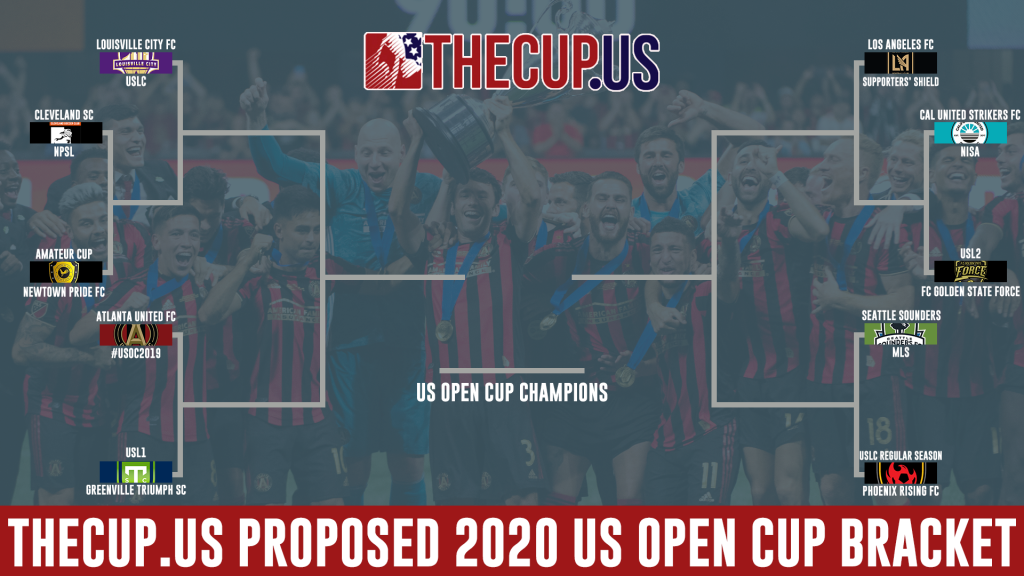
A proposed 2020 US Open Cup bracket
If the coronavirus pandemic pushes the start of the American soccer season to the point where teams will not have time to fit the Lamar Hunt US Open Cup into their schedule, we propose an abbreviated tournament for 2020. Graphic by Harrison Huntley | @hhuntley17

On March 13, the US Soccer Federation announced the 107th edition of the Lamar Hunt US Open Cup, which was scheduled to start at the end of March, was “temporarily” suspended due to the coronavirus pandemic (COVID-19). As more time has passed and league suspensions (MLS, USL, NISA) have extended past their original early April start dates, along with Thursday’s news that the National Premier Soccer League (NPSL) will cancel the 2020 summer season, the likelihood of major changes being made to US Soccer’s 2020 calendar are becoming more inevitable.

The prospect of the US Open Cup’s temporary suspension becoming permanent is now a reality.

At a time like this, it is hard to even consider sports factoring back into the public conscience. The rise of COVID-19 has brought the world to a halt with a lot of uneasy tension as we continue to live through this unprecedented event. If social media is any indication, fans, many of which are coping with a life without sports, and performing their civic duty by staying home, want to see the US Open Cup crown a champion in 2020.

In the interest of preventing the first-ever cancellation in the tournament’s 106-year history, we are offering a possible alternative to the US Open Cup that would crown a champion and allow the second-oldest continuously-operating soccer tournament in the world to retain its streak.

According to the USSF, the plan is to play all eight rounds of the tournament from start to finish. However, with the NPSL canceling their summer season, USL League Two likely not far behind, and with the remaining weeks of the pro season dwindling, there needs to be a backup plan.

What follows is a proposed 10-team tournament with the 2019 champions from across US Soccer. Factoring in US Soccer’s historical tendencies when it comes to travel while also borrowing elements from other events (USASA’s Hank Steinbrecher Cup, the Canadian Championship, and the NCAA basketball tournaments) would allow this event to finish in three to four weeks. Crucially, it would put minimal strain on the MLS and USL schedule with teams only having to play at most two additional games. Another concern for the pro leagues is to have the Open Cup not interfere with the home stretch of their regular season and their season-ending playoffs. This abbreviated schedule would be sensitive to that concern.

Obviously, if the pro seasons are able to resume in early summer, a larger tournament tournament could be planned. This proposal is simply a worst-case scenario.

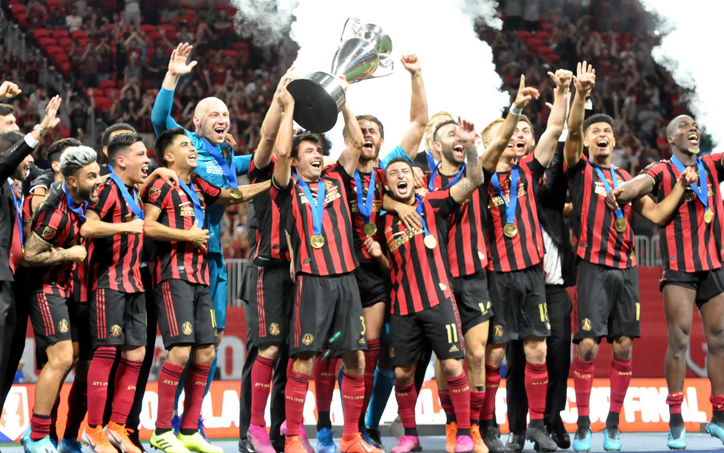
Atlanta United FC celebrates their 2019 Lamar Hunt US Open Cup championship. Photo: Allison Andrews

SELECTING THE TEAMS

The biggest hurdle for this proposal was whittling down a Modern Era-record 100-team field into something manageable. With Jeff Reuter’s report that USL teams inquired about pulling out of the tournament prior to its suspension are a clear indicator that having the competition’s entire field of eligible 62 pro teams would be unlikely.

To combat this, our proposal limited the professional teams to the ones that won a trophy in 2019. A sort of Cup Winners Cup.

Major League Soccer
Atlanta United FC – 2019 Lamar Hunt US Open Cup champions
Seattle Sounders FC – 2019 MLS Cup champions
Los Angeles FC – 2019 Supporters’ Shield champions

USL Championship
Louisville City FC – 2019 USL Championship finalist*
Phoenix Rising FC – 2019 USL Regular Season champion

*The 2019 USL Champion Real Monarchs are not eligible to participate in the US Open Cup since they are owned by Real Salt Lake (MLS).

USL League One
Greenville Triumph SC – USL League One Championship finalist**

National Independent Soccer Association (NISA)
California United Strikers FC – NISA West Coast Conference Champions (Fall 2019)

** The 2019 USL League One Champion North Texas SC are not eligible to participate in the US Open Cup since they are owned by FC Dallas.

Players from Greenville Triumph celebrate the club's goal against South Georgia Tormenta in the First Round of the 2019 US Open Cup. Photo: Brittany Hildreth | Twitter: @britthildreth
Players from Greenville Triumph celebrate the club’s goal against South Georgia Tormenta in the First Round of the 2019 US Open Cup. Photo: Brittany Hildreth | Twitter: @britthildreth

For Division 3, since both USL League One and NISA have only recently come into existence, awarding them two spots each felt unnecessary. Especially considering the leagues only have six and eight eligible teams, respectively. USL League One finished its regular season with an illegible team in first place, North Texas SC (owned by FC Dallas), followed in second place by a team that folded after only one season in Lansing Ignite FC. Having a spot go to the fourth place Forward Madison FC as “regular season champion” would make little sense. Instead, we decided that Greeville Triumph SC should represent USL-1 on the strength of their third place regular season finish, and finishing as runner-up in the league’s playoffs (falling the North Texas SC in the championship game).

NISA is a new Division 3 league that kicked off with a fall season that saw the eight teams split up into a pair of four-team groups. The top two teams from each conference advanced to a single-elimination playoff. Miami FC won the Eastern Conference playoff, while California United Strikers FC won the Western Conference championship game. Since Miami FC left to join the USL Championship, we have tapped the Strikers as the NISA representative for this abbreviated US Open Cup.

National Premier Soccer League
Cleveland SC – 2019 National Premier Soccer League National Semifinalist

USL League Two
FC Golden State Force – 2019 USL League Two National Semifinalist (See below, “The USL League Two Problem”)

National Amateur Cup
Newtown Pride FC – 2019 National Amateur Cup Champions

While 38 Open Division teams earned a chance to play for the Lamar Hunt Trophy, that number is once again far too high to realistically stage a tournament. As previously mentioned, the NPSL has already announced the cancellation of the 2020 season and TheCup.us has heard from multiple USL League Two teams that feel the likelihood of their season taking place is slim.

Newtown Pride FC celebrate after winning the 2019 USASA Amateur Cup championship in River Grove, IL. Photo: Newtown Pride FC

Both teams that competed in the 2019 NPSL national final, Miami FC and New York Cosmos B, pulled out of the league prior to the 2020 season. Between the two semifinalists, Midwest Region champion Cleveland SC and West Region champion ASC San Diego, Cleveland finished the regular season with a better record (win-percentage / points-per-game) and were the team selected by the NPSL to represent the league at the 2020 Hank Steinbrecher Cup.

If we are to assume the NPSL and USL-2 teams are both out, that eliminates 25 of the 38 Open Division teams, leaving 13 Open Division Local teams, and since Newtown Pride are the only one of those teams to win a national trophy (2019 USASA Amateur Cup), we will select them as the Open Division Local representative.

Despite the NPSL’s announcement, teams like the Denton Diablos FC and the Fort Worth Vaqueros have claimed on social media that they still want to participate in the US Open Cup even though their league season has been canceled.

The pairings will leave an odd number of Open Division teams in the tournament, meaning one professional team will need to take part in a Play-In Round to even it out. NISA representative Cal United will be this team, as it makes sense both geographically and because NISA is the most recently-sanctioned pro league.

The USL League Two Problem

Picking a team to represent the nation’s most secure amateur league was a challenge. USL League Two typically distributes its Open Cup berths according to how teams finish the regular season with the main metric being average points earned. This would contrast with the rest of the tournament field in which each league from Division 3 and lower only has their best finishing (and eligible) playoff team.

Allisson Faramilio celebrates with his FC Golden State Force teammates after upsetting the Las Vegas Lights in the 2018 US Open Cup. Photo: Michael Carranza - gossamr.com
Allisson Faramilio celebrates with his FC Golden State Force teammates after upsetting the Las Vegas Lights in the 2018 US Open Cup. Photo: Michael Carranza – gossamr.com

Going by a champions-first format would mean Flint City Bucks get in. However the team, which is the most successful Open Division side in the tournament’s Modern Era, announced late last year that they would be sitting out the tournament. The proposed March start to the 2020 tournament meant college players would not be able to take part in any competition that begins before May 1. With the virus potentially pushing any sports late into the summer to possibly early fall means college players would once again be at risk of being excluded. If the team’s previous response is anything to go by, passing over them again would make sense.

The second-best-finishing team would be the national finalist Reading United AC, another team with a lengthy Open Cup history. United qualified for the club’s 11th consecutive tournament last year, a Modern Era record for an Open Division team. 2020 would have been their 12th in a row, but they also declined to take part in the US Open Cup due to player eligibility concerns.

That leaves the two national semifinalists to pick from: Western Conference champions FC Golden State Force and Southern Conference champions South Georgia Tormenta FC 2. Since Golden State finished the year with a better record and higher average points statistic, which can be seen in TheCup.us’ original rankings of USL-2 teams, that means the spot goes to the Southern California side. Coincidentally, the Force was also the third choice in terms of average points overall from league teams.

One could realistically make the interpretation that the Des Moines Menace should be the USL League Two team entered since it finished atop TheCup.us’ league rankings. Or that ASC San Diego should be in for the NPSL since it was ranked one spot above Cleveland in our NPSL allocations list. The choices made were done using one such interpretation and also factoring in things such as travel distance.

That leaves us with: The Bracket!

A proposed 2020 US Open Cup bracket
Graphic by Harrison Huntley | @hhuntley17

Travel Costs

In this layout, a majority of the tournament’s games would be centered around the southeastern United States and Los Angeles. The right side of the bracket incidentally comes out to be a pretty good representation of the West Region in a typical Open Cup.

The opening round match between Cal United Strikers and FC Golden State Force (the latter of which already fields a pro team in NISA against the Strikers) would be between teams that are 40 minutes away from each other. The winner of that game would play Los Angeles FC, the MLS power that has its own stadium and plays north of both teams, with a maximum travel distance of a one-hour drive.

The west also holds the matchup with the longest distance between teams (not including the Final) with Phoenix and Seattle clocking in at over 1,100 miles. The saving grace is that this is a common flight route between major hubs. US Soccer has also shown that it would rather have one pairing be between teams spread far apart if it means other matchups are close together. Finally, whichever team wins is guaranteed to play a team from Los Angeles, which is a short flight for Phoenix Rising and a common travel route for the Sounders.

The left side of the bracket, practically the East Region, is a bit more messy. As luck would have it, every professional team in the East is centered around the southeast while the two Open Division sides are up north. A flight between Bradley International Airport in Hartford, Conn. and Cleveland Hopkins International Airport does exist and flies once-a-day so the Play-In Round could be done as normal. The winner of that game would have a one-to-two-hour flight between them and Louisville City FC, who have reached the last three USL Championship finals, winning two of them (2017, 2018).

On the other side, Atlanta to Greenville is either a simple two-hour drive or there are flights between the two cities. If both USL teams win, unless US Soccer would be willing to charter a flight between the two cities, there is no direct route between Louisville and Greensville and driving would be between six to seven hours one-way. So while not the farthest this match-up might be the most costly to set-up. A game between Louisville and Atlanta would also be fairly simple to set up.

Worst case scenario would see Greensville play either Open Division team in the Semifinal since there are no direct flights between those cities.

Scheduling the Tournament

Probably the biggest obstacle to overcome is adding more games to a team’s season while the leagues themselves try to complete as many regular season games as possible in order to make up for lost time and revenue. This is, without a doubt, the part that will make or break this imaginary tournament idea.

The key to making this work is to be quick and have a concrete date structure. A roughly four-week tournament would fit in exactly one month. For simplicity, August 2020 will be used since current hopes are that sports will resume at this time and it would be before the scheduled FIFA International Break between Aug. 31 and Sept. 8. Three of the four rounds would be played on either a Tuesday or Wednesday, keeping with typical Open Cup methodology.

Beginning with the Play-In Round contested between three Open Division teams and the NISA representative, these games could either be played on a weekday to keep with the normal structure (Aug. 4-5) or played on the weekend (Aug. 8-9). Not only would these teams have the luxury of being out of league play (NISA Fall season started in late August last year, USL League Two ends in July typically, and the NPSL announced this week that the 2020 season is cancelled due to COVID-19) but even if the games were played on the weekend it would fit with a mentality of Play-In games providing short rest prior to the actual tournament (SEE: NCAA basketball tournaments).

The Quarterfinals and Semifinals (MLS, USL-C, & USL-1 enter) would be played between Aug. 11-12 and 18-19 respectively. The final itself would be played on August 26. Ten games over 25 to 28 days.

Double Booking MLS Matches

While this suggestion is far from ideal, if a late summer edition of this tournament meets resistance from MLS, there is the option to double book league matches.

Players from LAFC celebrate a goal against the San Jose Earthquakes in a Round of 16 match in the 2019 US Open Cup. Photo: LAFC

In this tournament, MLS teams take up a majority of the field when compared to the other leagues (30% of the field) and are obviously the favorites. A total of three unique matchups can occur between MLS teams (Sounders v. LAFC, Atlanta vs. Seattle and Atlanta vs. LAFC). With this being the case, and with MLS definitely needing to restructure its season with a restart later this year (which will be assumed is happening otherwise this tournament is dead), then why not schedule these three potential matches at a point in time where they could double-up as US Open Cup games?

A similar precedent has been used by the tournament in the past as well. In the 1990s, leagues such as the A-League (Div. 2) and Major League Soccer both used regular season matches that doubled as Open Cup qualifiers. This same concept can be used with MLS games. In a three-week span, have Seattle play Los Angeles, then have Atlanta play the Sounders and L.A. in subsequent weeks. Both west coast teams were originally scheduled to play in Mercedes-Benz Stadium later this year and both the Sounders and LAFC have to play home and away against one-another.

Have these games scheduled to play on weekends in August. Seattle vs LAFC scheduled for either Aug. 22-23. For Atlanta, scheduling the team’s makeups against Seattle and Los Angeles on Aug. 28-29 and the subsequent game on Sept. 11-12 after the FIFA break. Whichever of the matchups is not used can be played as a standard league game. If the match-up ends up becoming MLS vs non-MLS, it can be played on the regularly scheduled weekday.

If the teams are matched in the tournament, the league games will double up as Open Cup games. If after 90 minutes the score is tied, the game is recorded as a draw in league standings but continues on for the standard extra-time to determine who advances in the tournament.

While this system isn’t perfect and should not be used normally, with only a handful of MLS vs. MLS games possible it wouldn’t make sense to have an entirely different game scheduled when the year only has so many days in it. The bonus to this is that if MLS is already playing a game then US Soccer has no reason to foot any travel bill.

In terms of broadcasting, both of the LAFC and Seattle games were already set to be played on ABC as was the Aug. 16 match between Atlanta and LAFC. The US Open Cup has a contract with ESPN+, MLS has out-of-market games broadcast on the service, and both ESPN and ABC are owned by Disney. The only wrinkle is that Fox Sports 1 was contracted to host the Seattle match in Atlanta, so if that were to become an Open Cup game it’s unclear how that could be changed. The other thing is that come later this year with the potential bottleneck of sports (NBA and NHL resuming, NFL starting, MLB starting late) broadcast contracts will need to be reworked regardless.

Pros of this Tournament

* It means the second longest continuously played soccer tournament in the world continues to keep that title
* Two out of the three Open Division teams are guaranteed to play at least one pro team.
* Open Division teams need to beat just one pro side in order to play a MLS team
* Teams are generally centered in two areas, cutting down on travel costs
* Tournament can be finished in as little as four weeks
* 10 teams represent the best of their respective leagues / divisions as a Champions League, of sorts

Cons of this Tournament

* Not open to every team in the country
* Will still be going up against a lot including a condensed MLS schedule and other sports (shared venues with Atlanta & Seattle)
* Very tight scheduling with little rest (if combined with makeup dates)
* No college players available to three Open Division teams due to dates (Note: This was already a reality by starting the tournament in March)

Conclusion

This variant of the tournament is the bare minimum to be an “Open Cup.” To be honest, it’s more like a “Slightly Ajar” Cup or “Emotionally Distant” Cup, if anything. But for a tournament that’s been played through two World Wars, a Great Depression, the Spanish Flu, and 18 presidents, it’s hard to accept that, for the first time, it might not happen.

In the end, health and safety of fans, players, coaches and team officials comes first and in time we shall see how this coronavirus situation plays out. When the time comes for soccer teams to safety get back on the field, hopefully at the end of the year, someone will lift the US Open Cup trophy for the 107th time.

Filed Under: 2020 US Open Cup, Feature - Main, US Open Cup Tagged With: 2020 US Open Cup

2020 US Open Cup suspended, future of 107th edition of tournament in question

March 14, 2020 by Ian Foster

The Houston Dynamo lift the trophy after winning the 2018 US Open Cup title. Photo: Houston Dynamo

Following the example of Major League Soccer (MLS), United Soccer League (USL), National Independent Soccer Association (NISA), the CONCACAF Champions League, and pretty much every major and minor sporting league in the region, the United States Soccer Federation (USSF) announced today they would be temporarily suspending the 2020 Lamar Hunt US Open Cup due to the COVID-19 pandemic.

The first round was scheduled to kick off on March 24, with the second round following two weeks later. Per the statement from USSF, there remains optimism that the tournament will be held in 2020, continuing the Open Cup’s run as the second-longest-running uninterrupted competition in the world (The Irish Cup was launched in 1881 and has never missed a year). The US Open Cup has carried on through multiple world wars, soccer wars, but it’s unclear if it will survive the coronavirus.

“Given the unique nature of the competition,” said the US Open Cup commissioner Paul Marstaller in USSF’s statement, “which encompasses clubs from multiple leagues that have suspended their seasons, we are taking this action and will look to determine future dates to allow the 2020 Lamar Hunt U.S. Open Cup to be played.”

What remains to be seen, however, is if this year’s Open Cup will still include MLS and USL sides. The Athletic’s Jeff Rueter reported yesterday that USL has already informed US Soccer that they intend to pull out.

The USL has told U.S. Soccer of their intent not to participate in #USOC2020 in order to prioritize the rescheduling of regular season matches effected by #COVID19, sources tell @TheAthleticSCCR.

— Jeff Rueter (@jeffrueter) March 12, 2020

The question remains, if the reporting is true that the USL may want to sit out the 2020 tournament, could Major League Soccer be far behind? The top two leagues make up nearly half of the entries in the 107th edition of the Open Cup. The USL Championship has 25 (US-based) teams in this year’s competition, while MLS has 23 (US-based) teams.

There’s no word on whether this suspension will impact those decisions. Both leagues would prefer to play a full schedule in front of fans, as much of their revenue derives from matchday income. Working with what is likely to be a highly-condensed schedule, the leagues are likely hoping to use what would have been the Open Cup dates for rescheduled matches.

As a tournament that’s been around for more than a century, the US Open Cup is no stranger to pandemics, but clearly this novel coronavirus is easily the most disruptive. 100 years ago, during the 1918/1919 edition of the tournament — then known as the National Challenge Cup — the Spanish Flu caused the postponement of a number of opening round games. There were also media reports of a few key players missing games due to the Hong Kong Flu in the late 1960s.

#USOC2020 ESSENTIALS

Click here to follow all 100 #USOC2020 teams on Twitter

Newtown Pride FC win first Amateur Cup title, qualify for 2020 US Open Cup
2020 US Open Cup Qualifying Schedule / Results
2020 US Open Cup Qualifying Round 1 Game-By-Game Review
2020 US Open Cup Qualifying Round 2 Game-By-Game Review
2020 US Open Cup Qualifying Win & You’re In Weekend Game-By-Game Review
2020 US Open Cup Qualifying Goalscoring Leaders

USL League Two champion Flint City Bucks sitting out 2020 US Open Cup after schedule ‘travesty’
Reading United AC declines 2020 US Open Cup entry due to ‘abhorrent’ schedule change, more teams to follow
Without college players available, 2020 US Open Cup schedule cripples NPSL, USL-2 teams

In our 18th year of covering the US Open Cup, support TheCup.us by joining our Patreon team!

Filed Under: 2020 US Open Cup, Feature - Main, US Open Cup Tagged With: 2020 US Open Cup

2020 US Open Cup: USSF announces Round 2 pairings and hosting scenarios for largest round of Modern Era.

January 29, 2020 by Jake Sillick

Laredo Heat SC plays San Antonio FC during a US Open Cup soccer match, Tuesday, May 14, 2019, at Toyota Field in San Antonio, Texas. San Antonio won 2-0. (Darren Abate/USL)

The professional teams in Division II and Division III leagues (USL Championship, USL League One, and NISA) now know who they will or could face in the Second Round.

The United States Soccer Federation announced the pairings for the Second Round of the 107th edition of the tournament that will take place April 7-9. In Round 2, the 19 winners of Round 1 will join 25 USL Championship, 6 USL League One, and 8 NISA teams in 29 matches. This is the largest round by number of matches in the Modern Era.

The hosts for the First Round, and all future rounds, are determined by random selection. If both teams apply to host and both teams meet the federation’s minimum venue standards, then the home team is decided by random draw.

The winners from Round 2 will advance to the Third Round which is scheduled to be played April 21-23. The 11 lowest ranked Division I (MLS) teams will enter in this round.

All games will be exclusively broadcast live on ESPN+ as part of the tournament’s new media rights agreement.

Interesting Notes:

  • This is, by far, the earliest start for the Second Round in the Modern Era (1995-present). Prior to this, the earliest the Second Round had started was in 2014 when it began on May 13.
  • The single-game Modern Era attendance record for the Second Round is 12,790 which was set in 2017 in a match between AFC Cleveland (NPSL) and FC Cincinnati (USL) at Nippert Stadium in Cincinnati, Ohio (May 17, 2017).
  • The number of Open Division teams that have eliminated professional teams since 1996 is 78. USL League Two has eliminated 56 pro teams, the Open Division Local teams from the USASA have eliminated 18 and the NPSL has upset 4.
  • The last Division III team to reach the Semifinals was Richmond Kickers in 2011.

This is an incomplete list of teams that did not apply to host the Second Round, based on the schedule scenarios. There are likely many more teams, but the schedule does not reveal them.

  • Newtown Pride FC (USASA)
  • Naples United (NPSL)
  • OKC Energy FC (USL Championship)
  • NTX Rayados (USASA)
  • Crossfire Redmond (NPSL)

#USOC2020 ESSENTIALS

Click here to follow all 100 #USOC2020 teams on Twitter

Newtown Pride FC win first Amateur Cup title, qualify for 2020 US Open Cup
2020 US Open Cup Qualifying Schedule / Results
2020 US Open Cup Qualifying Round 1 Game-By-Game Review
2020 US Open Cup Qualifying Round 2 Game-By-Game Review
2020 US Open Cup Qualifying Win & You’re In Weekend Game-By-Game Review
2020 US Open Cup Qualifying Goalscoring Leaders

USL League Two champion Flint City Bucks sitting out 2020 US Open Cup after schedule ‘travesty’
Reading United AC declines 2020 US Open Cup entry due to ‘abhorrent’ schedule change, more teams to follow
Without college players available, 2020 US Open Cup schedule cripples NPSL, USL-2 teams

In our 18th year of covering the US Open Cup, support TheCup.us by joining our Patreon team!

2020 Lamar Hunt U.S. Open Cup Competition Schedule

Second Round

Northeast Region

Date Game (home team listed first) Time Venue
April 7 Pittsburgh Riverhounds SC (USLC) vs. West Chester United SC (NPSL)/Vereinigung Erzgebirge (Pa.) winner 7 p.m. ET Highmark Stadium; Pittsburgh, Pa.
April 7 FC Motown (NPSL) vs. Saint Louis FC (USLC) 7 p.m. ET Montclair State University Soccer Park; Montclair, N.J.
   -or-
April 7 New York Pancyprian Freedoms (N.Y.) vs. Saint Louis FC (USLC) 8 p.m. ET Belson Stadium (St. John’s Univ.); Jamaica, N.Y.
April 8 Richmond Kickers (USLL1) vs. Virginia United FC (Va.)/Christos FC (Md.) winner 6:30 p.m. ET City Stadium; Richmond, Va.
April 8 Atlantic City FC (NPSL) vs. Austin Bold FC (USLC) 7 p.m. ET Rowan University Soccer Stadium; Glassboro, N.J.
   -or-
April 8 Austin Bold FC (USLC) vs. Newtown Pride FC (Conn.) 7:30 p.m. CT Bold Stadium; Del Valle, Texas
April 9 Hartford Athletic (USLC) vs. Western Mass Pioneers (USLL2)/GPS Portland Phoenix (USLL2) winner 7 p.m. ET Dillon Stadium; Hartford, Conn.

Southeast Region

Date Game (home team listed first) Time Venue
April 7 Charlotte Independence (USLC) vs. Stumptown Athletic (NISA) 7 p.m. ET Mecklenburg County Sportsplex; Matthews, N.C.
April 7 Tampa Bay Rowdies (USLC) vs. The Villages SC (USLL2)/South Georgia Tormenta FC 2 (USLL2) winner 7 p.m. ET Al Lang Stadium; St. Petersburg, Fla.
April 7 North Carolina FC (USLC) vs. North Carolina Fusion U23 (USLL2)/South Carolina United Bantams (USLL2) winner 7 p.m. ET Sahlen’s Stadium at WakeMed Soccer Park; Cary, N.C.
April 7 Chattanooga Red Wolves SC (USLL1) vs. Birmingham Legion FC (USLC) 7 p.m. ET Chattanooga Christian School; Chattanooga, Tenn.
TBD Miami United FC U23 (Fla.) vs. Miami FC (USLC) 7 p.m. ET Ted Hendricks Stadium (Milander Park); Hialeah, Fla.
   -or-
TBD Miami FC (USLC) vs. Naples United FC (NPSL) 7:30 p.m. ET Riccardo Silva Stadium; Miami, Fla.
April 8 Charleston Battery (USLC) vs. South Georgia Tormenta FC (USLL1) 7 p.m. ET Patriot’s Point Soccer Stadium; Mt. Pleasant, S.C.
April 8 Memphis 901 FC (USLC) vs. Chattanooga FC (NISA) 7 p.m. CT Mike Rose Soccer Complex; Memphis, Tenn.

Central Region

Date Game (home team listed first) Time Venue
April 7 Louisville City FC (USLC) vs. Nashville United (Tenn.)/Cleveland SC (NPSL) winner 7 p.m. ET Lynn Stadium (Univ. of Louisville); Louisville, Ky.
April 7 Greenville Triumph SC (USLL1) vs. New Mexico United (USLC) 7:30 p.m. ET Legacy Early College Field; Greenville, S.C.
April 8 Indy Eleven (USLC) vs. Michigan Stars FC (NISA) 7 p.m. ET Michael A. Carroll Track and Soccer Stadium (IUPUI); Indianapolis, Ind.
April 8 Detroit City FC (NISA) vs. El Paso Locomotive FC (USLC) 7:30 p.m. ET Keyworth Stadium; Hamtramck, Mich.
April 8 Louisiana Krewe FC (La.) vs. San Antonio FC (USLC) 6:30 p.m. CT Ragin’ Cajuns Soccer/Track Facility (Univ. of Louisiana); Lafayette, La.
   -or-
April 8 Corpus Christi FC (USLL2) vs. San Antonio FC (USLC) 7 p.m. CT Dugan Family Soccer and Track Stadium (Texas A&M Corpus Christi); Corpus Christi, Texas
April 8 FC Tulsa (USLC) vs. Tulsa Athletic (NPSL)/Fort Worth Vaqueros (NPSL) winner 7 p.m. CT Hurricane Soccer & Track Stadium (Univ. of Tulsa); Tulsa, Okla.
April 8 Forward Madison FC (USLL1) vs. Chicago FC United (USLL2)/Minneapolis City SC (NPSL) winner 7 p.m. CT Breese Stevens Field; Madison, Wis.
April 9 Union Omaha (USLL1) vs. Des Moines Menace (USLL2)/Med City FC (NPSL) winner 7 p.m. CT Caniglia Field (Univ. of Nebraska Omaha); Omaha, Neb.
TBD Denton Diablos FC (NPSL) vs. OKC Energy FC (USLC) 7 p.m. CT Univ. of North Texas Soccer Stadium; Denton, Texas
   -or-
TBD NTX Rayados (Texas) vs. OKC Energy FC (USLC) TBD Home team TBD

West Region

Date Game (home team listed first) Time Venue
April 7 LA Force (NISA) vs. San Diego Loyal SC (USLC) 7:30 p.m. PT Jesse Owens Stadium (Cal State L.A.); Los Angeles, Calif.
April 8 FC Boulder Harpos (Colo.) vs. Colorado Springs Switchbacks FC (USLC) 7 p.m. MT Regency Athletic Complex (Metropolitan State Univ. of Denver); Denver, Colo.
   -or-
April 8 Colorado Springs Switchbacks FC (USLC) vs. Crossfire Redmond (NPSL) 7 p.m. MT Weidner Field; Colorado Springs, Colo.
April 8 Phoenix Rising FC (USLC) vs. FC Golden State Force (USLL2)/FC Arizona (NPSL) winner 7:30 p.m. MST Casino Arizona Field; Tempe, Ariz.
April 8 Sacramento Republic FC (USLC) vs. Oakland Roots (NISA) 7:30 p.m. PT Papa Murphy’s Park; Sacramento, Calif.
April 8 Orange County SC (USLC) vs. California United Strikers FC (NISA) 7:30 p.m. PT Orange County Great Park – Championship Soccer Stadium; Irvine, Calif.
April 8 Olympic Club (Calif.) vs. Reno 1868 FC (USLC) 7:30 p.m. PT Negoesco Stadium (Univ. of San Francisco); San Francisco, Calif.
   -or-
April 8 FC Davis (NPSL) vs. Reno 1868 FC (USLC) 7:30 p.m. PT Ron and Mary Brown Stadium (Davis Sr. H.S.); Davis, Calif.
TBD San Diego 1904 FC (NISA) vs. ASC San Diego (NPSL)/Chula Vista FC (Calif.) winner 7:30 p.m. PT Lincoln High School; San Diego, Calif.
April 9 Las Vegas Lights FC (USLC) vs. Cal FC (Calif.)/Ventura County Fusion (USLL2) winner 7:30 p.m. PT Cashman Field; Las Vegas, Nev.

April 10 Third Round Draw
April 21-23 Third Round (11 lower-seeded Division I teams enter)
April 24 Round of 32 Draw
May 19-20 Round of 32 (12 higher-seeded Division I teams enter)
May 21 Round of 16/Quarterfinal Draw
June 10 or June 23-24 Round of 16
June 23-24 or July 14-15 Quarterfinals
July 14-15 or Aug. 11-12 Semifinals
Aug. 11-12 or Sept. 22-24 Final

Filed Under: 2020 US Open Cup, Feature - Main, US Open Cup Tagged With: 2020 US Open Cup

2020 US Open Cup: USSF announces Round 1 pairings, 38 Open Division teams enter competition

January 22, 2020 by Jake Sillick

Players from South Georgia Tormenta 2 celebrate in a First Round game against the Chattanooga Red Wolves in the 2019 US Open Cup. Photo: Raphael Pantin
Players from South Georgia Tormenta 2 celebrate against the Chattanooga Red Wolves in Round One of the 2019 US Open Cup. Photo: Raphael Pantin

UPDATE: The 2020 US Open Cup has been postponed due to the coronavirus pandemic.

The amateur Open Division teams now know who they will play and where for the earliest start of the Lamar Hunt US Open Cup in the Modern Era.

The United States Soccer Federation announced the pairings for the First Round of the 107th edition of the tournament that will take place March 24-25. In Round 1, 38 Open Division teams will face off in 19 matches.

The hosts for the First Round, and all future rounds, are determined by random selection. If both teams apply to host and both teams meet the federation’s minimum venue standards, then the home team is decided by random draw.

The winners from Round 1 will advance to the Second Round which is scheduled to be played April 7-9. All Division II (USL Championship) and Division III (USL League One and NISA) teams will enter in this round.

All games will be exclusively broadcast live on ESPN+ as part of the tournament’s new media rights agreement.

Interesting Notes:

  • There are 5 matches total between the same qualifying pools (allowed under the exception for the First Round to minimize travel costs)
    • 3 USL League Two vs. USL League Two matches
    • 1 NPSL vs. NPSL match
    • 1 LQ vs. LQ match
  • There will be a rematch of a Qualifying Round game between West Chester United SC and Vereinigung Erzgebirge, both Philadelphia area teams. West Chester United entered their USL of PA team in qualifying and lost to VE by a score of 2-1 on Nov. 24, 2019
    • West Chester United’s NPSL team then earned a berth in the main competition
  • When Chicago FC United hosts Minneapolis City in Round 1, it will be the first time that a US Open Cup game will take place at SeatGeek Stadium (formerly Toyota Park) in Bridgeview, Ill. that doesn’t involve the Chicago Fire (MLS)
  • Out of the 38 teams, only one of them has won the tournament before. New York Pancyprian Freedoms won the US Open CUp in 1980, 1982, 1983

#USOC2020 ESSENTIALS

Click here to follow all 100 #USOC2020 teams on Twitter

Newtown Pride FC win first Amateur Cup title, qualify for 2020 US Open Cup
2020 US Open Cup Qualifying Schedule / Results
2020 US Open Cup Qualifying Round 1 Game-By-Game Review
2020 US Open Cup Qualifying Round 2 Game-By-Game Review
2020 US Open Cup Qualifying Win & You’re In Weekend Game-By-Game Review
2020 US Open Cup Qualifying Goalscoring Leaders

USL League Two champion Flint City Bucks sitting out 2020 US Open Cup after schedule ‘travesty’
Reading United AC declines 2020 US Open Cup entry due to ‘abhorrent’ schedule change, more teams to follow
Without college players available, 2020 US Open Cup schedule cripples NPSL, USL-2 teams

In our 18th year of covering the US Open Cup, support TheCup.us by joining our Patreon team!

2020 Lamar Hunt U.S. Open Cup Competition Schedule

First Round

Northeast Region

Date Game (home team listed first) Time Venue
March 24 Western Mass Pioneers (USLL2) vs. GPS Portland Phoenix (USLL2) 7 p.m. ET Lusitano Stadium; Ludlow, Mass.
March 24 West Chester United SC (NPSL) vs. Vereinigung Erzgebirge (Pa.) 7 p.m. ET WCUSC/PF Kildare’s Pub Turf Field; West Chester, Pa.
March 24 Virginia United FC (Va.) vs. Christos FC (Md.) 7:30 p.m. ET Howison Homestead Soccer Complex; Woodbridge, Va.
March 25 FC Motown (NPSL) vs. New York Pancyprian Freedoms (N.Y.) 7 p.m. ET Montclair State University Soccer Park; Montclair, N.J.
March 25 Atlantic City FC (NPSL) vs. Newtown Pride FC (Conn.) 7 p.m. ET Rowan University Soccer Stadium; Glassboro, N.J.

Southeast Region

Date Game (home team listed first) Time Venue
March 24 North Carolina Fusion U23 (USLL2) vs. South Carolina United Bantams (USLL2) 7 p.m. ET Macpherson Stadium; Greensboro, N.C.
March 25 The Villages SC (USLL2) vs. South Georgia Tormenta FC 2 (USLL2) 4 p.m. ET The Villages Soccer Complex; Summerfield, Fla.
March 25 Miami United FC U23 (Fla.) vs. Naples United FC (NPSL) 7 p.m. ET Ted Hendricks Stadium (Milander Park); Hialeah, Fla.
March 25 Nashville United (Tenn.) vs. Cleveland SC (NPSL) 7 p.m. CT Vanderbilt University Soccer/Lacrosse Complex; Nashville, Tenn.

Central Region

Date Game (home team listed first) Time Venue
March 24 Chicago FC United (USLL2) vs. Minneapolis City SC (NPSL) 7 p.m. CT SeatGeek Stadium; Bridgeview, Ill.
March 24 Tulsa Athletic (NPSL) vs. Fort Worth Vaqueros (NPSL) 7 p.m. CT Case Soccer Complex (Oral Roberts Univ.); Tulsa, Okla.
March 25 Louisiana Krewe FC (La.) vs. Corpus Christi FC (USLL2) 6 p.m. CT Ragin’ Cajuns Soccer/Track Facility (Univ. of Louisiana); Lafayetta, La.
March 25 Des Moines Menace (USLL2) vs. Med City FC (NPSL) 7 p.m. CT Lions Field (Des Moines Christian School); Urbandale, Iowa
March 25 Denton Diablos FC (NPSL) vs. NTX Rayados (Texas) 7 p.m. CT Univ. of North Texas Soccer Stadium; Denton, Texas

West Region

Date Game (home team listed first) Time Venue
March 24 ASC San Diego (NPSL) vs. Chula Vista FC (Calif.) 6 p.m. PT Triton Soccer Stadium (UC San Diego); La Jolla, Calif.
March 24 Cal FC (Calif.) vs. Ventura County Fusion (USLL2) 7:30 p.m. PT Orange County Great Park, Field 5; Irvine, Calif.
March 25 FC Boulder Harpos (Colo.) vs. Crossfire Redmond (NPSL) 7 p.m. MT Regency Athletic Complex (Metropolitan State Univ. of Denver); Denver, Colo.
March 25 FC Golden State Force (USLL2) vs. FC Arizona (NPSL) 7:30 p.m. PT Rio Hondo Stadium; Whittier, Calif.
March 25 Olympic Club (Calif.) vs. FC Davis (NPSL) 7:30 p.m. PT Negoesco Stadium (Univ. of San Francisco); San Francisco, Calif.

April 7-9 Second Round (Division II and III teams enter)
April 10 Third Round Draw
April 21-23 Third Round (11 lower-seeded Division I teams enter)
April 24 Round of 32 Draw
May 19-20 Round of 32 (12 higher-seeded Division I teams enter)
May 21 Round of 16/Quarterfinal Draw
June 10 or June 23-24 Round of 16
June 23-24 or July 14-15 Quarterfinals
July 14-15 or Aug. 11-12 Semifinals
Aug. 11-12 or Sept. 22-24 Final

Filed Under: 2020 US Open Cup, Feature - Main, US Open Cup Tagged With: 2020 US Open Cup

2020 US Open Cup will feature Modern Era record 100 teams

January 8, 2020 by Jake Sillick

Photo: Houston Dynamo

US Soccer has announced the largest tournament in the Modern Era (1995-present) of the Lamar Hunt US Open Cup. Along with 62 professional teams (breaking the record of 52 pro teams set last season), there will be an additional 38 Open Division teams (up from the 32 teams in the 2019 edition)

Also announced was the pairing methodology for each round of the competition. It’s been mostly unchanged from previous years, but there are a couple changes.

Last month, US Soccer announced the 23 MLS teams, 12 Open Division Local Qualifiers, and the USASA Amateur Cup champion would participate in 2020 tournament. Along with those teams, 25 USL Championship, 6 USL League One, 8 NISA, 14 NPSL, and 11 USL League Two teams will participate for this tournament starting on March 24-25.

#USOC2020 ESSENTIALS

Click here to follow all 100 #USOC2020 teams on Twitter

Newtown Pride FC win first Amateur Cup title, qualify for 2020 US Open Cup
2020 US Open Cup Qualifying Schedule / Results
2020 US Open Cup Qualifying Round 1 Game-By-Game Review
2020 US Open Cup Qualifying Round 2 Game-By-Game Review
2020 US Open Cup Qualifying Win & You’re In Weekend Game-By-Game Review
2020 US Open Cup Qualifying Goalscoring Leaders

USL League Two champion Flint City Bucks sitting out 2020 US Open Cup after schedule ‘travesty’
Reading United AC declines 2020 US Open Cup entry due to ‘abhorrent’ schedule change, more teams to follow
Without college players available, 2020 US Open Cup schedule cripples NPSL, USL-2 teams

In our 18th year of covering the US Open Cup, support TheCup.us by joining our Patreon team!


All 100 teams in the 2020 Lamar Hunt US Open Cup:

Division I – Major League Soccer

Teams entering in the Round of 32 (12):

  • Atlanta United FC (defending Lamar Hunt US Open Cup champion)
  • D.C. United
  • Los Angeles FC
  • LA Galaxy
  • Minnesota United FC
  • New England Revolution
  • New York City FC
  • New York Red Bulls
  • Philadelphia Union
  • Portland Timbers
  • Real Salt Lake
  • Seattle Sounders FC

The four USA entrants to the 2020 Concacaf Champions League and the next four best American regular-season finishers in 2019 in each of the league’s Eastern and Western Conferences were granted the extra bye.

Teams entering in the Third Round (11):

  • Chicago Fire FC
  • Colorado Rapids
  • Columbus Crew SC
  • FC Cincinnati
  • FC Dallas
  • Houston Dynamo
  • Inter Miami CF
  • Nashville SC
  • Orlando City SC
  • San Jose Earthquakes
  • Sporting Kansas City


Division II – USL Championship (excludes teams majority-owned or otherwise controlled by a higher division professional club)

Teams entering in the Second Round (25):

  • Austin Bold FC
  • Birmingham Legion FC
  • Charleston Battery
  • Charlotte Independence
  • Colorado Springs Switchbacks FC
  • El Paso Locomotive FC
  • FC Tulsa
  • Hartford Athletic
  • Indy Eleven
  • Las Vegas Lights FC
  • Louisville City FC
  • Memphis 901 FC
  • Miami FC
  • New Mexico United
  • North Carolina FC
  • OKC Energy FC
  • Orange County SC
  • Phoenix Rising FC
  • Pittsburgh Riverhounds SC
  • Reno 1868 FC
  • Sacramento Republic FC
  • Saint Louis FC
  • San Antonio FC
  • San Diego Loyal SC
  • Tampa Bay Rowdies


Division III – USL League One (excludes teams majority-owned or otherwise controlled by a higher division professional club)

Teams entering in the Second Round (6):

  • Chattanooga Red Wolves SC
  • Forward Madison FC
  • Greenville Triumph SC
  • Richmond Kickers
  • South Georgia Tormenta FC
  • Union Omaha


Division III – National Independent Soccer Association

Teams entering in the Second Round (8):

  • California United Strikers FC
  • Chattanooga FC
  • Detroit City FC
  • LA Force
  • Michigan Stars FC
  • Oakland Roots
  • San Diego 1904 FC
  • Stumptown Athletic


Open Division teams entering in the First Round:

Local Qualifiers (12):

East Region:

  • Christos FC (USASA)
  • New York Pancyprian Freedoms (USASA)
  • Vereinigung Erzgebirge (USASA)
  • Virginia United* (ANFEEU)

Central Region:

  • Louisiana Krewe FC (USASA)
  • Miami United FC U23 (USASA)
  • Nashville United (USASA)
  • NTX Rayados* (USASA)

West Region:

  • Cal FC* (USASA)
  • Chula Vista FC (USCS)
  • FC Boulder Harpos (USSSA)
  • Olympic Club (USASA)

* Participated in 2019 Lamar Hunt U.S. Open Cup


2019 U.S. Adult Soccer Association National Amateur Cup champion:

  • Newtown Pride FC (Conn.)


National Premier Soccer League (14):

Listed by region in order of rank:

Northeast Region (3):

  1. Atlantic City FC
  2. West Chester United SC*
  3. FC Motown*

South Region (4):

  1. Tulsa Athletic
  2. Naples United FC
  3. Denton Diablos FC
  4. Fort Worth Vaqueros FC

Midwest Region (3):

  1. Cleveland SC
  2. Minneapolis City SC
  3. Med City FC

West Region (4):

  1. ASC San Diego
  2. FC Arizona
  3. FC Davis
  4. Crossfire Redmond

* Participated in 2019 Lamar Hunt U.S. Open Cup

Note: The NPSL entered its teams via the National Leagues track under Open Cup regulations, opting to use 2019 league results (a combination of playoff finishes and regular season success) to determine its qualifiers for the 2020 tournament.


USL League Two (11):

Division winners:

  • Chicago FC United
  • Des Moines Menace*
  • FC Golden State Force*
  • North Carolina Fusion U23
  • South Georgia Tormenta FC 2*
  • The Villages SC*
  • Western Mass Pioneers

Wild card entries (in rank order):

  1. GPS Portland Phoenix
  2. SC United Bantams
  3. Ventura County Fusion
  4. Corpus Christi FC

* Participated in 2019 Lamar Hunt U.S. Open Cup

Note: USL League Two entered its teams via the National Leagues track under Open Cup regulations, opting to use 2019 regular season league results (division winners ranked highest) to determine its qualifiers for the 2020 tournament.

Declined Bids

Also announced last month was the schedule for the competition, and with a start date before college players were allowed to leave their schools, it left USL League Two and NPSL teams scrambling to see if they could field teams. TheCup.us has confirmed the following teams declined their bids due to the schedule change:

  • Reading United AC (USL2) as Mid Atlantic Division champion
  • Brazos Valley Cavalry (USL2) as Mid South Division champion
  • Midland-Odessa Sockers (NPSL) as Lone Star Conference regular season champion and ranked 3rd in the South region rankings (First reported by TheCup.us)

The teams that benefit from the declined bids in USL2 are Ventura County Fusion and Corpus Christi FC.

Miami United FC would have also received a bid in the NPSL that was declined. However, this was likely declined for other logistical and roster management reasons as their Under-23 team in the UPSL qualified in Local Qualifying. Combined with Midland-Odessa Sockers declining their bid and that resulted in Denton Diablos and Fort Worth Vaqueros both getting a spot in the competition (as the 6th and 8th placed teams in the South rankings)

Separated teams

Just like in years past, some teams must be separated unless they reach the final due to the shared ownership or one team giving material technical support to another. The following pairs of teams must be separated:

  • Denton Diablos (NPSL) and Fort Worth Vaqueros (NPSL) because of shared ownership.
  • LA Force (NISA) and FC Golden State Force (USL2) because of shared ownership.
  • South Georgia Tormenta FC (USL1) and South Georgia Tormenta FC 2 (USL2) because of shared ownership.
  • San Jose Earthquakes (MLS) and Reno 1868 FC (USLC) because Reno receives material technical support from San Jose.

Pairing Methodology

With the new format of 11 MLS teams starting in the Third Round of the competition, there have been a couple changes to how teams are paired in each round of the competition.

First Round (March 24-25)

  • Number of Games: 19
  • Participants: 38 Open Division teams (12 local qualifiers, 1 USASA Amateur Cup champion, 14 NPSL, 11 USL League Two)
  • Pairings Format: Teams will be paired geographically against clubs from other qualifying pools*

* Teams may be paired from the same qualifying pool if it results in better overall travel for the first round teams.

Second Round (April 7-9)

  • Number of Games: 29
  • Participants (58): 19 First Round winners, 14 Division III teams (8 NISA, 6 USL League One), 25 Division II clubs (USL Championship)
  • Pairings Format: After the First Round pairings are made, each First Round pairing will be matched geographically to a specific Division III or Division II team. The remaining Division III and Division II sides will be paired to play each other (avoiding any remaining Division III clubs from playing other Division III sides and any remaining Division II clubs from playing other Division II sides), with these pairings also made geographically.

This means there will not be any NISA vs. USL League One matches in the Second Round since they are both Division III leagues and clubs. Any other matchup is a possibility.

Third Round Draw (April 10)

  • Participants (40): 29 Second Round winners, 11 lower-seeded Division I clubs (MLS)
  • After completion of the Second Round, participants in the Third Round will be pooled geographically into either ten groups of four (with nine groups having three Second Round winners and one Division I club and one group having two Second Round winners and two Division I clubs) or nine groups (with seven groups consisting of three Second Round winners and one Division I side and two groups having four Second Round winners and two Division I teams), with the number of groups (either ten or nine) based on geographical considerations. A random draw will determine the pairings within each group, with all Division I sides paired to face a Second Round winner and not another Division I club.

Third Round (April 21-23)

  • Number of Games: 20

Round of 32 Draw (April 24)

  • Participants: 20 Third Round winners, 12 higher-seeded Division I clubs (MLS)
  • After completion of the Third Round, participants in the Round of 32 will be pooled geographically into eight groups of four, with four groups having two Third Round winners and four groups having three. A random draw will determine the pairings within each group, with all Division I sides playing their first tournament game paired to face a Third Round winner and not another Division I club playing their first tournament game.

Round of 32 (May 19-20)

  • Number of Games: 16

Round of 16/Quarterfinal Draw (May 21)

  • The Round of 32 winners will be divided geographically (regardless of league affiliation) into groups of four. A random draw will determine the pairings within each group, resulting in a fixed bracket for the remainder of the tournament. Should a prohibited pair of teams reach the Semifinal Round and be scheduled to face each other, the matches will be re-drawn after the Quarterfinal Round to avoid this outcome.

Round of 16 (June 10 or June 23-24)

  • Round of 32 winners face each other as determined by the Round of 16/Quarterfinal Draw

Quarterfinal Round (June 23-24 or July 14-15)

  • Round of 16 winners face each other as determined by the Round of 16/Quarterfinal Draw

Draw to Determine Hosts for Semifinals and Final (June 25 or July 16)

Semifinal Round (July 14-15 or Aug. 11-12)

Final (Aug. 11-12 or Sept. 22-24)

Finally, there was a change in the competition policy regarding suspended matches. If a match has kicked off and is terminated prior to the end of the first half or is otherwise tied at the time of termination and the termination is not due to the conduct of one of the teams, the match shall be restarted at the point of termination if restarted within two days of the original match date (games are required to be rescheduled for the next day unless mitigating circumstances prevent this). Otherwise, the match shall be replayed in its entirety if the rescheduled date is three or more days following the original match date.

Filed Under: 2020 US Open Cup, Feature - Main, Feature - Qualifying, US Open Cup, US Open Cup Qualifying Tagged With: 2020 US Open Cup

Which NPSL, USL League Two teams are likely to play in 2020 US Open Cup?

December 20, 2019 by Michael Battista

The Des Moines Menace huddle up before kickoff of their First Round match vs. Duluth FC in the 2019 US Open Cup. Photo: Des Moines Menace

Despite the official announcement not happening until Jan. 9, teams from both recognized Open Division National Leagues (National Premier Soccer League and USL League Two) have been receiving word and announcing their acceptance into the 2020 Lamar Hunt US Open Cup on social media.

Not all the news is good however. Earlier this month, US Soccer announced the revamped format for the 2020 tournament which included teams from Major League Soccer entering in separate rounds and the First Round kicking off in March. The latter note comes at a cost for some Open Division teams that rely on NCAA athletes who are not allowed to play in the tournament before May 1. It has already been announced that both Reading United AC and the Flint City Bucks, the 2019 USL-2 finalists, have already publicly stated they will not field teams in the tournament due to roster concerns. TheCup.us also confirmed that the NPSL’s Midland-Odessa Sockers FC, who have qualified three times in the last five years, will also not be participating due to the schedule change.

With more teams switching leagues or declining spots, TheCup.us has been able to track down and confirm the 13 NPSL and 10 USL-2 teams that will join the 13 Open Division Local qualifiers in the First Round come March.

#USOC2020 ESSENTIALS

Newtown Pride FC win first Amateur Cup title, qualify for 2020 US Open Cup
2020 US Open Cup Qualifying Schedule / Results
2020 US Open Cup Qualifying Round 1 Game-By-Game Review
2020 US Open Cup Qualifying Round 2 Game-By-Game Review
2020 US Open Cup Qualifying Win & You’re In Weekend Game-By-Game Review
2020 US Open Cup Qualifying Goalscoring Leaders

USL League Two champion Flint City Bucks sitting out 2020 US Open Cup after schedule ‘travesty’
Reading United AC declines 2020 US Open Cup entry due to ‘abhorrent’ schedule change, more teams to follow
Without college players available, 2020 US Open Cup schedule cripples NPSL, USL-2 teams

In our 18th year of covering the US Open Cup, support TheCup.us by joining our Patreon team!

National Premier Soccer League

Since 2011, National Premier Soccer League (NPSL) teams have been awarded berths in the US Open Cup based on previous season results. Coming into 2020, that has not changed. However, as a result of teams joining other leagues and teams not being able to field a roster due to a lack of NCAA talent, some of the highest “ranked” teams will not be collecting their league allocated slot. This means, the next best team from their region can claim it.

This is easily trackable using our NPSL Open Cup ranking article (Ex: Miami FC is not participating through NPSL, so the next best South Region team, Tulsa Athletic, moves into the #1 spot).

Teams that were in-line or close to having a berth but declining are:
(*Would not have made it without teams from their region declining)

  • Miami FC (Moved to NISA, will not field team in NPSL)
  • New York Cosmos B (Will not field team in NPSL) (Confirmed)
  • Detroit City FC (Moved to NISA, will not field team in NPSL) (Confirmed)
  • Midland-Odessa Sockers FC (Confirmed to TheCup.us)
  • Chattanooga FC (Moved to NISA, will not field team in NPSL)
  • Brooklyn Italians (Will not field team in NPSL) (First reported by TheCup.us)
  • Orange County FC*
  • AFC Ann Arbor (Moved to USL-2)*
  • Grand Rapids FC (Moved to USL-2)*
  • Greenville FC*

Here are the NPSL teams that will compete in the 2020 US Open Cup:

(*Would not have qualified without a team declining a spot)

  • Tulsa Athletic (NPSL Quarterfinalist, South Region – Heartland Conference) (Tweet)
  • FC Motown (Northeast Region – Keystone Conference) (Tweet)
  • ASC San Diego (NPSL Semifinalist, West Region – Southwest Conference) (Tweet)
  • Cleveland SC (NPSL Semifinalist, Midwest Region – East Conference) (Tweet)
  • Naples United FC (South Region – Sunshine Conference)* (Instagram Post)
  • FC Arizona (NPSL Quarterfinalist, West Region – Southwest Conference) (Instagram Post)
  • Minneapolis City SC (Midwest Region – North Conference) (Tweet)
  • Atlantic City FC (Northeast Region – Keystone Conference) (Tweet)*
  • Denton Diablos FC (South Region – Lone Star Conference) (Tweet)*
  • FC Davis (West Region – Golden Gate Conference) (Tweet)
  • Med City FC (Midwest Region – North Conference) (Facebook post)*
  • Miami United FC (South Region – Sunshine Conference)*
  • West Chester United SC (Northeast Region – Keystone Conference) (Tweet)*
  • Fort Worth Vaqueros (South Region – Lone Star Conference) (Tweet)*

Of note is that Miami United FC’s Under-23 team also qualified for the tournament through local qualifying. The organization has confirmed to TheCup.us that both squads will play in 2020. According to Open Cup rules, they will not be allowed to play one another unless both reach the Final.

USL League Two

USL League Two teams (formerly the Premier Development League) have been receiving first round spots in the US Open Cup since the start of the Modern Era in 1995. This year will be no different. However, as a result of teams switching leagues and teams not being able to accommodate the March start date of the 2020 tournament, some of the highest ranked teams will not be collecting their league allocated spot meaning the next highest team will be awarded.

It’s also unclear if there was a change to USL League Two’s allocation process as the Flint City Bucks say they have declined the spot offered to them. They were originally 14th on our ranking list, but as league champion they may have been offered a US Open Cup berth.

Besides Flint City, two other teams will not be taking their spot in the tournament. Reading United, as Mid-Atlantic Division Champion, has declined their spot due to the schedule change, ending their Modern Era record streak of 11 qualifications in a row.

Colorado Pride Switchbacks U-23s, the Mountain Division champion, will not be fielding a team in USL-2 next season at all, so their spot is given to another team.

Here are the qualified teams:

  • Des Moines Menace (Heartland Division champion)
  • Western Mass Pioneers (Northeast Division champion) (Tweet)
  • FC Golden State Force (Southwest Division champion)
  • South Georgia Tormenta FC 2 (Deep South Division champion)
  • The Villages SC (Southeast Division champion) (Tweet)
  • Chicago FC United (Great Lakes Division champion) (Tweet)
  • North Carolina Fusion U23 (South Atlantic Division champion) (Tweet)
  • GPS Portland Phoenix (At-Large)
  • SC United Phantoms (At-Large) (Tweet)
  • Corpus Christi FC (At-Large) (Tweet)

We are still waiting to hear back from one more division winner, the Mid South Division champion Brazos Valley Cavalry on whether they have entered into the cup. The next team in line after that is Ventura County Fusion. Ventura County is still exploring the option of playing.

Filed Under: Feature - Main, Feature - Qualifying, US Open Cup, US Open Cup Qualifying Tagged With: 2020 US Open Cup, 2020 US Open Cup Qualifying, National Premier Soccer League, NPSL, US Soccer, USL League 2, USL2

USL League Two champion Flint City Bucks sitting out 2020 US Open Cup after schedule ‘travesty’

December 18, 2019 by Josh Hakala

Flint City Bucks associate head coach Andy Wagstaff. Photo: Flint City Bucks

The two teams that reached the 2019 USL League Two championship game are both opting out of the 2020 Lamar Hunt US Open Cup. A day after Reading United AC announced they are declining their spot in the 107th edition of the tournament next spring, the team that edged them in the league title game, the Flint City Bucks, declared they would do the same.

Sorry to say the Bucks have informed @USLLeagueTwo and @opencup @usopencup that we will be forced to pass if given the option to join the 2020 USOC due to lack of venue, players, coaches in Mar/Apr. Not exactly how we anticipated celebrating 25 years. More details to follow

— Flint City Bucks (@FlintCityBucks) December 18, 2019

The United States Soccer Federation’s (USSF) announcement that the 2020 US Open Cup would begin the week of March 24-25 delivered a significant blow to National Premier Soccer League (NPSL) and USL League Two (USL-2) teams that rely on college players to fill out their roster.

According to NCAA rules, college soccer players are not allowed to compete in a competition outside of their school prior to May 1.

17.19.8.1.1.2 May 1 Exception. A student-athlete in soccer may compete outside an institution’s declared playing and practice season as a member of an outside team in any noncollegiate amateur competition, provided: (Adopted: 1/14/97 effective 8/1/97, Revised: 10/31/02)
(a) Such participation occurs not earlier than May 1;
(b) The number of student-athletes from any one institution does not exceed five;
(c) The competition is approved by the institution’s director of athletics; and
(d) No class time is missed for practice activities or for competition.

The new format for the 2020 US Open Cup will see the first three rounds of the competition completed before the month of May. In the Modern Era (1995-present), only 17 Open Division teams have advanced beyond Round 3.

Flint City Bucks celebrate the 2019 USL League Two championship with a 1-0 win over Reading United AC. Photo: Flint City Bucks

“This is a travesty and a complete disaster for US Soccer and the credibility of the US Open Cup,” said Bucks owner Dan Duggan in a press release. “Not only are the teams punished, but the experience for the young college age player to be able to take on pro teams and audition in front of pro coaches is gone. This incentive was one of the most important parts of the tournament and the reason you saw so many motivated young college players want to participate in this great event. Now all that history and motivation is gone by the short sightedness of a few people making decisions without fully understanding the repercussions.”

The Flint City Bucks, who will celebrate the club’s 25th season in 2020, are without question the most successful Open Division club in the Modern Era of the US Open Cup. Since 1995, no amateur team has more tournament wins (15), games played (30), goals scored (53), and pro team upsets (10). Out of their 10 wins over professional opposition, two of them are against Major League Soccer teams. They remain the only Open Division team to ever eliminate multiple MLS teams.

“We defeated the New England Revolution in 2000 with a roster made up of NCAA players that most of the MLS coaches had never heard of. We defeated the Chicago Fire in 2012 with a roster of players that mostly went on to become pros, many in MLS,” Duggan added in the release. “We don’t win either of those games or even get to host those kinds of matches without NCAA players.”

Their success is not limited to Open Cup play as they hold just about every USL League Two record including four league titles. The club edged Reading United 1-0 to win the 2019 USL-2 title in their first season since relocating to Flint, Mich., after spending the last 16 years in Metro Detroit.

With the Bucks and Reading United both out of the tournament, it changes the landscape of the USL League Two entries for the 2020 US Open Cup. Using TheCup.us projections, which was made with criteria listed in the 2020 US Open Cup Open Division handbook, here is the updated list of teams that will take part. All of the teams listed below have confirmed that they will take part in the competition, with the exception of the Colorado Pride Switchbacks U-23s, who will not be fielding a team next season. The number of teams that USL League Two will be awarded is scheduled to be announced on Jan. 9, 2020.

Bold = confirmed that they plan to participate in #USOC2020 if invited

1. Des Moines Menace
2. Western Mass Pioneers
3. FC Golden State Force
4. Brazos Valley Cavalry FC
5. Reading United AC
6. Colorado Pride Switchbacks U-23s
7. South Georgia Tormenta 2
8. The Villages SC
9. Chicago FC United 
10. North Carolina Fusion U-23s
11. GPS Portland Phoenix
12. SC United Bantams
13. Ventura County Fusion
14. Corpus Christi FC

MORE: Reading United AC declines 2020 US Open Cup entry due to ‘abhorrent’ schedule change, more teams to follow

MORE: Without college players available, 2020 US Open Cup schedule cripples NPSL, USL-2 teams

MORE: Which NPSL teams will qualify for 2020 US Open Cup?

MORE: Which USL League Two teams could qualify for 2020 US Open Cup?

MORE: 2020 US Open Cup Projections: Possible format and who could play in 107th tournament this Spring

Filed Under: 2020 US Open Cup, Feature - Main, Feature - Qualifying, US Open Cup, US Open Cup Qualifying Tagged With: 2020 US Open Cup, Flint City Bucks, USL League Two

  • Page 1
  • Page 2
  • Go to Next Page »

Primary Sidebar

Follow Us on Social Media

  • Bluesky
  • Facebook
  • Instagram
  • Twitter
  • YouTube

U.S. Open Cup History

1935 National Challenge Cup Semifinals: After 29 days, Central Breweries win 3-game Western Final

The Western Final of the 1934/1935 National Challenge Cup featured one of Chicago’s best teams from the first 30 years of the tournament against a St. Louis team that would form their own dynasty.

  • 1995 US Open Cup: Rob Ukrop of Richmond Kickers voted TheCup.us Player of the Tournament
  • 1995 US Open Cup Final: Jeff Causey of Richmond Kickers voted TheCup.us Player of Round
  • 1995 US Open Cup Final: Richmond Kickers survive heat, beat El Paso Patriots in PKs to win title
  • 1995 US Open Cup Final Preview: El Paso Patriots hosting amateur Richmond Kickers in “El Sauna”
  • 1995 US Open Cup Semifinals: Jake Arrambide of El Paso Patriots voted TheCup.us Player of Round

Analytics powered by

Copyright © 2026 • Built by Jacob Martella Web Development