• Skip to primary navigation
  • Skip to main content
  • Skip to primary sidebar
  • US Open Cup Central
  • US Open Cup Qualifying
  • US Open Cup History
  • Amateur Cup

Complete U.S. Open Cup Coverage

  • 2026 USOC Schedule
  • 2026 USOC Stat Leaders
  • 2027 USOC Qualifying Results
  • TheCup.us Awards
  • Join TheCup.us Patreon!
  • Contact Us

Stegman's SC

As road teams huddle in bathrooms, warehouses, what are venue standards for US Open Cup qualifying?

November 28, 2017 by Matt Ralph

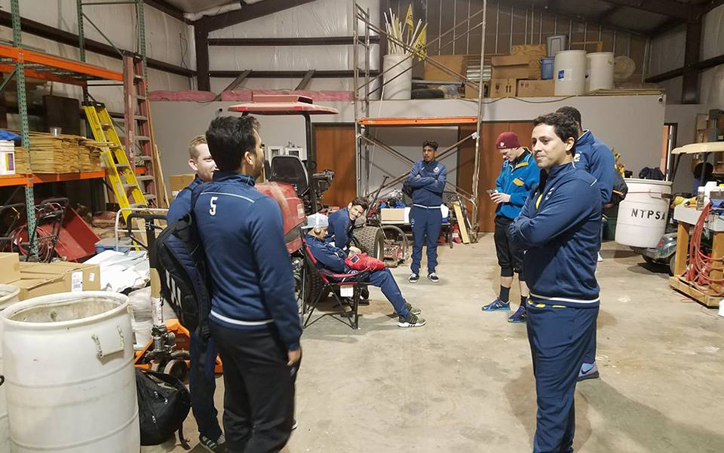
Players from Motagua of New Orleans gather in a warehouse in Balch Springs, Texas, the site of their 2018 US Open Cup qualifying match against NTX Rayados. Photo: Motagua of New Orleans Facebook page

Like all knockout competitions, open division qualifying for the Lamar Hunt US Open Cup is a grind that often has a charming edge to it lost in the later rounds when professional teams enter the fray. But there’s hardly anything romantic about a coach giving his team a halftime talk in a public bathroom or another team finding shelter from the cold in a storage shed only to be kicked out by a groundskeeper.

That’s the situation a couple of amateur teams found themselves in when they went to great lengths to travel and play in unsuitable venues for the final round qualifying two weekends ago.

For Stegman’s SC, the parent club of the NPSL’s Minneapolis City SC, that meant flying to Rochester, New York to play in 30-degree weather at a venue that didn’t have suitable locker rooms. Instead, the team had to huddle in a bathroom during halftime while it was actively in use by the public.

“They definitely weren’t prepared to host us, which was particularly disappointing considering how far we had to travel,” Stegman’s SC player Daniel Warner said.

But hey! We got to wait in the cold while they got ready in a heated room until we demanded access to it to get dressed. #Hospitality pic.twitter.com/p1WmvljGZK

— Minneapolis City SC (@mplscitysc) November 20, 2017

Sarah Schreier had an even more difficult time as a member of the team’s staff, noting that because the facility was locked when they arrived there were no restrooms available.

“I was told I could go into the woods or drive into town,” she said. “I’m a staff member of Stegman’s City, traveling with a skeleton staff, so I couldn’t just leave for 25 minutes just to use the bathroom. After the guys had checked in, and about 15 minutes before kickoff, I took a van ‘into town’ about 15 minutes away so I could finally go to the bathroom. I missed kickoff and our first and only goal.”

Would thank them for their hospitality but… pic.twitter.com/DZnreIFgQv

— Minneapolis City SC (@mplscitysc) November 19, 2017

Motagua of New Orleans traveled more than seven hours to Balch Springs, Texas, where they claim to have had an interesting encounter with a groundskeeper.

“Well, we had to go into a warehouse just to keep warm last night,” a post on the club’s Facebook account reads. “To add insult to injury, the groundskeeper kicked us out stating we could not utilize said space. Not to say this was reason we lost but after traveling long hours, to find out we have no where (sic) to rest, change, prepare for a very important match, is very unacceptable.”

The argument from both teams is that they were better equipped to host the match, but instead had to travel. Stegman’s also traveled to Illinois in the second round and won by forfeit in the first round. Motagua traveled to Missisippi in the first round and to Lafayette, Louisiana for Round 2.

Host sites for the qualifying rounds are determined by “a random draw or coin flip” but there is a process by which teams have to submit up to two potential venues should they be selected to host.

While there are extensive requirements for suitable venues once the “US Open Cup proper” begins, the responsibilities of the home team are limited to providing a safe playing field a minimum of 100 yards by 65 yards, regulation-size goals and corner flags, at least three properly-inflated match balls and making sure the officiating crew is paid at the end of the match. Beyond that, it’s on the host team.

Tito Salas, a player/coach/manager for NTX Rayados, was surprised to hear of the complaints from CD Motagua, a team he has become well-acquainted with in regional competitions and for whom his brother-in-law Reece Wilson plays.

Both Salas and Wilson missed the game that sparked the complaints, which the Rayados won, because they were away on a family vacation but Salas said the two teams played at the same facility in the second round last year and he didn’t hear any complaints. The weather was a factor, however, this year as the wind chill was in the 40s.

“I think locker rooms for me are very much an extra,” Salas said. “I get it, they expect more and they want more and that’s fine but there are a lot of reasons, financial and availability, that we can’t play in a stadium that has all of those things for qualifying.”

Elizabeth Sánchez, a spokeswoman for the US Open Cup, organized by the US Soccer Federation, said the looser venue standards for local qualifying are designed to enable more teams to participate.

“We want as many amateur teams as possible to participate in Open Cup qualifying,” she wrote in an email to TheCup.us. “The venue requirements for this phase of the tournament are meant to allow for this. In all practicality, only an adequate field marked for soccer, goals, nets, corner flags and balls are needed. This is not unlike most amateur-level leagues.”

Rochester River Dogz, which beat Stegman’s SC 2-1 in their game, did not respond to a request for comment.
Filed Under: 2018 US Open Cup, Feature - Main, Feature - Qualifying, US Open Cup, US Open Cup Qualifying Tagged With: 2018 US Open Cup qualifying, CD Motagua, NTX Rayados, Rochester River Dogz, Stegman's SC

2018 US Open Cup qualifying: Rochester River Dogz make history by qualifying for first US Open Cup

November 21, 2017 by Brendan Doherty

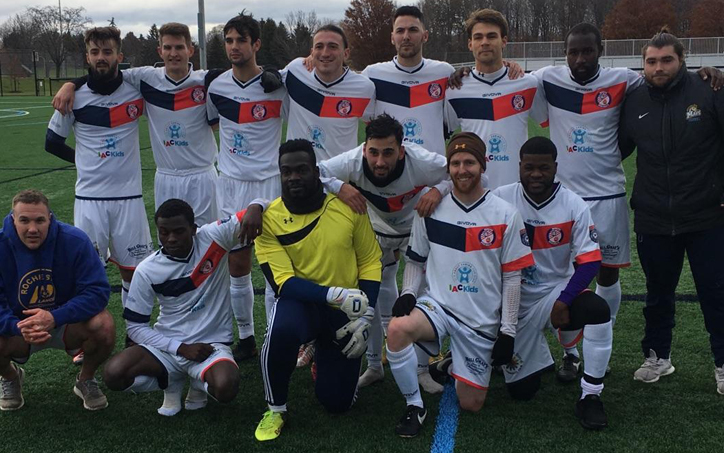
Rochester River Dogz pose for a team photo before their 2018 US Open Cup qualifying match against Stegman's SC. Photo: Domenico Vella | Rochester River Dogz
Rochester River Dogz pose for a team photo before their 2018 US Open Cup qualifying match against Stegman’s SC. Photo: Domenico Vella | Rochester River Dogz

On a blustery afternoon amid chilling winds and freezing rain in Rochester’s suburb of Pittsford, NY, the Rochester River Dogz earned a place in the 2018 Lamar Hunt US Open Cup. Hosting Stegman’s Soccer Club, a local amateur side and the parent club of Minneapolis City SC of the National Premier Soccer League, the River Dogz are themselves related to the NPSL team founded under the same name and since re-branded to the Lancers.

The River Dogz would defend their home turf, prevailing 2-1 to become the first open division amateur team from Western New York to qualify for the US Open Cup in the Modern Era (1995-present).

The River Dogz entered the competition through the Rochester District Soccer League, an elite amateur circuit recognized by USASA, but used the players and kits from the NPSL side. Similarly, Stegman’s, a member of the Minnesota Amateur Soccer League, fielded much of its NPSL roster and suited up in MPLS City’s jerseys.

The visitors struck in just the first minute of play, before the Minnesota-style weather took hold.

Nicholas Hutton sent dangerous service into the area from the right wing. Forward Ben Wexler did well to meet the cross but his strike whistled off the crossbar. Stegman’s Timothy Wills reacted first and poked home the rebound to take the early lead.

After conceding, the River Dogz regrouped and mounted some chances of their own. The hosts appeared to notch a goal in quick response after the right winger cut inside and fired a shot on his left that fell nicely to a teammate for an easy rebound. The assistant referee has raised his flag, however, and the score remained 1-0 for the Minnesotans.

The Rochester River Dogz (white) and Stegman's SC square off in a 2018 US Open Cup qualifier at Pittsford Thornell Farm Park in Pittsford, NY. Photo: Domenico Vella | Rochester River Dogz
The Rochester River Dogz (white) and Stegman’s SC square off in a 2018 US Open Cup qualifier at Pittsford Thornell Farm Park in Pittsford, NY. Photo: Jameson Pester | Rochester River Dogz

Despite some flowing passing moves, Rochester’s equalizer came from another rebound. Rochester forced a turnover in Stegman’s third with coordinated pressure from midfield. Center forward Austin Gerber received a through ball that split Stegman’s defense and hit a heavy strike that goalkeeper Matt Elder reacted quickly to kick away. Unfortunately for the visitors, the balled popped out to attacking midfielder Stefanos Stamoulocatos and the former U.S. youth international buried the follow-up from a tight angle with his left foot to tie the match in the 26th minute.

Stegman’s number 11, Whitney Browne was active throughout the game. He forced Rochester’s Will Banahene into a diving save from a set piece in the opening 15 minutes and was not shy about unloading shots from distance either.

Rochester held court for much of the remainder of the first half. The River Dogz tried to build measured attacks through midfield, probing for an opening between defenders, while still effectively using the long ball upfield for Gerber to chase. In contrast, Stegman’s kept several players deep even when in possession in the final third.

In the second half, Stegman’s pushed forward more often looking for a second goal but left themselves more vulnerable to counterattacks. A quick break chance almost put the hosts ahead early in the second half but the shot from Anthony Rozzano’s cross bounced off the crossbar.

Rochester’s utility defender Alex Harling, having played center back, right back, and left back on Sunday preserved equity in the middle of the second half. Stegman’s capitalized on a poor pass from Rochester’s No. 14, who had just entered the match as a substitute, and attacked quickly through the middle. The visitors may have thought difficult part of the move was over when a Stegman’s attacker rounded Banahene, but Harling recovered expertly to clear the eventual shot off the goal line.

Shortly after nearly conceding on one end, Rochester grabbed the go-ahead goal at the other. Gerber received another well-timed through ball that put him through with Elder and set himself up for a right-footed instep shot curled low to the far post. To his credit, Elder got a touch on the shot but could not prevent the game-winner from dribbling over the line.

Facing elimination after an unforgiving qualification process, Stegman’s rose to the occasion. The visitors moved the ball around the field well while pressing forward with urgency, peppering Banahene’s goal with efforts.

“Stegmans came to play that’s for sure,” said River Dogz general manager/assistant coach Marc Mandell. “After an early goal a minute into the game, our players had to buckle down and focus on how to get back in the game. I was very pleased that we were able to come back being a goal down to win 2-1. Our goalkeeper Will Banahene was definitely the man of the match coming up with some huge saves and Austin Gerber came through with the game-winning goal for the second game in a row.”

Perhaps an effort to run the clock down, two Rochester players received bookings in the final minutes of the match. The first was to Rochester’s No. 11 for his part in some shoving and gesticulating during a fracas near the Stegman’s goal and the second was to Rozzano for time-wasting after he cleared a ball past the bleachers once it had already crossed the sideline.

Stegman’s players showed well and can be proud of their efforts (after raising the funds to cover their airfare), but it was Rochester that came away with the 2-1 victory.

With the win, the River Dogz will qualify for the 105th edition of the US Open Cup that will begin next May. Their head coach, who has plenty of US Open Cup experience as a player with the Rochester Rhinos, was proud of his team’s performance.

“Rochester has a ton of local talent and I am happy to see the community rally around these guys,” said Doug Miller, who scored the game-winning goal for the Rhinos in the 1999 US Open Cup Final. “This cup means a lot to me and my ex-teammates and to be a part of it again is exciting”

Filed Under: 2018 US Open Cup, Feature - Qualifying, US Open Cup, US Open Cup Qualifying Tagged With: 2018 US Open Cup qualifying, Minneapolis City SC, Rochester River Dogz, Stegman's SC

2018 US Open Cup Qualifying Round 2: Nick Hutton’s OT winner sends Stegman’s SC into final round

October 24, 2017 by Nik Myles

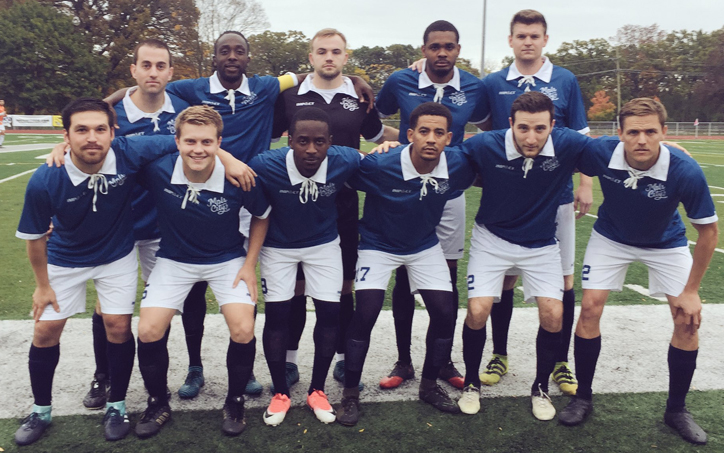
Stegman's SC poses for a team photo before the club's 2018 US Open Cup qualifying game against Aurora Borealis SC. Photo: Stegman's SC
Stegman’s SC poses for a team photo before the club’s 2018 US Open Cup qualifying game against Aurora Borealis SC. Photo: Stegman’s SC

MORE: 2018 US Open Cup Qualifying Results/Schedule

Stegman’s SC made the trip down to Mooseheart, Ill., about an hour west of Chicago, to take on Aurora Borealis SC in the second round of the 2018 US Open Cup qualifying tournament. In the end, after a wet and rainy game, Stegman’s prevailed, 3-2, on the strength of an extra time goal by Nick Hutton to send the Minneapolis-based club into the final round of qualifying.

A kickoff that clashed with both the Chicago Bears and Decision Day in Major League Soccer, led to a sparse crowd witnessing a tightly contested battle in miserable conditions, eventually justly shaded by the visitors.

Aurora opened the scoring after about 15 minutes, when Arturo Garza swung a 25-yard free kick around the wall and into the top corner. The temptation in these moments is always to look at the wall and the keeper, but sometimes the shot is just too good.

The visitors were more composed on the ball, and more organised across the field, and it was only a matter of time before they found the equaliser. Home keeper Eduardo Sandoval did not look at home in the keeper’s jersey all day, and one can only hope that it was simply the vagaries of the US Open Cup scheduling that led him to be standing between the posts. His lack of confidence was finally exposed on the half hour mark as Tim Willis picked his pocket and scored the easiest goal of his career.

Five minutes later Stegman’s took the lead, as their perseverance with long diagonal balls paid off, allowing Olsen to lash home past the hapless Sandoval.
Stegman's_Soccer_Club_Logo
Stegman’s deserved their halftime lead, but Aurora came out for the second half with increased vigor. In the 50th minute, Ryan Salazaar pulled the ball down on the edge of the area, and ripped one past Matt Elder in the visitor’s goal.

The second half was a more even affair than the first, with the wet and windy conditions not really helping the game as a spectacle. Both sides traded blows, but clear cut chances were few and far between.

Extra time offered more of the same. Both teams were understandably exhausted, and tricky play gave way to hopeful punts downfield. Lacking anyone to hold the ball up on either side, it was always likely to be a set play that decided this. And so it was that Stegman’s stand-out player, Martin Brown, curled in a corner in the 100th minute, which was met with interest by left back Nick Hutton, leaving Sandoval grasping at thin air.

Aurora tried to battle back, but lacked any clinical incision. The stuffing was knocked out of them, and after 120 minutes, Stegman’s deserved the win.

With the win, Stegman’s moves on to the final round of qualifying where they will have to hit the road again. This time, they have a much longer trip to Western New York ahead of them to take on the Rochester River Dogz. Even though the US Soccer Federation now offers some financial assistance to teams so they can cover travel costs, with back-to-back road games Stegman’s still needs help. The club has launched a fundraising campaign to help pay for their travel to Rochester.

Man of the Match (Aurora): Corey Novotney
Man of the Match (Stegman’s): Martin Brown

Filed Under: 2018 US Open Cup, Feature - Qualifying, US Open Cup, US Open Cup Qualifying Tagged With: 2018 US Open Cup qualifying, Aurora Borealis SC, Stegman's SC

Travel costs are a barrier for many US Open Cup qualifying teams, now USSF is offering help

October 21, 2017 by Josh Hakala

The US Soccer Federation will provide some financial assistance to cover the cost of flights for amateur teams that have to make a trip longer than a six-hour drive for a US Open Cup qualifying match. Photo: Richard Eriksson - Flickr
The US Soccer Federation will provide some financial assistance to cover the cost of flights for amateur teams that have to make a trip longer than a six-hour drive for a US Open Cup qualifying match. Photo: Richard Eriksson – Flickr

There has not been an open division amateur club from Oregon qualify for the Lamar Hunt US Open Cup since 1992. So the International Portland Select (now operating under the name of IPS/Marathon Taverna) set out to change that in 2015. The club entered the newly-formed Open Division qualifying tournament with hopes of representing their state in the country’s oldest cup competition.

After getting a free pass into the Second Round because a team couldn’t afford the trek to Portland from Kansas City, they drew a team in Texas for their next match. The cost of flying a whole team roughly 2,000 miles to Dallas was too much for IPS so they withdrew from the competition.

After losing their opening game last year at home, they are back for the 2018 qualifying tournament. This weekend, IPS are prepared for another expensive and lengthy trip for a Round 2 qualifier in Colorado to take on Indios Denver FC. However, due to a recently-approved policy change, IPS, and other teams like them, will have some help.

MORE: 2018 US Open Cup qualifying Round 1 review, Round 2 schedule

For the first time, the US Soccer Federation will offer financial assistance to clubs in the open division amateur qualifying tournament who have to make road trips longer than six hours. Teams won’t find this information in the 2018 qualifying handbook because this new policy was approved after it was released. The three clubs that qualified for what the federation describes as a “partial airfare subsidy” were offered $200 per airline ticket after the team covers the first $100. According to the USSF, any airline ticket that exceeds the $300 will be reviewed on a case-by-case basis.

This is clearly an effort to help out amateur clubs that don’t have large budgets and to minimize the number of teams who are forced to forfeit. There have been 15 games forfeited over the last three years, and travel burdens are a big reason for that.

For this weekend’s Second Round, three teams qualified for the travel subsidies: IPS Marathon Taverna (Portland, Ore. to Denver, Colo.), Stegman’s SC (Minneapolis, Minn. to Mooseheart, Ill.) and Ann Arbor FC (Ann Arbor, Mich. to Rochester, N.Y.). Unfortunately, Ann Arbor FC recently confirmed that they are unable to make their trip to Western New York due to a lack of player availability so they forfeited their match.

For those two remaining clubs, those lengthy road trips would have been a major blow to their limited budgets.

Stegman's Soccer Club logo“The financial burden is significant to a team like ours regardless of whether we’re drawn away and have to travel or to host and need to find a suitable venue for the match,” said Nick Sindt, one of the founding members of Stegman’s SC. “Obviously hosting allows us to offset some of the burden by ticket sales, but there’s never a guarantee that we’d recoup all of our expenses.”

Teams like IPS and Stegman’s SC (which is affiliated with the supporter-owned Minneapolis City SC of the NPSL), stuggle with the fact that historically very few teams near them sign up for Open Cup qualifying. In the Modern Era, only three amateur clubs from the Land of 10,000 Lakes that have registered for the open division qualifying tournament. This means that if they have to travel, they are surrounded by states that rarely enter multiple teams into the tournament. North and South Dakota have never entered the tournament, the only Iowa team to enter has been affiliated with the Des Moines Menace (no entry since 2014), and Wisconsin hasn’t had a team participate in the tournament since 2015.

For IPS, it’s even worse, as the states of Oregon and Washington have a history of not entering the qualifying tournament, with only a handful of Cascadia teams signing up since 1995.

International Portland Select / Marathon Taverna logoWhen teams like IPS are located so far away, it’s just as difficult for teams to travel to them as it is for them to travel. In 2015, the Kansas City Athletics claimed that a trip to Portland — nearly 1,800 miles by car — would have ruined the club financially.

Once the Athletics forfeited, IPS were facing an even longer trip for their Round 2 match against the North Texas Rayados. A drive from Portland to Dallas is roughly 2,000 miles, so it would require flying. The cost of flying a soccer team and coaches, combined with transportation when they arrive, meals and a hotel stay becomes an expensive operation. Too much for IPS to handle, so they announced that they would have to forfeit.

Stegman’s SC explored their travel options thanks to the work of Minneapolis City’s business director Sarah Schreier, and they have decided to travel by bus from Minneapolis to Mooseheart, Ill., which is located about an hour’s drive west of Chicago. According to Schreier, they chose to travel by bus because it was more efficient, both financially and logistically, to drive directly to Mooseheart, rather than flying to Chicago and then paying for transportation for the entire team to drive about an hour to their destination. (Not to mention the potential traffic issues of getting out to Chicago’s western suburbs)

Schreier says the total cost of the trip is roughly $5,500 – $6,000, which is a lot for an amateur club, even for a club like Minneapolis City (which is the part of Stegman’s SC organization) that enjoys some impressive fan support. The amount of money they will receive from the USSF is unclear at this point. The federation’s travel subsidy plan did not initially include the prospect of a team choosing to drive, so Schreier says they are in discussions with the USSF to determine how much assistance they will receive.

While IPS was unable to provide their travel expenses prior to this story being published, one can expect that flying a team from Portland to Denver is more costly than traveling from Minneapolis to Mooseheart.

The USSF’s open division qualifying tournament for the US Open Cup is in its third year and still faces challenges and growing pains. The goal, one can assume, is to minimize the number of forfeited games. There will always be player availability issues, or teams that will fail to register players properly, but educating the teams in advance on what is required, both logistically and financially, could go a long way to reaching that goal. Now, with the federation offering financial assistance for teams forced to make lengthy trips, this should help remove some barriers for some teams to compete in the country’s oldest cup competition.

“I think the new policy is great for all of the teams who aren’t professional clubs,” said Sindt. “The majority of clubs in our position, or in the lower levels of the US Soccer pyramid, are run without significant outside investment and therefore exist on shoestring budgets. Having money available from the federation to mitigate the travel costs keeps teams and clubs like us from mortgaging our future for a chance to compete, which should then see more teams able to enter in the future and hopefully fewer and shorter trips all around.”

Filed Under: 2018 US Open Cup, Feature - Qualifying, US Open Cup, US Open Cup Qualifying Tagged With: 2018 US Open Cup qualifying, Ann Arbor FC Elite, International Portland Select, Stegman's SC

Primary Sidebar

Follow Us on Social Media

  • Bluesky
  • Facebook
  • Instagram
  • Twitter
  • YouTube

U.S. Open Cup History

1935 National Challenge Cup Semifinals: After 29 days, Central Breweries win 3-game Western Final

The Western Final of the 1934/1935 National Challenge Cup featured one of Chicago’s best teams from the first 30 years of the tournament against a St. Louis team that would form their own dynasty.

  • 1995 US Open Cup: Rob Ukrop of Richmond Kickers voted TheCup.us Player of the Tournament
  • 1995 US Open Cup Final: Jeff Causey of Richmond Kickers voted TheCup.us Player of Round
  • 1995 US Open Cup Final: Richmond Kickers survive heat, beat El Paso Patriots in PKs to win title
  • 1995 US Open Cup Final Preview: El Paso Patriots hosting amateur Richmond Kickers in “El Sauna”
  • 1995 US Open Cup Semifinals: Jake Arrambide of El Paso Patriots voted TheCup.us Player of Round

Analytics powered by

Copyright © 2026 • Built by Jacob Martella Web Development