The 30th anniversary of the 1995 Open Cup is upon us this year, and as we did with the inaugural tournament in 1913-1914, we’re going to take you back in time and relive the 1995 US Open Cup in chronological order, as it happened. Unfortunately, outside of the Final, no video of any of the tournament games exists (that we are aware of), but we have compiled accounts of each game based on newspaper reports, interviews with players and coaches.
1995 also marked the beginning of what TheCup.us has defined as the US Open Cup’s “Modern Era” (more on that in a moment). The American soccer landscape was shifting and the country’s national championship reflected that.
EDITOR’S NOTE: If you know anyone associated with any of these teams or might have any information about any of the games from the 1995 US Open Cup, email us HERE. Our goal is to compile a complete historical record of the US Open Cup and we welcome anyone who has stats, team information, photos, videos, or memories about this tournament.
Heading into 1995, the landscape of American soccer, and the US Open Cup, was about to take a drastic change. With a successful hosting of the 1994 World Cup in the rear-view mirror and the debut of Major League Soccer a year away, the US Open Cup would see participation from teams of the top outdoor league for the first time since 1966.
The six-team American Professional Soccer League (or the A-League as it would be known in 1995) would be that top league for at least one more season. The APSL limped into the ’94 off-season with just four teams after three clubs ceased operations. The addition of the Atlanta Ruckus and New York Centaurs in the early part of 1995 brought the roster up to six teams, two Canadian and four American. Previously the teams of the APSL avoided the US Open Cup, perhaps more concerned with simply surviving their own league season.
1995 US Open Cup Preview: The state of American soccer in 1995
1995 USOC Round 1 POTR: Carlos Llamosa
1995 USOC Q-Finals POTR: Ben Crawley
1995 USOC Semis POTR: Jake Arrambide
1995 USOC Final POTR: Jeff Causey
1995 USOC Player of Tourney: Rob Ukrop
1995 US Open Cup Results (click on the score of the game for a match report)
Alongside (or below) the APSL was the United Systems of Independent Soccer Leagues, or USISL for short. The league that would eventually become today’s United Soccer League got its start in 1986 as a semi-pro indoor league centered around Texas and Oklahoma.
Eventually the USISL moved outdoors, and in 1995, the 69 teams split into professional and amateur leagues. Unlike the APSL, USISL teams took part in the Open Cup, with much success. In 1991, the Richardson Rockets reached the Open Cup Final, having defeated fellow USISL club New Mexico Chilies in the Semifinals. The Rockets advanced to the Semifinals again in 1992, and the Quarterfinals in 1993 and 1994.
The third piece of the puzzle was the United States Amateur Soccer Association (USASA). The semi-pro and amateur teams from across the country had kept the Open Cup alive for nearly 30 years. Now, instead of the top USASA teams being the favorites to win the Open Cup, they were suddenly the underdogs, up against the new challenge of professional teams.
The 1995 Open Cup field was limited to just 16 teams, the four American APSL clubs, eight USISL teams, and four USASA teams. The APSL teams had automatic berths in the Open Cup field, while the USISL and USASA held qualifying games to determine its representatives.
For the USASA that meant sticking to the same format when the Open Cup was all theirs, the winners of the four regions (I-East, II-Midwest, III-South, IV-West) would qualify.
For the USISL, it meant eight separate tournaments divided geographically among the teams that showed interest, with each region choosing its own format.
Why the “Modern Era’?
Followers of our coverage at TheCup.us may wonder why we refer to the years after 1995 as the “Modern Era”. Many assume that the Modern Era would begin in 1996 when Major League Soccer formed. While the launching of MLS was a game-changer for the sport in the United States, the groundwork for the tournament’s inclusion of professional teams was laid a year earlier.
There are two main reasons for this. One, as previously mentioned, the 1995 US Open Cup was the first edition of the tournament since 1966 to feature teams from the top outdoor league in the country. During its lifetime, clubs from the NASL stayed out of the tournament for one reason or another. In the days of the APSL in the late 1980s / early 1990s, that league’s teams also avoided the Open Cup. In 1995, with the first season of Major League Soccer a year away, the APSL, now the A-League, finally became involved in the competition.
The second reason is that from 1970-1994, we still have an incomplete record for each year’s results and stats. Some years are better than others, but when referring to or comparing historical occurrences in current tournaments, it is more accurate most of the time for us to limit our comparison beginning with 1995, since saying “all-time” would be inaccurate due to the info we are missing for some years prior to 1995.

1995 US OPEN CUP QUALIFYING
USISL
USISL qualifying kicked off in March of 1995 with three teams in the Northeast region playing a single game elimination tournament. The Cape Cod Crusaders and Connecticut Wolves opened qualifying on March 10 in West Haven, Conn. The Wolves took a 2-1 halftime lead, but Ron Murphy tied the game for Cape Cod the second half. No extra time was played, and Connecticut won the penalty shootout 5-4.
A week later, the Wolves hosted the New York Fever (who drew a bye) at New Britain, Conn., Erik Barbieri and Chris Wright scored two goals each in the opening half in Connecticut’s 4-1 win, making them the first club to qualify for the US Open Cup under its new format.
Next up in the Southwest region, the Valley Golden Eagles and Los Angeles Salsa faced off in a two-leg aggregate goal series. In addition, the region was experimenting with 30-minute halves using a running clock, meaning the clock stopped when play stopped. In the first leg, on April 29, Bobby Bruch scored with two minutes remaining for the Salsa to tie the game and force golden goal extra time. Bruch then tallied again three minutes into extra time for the win. In the return leg on May 7, a Juan Solis hat trick was not enough for the Salsa as the Golden Eagles pushed their way to a 5-3 win.
The West Region kicked off in mid-April with a four-team, single-game tournament. On April 14, the Chico Rooks opened with a wild 7-3 win over the North Bay Breakers, Roman Ritz scoring five of the Rooks’ goals. Two weeks later, the San Francisco All Blacks advanced via shootout after a 1-1 draw with Monterey Bay. In the final on May 29, Chico defeated San Francisco 3-1 with the help of a Lance Welker brace.
In the Southwest region the Los Angeles Salsa and Valley Golden Eagles faced off in a two leg aggregate goals series. LA took the first game 3-2 on the strength of two Bobby Bruch goals, but in the second game the Golden Eagles overcame a Juan Solis hat trick to beat the Salsa 5-3, taking the series 7 goals to 6.
A round robin tournament would determine the teams from the South Central and Northwest regions. In the South Central, the El Paso Patriots had little trouble with the New Orleans Gamblers and Texas Lightning, posting wins of 3-1 and 5-1 respectively to easily win the group.
The Northwest was more competitive with four teams, Everett Bigfoot, Cascade Surge, Portland Firebirds and Spokane Shadow competing. Early on Everett, Portland and Spokane traded wins against each other with Cascade playing all three in the final games of the group. Cascade knocked off Spokane (5-3) and Portland (2-1) to set up a showdown with Everett on June 2. Everett won 4-2, tying Cascade on points at 19, but claiming the Open Cup spot due to their head-to-head victory.
The final two USISL teams were determined just weeks before the Open Cup was to begin. IN the Southeast region the Tampa Bay Cyclones faced the Ft. Lauderdale Strikers in a two-leg aggregate series on June 4 & 11. The Cyclones won both games, 4-2 and 2-1 to qualify.
Finally in the Midwest, the Chicago Stingers defeated the St. Louis Knights 4-1 on June 11 in extra time in a single game. Don D’Ambra tied the game for Chicago in the 90th minute, and the Stingers added three more in the extra session.
USASA

The USASA determined its four teams in late May and early June. In the Region I Final, four-time US Open Cup champion (1967-69, 1974) New York Greek American Atlas played to a 1-1 draw with Spartans SC (Fairfax, Va.) only to ultimately lose the penalty shootout, 12-11.
In Region II, 1990 Open Cup winners AAC Eagles defeated Thermadyne (St. Louis, MO) 4-1 in the Final. In the previous round the Chicago-based Eagles traveled to Kentucky and thrashed Louisville Soccer Alliance 12-0.
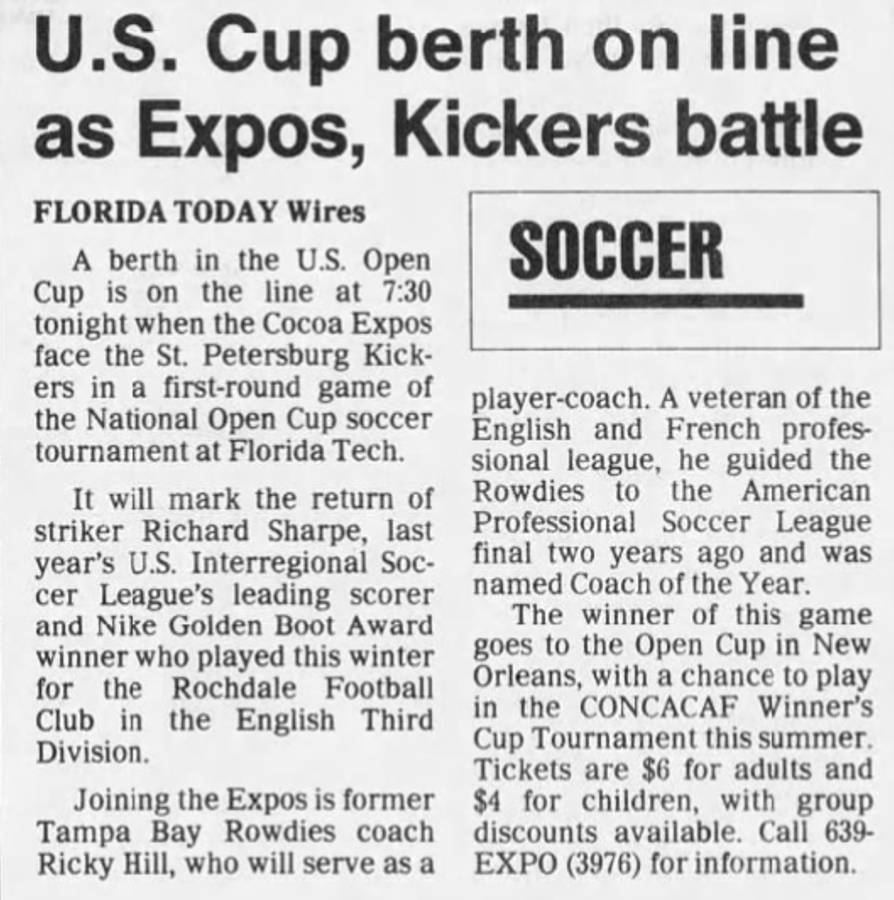
In Region III, another former champ claimed a spot in the 1995 Open Cup. 1989 winners McCormick St. Petersburg Kickers defeated Houston-based Excel SC, 2-1 after jumping out to a 2-0 lead at halftime.
Finally in Region IV, yet another former Open Cup champ had a shot at qualifying but fell one game short. CD Mexico, 1992 winners, saw their hopes dashed when they were beaten 2-1 in extra time by Flamengo SC of Salt Lake City in the Semifinals. In the Region IV championship, Flamengo crushed San Nicholas SC (Santa Barbara, CA) 5-0 to punch their ticket.