
The National Amateur Cup, along with the US Open Cup, is one of the two major domestic club cup competitions in the United States. While the Open Cup is open to professional, semi-pro and amateur teams, the Amateur Cup is only open to amateur teams.
The tournament got its start in 1923 in response to the popularity of the then decade-old National Challenge Cup (US Open Cup). For most of its history it was organized and run by US Soccer, but since the 1980s the USASA (United States Adult Soccer Association) has managed the competition. For much of its history the tournament divided teams in Eastern and Western divisions. Each state or region held qualifying tournaments, with the winners competing in a single elimination bracket and the Eastern and Western winners meeting in the Championship Final.
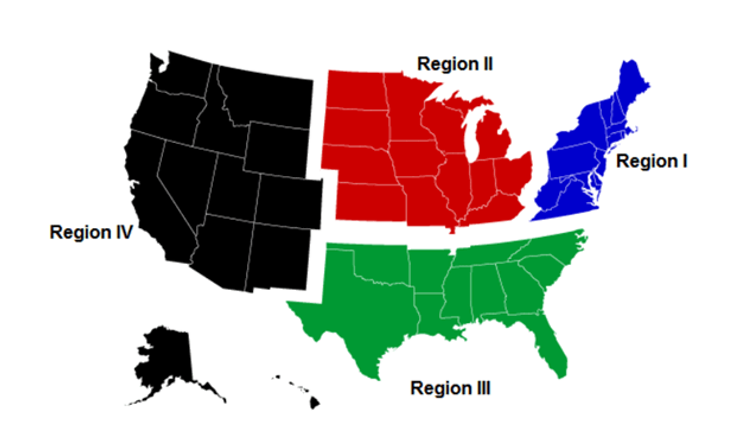
Since 1979, the field has been divided into four regions, Region I (East), Region II (Midwest), Region III (South) and Region IV (West). The winner of each Region earns a berth in the National Semifinals, and the Semifinals and Final are played at a neutral venue over a single weekend. Over the last few years state qualifying has been scrapped to allow more than one team per state association to participate in the regional tournaments.

Beginning in 2018, the winner of the National Amateur Cup was granted a berth in the following year’s US Open Cup. The defending champion also earns a spot in the Hank Steinbrecher Cup, a four-team tournament between the champions of the two national amateur leagues (NPSL & USL League Two), the reigning National Amateur Cup champion, and the previous years Hank Steinbrecher Cup winner. The Flint City Bucks have won the Hank Steinbrecher Cup a record four times, all consecutive from 2017-2022.
History of the National Amateur Cup
With entries for the National Challenge Cup increasing each year, the United States Football Association decided to create a tournament solely for amateur clubs. It would be the first tournament for “simon pure’ teams since the American Amateur Football Association Cup was held in 1912 and 1913. On May 21, 1922 at the USFA convention in Boston, the competition was ratified, and 67 teams would enter later that fall.
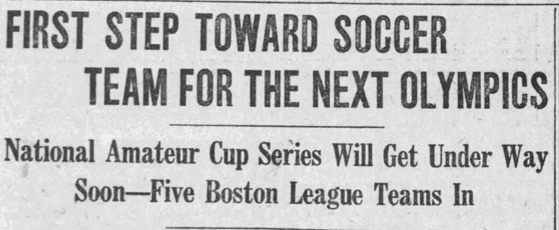
As would become customary throughout the tournament’s history, teams from areas that hadn’t been represented in the National Challenge Cup were enticed to throw their hats in the ring. Indiana (Gary SC), Maine (Oxford Athletic) and California (Olympic FC of San Francisco) all entered the inaugural tournament, though the entry from Olympic FC was turned down due to the long travel distance to California. Inclement winter weather wreaked havoc with the new competition, causing three of the four Quarterfinal contests to be delayed until June. It was then decided to abandon the tournament and the four Quarterfinal winners (Roxbury from Massachusetts, Fleisher Yarn of Philadelphia, Jeanette from the Pittsburgh area and Chicago’s Swedish American SC) would receive winners medals. Unfortunately, it would not be the first time the tournament finished without a grand champion determined on the playing field.
In 1924, the entry total rose to 81 teams, and while this tournament was played to its conclusion, it didn’t do so without controversy. It was decided that the winner of the 1924 Amateur Cup would represent the United States in the 1924 Olympics, with the idea being a team that had been playing together would perform better than a team of players from across the country. The plan backfired when it was realized seven of the eight teams in the Quarterfinals featured players that could not represent the United States. Just one team, Union Electric of St. Louis, had a roster that was 100% eligible. They proposed that the other seven teams should be disqualified, and the Amateur Cup and Olympic berth awarded to them. When their proposal was turned down, the club withdrew from the tournament.
The first Amateur Cup Final
The first ever Amateur Cup final would be contested by two of the previous year’s Quarterfinal winners, Chicago’s Swedish American SC and Fleischer Yarn of Philadelphia. In front of 4,000 onlookers at Chicago’s DePaul Field, Fleischer won 3-0 behind Andy Stradan’s two second half goals and a James McLaughlin goal in the opening half, which Stradan also assisted on.
Toledo AC won the 1925 title over McLeod Council of Jersey City 2-1 after extra time, but did not defend its championship as the club turned professional to join the Michigan-based Western Intercity Soccer League.
The first dynasty, “professional” rule change
In 1926, Heidelberg began what could be considered the first dynasty of the Amateur Cup, reaching the Final in 1926, then winning in 1927 (3-0 over La Flamme Cobblers of New Bedford, MA) and 1929 (9-0 over Newark First German). In between Heidelberg’s title wins was another un-played Final, this time involving Detroit’s Swedish American AC and Hudson Essex of Fall River. The USFA declared the team co-champions after Sam Mark withdrew his offer to host the game at his stadium in Tiverton, RI when he found out the Fall River team preferred to play the game in Detroit.

One significant rule change was implemented for the 1929 tourney. It was decided to allow teams to enter that had professional players, as long as those players did not participate in any games in the tournament. Previously if a team had even one professional player, they were barred from entering the tournament.
A pair of violent incidents occurred during the early rounds of the 1929 tournament. During a first-round game between Heidelberg and Dunlevy on Dec. 9, 1928, Crompton of Dunlevy struck and injured referee Bob Brown in the 80th minute. The next day Crompton was suspended for life by the Western Pennsylvania Football Association.
On March 30, 1929, after Heidelberg routed Corinthians (Castle Shannon, PA) 9-2 in the Western semifinals, the Curry, PA crowd assaulted the Heidelberg players and match officials as they left the field towards the dressing areas. Several Heidelberg players were injured, including Fred Donnelli, who scored four goals in the game. Afterwards it was announced that the grounds at Curry were barred from hosting any more games for the season, and Corinthians manager Warner McKay was suspended until Jan. 1, 1930 for failing to provide adequate security.
Heidelburg did not have the chance to win their third Amateur Cup crown in 1930 after being suspended for the season by the Western Pennsylvania Football Association on Nov. 7, 1929. The club was sanctioned because of irregularities in players contracts, as well as failing to play a Western Pennsylvania Cup game on Nov. 3. In their absence, another team from Western Pennsylvania, Gallatin, reached the Final. After playing to a 3-3 draw with Raffies of Fall River, Gallatin forfeited the replay when manager Harry Sickles claimed the team did not have the money to travel to Fall River. It was the third time in eight years that the tournament was not completed on the field.
Pre-World War II: Ohio, Western Pennsylvania, Fall River take over
In 1931 and 1932 the Amateur Cup title belonged to Northeast Ohio as Goodyear defeated New Bedford’s Black Cat Filling Station 2-0 after a 1-1 draw, and Cleveland’s Shamrocks SC upended Santo Cristo, also from New Bedford, 2-1. The 1932 Final marked the end of a seven-year run where teams from either New Bedford or Fall River reached the Final six times.
Western Pennsylvania resumed its command of the Amateur Cup in 1933, as a team from that region would reach the Final from 1933-1940, winning the title in 1935 (WW Reihl) and 1940 (Morgan). One interesting (and embarrassing) thing happened in the 1936 tournament. The United States Football Association gave WW Riehl a bye to the Quarterfinals, not realizing the defending champion WW Riehl team from 1935 had become Castle Shannon, and a new team had taken up the name WW Riehl. The “new” WW Reihl lost to the old WW Reihl (Castle Shannon) 1-0, and Shannon went on to the Final, losing to Deutscher Sport Club Brooklyn 2-1 after extra time.

Western Pennsylvania and Fall River took over the Amateur Cup Final from 1938-1943, as team from those two areas met six times in a row, with Fall River winning four titles (Ponta Delgada 1938, St. Michael’s 1939, Fall River SC 1941 and 1942), and Morgan Strasser winning in 1940 and 1943 for Western Pennsylvania.
Post-World War II: Ponta Delgada, Kutis SC set standard for decades to come
Just as World War II caused a drastic drop in teams participating in the US Open Cup, the Amateur Cup also saw its entry total drop, with 41 teams entering in 1943. Once the war was over, entries for the Amateur Cup skyrocketed, jumping from 83 teams in 1946 to 175 teams in 1947. One notable occurrence took place in 1947, the Ford #22 UAW-CIO team from Windsor, Ontario, Canada made it to the Second Round, a mere two games from a spot in the Final. It was not unusual for Windsor clubs to play in Michigan based, thus they were members of the Michigan State Association and therefore eligible for the Open and Amateur cups.
New York’s Sport Club Eintracht won back to back championships in 1944 and 1945, but soon had to make way for a new dominant force in American soccer, Ponta Delgada. Ponta had already won the Amateur Cup in 1938, but in 1946 reached the Final of both the Open and Amateur cups, winning the Amateur 5-2 over Castle Shannon and dropping the Open Final to Chicago’s Viking AA 3-2 over two legs. Ponta achieved the double in 1947, first winning the Amateur final 10-1 over Carondelet SMAC of St. Louis, and later taking the Open crown from Chicago’s Sparta A & BA 9-3 over two legs. Ponta’s win over Carondalet was so dominant the St. Louis club requested the cancellation of the second leg. 1948 saw Ponta win a third Amateur Cup in a row, becoming the second club to three-peat the Open or Amateur Cup, the first being Stix, Baer & Fuller/Central Breweries of St. Louis in the Open Cup from 1933-35.
As a result of their dominance in both cups, Ponta was selected as a team to represent the United States in 1947 in the North American Soccer championship, a three team tournament between the U.S., Mexico and Cuba. Ponta added titles in 1950 and 1953 to bring their total to six.

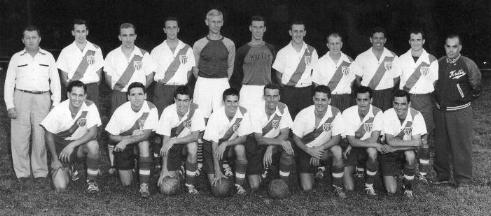
Ponta Delgada would hold its record of six Amateur Cup titles for just seven years, as a new dynasty would begin. Kutis SC began as the St. Louis Raiders in 1947 as a professional team to play in the short-lived North American Soccer Football League. When the league collapsed in late 1947, the Raiders turned amateur to play in the St. Louis Major League. The Raiders won the Amateur Cup in 1952, a year before Ponta Delgada won number six. After the Amateur Cup win the Raiders changed their name to follow their new sponsor, Kutis Funeral Home. Kutis won its second Amateur crown in 1956 over Ukrainian American SC of Philadelphia. The Final was set to be played over two legs, but the referee Julius Riepze stopped the first leg at the 88th minute when the Ukrainians continued to argue a penalty kick call. The USSF canceled the second leg and awarded the game to Kutis declaring them champions.
The win by Kutis kicked off perhaps the greatest dynasty in American soccer as they would go on to win six Amateur Cup titles in a row from 1956-1961. In 1957 Kutis became the second team after Ponta Delgada to win the Amateur & Open Cup Double, the first defeating New York Hakoah for the Open Cup crown 6-1 over two legs in the spring, then defeating Rochester’s Ukrainian American SC 1-0 in June for the Amateur title. During this time Kutis also reached the Semifinals of the Open Cup in 1959 and 1960. The remarkable run of Kutis was stopped in 1962 by Carondelet CMAC with a 4-2 defeat in the Missouri Semifinals.
Diversity increases as 1960s arrive
As the tournament moved through the 1960s, clubs from parts of the country that had never seen the Open or Amateur Cups began to take part. Clubs from Dallas, Texas had been entering since the late 1940s, and by the 1960s teams from such soccer outposts as Kansas City, Omaha, Salt Lake City, and Denver took a shot at the Amateur Cup. In 1969, even South Dakota (Rapid City Vikings), Alaska (Sons of Norway) and Florida (Aerodex Jets, Miami) saw teams take part in the tournament. One area that was underrepresented was Los Angeles, as few clubs from southern California chose to enter the Amateur Cup. In fact, in 2023 SC MesoAmerica became the first L.A. area club to win the Amateur Cup.
Unlike Ponta Delgada and Kutis, no single team dominated the Amateur Cup in the 1960s like those teams did in the 40s and 50s. From 1962-1969 seven different teams took the Amateur Crown, with the Chicago Kickers coming closest to a dynasty with three titles in six years (1966, 1968 and 1970). Kutis won title number eight in 1971, defeating Cleveland’s Inter Italian SC 4-1, and the Chicago Kickers claimed title number four with a 2-0 win over Kearny Scots in 1975. Philadelphia Inter (1973 and 1974) and the Denver Kickers (1977 and 1978) won back to back championships, and Milwaukee’s Bavarian SC won the first of their six titles in 1976. Atlanta’s Datagraphic became the first team from the Southern part of the U.S. to win the Amateur Cup with a 1-0 win over San Francisco Glens, played at Atlanta’s Fulton County Stadium prior to a Tulsa Roughnecks-Atlanta Chiefs NASL game.
USASA takes over Amateur Cup, splits tournament into regions
In the 1980s the USASA (United States Adult Soccer Association) took over organizing both the Open and Amateur Cups, and one major change was to split the teams into four regions, Region I (East), Region II (Midwest), Region III (South) and Region IV (West), with the winner of each region advancing to the National Semifinals. Another change would see the Amateur Cup Final played at a neutral venue, alongside the other Cup finals organized by the USASA.
Diversity continued among the Amateur Cup champions, with no team winning more than two titles in a row until Bavarian SC won three straight from 2001-2003. It would also mark the last time the Amateur Cup would see a team successfully defend its title, although Bavarian SC would reach three finals in a row from 2016-2018, winning in 2018.
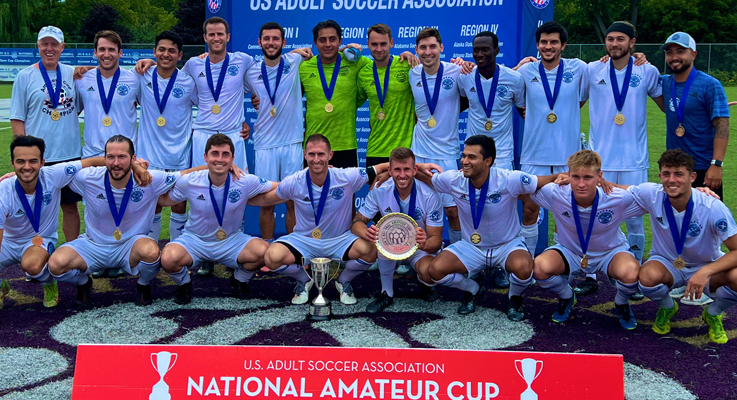
The 2018 tournament also saw a spot in the Open Cup granted to the defending Amateur Cup champion, which Bavarian SC was the first to take advantage of in 2019. Bavarian would win their sixth Amateur Cup in 2022, tying them with Ponta Delgada and putting them within two of Kutis SC’s eight. The Milwaukee club also trails Kutis by one with nine appearances in the Final.